There’s no dearth of options when it comes to security cameras — they come in all shapes and sizes, spanning different price points, and boasting different capabilities. However, finding one that’s reliable and offers the full gamut of required features can be a tough ask. And finding one that eliminates the hassle of wiring, without needing frequent battery charges, can be even tougher. Enter Reolink Altas — an outdoor security camera that boasts a plethora of useful features. It’s battery-powered, so you don’t need to rack your brains trying to find a suitable mounting location near a power socket or run long wires that look unsightly. What’s more, it even comes with a solar panel option that promises unlimited battery life. Let’s dive a bit deeper into its capabilities.
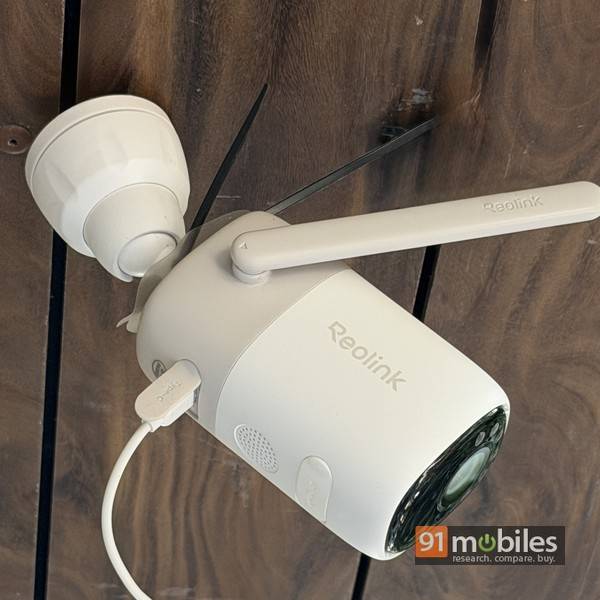
Table of Contents
Design
The Altas kit I received included the camera and the 3W solar panel, along with mounting hardware for both. Apart from hardware you can use to screw these to the wall, you also get straps that let you mount these devices on poles. The camera also has a standard tripod mount, so you can set it up on a tripod if you want.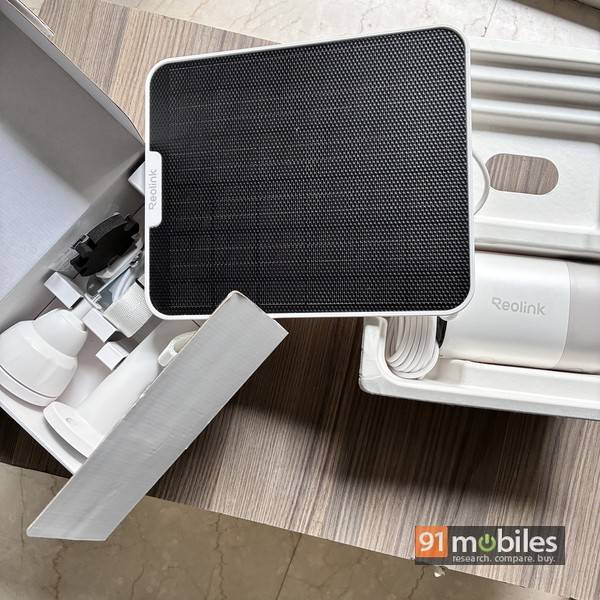
However, there’s no option to mount the camera on a magnetic base, similar to the one available with the likes of the Google Nest Battery and TP-Link Tapo C425. Both of these are wire-free, battery-powered cameras and come with magnetic bases that make it simple to mount the device and remove it for charging when needed.

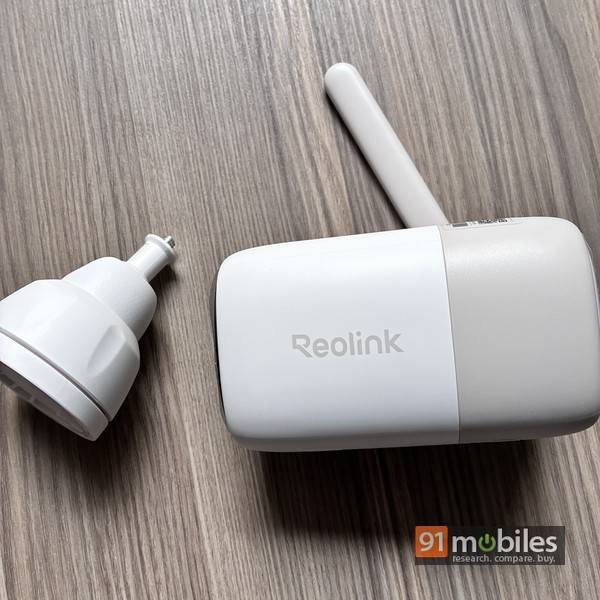
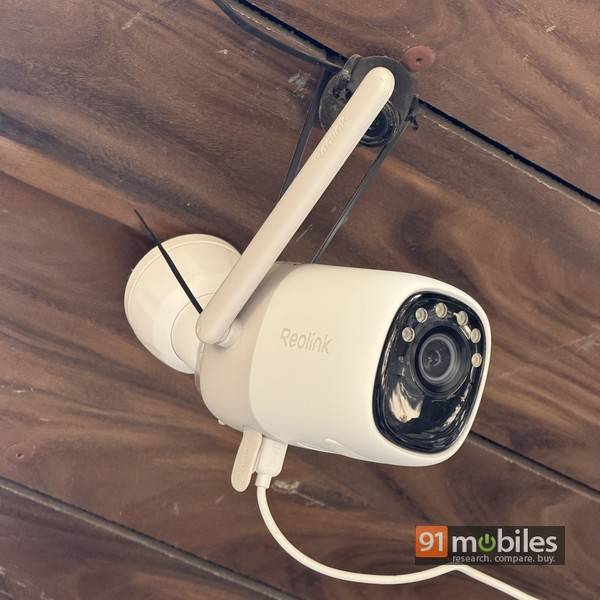
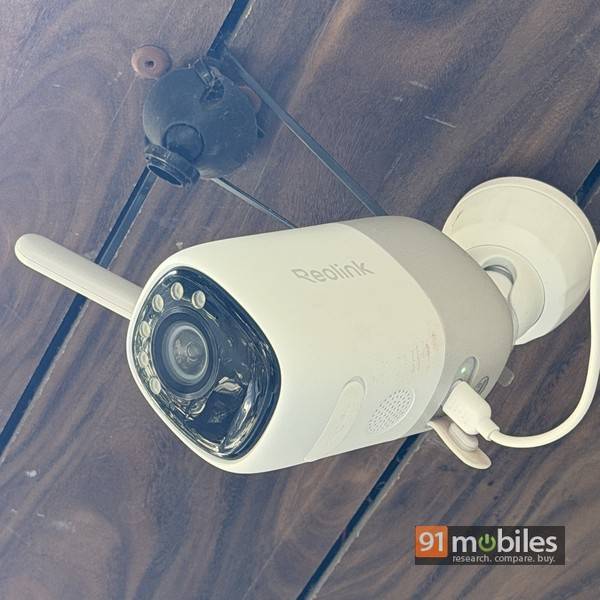
Moving on to the Altas, a single look is enough to tell you it’s a serious piece of equipment. The cylindrical device weighs over half a kg and features a swiveling antenna on the side. The dual-tone white / off-white body has the camera lens in front along with a bunch of LEDs, the daylight sensor and the PIR lens that detects motion. At the bottom, you’ll find a speaker and two rubber flaps. One hides the power button and a microSD card slot, while the other hides a Type-C port.
Specs and features
The Reolink Altas boasts a laundry list of features, headlined by its 2K recording and up to 540 days of promised battery life. Here are the key highlights:- 1/1.8″ CMOS sensor, 2,560 x 1,440 pixels, up to 15fps
- 540 days of battery life in motion sensor trigger mode (based on 5 minutes of daily recording), 20,000mAh battery
- Pre-recording 2-10 seconds
- Full colour night vision
- Dual-band Wi-Fi 6
- Advanced AI detection and real-time alerts
- PIR detection range 33 ft
- Support for Google Assistant and Alexa
- Support for up to 512GB microSD card
- IP66 weatherproof
Usage and app
You’d need the Reolink app, available for both Android and iOS, to set up and use the camera. Setup is simple and straightforward, and once you’re done, you’re ready to secure your home with the Altas. The app layout is simple as well, and using it, you can view the live feed captured by the camera on a real-time basis as and when you want. To record video, you need to pop in a microSD card or subscribe to cloud recording, but unfortunately, the cloud recording plans aren’t available in India.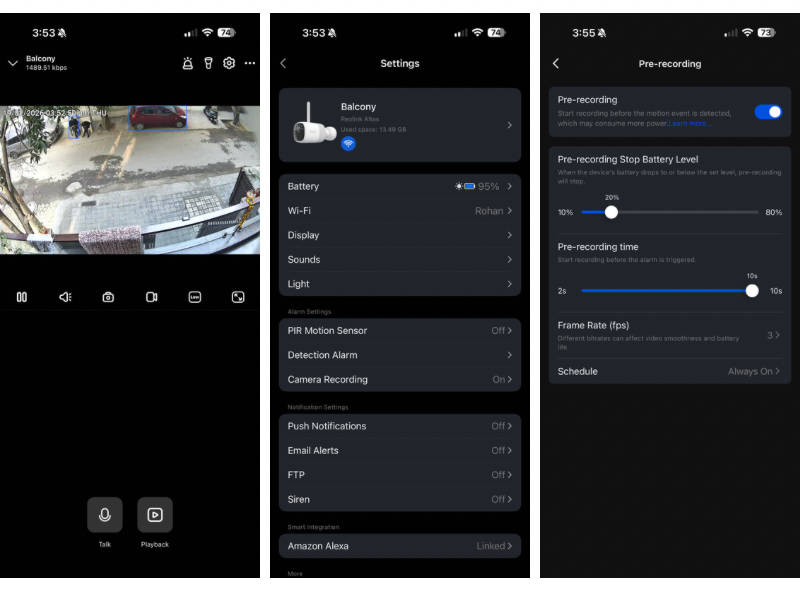
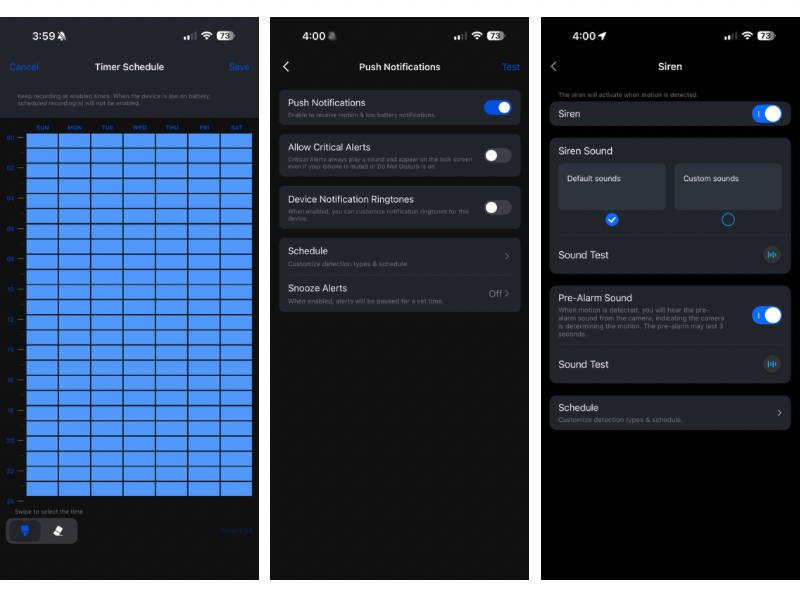
The app interface allows you to pause the stream, toggle audio, click a photo or record video on demand, switch resolution between “clear” and “fluent”, call via the two-way talk feature and hit playback to view recorded video. You can also trigger an audio alarm and switch on the spotlight. In the settings menu, you can check the battery levels, switch Wi-Fi networks, link to your Amazon Alexa account etc. The most important section of the settings menu, however, is where you set up the recording and configure the alerts. Recording can be done on a continuous basis (which eats up battery), or based on motion detection, and you can even set up a schedule for this. For alerts, you can choose to set up push notifications, email alerts, and siren, and set up schedules for each of these too. I like how extensive this is and the range of options available.
Under display settings, you can flip the image horizontally or vertically, and even set up a privacy mask to hide a portion of the recording frame.
Performance
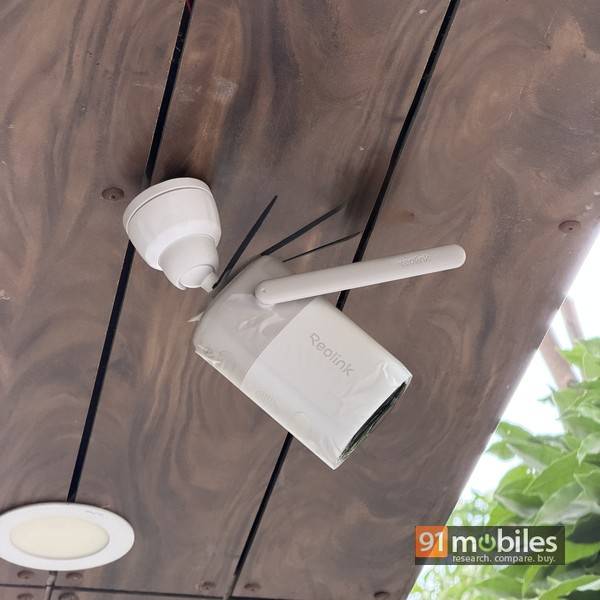
From the get-go, it’s clear that the Altas is a capable performer from an image quality perspective. It offers clear, sharp images, both in daylight and in low light. Lack of infrared means it has to rely on its spotlight in pitch dark conditions, but other than that, it works extremely well.
Motion detection works quite well too and while notification alerts aren’t instantaneous, the Altas reliably alerts you of any movement happening across the frame within seconds. If you’ve set it to record basis motion detection, you can view recorded clips and see what transpired at a particular time. There’s even an option to record time-lapse videos which can throw up interesting results, provided you have something nice to point the camera at, such as the setting sun, for instance.
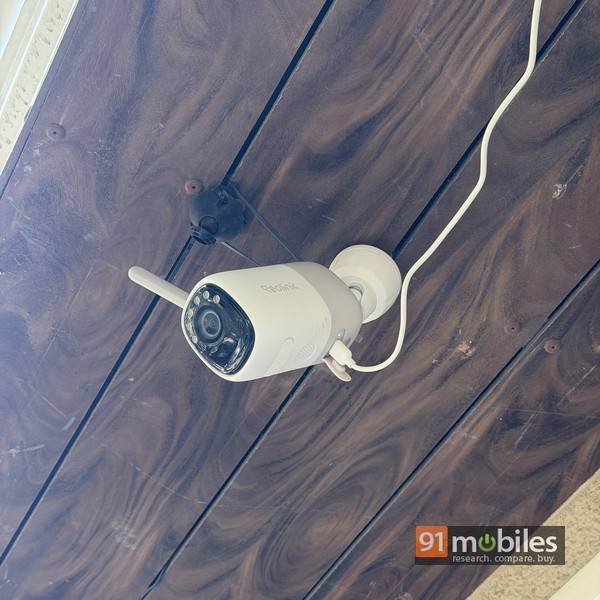
The battery life is one of the key highlights, and even without the solar panel connected, I managed to get about two weeks of use on a single charge. I had the PIR sensor (motion detection) on all the time and set the camera to record when it detected motion. Worth mentioning that I have the camera installed on my balcony and there’s frequent movement of people and vehicle on the street below, so two weeks of battery life is quite impressive. Adding the solar panel extended it further, and while this should enable unlimited battery life in theory, that isn’t the case. There are quite a few variables that affect battery life, such as availability of sunlight, the location where the solar panel is mounted and if it gets enough light, the features that are enabled on the camera, the frequency of movement it detects, etc. Most of my testing period was during Delhi’s winters with quite a few foggy days in the middle, so the conditions were less than ideal for testing the solar panel’s effectiveness. Suffice it to say that it does help quite a bit and if you set your schedules right and give it enough sunlight, the Altas and solar panel combo will ensure you don’t need to charge your camera often.
Verdict
Listed at $149.99, with he 3W solar panel costing an additional $29.99, the Reolink Altas makes for a compelling option overall. It doesn’t come cheap, but there are few direct rivals available to buy in India that can match its capabilities. The security camera industry is quite fragmented too, and many brands are vying for your attention. Reolink’s contender comes in as a loaded, feature-rich option, with the brand carrying solid reputation in this segment. The key highlights of the Altas include good image quality, a range of customisation options in terms of scheduling and alerts, and the long battery life, aided by the solar panel. Worth a closer look if you’re looking for a capable, wire-free, install-and-forget security camera.
Editor’s rating: 8 / 10
Pros:
- Good image quality
- Unlimited battery life (almost)
- Customisable alerts
- Pre-recording option
Cons:
- No infrared night vision
- No pan and tilt support