Android flagships are getting a mAhssive battery upgrade and there’s no looking back


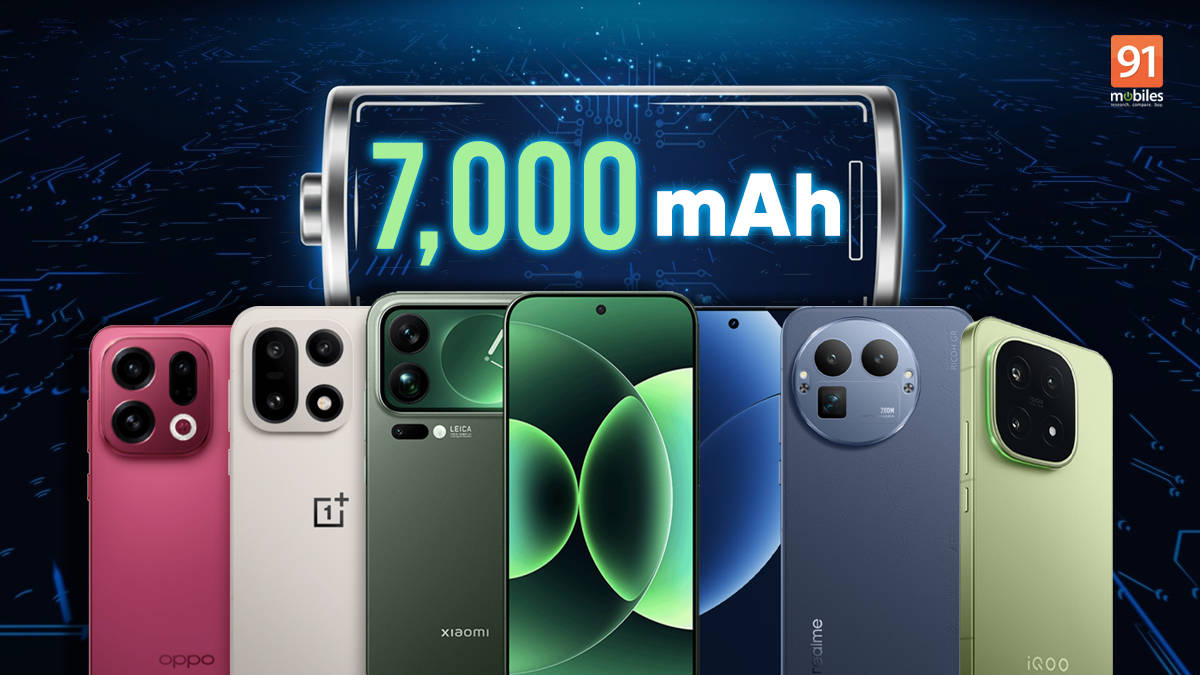
Smartphone battery capacities have seen a significant increase in 2025, particularly on flagship models. The average battery size is increasing as market leaders push past old limits. A recent Counterpoint survey stated that battery endurance is one of the top three factors users consider while buying a smartphone, with processor and storage capacity being the other two. In fact, in the sub-Rs 20,000 segment, battery life was the most important differentiator for consumers, which explains why we see larger battery sizes on lower-tier phones more often than on flagships. However, 2025 has ushered in an era where 7,000mAh batteries can be considered the new normal on premium Android phones.
Show Full Article
The Xiaomi 17 series kicked things off, with the standard Xiaomi 17 and Xiaomi 17 Pro Max packing 7,000mAh+ batteries, a figure that once sounded outlandish outside of niche phones. Realme GT8 series (GT7 also had a 7,000mAh battery), OPPO Find X9 series, iQOO 15, and OnePlus 15 all followed with similar numbers. Such capacities were previously mostly seen in mid-range devices, such as the Samsung Galaxy M51 (which was the first to introduce a 7,000mAh battery back in 2020) and more recent ones like the Realme 15x, iQOO Z10 series, OnePlus Nord CE5, and Vivo T4.
In stark contrast, Samsung’s flagship Galaxy S-series, including the latest Galaxy S25 Ultra, continues to use 5,000mAh cells. Apple, meanwhile, also remains conservative, relying on silicon and software optimisation to deliver a full-day battery life. The iPhone 17 Pro Max‘s battery still hovers around 5,000mAh, but offers competitive screen-on times due to chip efficiency and optimisation.
Table of Contents
Why are battery capacities the new selling point in flagships?
Brands now seem to be responding to market fatigue. Incremental hardware gains like camera pixel counts, ultra-fast charging, and extreme screen brightness are no longer enough to sway buyers. Endurance and utility are now the key differentiators, prompting companies to highlight battery size in their marketing. Android OEMs are now making battery capacities a central theme, addressing consumer frustrations with frequent charging and battery drain during AI tasks or gaming. This could also allow these brands to edge out Apple and Samsung in markets like India and Southeast Asia, where power infrastructure and travel patterns make big batteries more desirable.


To users, this could be a game-changer. A 7,000mAh flagship could finally make multi-day use realistic for heavy gamers and power pros. Paired with 80W, 100W, or even 120W fast charging speeds, topping up these batteries is no longer a test of patience – a quick coffee break can give you hours of use. This also translates to fewer charging cycles and lower battery degradation over time.
The science behind slim phones with large batteries
So what made OEMs so conservative in the flagship segment in the past? Till now, the presence of larger batteries in budget and midrange phones was mainly due to freedom for building thicker devices, fewer internal hardware demands, and a market focussed on endurance over aesthetics. Flagship phones had to balance performance, design, and user expectations inside slim and lightweight bodies. The biggest problem with packing a 7,000mAh battery into a sleek flagship is maintaining a slim profile and manageable weight. Now, brands have managed to keep thickness in check using new cell chemistries and space-saving internals. Makers have been dealing with this by leveraging advances in battery technology with silicon-carbon cells, allowing more capacity without proportionally increasing battery thickness.


For instance, the OPPO Find X9 features a battery with a capacity of over 7,000mAh, yet measures approximately 7.99mm thick, which is significantly thinner than many older phones with smaller capacities. OPPO explains how they achieve this. OPPO’s third-generation silicon-carbon battery features 15 percent silicon content and an industry-leading energy density of more than 850Wh/L. Thanks to optimised interior stacking and redesigned layouts for cameras and motherboards, OPPO was able to fit these large batteries without making the phones thicker.
The Find X9 measures just 7.99mm thick, while the Find X9 Pro maintains the same 8.25mm thinness as its predecessor, despite featuring a larger 7,500mAh cell. Constructed using OPPO’s patented spherical silicon-carbon material, the battery’s structure improves durability and enables it to undergo up to 400 more charge cycles than previous designs. The company claims to maintain its capacity of over 80 percent even after five years of normal use.
Silicon-carbon batteries are an evolution of the familiar lithium-ion cells used in today’s smartphones, designed to pack more energy into slimmer devices. Instead of relying solely on graphite for the anode, these newer batteries mix silicon with carbon – a tweak that allows them to store significantly more lithium ions, resulting in higher energy density. In simple terms, they deliver the same battery life in a smaller physical footprint, helping manufacturers make thinner phones without compromising endurance.
The carbon component stabilises silicon’s tendency to expand and crack during charging, improving safety and longevity. These batteries also handle faster charging speeds more efficiently, producing less heat and requiring less bulky thermal management. As a result, brands adopting silicon-carbon battery technology can offer sleeker designs with high-capacity batteries and ultra-fast charging. Foldables and AI-centric flagships are also part of this trend. With dual screens and always-on AI assistants that consume even more power, batteries don’t just need higher capacities, but smarter and more efficient use.
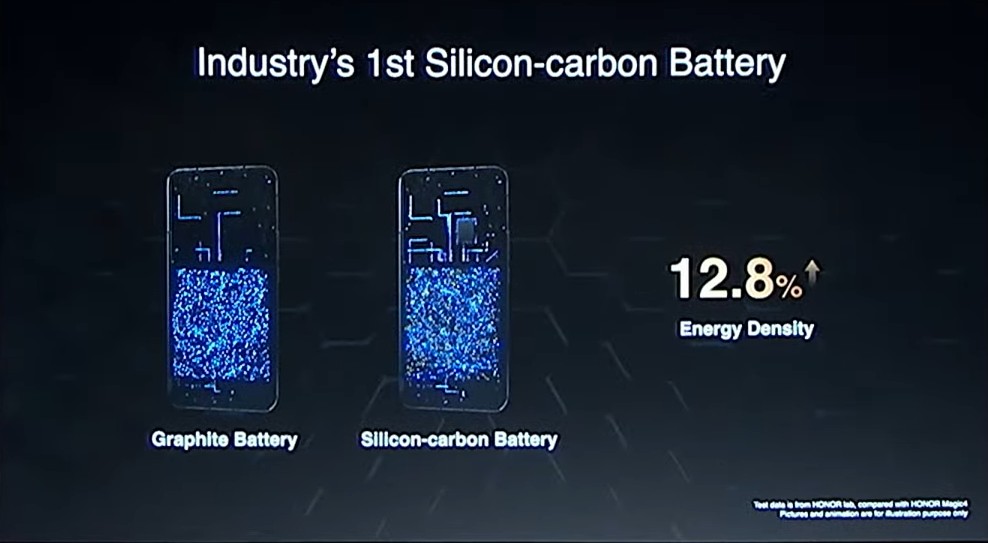

The first phone with a silicon-carbon battery was the Honor Magic 5 Pro, which was announced at Mobile World Congress in February 2023, with a capacity of 5,450mAh for the Chinese model.
Does 7,000mAh actually mean multi-day usage?
So, how does a buyer make sense of this? Firstly, battery capacity is just a part of the story. Optimisation matters, and a well-tuned 5,000mAh phone might outperform a poorly managed 7,000mAh one. Chipset efficiency, thermal management, power-dense displays, and charging speeds all factor into the real-life experience.
PCMark Battery score (in hours)


vivo T4
7300 mAh
18.0

realme P4 Pro
7000 mAh
17.3

OnePlus Nord CE 5 5G
7100 mAh
16.5

Samsung Galaxy S25 Ultra
5000 mAh
13.9

vivo X200 Pro
6000 mAh
13.7
PCMark battery test measures phone battery life from 100% to 20% (higher is better)
While we have yet to test the current batch of 7,000mAh flagships, as none of them have launched in India yet, we internally tested the Vivo X200 Pro, which debuted last year. The PCMark test revealed the 6,000mAh battery lasted 13 hours 43 minutes. Interestingly, the Samsung Galaxy S25 Ultra, with a 5,000mAh battery also gave a similar endurance – 13 hours 51 minutes. However, for perspective, phones in the Rs 20,000 segment with 7,000mAh+ batteries, such as the Vivo T4, OnePlus Nord CE5, iQOO Z10, and Realme P4 Pro, all registered over 16 hours of endurance in the PCMark test. Note that flagships come with displays and features that consume more battery life, so power optimisation in the current lineup of Android top-tier devices would be interesting to note.

Users who travel, stream lots of content, or multitask will benefit the most. Business users, content creators, and gamers should especially consider devices in this new endurance class. For the average social user, it’s less critical, but one can never go wrong with charging confidence.
The emergence of 7,000mAh batteries in Android flagships is a return to functional innovation – something that brings a practical benefit that users actually feel every single day. With longer battery life, brands are acknowledging that a great camera or a top-tier chip means much less if your phone’s dead by dinnertime. This new focus on real-world endurance may be the most significant, user-driven hardware movement in years, signalling a future where phones work for us, from dawn to dusk, two days in a row on a single charge. However, considering Si-C tech is new and we don’t know how these batteries perform in real-world scenarios, waiting for battery performance reviews will paint a clearer picture to inform a buying decision.