Gigabyte unveils Z890 PLUS motherboards for Intel Core Ultra 200S Plus


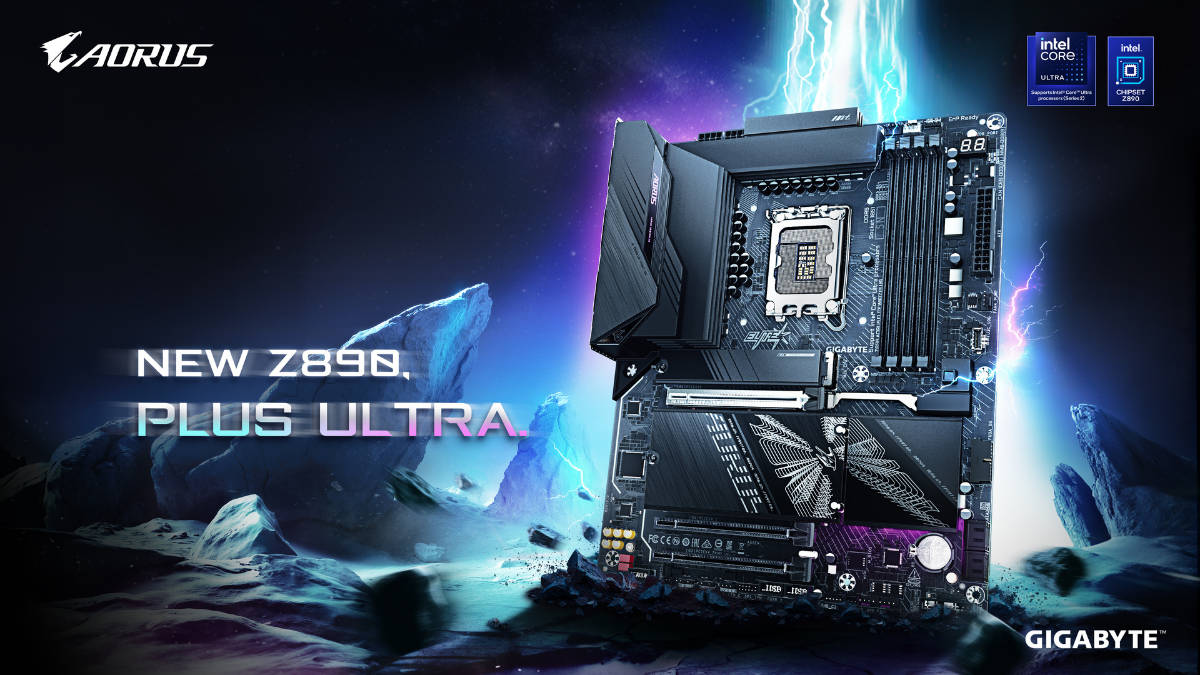
Gigabyte has unveiled its Z890 PLUS Series motherboards, purpose-built for Intel’s newly announced Core Ultra 270K Plus and 250K Plus processors. The lineup introduces two headline features: first, Ultra Turbo Mode, and second, D5 Duo X memory technology. This positions the Z890 PLUS as Gigabyte’s mainstream-focused answer to the performance ceiling unlocked by Intel’s latest desktop silicon.


Intel’s Core Ultra 200S Plus launch on March 26, 2026, is shaping up to be one of the more active desktop platform refreshes in recent memory. With multiple board partners already announcing dedicated support. MSI has already confirmed its 800 Series motherboard lineup for the 200S Plus. But for now, let’s take a look at what GIGABYTE has done with its motherboards.
Pricing and specific model availability have not been confirmed. Gigabyte has indicated the Elite, EAGLE, FORCE, and Duo X variants will roll out in succession. Suggesting a staged launch across price tiers rather than a simultaneous release.
Show Full Article
Table of Contents
Ultra Turbo Mode: one-click overclocking in three tiers
Let’s address the standout feature first, Ultra Turbo Mode. A system-level optimisation tool exclusive to the Z890 PLUS Series. Gigabyte claims that it can unlock up to 40% more performance with a single click. The figure is based on internal testing using an Intel Core Ultra 270K Plus running at DDR5-10266 in Hitman 3. This was done with Intel’s Application Performance Optimisation enabled. Its a specific test condition that should be treated as a best-case scenario rather than a general performance uplift.
The mode operates across three progressive tiers:
- LV1 Intel 200S Boost is enabled by default and applies precision-tuned overclocking for immediate gaming gains.
- LV2 Turbo Mode pushes further with optimised core curves and aggressive memory acceleration.
- LV3 Extreme Mode is the maximum setting. Brands says it is designed for competitive benchmarking and elite gaming scenarios. Where stability margins are less of a concern than peak output.
For mainstream buyers who have historically avoided manual overclocking due to complexity. The tiered approach is a practical middle ground offering meaningful headroom without requiring deep BIOS familiarity.
D5 Duo X pushes DDR5 to 10266 MT/s
The second major innovation is D5 Duo X. It’s a memory platform technology exclusive to the Elite Duo X and Force Duo X models. It is limited to the Z890 PLUS lineup only. The technology addresses a persistent limitation of high-capacity DDR5 configurations. That is, adding more DIMMs typically forces a trade-off between capacity, frequency, and signal stability.
D5 Duo X supports the CQDIMM standard with backward compatibility for CUDIMM. CUDIMM (Clocked Unbuffered DIMM) is a DDR5 module with a small built-in clock driver chip. Think of it as DDR5 with a signal booster built into the stick itself.
CQDIMM (Clocked Quad DIMM) takes that concept further. It uses the same clock driver approach but is designed specifically to support higher capacities. This is what allows D5 Duo X to deliver four-slot capacity in a two-slot configuration while still hitting extreme frequencies.
The implementation combines optimised PCB circuit layouts, refined clock driver architecture, and advanced BIOS tuning. As per the brand, this is done to reduce memory channel loading while improving signal integrity. The result? As per Gigabyte’s testing, DDR5 operation at 10266 MT/s, a figure that the company is positioning as a new high-water mark for mainstream desktop platforms.
The D5 Duo X technology is especially relevant for content creators and AI workload users who need high-capacity, high-frequency memory. That to without the stability compromises typically associated with fully populated DDR5 configurations. For pure gaming builds, Ultra Turbo Mode offers meaningful headroom. However, the 40% performance claim should be verified against independent benchmarks once the platform is in reviewers’ hands.
Additionally, Gigabyte has partnered with ADATA, TeamGroup, and V-Color, among others. To validate high-capacity CQDIMM compatibility. Along with a stated focus on AI computing and professional content creation workloads.
Platform features and build quality
Power delivery is handled by a Digital Twin 16+1+2 phase VRM, cooled by Gigabyte’s VRM Thermal Armour Advanced. Storage thermal management gets an upgrade through M.2 EZ-Flex, a flexible heatsink base. It is designed to improve contact consistency between the heatsink and SSD surface. It’s a small but meaningful refinement for sustained NVMe performance under load.
Structural integrity is addressed through the UD Base Plate. This is a full-coverage metal baseplate that reinforces the PCB. It prevents pin exposure and adds stability during installation. Meanwhile, connectivity includes 5GbE LAN, Wi-Fi 7 with a directional high-gain antenna. Additionally, a PCIe 5.0 M.2 storage, and USB4 Type-C with DisplayPort Alt Mode support.
Assembly quality-of-life features include screwless M.2 heatsink retention via EZ-Latch Plus. Quick-release PCIe slot mechanisms and a revised UC BIOS 2.0 interface.
Gigabyte is making a calculated play with the Z890 PLUS Series here. Rather than simply offering Z890 chipset support for the 200S Plus processors at a competitive price, the board introduces exclusive platform-level features. That creates a reason to choose Gigabyte specifically over the broader Z890 ecosystem. Ultra Turbo Mode and D5 Duo X are both proprietary differentiator features. That competitors on the same chipset cannot replicate without their own equivalent implementations.

The Z890 PLUS Series is Gigabyte’s answer to the question: how do you stand out when multiple board partners are supporting the same processor on the same chipset? On one side, there is MSI, which is leaning on platform ecosystem depth and backward compatibility. On the other side, Gigabyte is leading with proprietary performance tools in Ultra Turbo Mode and D5 Duo X. But for buyers building a new system around the Core Ultra 270K Plus or 250K Plus, both lineups are worth evaluating side by side.