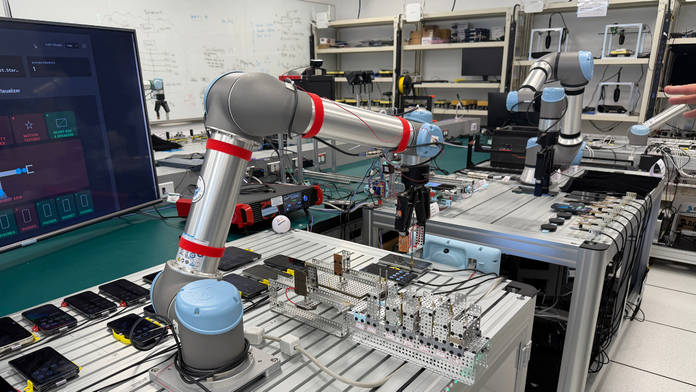
For those of us who love shiny new gadgets, watching smartphones being subjected to abuse and torture can be quite painful. And yet, when Google invited me to take a peek inside its Pixel Labs in Taiwan, I just had to say yes. I was one of a handful of non-Googlers ever to set foot inside these facilities, where Pixel smartphones are tested on various aspects to ensure they’re ready to withstand the rigours of daily use without breaking a sweat. These hardware labs are Google’s largest outside the US and as you can imagine, are packed with all sorts of high-tech equipment, robots and paraphernalia to evaluate and test smartphones on a bunch of different aspects, such as durability, thermal design etc. Let me take you on a quick tour of a few of the tests I witnessed.
Table of Contents
Inside the durability lab
While durability could be one of the easiest things to test (think drop tests, water sprays etc), Google’s durability labs emulate real-world scenarios in a controlled manner. And they go well beyond just drop tests and spraying water, though these were there. Here’s a gist:- The controlled drop test performed here drops a phone (the Pixel 10 Pro in this case) from a set height and at specific angles. They even have a bunch of different types of floor surfaces to drop the phone on, to see how it impacts (no pun intended) the outcome.


- I also caught a Pixel phone taking a shower, as jets of water got sprayed on it from different angles. This is completely automated, with the phone placed inside a specific machine made for this purpose, with the objective of testing resistance to water.

- And then there’s the tumble test, with a phone moving around randomly inside a rotating cylinder, along with a bunch of things commonly found inside women’s handbags — a set of metal keys, a hairbrush, a nail cutter and a nail file, a tube of cream, pens, a small bottle of hand sanitiser, hair clips, etc. This particular test involved the phone going through 1,000 tumbles, designed to evaluate resistance to scratches.
- The ball drop test, as the name implies, involves dropping a heavy ball on the phone’s screen.

- A hinge test that involves folding and unfolding the Pixel 10 Pro Fold 200,000 times to test hinge reliability.
- And one of the most interesting ones — the sit-on test. I do like the names Google has given its tests, though I chose to call this test by a different name, one that I can’t write here. This test mimics a scenario where a user has the phone in their back pocket and sits on it by mistake — something we’ve all been guilty of doing at some point or another. It uses a metal arm with a rubber pad attached to put pressure on the phone to see how it fares.
Inside the comms & sensors lab
This lab is specifically for testing how Pixel smartphones behave and interact with users and other devices, testing connectivity and various sensors. Various types of robotics are employed here to automate the tests. The ones I saw included:- A robotic arm performing tests on the phone’s screen, pressing various virtual keys on the keyboard.

- A few phones placed on a rotating turntable, going back and forth on a slider as it moved closer and then away from a light source. The brightness and colour temperature of the light can be varied to test the adaptive light sensors on the phones.
- Another robotic arm that kept placing and removing a Pixel tablet on its dock repeatedly, to ensure reliable operation. Alongside, a bunch of different phones were placed to test the reliability of the USB Type-C port.

- One more robotic arm picked up Pixel smartphones and placed them on different testbeds for testing — there was one for testing the proximity sensor, one for the temperature sensor, another to test touch latency, one to test the motion sensor, and a sound box to test sound.

- Another test used a rotating artificial arm on which a Pixel Watch 4 was strapped, next to a Pixel smartphone moving back and forth on a slider. This tests the connection between the smartwatch and the phone.
Inside the audio lab
The audio labs have a bunch of anechoic chambers — rooms that are designed in such a way that there’s no echo at all. Being inside one can feel quite weird since there’s absolutely no sound at all, and there’s a strange feeling of being disconnected from the world. In fact, a fellow journalist mentioned she could hear her own thoughts, and that’s an apt way to put it. These are some of the tests I witnessed:- Real-time voice translation and noise isolation, with a cellular phone call made from a Pixel smartphone to another placed inside different soundproof rooms.
- Evaluation of Audio Zoom, a feature that focuses on the voice of the speaker while recording video and zooming in from a distance. This test is done inside one of the aforementioned anechoic chambers, with a bunch of different speakers generating sounds to mimic different environments such as a noisy restaurant, a music concert etc.

- Tests to evaluate call quality on a Pixel Watch 4, done inside another anechoic chamber.
Inside the design lab
The tests I saw inside this particular design lab test various aspects related to how different materials impact durability, longevity and usage:- A test that uses infrared cameras to evaluate the temperature of a phone and its innards in real time. Various cooling solutions such as graphene sheets, cooling gels, thermal pastes, etc., are on display here.
- A machine that stretches different materials (such as silicone in this case) to test flexibility and breaking point.

- A closer look at the mechanism of the Pixel 10 Pro Fold’s fearless hinge, showing the many moving parts inside and how they work together to ensure reliability.
To tell you the truth, this isn’t the first time I’ve seen phones being tested. But credit where it’s due — Google’s labs are extremely high-tech, involve a lot of precision, and mimic real-world conditions in a way I haven’t seen before. Of course, this is Google we’re talking about, so this doesn’t really come as a surprise. Seeing it first hand, though, made me realise what goes on behind the scenes to ensure the devices we buy and use work as intended. Many features we end up taking for granted these days — IP ratings, phones that survive rain and drops to the floor, even basic stuff like our phone screens adjusting their brightness based on ambient light – involve extensive testing to ensure they provide years of pain-free service. And if this means subjecting the devices to a lot of ‘pain’, so be it.
Disclosure: this writer was in Taiwan on Google’s invitation