Intel launches Core Ultra 200HX Plus mobile processors with Binary Optimisation Tool for better gaming performance


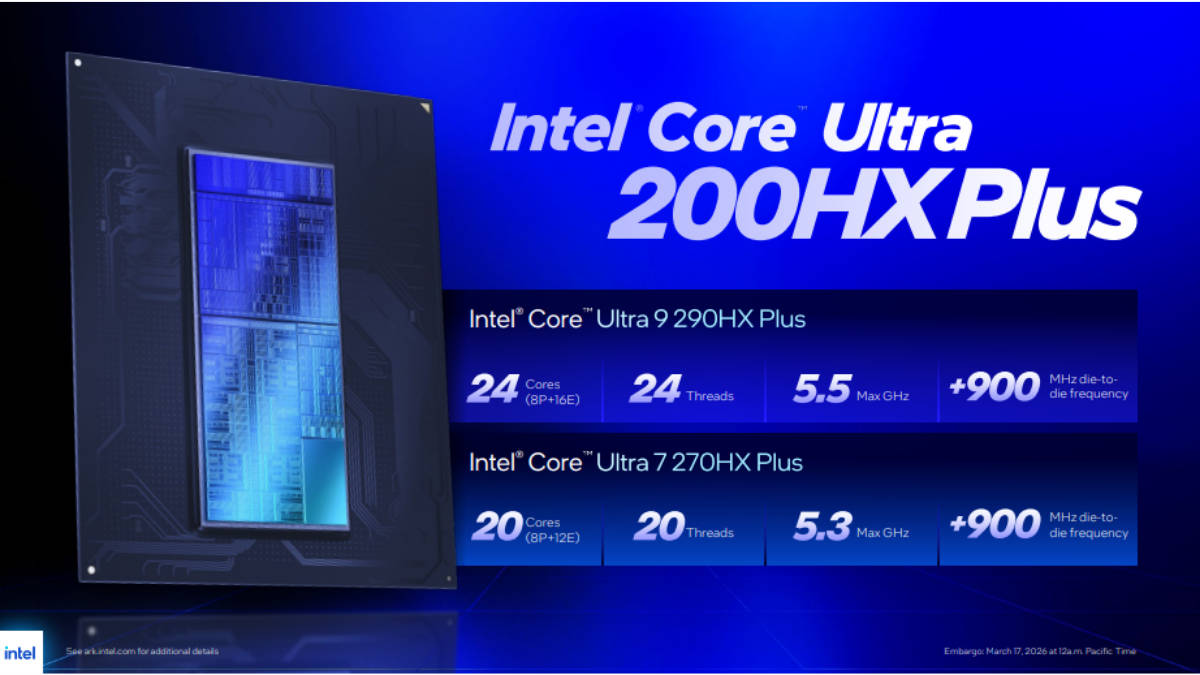
Intel has launched the Core Ultra 200HX Plus series of mobile processors. Unveiling two new high-performance laptop chips designed for gamers, content creators, and workstation users. This lineup includes the Core Ultra 9 290HX Plus and Core Ultra 7 270HX Plus, which are available in partner systems starting March 17, 2026.


Table of Contents
What’s new over the previous generation
The 200HX Plus series builds on the existing Core Ultra 200HX base with two significant improvements:
The first is a 900MHz increase in the die-to-die frequency, or the communication link between the CPU and memory controller, compared to the Core Ultra 7 285HX and 265HX. Intel claims this nearly one gigahertz boost in internal bandwidth reduces system latency and enhances gaming performance. Which matches what the company has stated for its 200S Plus desktop models.
Show Full Article

The second addition is the Intel Binary Optimization Tool, also featured in the desktop 200S Plus lineup. See, most games are not written exclusively for your specific CPU. They are built to run broadly across many processors, including older Intel architectures, AMD chips, or even game console hardware. As a result, some of the instructions a game sends to your CPU are not as efficient as they could be for your particular silicon.
The tool intercepts those instructions and rewrites them in real time to better match how your Intel processor actually works at a hardware level. Squeezing more instructions per clock cycle out of the same game code. Without the game developer needing to release a patch or update.
This positions it as a broader compatibility and performance bridge rather than a narrow tuning patch. It operates through Intel’s Application Optimization software and requires advanced mode to be turned on.
Connectivity upgrades include support for discrete Intel Wi-Fi 7 at speeds of up to 5Gbps, Bluetooth 5.4, and Thunderbolt 5 with bidirectional bandwidth of up to 80Gbps. This is especially important for workstation users handling large file transfers, 8K media streaming, or setups with multiple accessories.
Performance claims
Intel’s main claim is up to 8% faster gaming performance for the Core Ultra 9 290HX Plus compared to the previous generation Core Ultra 9 285HX. This is based on a geometric mean across 32 games at 1080p High settings with the Optimization Tool activated on select titles. Single-thread performance increases by up to 7% in Cinebench 2026 over the same comparison.

As with all benchmark claims from manufacturers, these figures depend on Intel’s internal testing under specific configurations. Independent reviews across a wider range of workloads and thermal conditions will provide a clearer picture.
| Brand | Device |
| Acer | Acer Predator Helios Neo 16S AI |
| Acer Predator Helios Neo 16 AI | |
| Acer Predator Helios Neo 18 AI | |
| ASUS | ASUS ROG Strix SCAR 18 |
| Colorful | Colorful iGame M16 Origo |
| Dell Technologies | Dell Alienware 16 Area-51 Gaming Laptop |
| Dell Alienware 18 Area-51 Gaming Laptop | |
| Dell Alienware 16X Aurora Gaming Laptop | |
| HP Inc. | HyperX OMEN 15 |
| HyperX OMEN 16 | |
| HyperX OMEN MAX 16 | |
| Lenovo | Lenovo Legion 7i (16″, 10) |
| Lenovo Legion 5i (15″, 11) | |
| Lenovo Legion Pro 7i (16″, 10) | |
| Lenovo Legion Pro 5i (16″, 10) | |
| MAINGEAR | MAINGEAR Ultima 18 |
| Mechrevo | Mechrevo Yaoshi 18 Pro |
| Mechrevo Yaoshi 16 Ultra | |
| MSI | MSI Raider 16 Max HX |
| Origin | Origin PC Gaming Notebook EON18X |
| Origin PC Gaming Notebook EON16X | |
| Puget | Puget Mobile C162-G |
| Razer | Razer Blade 18 |
For the Indian market, brands like Acer, ASUS, Dell, HP, and Lenovo have strong local distribution, so 200HX Plus systems should reach retail and online channels without significant delays.
The 200HX Plus follows the same approach Intel is using with the desktop 200S Plus. It features incremental architectural improvements. Alongside the Binary Optimization Tool as a distinguishing software layer. The tool represents an interesting strategic move for Intel this generation. Instead of waiting for hardware to close the instruction-per-cycle gap, Intel is using software optimisation to squeeze more performance from existing hardware.

This approach is important because competition for high-performance laptops is growing. AMD’s Ryzen AI PRO 400 Series targets the same professional and creator market with up to 60 TOPS of NPU compute. Qualcomm’s Snapdragon X Elite is adding pressure in the efficiency segment. Intel’s response in the HX segment focuses on improving gaming and single-thread performance. Areas where x86 familiarity, a mature ecosystem, and the Binary Tool give it a solid advantage.
For buyers upgrading from a 285HX, the 200HX Plus is a meaningful step up, especially if the Optimization Tool covers your regular titles. Thunderbolt 5 is adding genuine value for workstation users. Meanwhile, those coming from older hardware like the i9-12900HX will see a more pronounced gap.

Real-world thermal performance, sustained clock behaviour under load, and battery life in creator workloads still need testing across the entire OEM lineup. The actual implementation will vary significantly between a thin-and-light creator laptop and a heavy-duty 18-inch gaming machine. This makes reviews of specific systems more insightful than platform-level benchmarks for final purchasing decisions.