LG ranks high among India’s most aspirational smart TV brands: 91mobiles Smart TV Buyer Insights 2026


The Indian smart TV market is as dynamic as it gets. Driven by the growing demand for large-sized TVs with superior display technologies, consumers are now seeking a better experience that enhances their OTT content streaming. The 91mobiles Smart TV Buyer Insights Survey 2026, which gathered responses from over 3,000 users across India, sheds light on how purchasing patterns, feature priorities, and brand loyalty are evolving.
While several brands continue to battle for market share, LG is cementing its position as a highly aspirational premium player. The survey reveals that LG isn’t just retaining its existing user base, but also presents itself as a trustworthy brand that users are ready to switch to.
Table of Contents
LG possess one of the highest brand loyalties among smart TV owners


- According to 91mobiles’ report, over 14 percent of the survey participants own an LG TV, narrowly trailing behind Sony, which holds a 15.4 percent share. While a positive brand perception plays a crucial role in building a strong share, LG caters to a wide range of price segments, allowing it to garner a large consumer base.
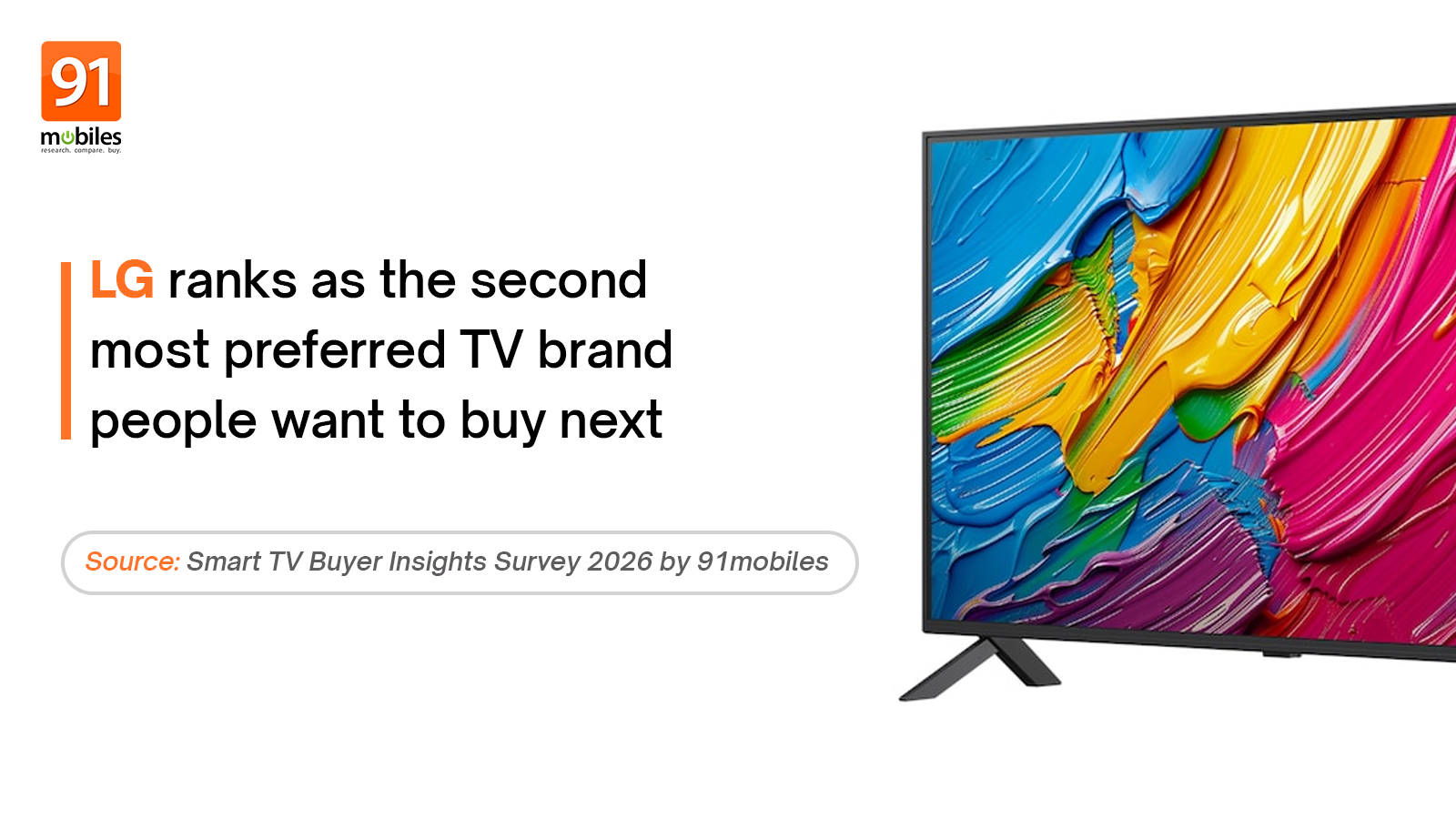
- More importantly, the report reveals that LG is the second most preferred brand for a user’s next purchase, ahead of its arch-rival, Samsung.

- This could be attributed towards various factors, such as trust in the brand’s after-sales services, user experience, superior display output, and others.
- As a result, many TV owners taking up the survey looking to switch from value-centric brands like Xiaomi, as well as legacy giants like Samsung and Panasonic, claim that they would prefer LG when purchasing a smart TV in the future.
- Speaking of numbers, 11.5 percent of Sony TV users are planning to switch to LG, while a good chunk of Samsung TV owners, at 16 percent are eyeing an LG TV next.
Similarly, 11 percent of the survey participants with a Xiaomi TV wish to migrate to LG, while almost 20 percent of Panasonic owners are aiming for an LG TV.

Major aspects buyers look for when purchasing a TV, and why LG ranks high in preference
To understand why LG has built this massive pull, one must look at what Indian buyers prioritise when upgrading. The survey report mapped out several consumer preferences, and they happen to align perfectly with LG’s core strengths:
Picture quality is a top priority: 5 in 10 buyers cited picture quality as their number one priority when buying a new TV. Furthermore, 75 percent of respondents consider the TV’s display technology to be the most critical aspect when evaluating a screen.
Over the years, LG has come up with TV lineups with OLED evo and QNED technologies. These displays have been acclaimed to deliver perfect blacks, superior brightness, and exceptional colour accuracy.
Video and audio enhancement technologies are highly favoured: With a huge OTT content portfolio at their disposal, 45 percent of participants stated they want premium cinematic formats like Dolby Vision IQ and HDR10+, while 43 percent of the survey takers wish to have Dolby Atmos in their next television.
Many high-end LG televisions natively support Dolby Vision IQ, ensuring the panel dynamically adjusts to the ambient light in the room for a natural, theatre-like fit, while integration of Dolby Atmos and its proprietary AI Sound Pro technology creates a multi-channel audio environment.
Smarter UI navigation: Software is no longer an afterthought. 57 percent of participants consider the user interface and navigation experience to be “very important”. LG’s internal webOS platform serves this exact demographic. It’s a renowned TV OS that features fluid and snappy operations, neatly organises apps and content, and integrates well with other LG devices.

LG’s webOS trails slightly behind Google TV as the preferred TV OS
Even though Google TV accounts for 37.3 percent and around 56 percent of current ownership, and OS preference share, respectively, the demand for LG’s webOS isn’t far off.
This presents a nuanced opportunity for the South Korean tech giant. While Google TV offers a vast repository of apps, it takes a basic approach with the user interface, where people may not have the flexibility to customise their homescreen.
LG can position webOS as the sophisticated, premium alternative. It provides a cleaner, highly organised layout that focuses less on forced recommendations and more on fluid navigation and user control. Paired with LG’s ThinQ AI architecture and the HomeHub ecosystem, webOS doubles as a centralised dashboard for managing smart home devices. This feature set gives tech-forward buyers a strong reason to opt for LG’s ecosystem over a TV running on Google TV.
Summing up
The data from the 2026 survey paints a clear picture of the Indian smart TV buyer: they are deliberate, well-informed, and quality-driven. Over 35 percent of buyers take more than two weeks to research their purchase, and 56 percent compare three or more devices before pulling the trigger.
Furthermore, as we have seen in the sections above, LG ranks high in brand ownership and loyalty, positioning itself as a go-to choice for many, thanks to its undisputed display technologies, cinematic audio integrations, and a refined smart TV ecosystem that runs on an intuitive TV OS. With such advantages up its sleeves, LG is positioned to remain the upgrade of choice for Indian households looking to level up content watching experience.