
Samsung’s Galaxy A series has long been the company’s volume driver in the mid-range segment, balancing premium-inspired design with dependable hardware and long-term software support. Interestingly, the existing Galaxy A56 5G and Galaxy A36 have just seen price revisions in India, hinting that their successors, the Galaxy A57 and Galaxy A37, could debut at slightly higher price points when they arrive next month.
While Samsung has yet to officially confirm its launch, both upcoming models have appeared on the European Union’s EPREL (European Product Registry for Energy Labelling) database, revealing key battery, durability, and software support details ahead of their announcement.
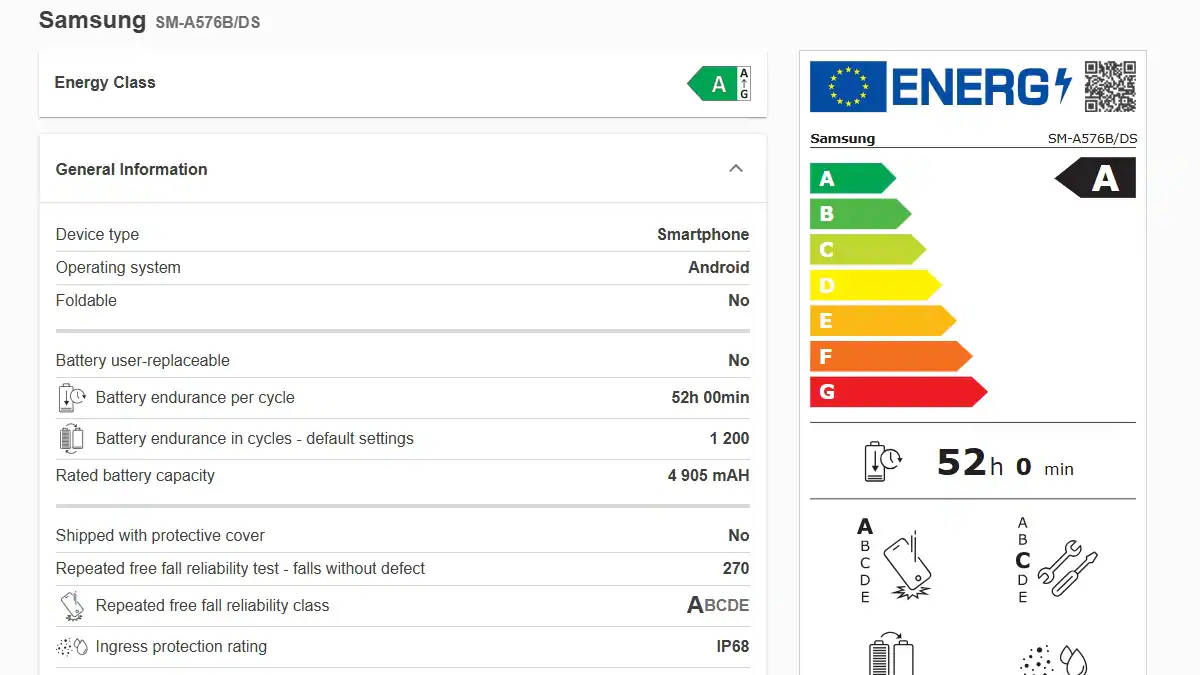
The Galaxy A37 (SM-A376B/DS) and Galaxy A57 (SM-A576B/DS) listings indicate a 4,905mAh rated battery for both devices. Samsung may market them as 5,000mAh typical capacity units. In terms of endurance, the Galaxy A37 is listed with up to 53 hours per charge cycle, while the Galaxy A57 is close behind at 52 hours. Both devices are rated to retain at least 80 percent battery health after 1,200 charge cycles.
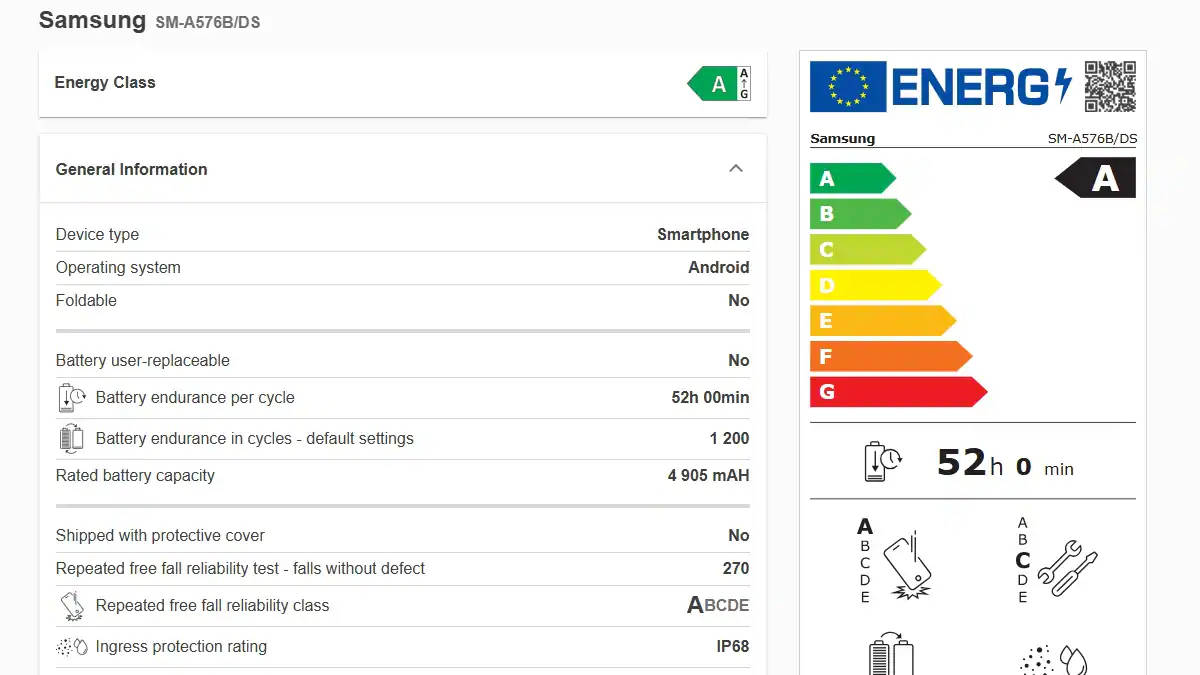
Notably, both smartphones are shown with IP68 certification for dust and water resistance. This would mark an upgrade over the IP67 rating offered by their predecessors, potentially improving dust and water resistance. The database also reveals five years of guaranteed operating system security, corrective, and functional updates. While this suggests five years, Samsung is expected to offer six years of software support to the Galaxy A57 and Galaxy A37.
The listing also reveals repairability scores for the Galaxy A57 and A37. Both models received a ‘C’ grade (on an A–E scale). The Galaxy A57 earned an ‘A’ rating for drop resistance, while the Galaxy A37 secured a ‘B’, suggesting the former may have slightly better structural reinforcement.
Beyond EPREL, the devices have also surfaced on Singapore’s IMDA certification site, suggesting an imminent launch.
Leaks suggest both models will feature FHD+ AMOLED displays with 120Hz refresh rates. The Galaxy A57 is tipped to sport a 6.6-inch panel, while the Galaxy A37 may come with a slightly larger 6.7-inch display. On the performance front, the Galaxy A57 is rumoured to run on the new Exynos 1680 chipset, whereas the Galaxy A37 could be powered by the Exynos 1480.
Both are expected to offer triple rear camera setups led by a 50MP primary sensor, along with 12MP front-facing cameras. This is a similar setup to the Galaxy A56, but we could see some sensor changes or software upgrades.
If accurate, this would represent incremental upgrades over the outgoing models, focusing more on refinement and durability than dramatic spec overhauls.
The Galaxy A36 and Galaxy A56 were launched in India in March last year, but have now received two price hikes, pushing them to the sub-Rs 40,000 and Rs 50,000 bracket. Both smartphones stand out for their impressive displays, reliable cameras, and long-term software support. However, with recent price increases already affecting those models and component costs, including memory and semiconductor pricing, fluctuating globally, it would not be surprising if the Galaxy A37 and Galaxy A57 debut at slightly higher starting prices.
If you are currently considering the Galaxy A36 or Galaxy A56 at their revised prices, it may be worth waiting for the A37 and A57 launch to assess the improvements. However, buyers who prioritise bigger batteries and faster charging speeds may want to consider alternatives. Performance gains from the Exynos 1680 and Exynos 1480 will also need real-world validation before concluding.
For long-term users who value brand reliability and software longevity over raw performance benchmarks, the Galaxy A57 and Galaxy A37 could emerge as compelling upgrades, provided Samsung keeps pricing competitive. If the launch prices climb significantly, alternatives from OnePlus, Xiaomi, or iQOO may offer stronger hardware value on paper.
An official announcement is expected next month, which should clarify positioning and pricing strategy.