Vivo X500 vs Vivo X300: what’s changed and how much of an upgrade is the new flagship?


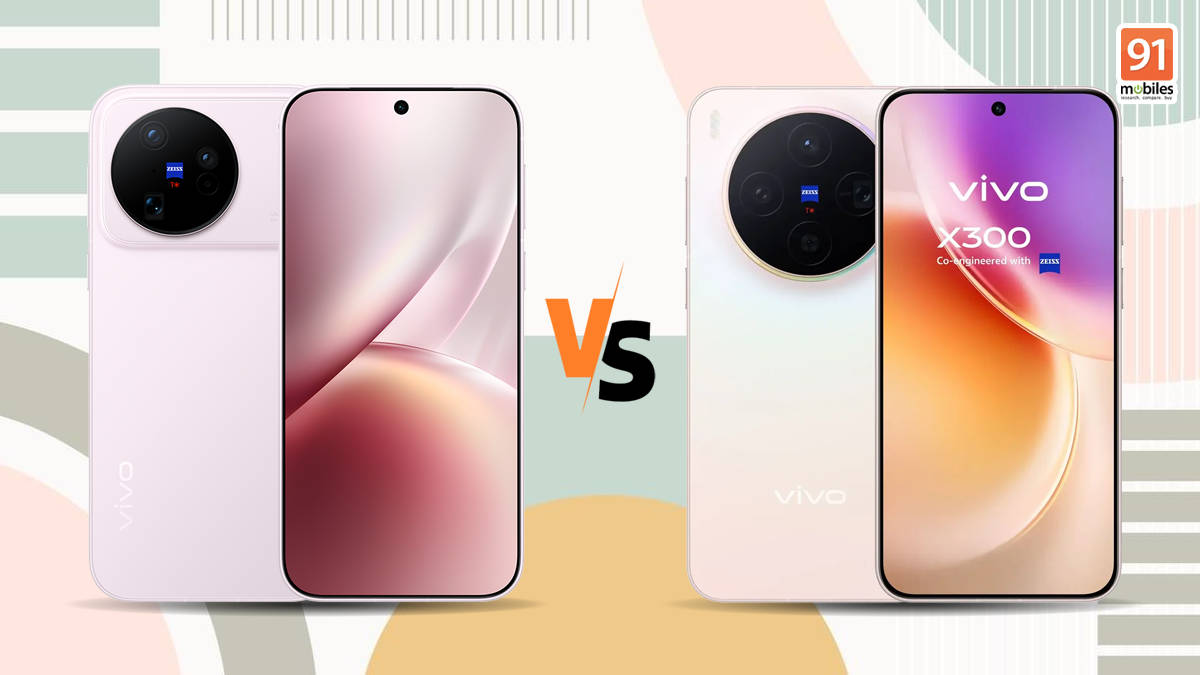
Vivo's latest flagship, the Vivo X500, has arrived in India, succeeding last year's X300. The new model brings a redesigned camera module, a larger display and battery, an upgraded processor and changes to the Zeiss-backed camera system. It also comes with a significant price increase over its predecessor. But how much has actually changed between the two generations, and are there any areas where the older X300 still has an advantage? Let's find out.
Specs at a glance
| Specification | Vivo X500 | Vivo X300 |
| Display | 6.59-inch 1.5K AMOLED, 144Hz | 6.31-inch 1.5K LTPO AMOLED, 120Hz |
| Processor | MediaTek Dimensity 9600M | MediaTek Dimensity 9500 |
| Cameras | 50MP main, 50MP ultrawide, 64MP periscope telephoto; 50MP front | 200MP main, 50MP ultrawide, 50MP telephoto with 3x optical zoom; 50MP front |
| Battery | 7,500mAh; 90W wired, 40W wireless | 6,040mAh; 90W wired, 40W wireless |
| Software | OriginOS 7, Android 17 | OriginOS 6, Android 16 |
| Durability | IP68, IP69 | IP68, IP69 |
Table of Contents
Vivo X500 vs Vivo X300: price
The Vivo X500 is available in a single configuration with 12GB + 256GB storage, priced at Rs 1,19,999. It comes in Titanium Black and Ember Red.
The Vivo X300 launched in India at the following prices:
- 12GB + 256GB: Rs 75,999
- 12GB + 512GB: Rs 81,999
- 16GB + 512GB: Rs 85,999
The X500 costs a whopping Rs 44,000 more than the X300's entry-level launch price. There was no officially announced price hike for the standard X300, though subsequent listings on Vivo's store showed it to start at Rs 83,999 despite no stock. The phone started disappearing from retail channels after the Vivo X300 FE launched in May 2026, and it is now unavailable across major online and offline channels. Vivo never formally confirmed its discontinuation, but the limited stock situation pointed towards a gradual phase-out.
The X300 FE arrived at Rs 79,999, placing it above the original X300's starting price despite using a sub-flagship Snapdragon 8 Gen 5 chipset. The standard X300 had a more powerful Dimensity 9500 processor and a more versatile camera setup, which made the overlap between the two models difficult to justify, and probably the reason for the phasing out.
Vivo X500 vs Vivo X300: design
The rear design is one of the biggest changes between the two generations. The Vivo X300 has a large circular camera island positioned towards the centre of the upper half of the back panel. The X500 moves to a raised rectangular camera plateau towards the upper-left corner, with the circular camera arrangement integrated into this broader section.


The new layout brings to mind the camera plateau introduced on the iPhone 17 Pro series. The two designs are not identical, but the wider raised section is a noticeable departure from the X300's standalone circular camera module. Vivo has also used a glass back with a metallic frosted finish on the X500, giving it a different look from the previous generation.


The X500 is also larger and heavier. It weighs around 213 gms and measures 8.15 mm in thickness, compared to the X300's 190 gms weight and 7.95 mm thickness. This is partly down to the larger display and battery. So, while the new model gets a more contemporary camera design, the X300 retains an advantage for users who prefer compact phones.
Vivo X500 vs Vivo X300: display
The X500 moves to a larger 6.59-inch 1.5K AMOLED display with a 144Hz refresh rate. The X300 has a smaller 6.31-inch 1.5K LTPO AMOLED panel with a 120Hz refresh rate. The X500's larger screen offers more room for videos, gaming and multitasking, while the higher refresh rate should make supported content and animations look smoother. The X300, on the other hand, has an LTPO panel that can dynamically adjust its refresh rate depending on the content on screen, helping manage power consumption.
This is an upgrade in screen size and refresh rate, but not necessarily in every respect. The X300's LTPO technology and compact dimensions remain useful advantages, especially for those who prefer smaller flagship phones. LTPO, which is a smart display tech that automatically changes how fast your screen refreshes to save battery life, is reserved only for the X500 Pro models.
Vivo X500 vs Vivo X300: durability
Vivo has retained the same IP68 and IP69 dust and water resistance ratings on both generations. This means the X500 doesn't bring a higher official ingress-protection rating over the X300. In simple terms, this means the phones are protected against dust entering their bodies and can survive accidental drops in water. The IP68 rating covers immersion in fresh water under specified conditions, while IP69 means the phones can also withstand high-pressure, high-temperature water jets. So, accidental splashes, rain or brief submersion should not be a concern, but this does not mean the phones are waterproof or should be deliberately used underwater. Water resistance can also weaken with regular wear and tear.
Both phones have premium glass-and-metal construction, although the X500 has a larger camera plateau that protrudes from the rear. At this price, using a protective case and screen guard is still advisable.
Vivo X500 vs Vivo X300: cameras
The camera hardware, which is the main USP of the X-series, has undergone some interesting changes. Both the models feature a triple Zeiss setup. The X300 features a 200MP primary camera, a 50MP ultrawide camera and a 50MP Sony LYT-602 telephoto camera with 3x optical zoom. The X500 switches to a 50MP main camera, a 50MP ultrawide camera and a 64MP APO periscope telephoto camera with optical image stabilisation. Both phones have a 50MP front camera.

The move from 200MP to 50MP on the primary camera may look like a downgrade on paper, but megapixel count alone does not determine image quality. The X500 uses a large Sony LYTIA 828 sensor, which should help with light capture and dynamic range. The 64MP periscope camera also brings higher resolution than the X300's 50MP telephoto unit, along with 3.1x optical zoom. How it behaves in real life is something that will be gauged in our in-depth review.
Vivo has also introduced newer video capabilities and improved telephoto features on the X500, including support for its separately sold ZEISS Telephoto Extender Gen 2. The X300 already offered a capable camera system, though, with a high-resolution primary sensor and 3x optical zoom. So the X500's camera upgrade is more about its newer sensor and telephoto capabilities than simply increasing megapixel counts.
Vivo X500 vs Vivo X300: chipset, battery
The Vivo X500 is powered by the MediaTek Dimensity 9600M, while the X300 uses the Dimensity 9500. Despite the newer name, the 9600M is largely a software and firmware refresh of the 9500 rather than a new-generation chipset with substantially upgraded hardware.
Both processors use TSMC's 3nm process and share the same CPU architecture, clock speeds, Mali-G1 Ultra MC12 GPU, NPU 990 and memory and storage support. The camera processing capabilities are also largely unchanged. The 9600M brings MediaTek's newer Dimensity Scheduling Engine 3.0, updated gaming features and support for newer on-device AI models. These additions could improve resource management, gaming features and AI experiences, but the underlying hardware does not represent a major performance upgrade over the X300.
This means the X500's chipset shouldn't be a major reason for X300 owners to upgrade. The Dimensity 9500 remains a flagship-grade processor, and the newer branding on the 9600M doesn't translate into a substantial jump in raw CPU or GPU performance.
Battery capacity, however, sees a more meaningful increase. The X500 packs a 7,500mAh battery, compared to the 6,040mAh unit on the X300. That's an increase of around 24 per cent, which should translate into better endurance, particularly with the larger display. Both phones support 90W wired and 40W wireless charging, so charging speeds remain unchanged. How much of the mAh increase translates into real-life figures, we'll get to later once the figures are in.
Vivo X500 vs Vivo X300: software
The X500 ships with OriginOS 7 based on Android 17, while the X300 launched with OriginOS 6 based on Android 16. The newer version brings interface refinements, updated animations, AI features and improved cross-device connectivity. The X500 also adds features such as Quick Share integration with iPhones, Apple Watch and AirPods connectivity, and access to iCloud photos through the file manager. These additions could be useful for people who use devices across both Android and Apple's ecosystem.
Vivo has promised five major Android OS upgrades and seven years of security updates for the X300. The X500 gets the same support commitment, so the newer phone doesn't offer an advantage in the number of promised updates, although it starts with a newer Android version.
Summing up
The Vivo X500 brings meaningful upgrades in battery capacity, display size, refresh rate, chipset and telephoto photography. Its redesigned camera plateau also gives the phone a distinct look compared to the X300. However, it is noticeably larger and heavier, and the shift from a 200MP to a 50MP primary camera may not appeal to users who prioritise high-resolution photography.
The X300 still had some strengths that Vivo has not carried forward in the same form, particularly its compact dimensions, LTPO display and 200MP primary camera. The X500 is the more capable and better-equipped flagship overall, but the Rs 44,000 difference between their launch prices is substantial. For existing X300 owners, the larger battery, newer chipset and camera changes are worthwhile upgrades to consider, but they may not justify an immediate switch unless those are specific priorities.

