Cuzor Pulse 70W GaN Charger review: more power to you


Bangalore-based Cuzor has made a name for itself in the router UPS segment. Unless you’ve been living under a rock, these tiny devices are designed to ensure your Wi-Fi router continues to function during a power outage, and came to the fore during the pandemic when work-from-home was the norm. A mini UPS resembles a power bank and also helps prevent your Wi-Fi router from restarting when a power outage happens and the electric supply shifts to a power backup, such as a generator. I bought a Cuzor mini-UPS for the very same reason, back in 2021, and it continues to serve me well to this day. And with its very first GaN charger, Cuzor is looking to disturb the charger segment in the same way.

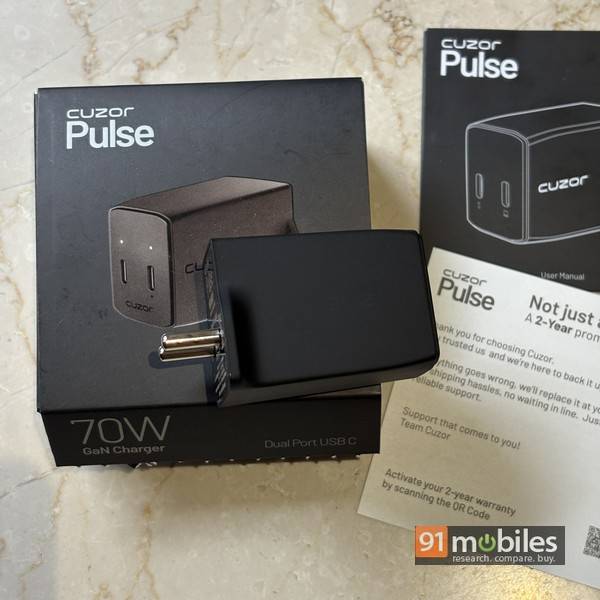
Right at the outset, the 70W output caught my eye. Most GaN chargers available in the market advertise 65W, but as per Cuzor, the extra 5W can be crucial in the real world. The reason is that in dual-port mode, the Cuzor Pulse can provide 25W to smartphones while the first port is connected to your laptop. And 25W works well for many premium flagships like those from Apple, Google and Samsung, ensuring faster charging. But that’s not the only highlight.
Table of Contents
Features

Here’s a look at some of the features that help the Cuzor Pulse 70W charger stand out from others.
- Provides 25W in dual-port mode
- LED notifications (more on this later)
- Supports PD 3.0, PPS, QC 2.0 and QC 3.0 charging protocols
- 1W/mK silicone potting solution that promises to keep components cool and offers stability and insulation
- Drop-tested, tested at 70W loads in 40 degrees ambient temperature
- 2-year doorstep warranty
Usage and performance

The solid build quality is evident when you handle the charger — it’s compact, yet weighty for its size. Sporting a matte black finish, it comes with a pair of standard pins to suit Indian electrical sockets at one end, and a couple of Type-C ports at the other end. Cuzor doesn’t include any cables with it, and maybe the brand could consider bundling one in the future to help increase the overall value proposition.

A tiny LED is placed above each of the Type-C ports, and these are another highlight of the Cuzor Pulse. When no device is connected or when it’s powered off, these LEDs remain off and are barely visible. They blink rapidly when the connected device is charging fast, and the blinking slows down to a throb when the connected device is drawing very little power. And when the connected device is fully charged, the LEDs switch to a steady glow. This helps give you a visual indication of the charging status, without having to check your device — quite handy.

I used the Cuzor Pulse 70W to power a MacBook Air M1 and an iPhone 16, and this dual-port use is what it’s designed for. Using a PowerZ test device provided by the brand, I was able to verify the supported charging protocols and also check the power output of the charger while it was juicing up my devices. The PowerZ test module displayed close to 45W on the MacBook Air, and ~25W on the iPhone 16. With both devices starting at 10 percent battery levels, the laptop touched 30 percent and the iPhone 37 percent within 15 minutes, with both LEDs on the charger blinking rapidly. In 37 minutes, the laptop touched 50 percent, with the iPhone at 66 percent. And in 1 hour 10 minutes, I had them at 75 and 90 percent respectively, and the LEDs on the Cuzor Pulse 70W were blinking at a slow throb. The charger itself got a bit warm in that time, which is par for the course.
Verdict

The Cuzor Pulse 70W carries a sticker price of Rs 2,499, which is a tad lower than competing options from the likes of Nothing, Stuffcool etc, but there’s no dearth of cheaper options as well. Where the Pulse 70W stands out are features like fast charging and solid build quality. However, aspects like the LED indicators and the two-year doorstep warranty are quite unmatched, and help it get a thumbs up and a strong recommendation from my end. In short, the Cuzor 70W seems ideal for day-to-day charging needs in the office and at home, and should prove to be really useful during travel as well.
Editor’s rating: 8.5 / 10
Pros:
- Fast charging for 2 devices
- LED indicators
- 2-yr doorstep warranty
Cons:
- No cable included
- No Type-A port