
In the ₹40,000-₹50,000 upper mid-range smartphone segment, the decision is no longer about picking a good phone, it is about picking the most complete one. This is where the Galaxy A37 5G, vivo V70, and OPPO Reno 15 approach things very differently.
The Galaxy A37 5G brings a 6.7-inch FHD+ Super AMOLED display with 120Hz refresh rate, HDR10+ support, and up to 1900 nits brightness, a with 45W fast charging, a 50MP OIS camera system with Nightography, and six years of software support.
The vivo V70 and OPPO Reno 15, in comparison, push 6500mAh batteries, 80W–100W charging, higher-resolution displays, and more aggressive multi-camera hardware. On paper, it looks competitive. In practice, the Galaxy A37 stands out for how well it brings everything together.
Table of Contents
Design: Balanced ergonomics vs spec-driven styling
The Galaxy A37 keeps things clean and functional, with finishes like Awesome Charcoal, Awesome Graygreen, and Awesome Lavender. It is designed with everyday usability in mind, focusing on grip, balance, and long-session comfort. The vivo V70 and OPPO Reno 15 lean more into slim profiles and visual styling, with thickness figures around 7.5-7.8mm and weights close to 190-197g.

These choices make them look sleeker on paper and in quick comparisons. But once you spend time using all three, the difference becomes clearer. The thanks to its 7.4mm slimness, with better weight distribution and a more natural grip. It achieves this due to Samsung’s focus on how the phone actually feels during extended use. That approach makes a bigger difference over time, and it is where Samsung’s design philosophy proves more practical.
Display: Higher resolution vs better visibility and balance
The vivo V70 and OPPO Reno 15 offer higher-resolution AMOLED displays around 1260 × 2750 pixels, paired with 120Hz refresh rates and pixel densities above 450ppi. The Galaxy A37 uses a 6.7-inch FHD+ Super AMOLED display (1080 × 2340) with 120Hz refresh rate, HDR10+, Vision Booster, and up to 1900 nits peak brightness.
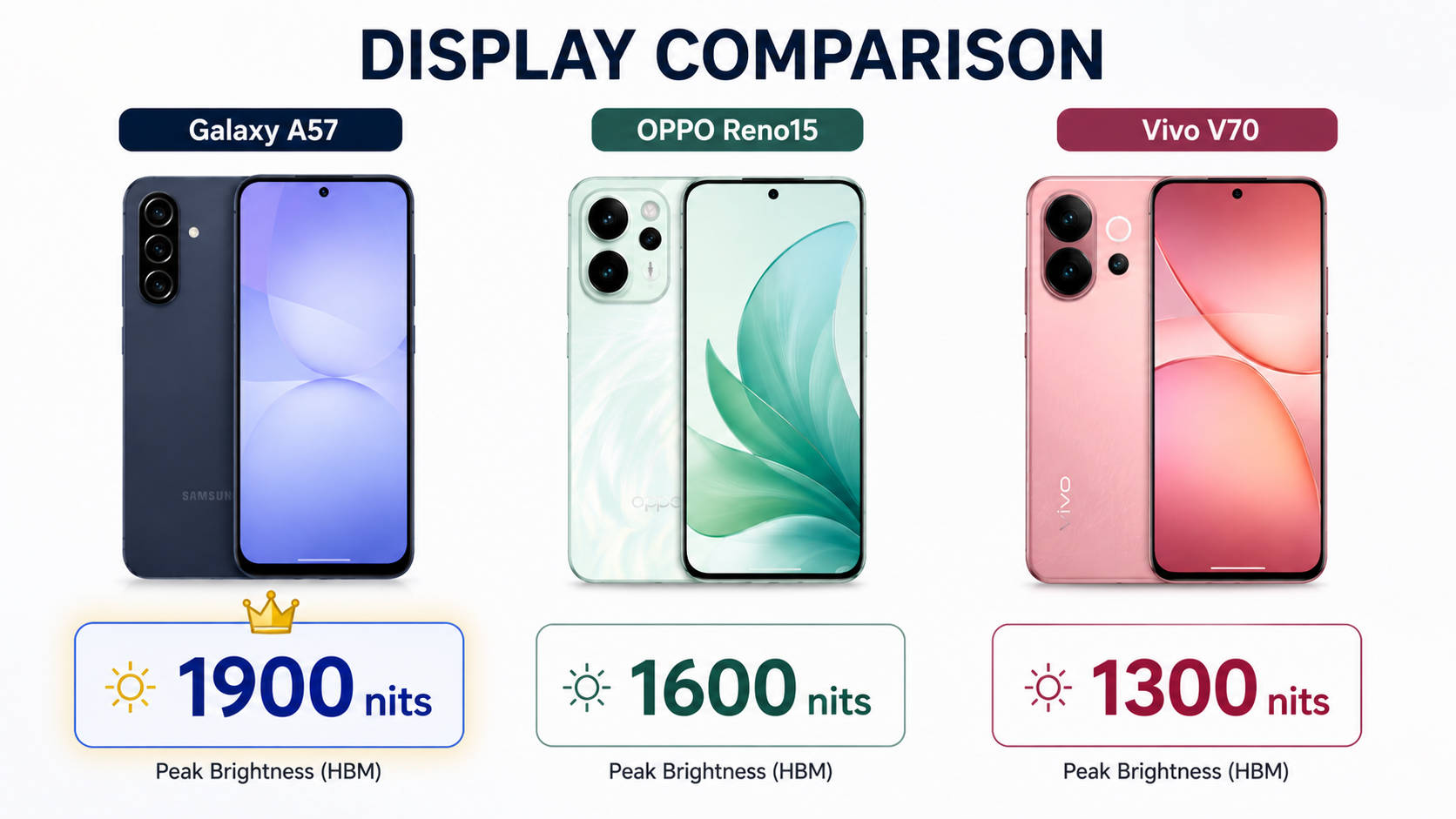
What this means is that the Samsung Galaxy A37 is clearly tuned for usability. The higher brightness ensures better outdoor visibility, while HDR10+ improves contrast and colour depth for content. More importantly, the display adapts intelligently to reduce power consumption while maintaining smoothness. In everyday use, that balance matters more than extra pixels. The Galaxy A37 delivers a display that feels more consistent across different environments, which ultimately makes it the better viewing experience.
Performance and gaming: Peak numbers vs sustained consistency
Most phones in this segment are fast enough in terms of specifications, so that’s not really the issue anymore. The Galaxy A37 has the same foundation with LPDDR5X RAM and UFS 3.1 storage, going up to 12GB RAM and 256GB. But what you notice isn’t just speed, it’s how well it holds up once you’ve been using it for a while.

Open a bunch of apps, switch between them, leave things running in the background, it doesn’t start slowing down or reloading everything. It just stays smooth. That becomes even clearer when you’re gaming. A lot of phones feel great in the first few minutes, then you start noticing frame drops or heat kicking in. Here, it’s more stable. Frame rates don’t jump around, the phone doesn’t suddenly get warm, and you can keep going without feeling like it’s struggling. It’s that consistency that stands out. Not just fast for a moment, but reliable over time.
AI: System-level intelligence vs feature-level additions
The Galaxy A37 integrates agentic AI directly into the system, enabling cross-app actions, AI-powered editing, object erasing, and contextual optimisation. Amazing, right? This is supported by improved NPU performance and faster AI processing, making these features quicker and more efficient in real use.

While the vivo V70 and OPPO Reno 15 also offer AI-based features, they are more feature-specific rather than system-wide. The Samsung Galaxy A37’s implementation feels more cohesive, thereby allowing AI to enhance everyday tasks instead of acting as an add-on.
Camera: Why more megapixels don’t always mean better images
The OPPO Reno 15 comes with a 200MP main camera and additional 50MP sensors, while the vivo V70 leans on a 50MP ZEISS setup with a dedicated telephoto lens. On paper, those numbers sound impressive, but higher megapixels don‘t always translate into better photos. The Galaxy A37 keeps things simpler with a 50MP main camera, backed by a 1μm sensor, OIS, VDIS stabilisation, and an improved ISP with low noise mode. What that really means is consistency. Photos come out clean, balanced, and closer to what you actually saw. That difference shows up when you compare them side by side. The vivo and OPPO cameras tend to push colours and sharpness a bit more, which can look good at first glance but often feels processed. The Galaxy A37 takes a more natural route. Skin tones look right, colours don‘t feel exaggerated, and images don‘t look overdone.

Low light is handled well too. Nightography helps keep noise in check and improves contrast, so shots don‘t fall apart once the lighting drops. It also feels quicker to shoot, which makes it easier to capture moments without missing them. The front camera is also better than what OPPO and vivo offer. It uses a 12MP sensor with an f/2.2 aperture, supports Full HD video recording, and comes with features like screen flash and HDR support, so selfies come out clear and usable across lighting conditions. What stands out here is consistency again. Selfies don‘t feel overly smoothed or artificially enhanced. Zoom might be where competitors try to stand out, but in everyday use, the Galaxy A37 ends up being more reliable. You get photos that look right more often, without needing to tweak or retake them, and that‘s what really matters.
Battery and charging: Bigger numbers vs long-term reliability
The vivo V70 and OPPO Reno 15 offer 6500mAh batteries with 80W to 100W fast charging, focusing on faster top-ups. The Galaxy A37 has a 2-day battery with 45W fast charging, reaching around 60% in 30 minutes. The difference lies in how the battery is designed to perform over time.

The A37 supports up to two days of usage through optimisation features like adaptive display, deep sleep engine, and efficient background management. It is also rated for up to 1200 charging cycles and comes with an A-rated battery system so that users get better long-term health. While competitors prioritise speed, the Galaxy A37 prioritises longevity and consistency, which ultimately matters more in daily use, especially in India.
Storage and longevity: More than just capacity
The Samsung Galaxy A37 offers configurations up to 12GB RAM and 256GB storage, supported by faster memory systems like LPDDR5X RAM and UFS 3.1 storage, which directly improve app loading speeds, multitasking, and overall responsiveness. The vivo V70 and OPPO Reno 15 also offer similar RAM configurations, and in some cases, OPPO extends storage up to 512GB. Even though it seems like a win, the truth is that in practical use, raw storage capacity is only one part of the equation.

What matters more is how efficiently that storage is used and how long the phone remains relevant. This is where the Galaxy A37 clearly pulls ahead. With six OS upgrades and six years of security updates, it offers one of the longest support cycles in this segment. That means the phone not only stays secure but also continues to receive new features and improvements over time. Apps remain optimised, performance stays consistent, and the overall experience does not feel outdated quickly.
In comparison, competitors, but without equivalent long-term software support, that advantage becomes less meaningful over time. The Galaxy A37 combines fast storage with long-term usability, which makes it the stronger choice for users planning to hold on to their device for years.
Durability: Built for real world use
The Galaxy A37 comes with Gorilla Glass Victus+ on both the front and back, and that’s what you notice first in day-to-day use. It just feels tougher. Whether it’s the phone brushing against keys in your pocket or being placed on rough surfaces, you’re not constantly thinking about scratches or minor damage. That kind of protection makes a difference over time. You end up using the phone more freely, without being overly careful every time you set it down or pick it up. It feels built to handle everyday wear without needing too much fuss. It can also handle splashes, dust, and even brief submersion. But in regular use, it’s really the Gorilla Glass Victus+ on both sides that stands out, because that’s what you’re relying on every single day.

In comparison, while the vivo V70 and OPPO Reno 15 offer solid build quality, they do not consistently match this combination of flagship-grade glass protection and full IP68 certification across the segment. That creates a clear and measurable advantage for the Galaxy A37. Durability is often overlooked in spec comparisons, but it plays a critical role in long-term ownership. A phone that is built to handle real-world conditions is simply easier to live with, and this is where the Galaxy A37 stands out clearly.
Price and value: A more complete proposition
The Galaxy A37 starts at ₹36,999 for the 8GB + 128GB variant, including a ₹5,000 instant cashback, while the Galaxy A57 is priced at ₹49,999 for the 8GB + 256GB variant with a ₹7,000 instant cash back included. That makes both phones significantly more competitive in the premium mid-range segment. The vivo V70 and OPPO Reno 15 continue to sit in a similar or slightly higher price bracket depending on storage configurations, often starting closer to the mid-₹40,000 range and going upwards.
Where the difference becomes clearer is in what that price actually includes. The Galaxy A37 brings together a 6.7-inch Super AMOLED display with HDR10+ and up to 1900 nits brightness, a 5000mAh battery rated for up to two days of use, 45W fast charging, IP68 durability, a 50MP OIS camera with Nightography, LPDDR5X RAM with UFS 3.1 storage, and six years of software support into a package that feels far more complete in everyday use.
The vivo V70 and OPPO Reno 15 do push certain headline specifications harder, including larger battery capacities, faster charging numbers, or higher megapixel counts. But those strengths tend to shine in more specific situations. The Galaxy A37 feels more balanced overall. The display, battery life, durability, camera consistency, long-term software support, and day-to-day performance all work together in a way that feels easier to live with over time. That is ultimately where the value proposition becomes stronger. It is not just about excelling in one area, but about delivering a more complete smartphone experience across the board.
The final call
The vivo V70 and OPPO Reno 15 are built to stand out through individual specifications, whether that is battery size, charging speed, or camera hardware. The Galaxy A37 is built differently. It brings together display quality, performance stability, AI integration, camera consistency, battery reliability, durability, and long-term software support into one cohesive package. That balance is what defines the experience over time. Performance stays smooth, the camera remains dependable, the battery continues to hold up, and the software keeps improving. In a segment where most phones excel in parts, the Galaxy A37 stands out for getting everything right together. And that is what ultimately makes it the smarter and more dependable choice.
This is a promotional post done as part of a brand collaboration.