
Show |
Dinosaur | Prehistoric
Disclaimer: All content and media belong to original content streaming platforms/owners like Netflix, Disney+ Hotstar, Amazon Prime Videos, JioCinema, SonyLIV etc. 91mobiles entertainment does not claim any rights to the content and only aggregate the content along with the service providers links.









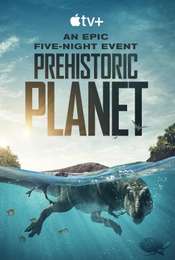
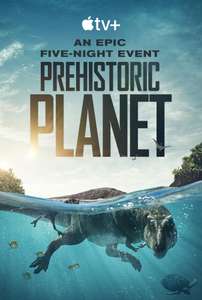
The breath-taking documentary series Prehistoric Planet transports viewers on an incredible journey back in time to see the amazing discoveries of the Earth's prehistoric past. The show unravels the mysteries underlying prehistoric life through amazing images, scientific research, and entertaining narration, delivering a fascinating peek into the variety and magnificent species that once walked our globe. Prehistoric Planet's spectacular cinematography and special effects are one of its most notable features. The series brilliantly blends cutting-edge computer-generated animation with real-world settings and landscapes, taking viewers to many eras and ecosystems with astounding realism. The careful attention to detail in reconstructing prehistoric species and their environs is utterly mesmerizing, enabling audiences to completely immerse themselves into a world that no longer exists. "Prehistoric Planet" is a must-see for nature lovers, palaeontologists, and anybody interested in the fascinating species that once roamed our globe. It is a show that will keep the audiences entertained from the very start.
OUTSTANDING SCORE DOCUMENTARY TV SERIES | 2022 | Hans Zimmer
Best Original Score Documentary Series TVDigital | 2022 | Hans Zimmer
Outstanding Visual Effects in a Photoreal Episode | 2026 | François Dumoulin
Outstanding Anthology Series | 2023 | Tim Walker
Outstanding Achievement in Anthology Series | 2023 | Mike Gunton
Best Music | 2022 | Hans Zimmer
Outstanding Music Composition for a Documentary Series or Special (Original Dramatic Score) | 2023 | Hans Zimmer
Best Original Composition In A Television Programme | 2023 | Hans Zimmer
Outstanding Editing DocumentaryNonfiction Episode or NonTheatrical Feature | 2022 | Andy Hague
Outstanding Virtual Cinematography in a CG Project | 2023 | Daniel Fotheringham
Paleontology aficionados have viewed the series as a spiritual successor to Walking with Dinosaurs (1999). Ironically, David Attenborough refused to do the narration on Walking with Dinosaurs (1999) because he was unwilling to support a fictitious wildlife documentary at the time. Attenborough has since changed his view leading to his work here.
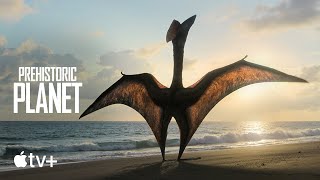
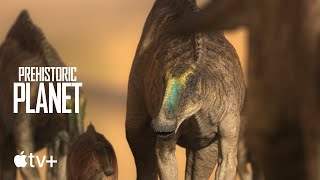
The series' goal was not just to portray a more up-to-date view on prehistoric animals, but also to address common clichés of paleontological media and present speculative ideas to viewers. From the 2000s onward, many of the scientists and artists working on the show, like scientific consultant Darren Naish, have reinterpreted our understanding of prehistoric animal appearances and behavior to be more in line with the modern animal kingdom. This line of thought is usually called "All Yesterdays", referring to a 2012 book co-authored by Naish, which presented bold, unusual but scientifically grounded ideas on extinct animals. Paleoartist and series advisor Mark Witton also wrote extensively about the importance of speculation and not taking hypotheses as absolute fact, reasoning that most modern animals have physical traits and behaviors that cannot be discerned by their bones alone. In older media, dinosaurs were often depicted with very little soft tissue and dull colors, which is not what we see in today's fauna, especially on birds. The series thus showcases bright display colors or inflatable skin structures on certain animals. Predatory animals like T. rex are often characterized as hyperactive, roaring monsters in media, but in reality it was a normal animal that only turned aggressive when necessary and might not have been able to roar. Mid-20th century beliefs posited that carnivorous dinosaurs were afraid of water, herbivores were gentle giants and dinosaurs couldn't survive in cold climates. These notions are also baseless, so the series depicts T. rex swimming, herbivores engaging in violent combat and dinosaurs living in near-arctic regions, protected from the cold by layers of fat or feathers.
During production, a scientific study showed that the large, bumpy scales on the back and flanks of the horned predatory dinosaur Carnotaurus were probably not arranged in ordered rows as previously thought, but in a random, irregular pattern. It is also speculated that the horns could have been much larger in life due to their keratinous sheath. The show's Carnotaurus models were finalized before this publication and the scientific consultants were not given access to study the actual fossil materials, so the animal's design in the series is now generally considered outdated.
During the 2000s and 2010s, T. rex was thought to have had a feathery coat because many of its distant relatives had fuzz and feather impressions preserved on their fossils. Studies published in the late 2010s however showed that tiny patches of Tyrannosaurus' skin impressions lacked feathers. Scientists still debate whether this means the animal had no feathers or if it had feathers on other parts of its body, though most modern reconstructions lean toward a scaly skin. This series takes a middle-road approach by showing juvenile T. rex with fuzzy feathers that kept it insulated and camouflaged, while adults have mostly naked skin and only a thin line of fuzz on the back of their neck. Other dinosaurs were reconstructed differently. The giant Deinocheirus is shown with shaggy feathers even as an adult, a notion that some scientists involved with the series like Mark Witton have argued against, as the animal could have overheated. However due to the climate where Deinocheirus lived, others speculate it might have needed feathers to keep itself warm during the night, and it could have cooled itself down in water, or kept itself internally cool with the air-filled sacs that all dinosaurs had in their body.
The series generated discourse on Paleo Twitter as its devotion to accuracy in portraying dinosaurs was contrasted to the portrayal in Jurassic World: Dominion (2022). A few also criticized the series for its lack of action and soft portrayal of theropod dinosaurs. The response was that the series was meant to be more accurate to life and not present dinosaurs as mindless violent monsters.
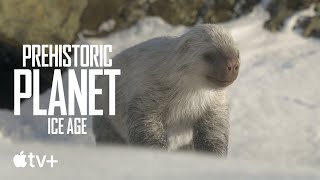
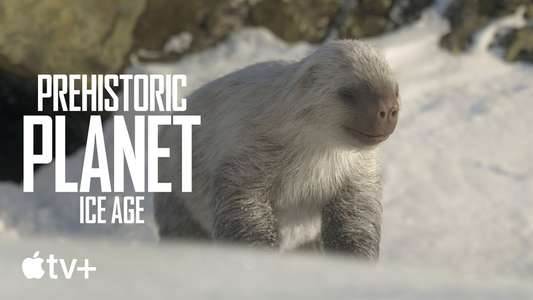
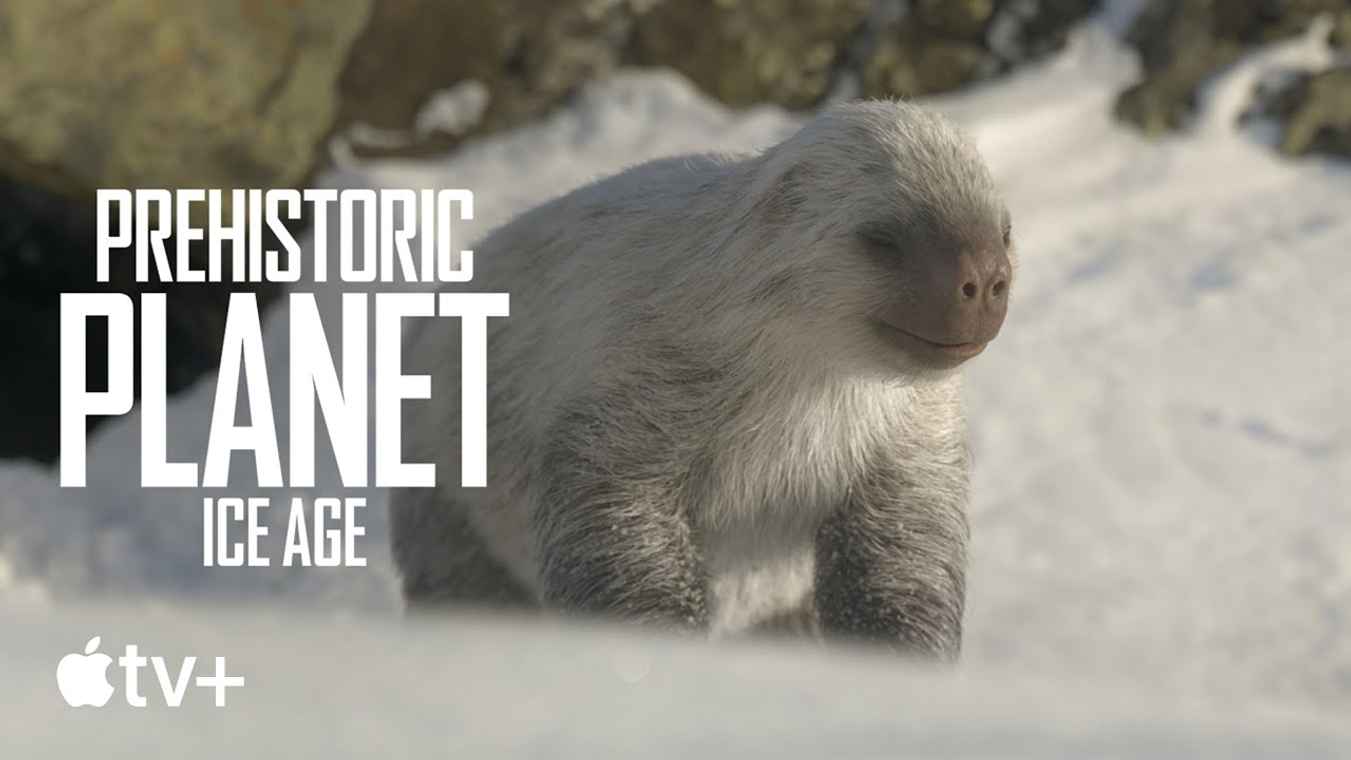
The third season, 'Prehistoric Planet: Ice Age', features Tom Hiddleston as the narrator, taking over from Sir David Attenborough who narrated the first two seasons.
The visual effects for 'Ice Age' were handled by Framestore, known for their work on 'Gravity' and 'The Golden Compass'.
Composers Anže Rozman and Kara Talve utilized a custom instrument called the 'Terror Tone', created by Jim Henson's Creature Shop, for the score of 'Ice Age'.
The series was in development for over a decade before its release.
Palaeozoologist Darren Naish served as the lead consultant to ensure scientific accuracy in the depiction of the prehistoric animals.
The visual effects were created by MPC, the same company that worked on 'The Jungle Book' (2016) and 'The Lion King' (2019).
The series was in development for over a decade.
Palaeozoologist Darren Naish served as the lead consultant to ensure scientific accuracy.
The visual effects were created by MPC, the same company that worked on 'The Lion King' (2019) and 'The Jungle Book' (2016).
Season 3, titled 'Prehistoric Planet: Ice Age', shifts focus to the Pleistocene megafauna and is narrated by Tom Hiddleston.
The series had been in development for a decade before its release.
Palaeozoologist Darren Naish served as the lead consultant for the depictions of prehistoric life.
The show features feathered dinosaurs, reflecting up-to-date paleontological research.
The series aims to depict dinosaurs and other prehistoric creatures with scientific rigor, incorporating the latest paleontological research.
The first two seasons are narrated by the renowned naturalist Sir David Attenborough.
The third season, titled 'Prehistoric Planet: Ice Age', shifts focus to the Pleistocene megafauna and is narrated by Tom Hiddleston.
The series is executive produced by Jon Favreau, known for his work on 'The Mandalorian' and live-action Disney adaptations.
The musical score is composed by Academy Award winner Hans Zimmer.
The third season, focusing on the Ice Age, features narration by actor Tom Hiddleston.