So you’ve just brought home a new 43-inch, 55-inch, or bigger smart TV, and the first movie night made one thing obvious: the built-in speakers can’t keep up with the picture. Flat-panel TVs are thinner than ever, which means there is less room for drivers, resulting in dialogue that thins out during action scenes and bass that’s basically theoretical. A soundbar is the natural next purchase, but the segment under ₹20,000 is full of systems that promise home-theatre sound and quietly cut corners to hit the price.
Here’s what actually pairs well with a new TV, and what to check before you connect one. Since none of these are single-purpose boxes, it’s worth thinking about the same soundbar the next time you’re hosting: switched over to Bluetooth, the same 5.1 systems that carry a movie night double up as party speakers, with enough RMS output and low-end from the subwoofer to fill a living room for a house party without anyone needing to huddle around a phone speaker.
Table of Contents
Overview of the best soundbars under ₹20,000 for a new TV
boAt Aavante Prime 5.1 5000D | Zebronics Juke BAR 9510WS PRO | Sony HT-S20R | |
Price | ₹11,999 | ₹12,499 | ₹17,990 |
Output | 500RMS | 600RMS | 400RMS |
HDMI | eARC | ARC | ARC |
Surround Sound | Real 5.1, wired rear speakers | Real 5.1, wireless rear speakers | Real 5.1, wired rear speakers |
Dolby | Dolby Audio | Dolby Audio | Dolby Digital |
Bluetooth | 5.3 | 5.1 | 5.0 |
Best For | Matching a new eARC-enabled smart TV | Rental homes where cable routing is a problem | Buyers upgrading from an existing Sony TV/soundtrack setup |
What matters when you’re buying a soundbar to go with a new TV
A soundbar you’re pairing with a fresh TV purchase has different priorities than one bought as a standalone upgrade. Here’s what to check first.
- HDMI eARC vs ARC on your TV, not just the soundbar: Most smart TVs launched in the last two to three years support eARC, and if yours does, buying a soundbar that only supports the older ARC standard means you’re capping the audio quality your TV is actually capable of sending out. Check your TV’s ports before assuming any soundbar will “just work” at full quality.
- Real 5.1 versus simulated surround: If the whole point of the new TV was a proper home-theatre feel, a soundbar without physical rear speakers is working against that goal. Software-simulated surround from a single bar is serviceable but noticeably flatter than genuine rear channels.
- RMS output relative to room size: A bigger TV usually means a bigger room or a farther seating distance. RMS is the sustained output that determines whether the sound actually fills that space; peak or “total rated” figures look bigger on the box but don’t tell you what the system can hold at movie volume for two hours straight.
- Dolby Audio vs Dolby Digital: Most OTT content and modern broadcast is mixed for Dolby Audio (which covers Dolby Digital Plus), so a soundbar that only decodes the older Dolby Digital standard is working with a narrower slice of what your new TV can actually receive from Netflix, Prime Video, or a set-top box.
- Cable routing around the new setup: If the TV unit just moved, or you’re mounting the new TV on the wall for the first time, decide upfront whether running rear-speaker cables around the room is workable, or whether wireless rear speakers are worth the trade-offs that come with them.
- Bluetooth version, for when the TV isn’t even on: A soundbar bought for a new TV usually spends a good chunk of its life on Bluetooth instead, streaming from a phone during a house party or a get-together. A newer Bluetooth version means a more stable connection and less dropout when the room is crowded and phones keep switching hands to change the playlist.
boAt Aavante Prime 5.1 5000D – Best Soundbar for a New eARC Smart TV
Price: ₹11,999
Key Specs:
- 5.1-channel with wired subwoofer and 2 wired rear satellites
- 500W RMS output
- Dolby Audio
- HDMI eARC, Optical, USB, AUX
- Bluetooth 5.3
- Music, Movie, and News EQ modes
- Master Remote
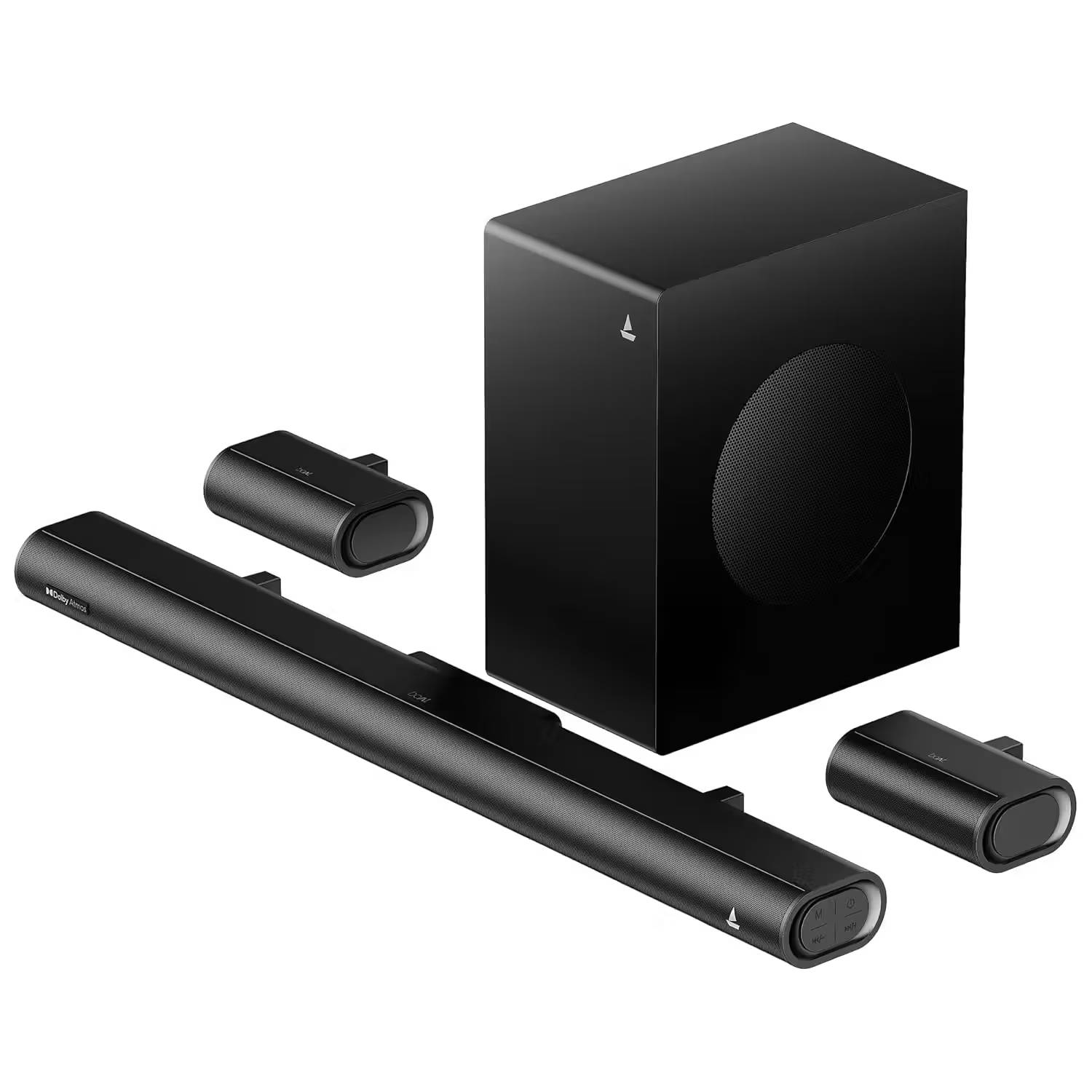
If your new TV supports HDMI eARC, which most recent smart TVs do, the boAt Aavante Prime 5.1 5000D is built to use that connection properly. eARC passes higher-quality audio formats than standard ARC, and pairing it with a soundbar that actually decodes eARC means the TV isn’t the bottleneck. On top of that, 500W RMS across a genuine 5.1-channel layout, with a wired subwoofer and two wired rear satellites, gives a new large-screen TV the kind of room-filling, directional sound that matches the upgrade in picture quality. Dolby Audio decoding lines up with how most streaming content is mixed, so shows and movies on a new TV sound the way they were mastered, not a stereo downmix stretched across the room.
The three EQ modes switch automatically between content types, useful for a household that’s mixing OTT binge-watching with music streaming over Bluetooth 5.3 on the same new setup. The one thing to plan for: running cables to the two rear speakers, which is a one-time job best done at the same time as the TV wall-mounting or unit setup, rather than an afterthought. When the TV isn’t in use, the same 500W RMS and Music EQ mode make this a loud and most stable option here for a house party, and Bluetooth 5.3 holds the connection well even with guests constantly reconnecting their own phones to change the music.

Best for: Anyone whose new smart TV has an HDMI eARC port and wants the audio pairing to actually take advantage of it, with real 5.1 sound and Dolby Audio to match, and who also wants the highest-output option here for hosting.
Zebronics Juke BAR 9510WS PRO – Best Soundbar for a Rented or Freshly Painted Room
Price: ₹12,499
Key Specs:
- 600W total output
- 5.1-channel with wireless dual rear satellites
- 6.5-inch subwoofer (225W) and triple-driver soundbar (225W)
- Dolby Audio
- HDMI ARC, Optical, USB, AUX
- Bluetooth 5.1
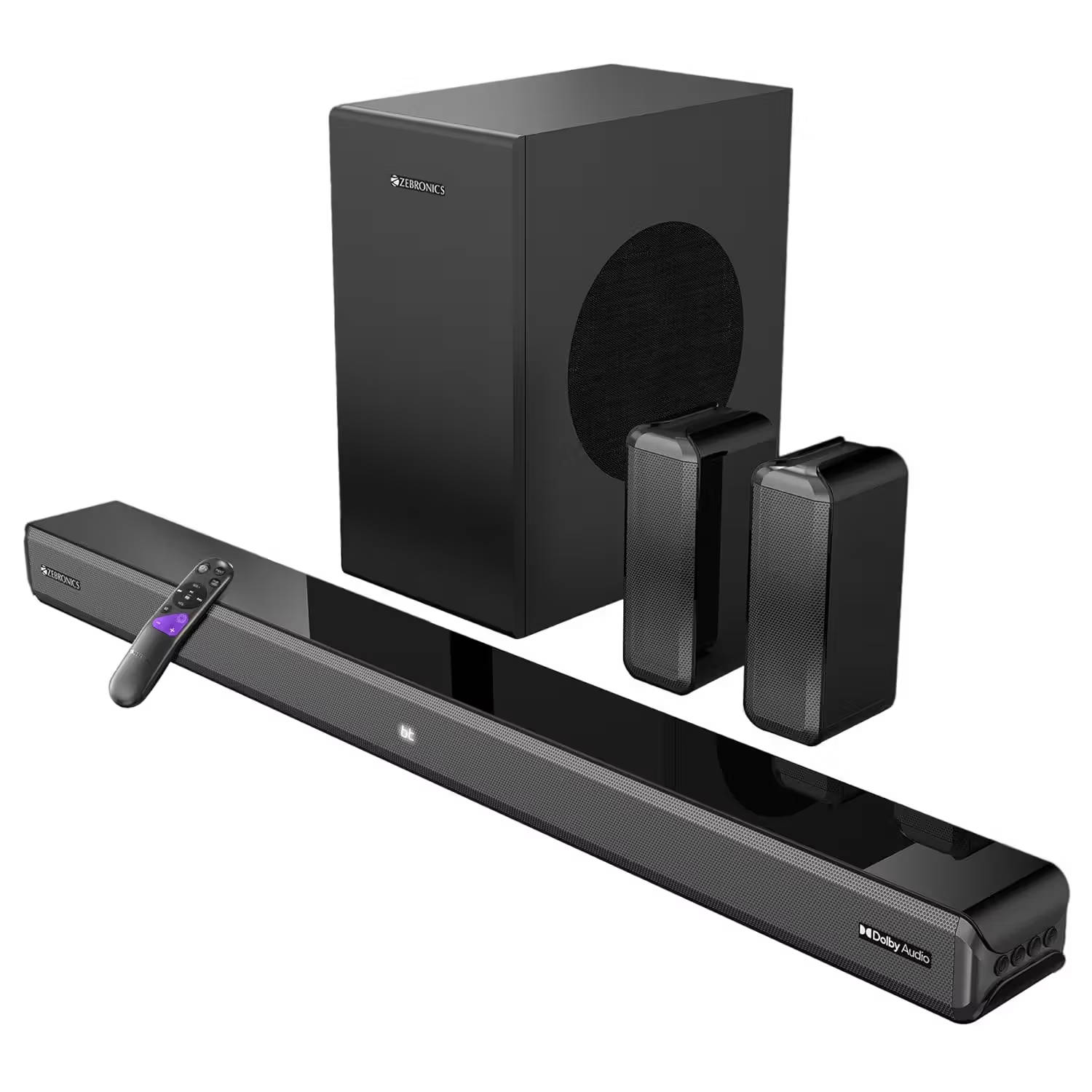
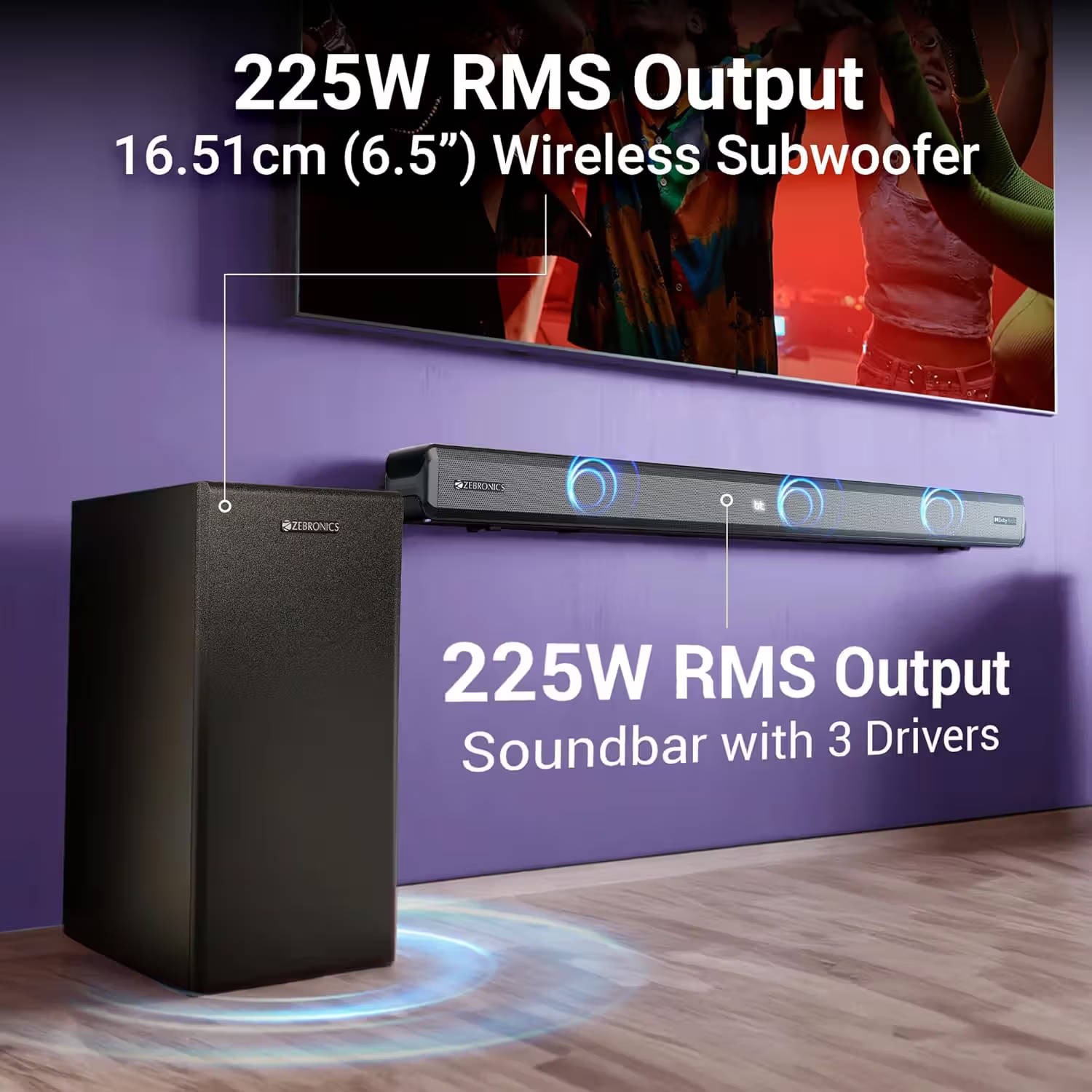
New TV, new room, and no interest in drilling holes or running cable channels along fresh walls? The Zebronics Juke BAR 9510WS PRO solves that specific problem with wireless dual rear satellites, so the 5.1 setup goes in without cabling across the room. Dolby Audio and a combined 600W total rated output from the 6.5-inch subwoofer and triple-driver bar make it a genuinely capable system for the price.
The trade-off is worth knowing about before you buy: that 600W figure is a total rated number, not RMS, so it isn’t directly comparable to a system quoting RMS output. It also connects over HDMI ARC rather than eARC, so if the new TV supports eARC, this soundbar won’t make full use of it, and Bluetooth 5.1 is a step behind the newest bars on the market. For a rental or a room where the paint is still drying, the wireless convenience is a fair trade for those gaps. For a house party, the wireless rear satellites are handy too, since they can be moved to wherever guests are actually gathering instead of being fixed to two corners of the room by cable length.
Best for: Buyers setting up a new TV in a rented flat or a newly done-up room, where wireless rear speakers matter more than eARC support or RMS-rated output, with the same flexibility carrying over to repositioning speakers for a party.
Sony HT-S20R – Best Soundbar for Sony TV Owners
Price: ₹17,990
Key Specs:
- 400W total output
- 5.1-channel with wired subwoofer and 2 wired rear speakers
- Dolby Digital
- HDMI ARC, Optical, USB
- Bluetooth 5.0
- Auto Sound, Cinema, Music, and Standard sound modes
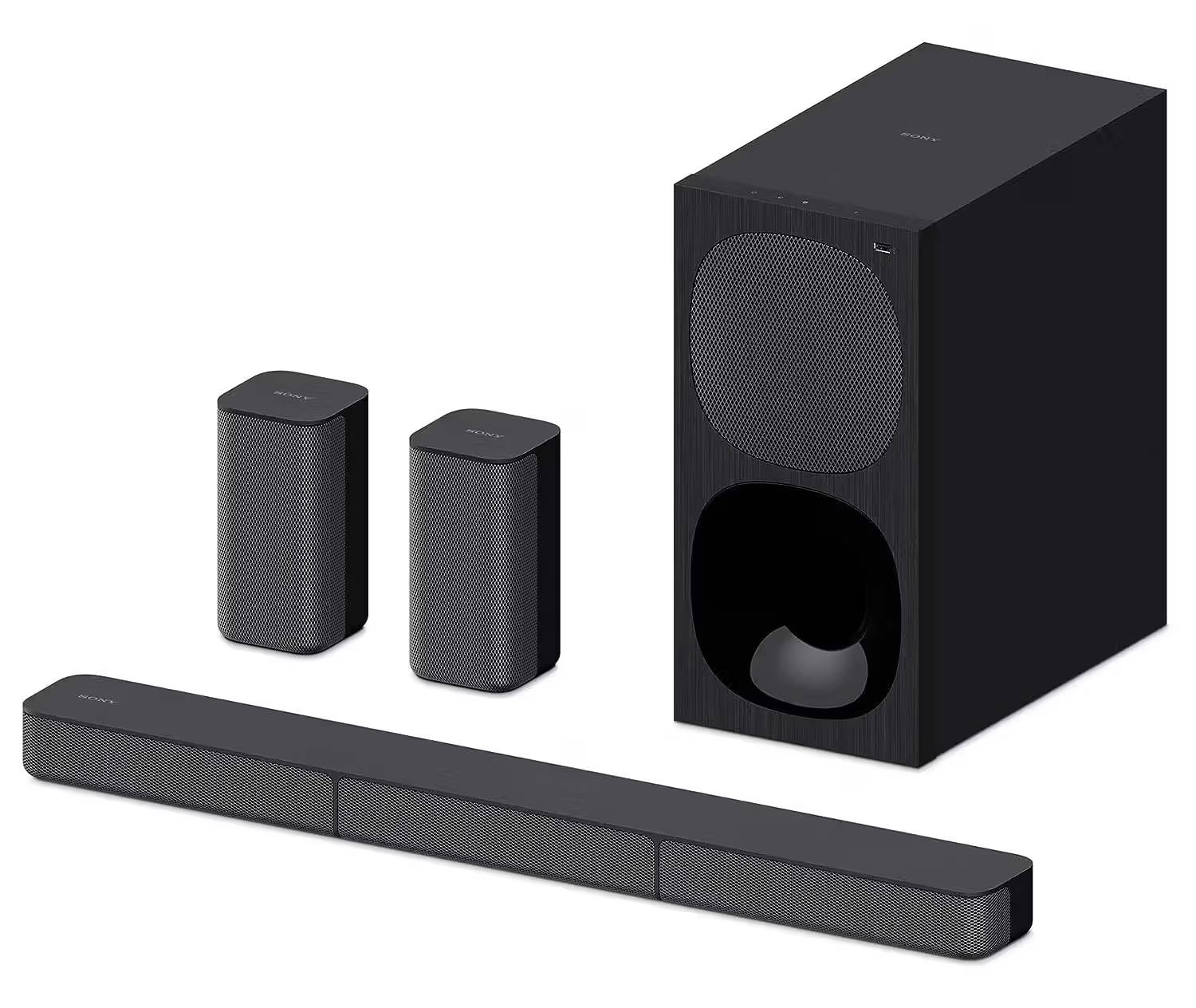
If the new TV in the house is also a Sony, the Sony HT-S20R has a genuine advantage that has nothing to do with the spec sheet: Sony’s remote and audio-return behaviour across its own TV and soundbar lineup tends to be more consistently tuned than mixing brands, and Sony’s after-sales network is well established in India. The 400W, 5.1-channel setup with a wired subwoofer, two wired rear speakers, and Dolby Digital decoding is a known quantity, and Night Mode and Voice Mode are genuinely useful additions for late-night viewing without waking the house.
Outside of the same-brand pairing, though, the case gets harder to make. At ₹17,990 it’s the most expensive of the three, with 400W against a 500W RMS rival, Dolby Digital rather than the broader Dolby Audio, HDMI ARC instead of eARC, and Bluetooth 5.0. For a mixed-brand household or a new TV from any other manufacturer, the premium here is harder to justify. It’s also the least suited of the three to hosting duty, since 400W is the lowest output here and Bluetooth 5.0 is the most likely to lag when several phones are hopping on and off the connection through the evening.
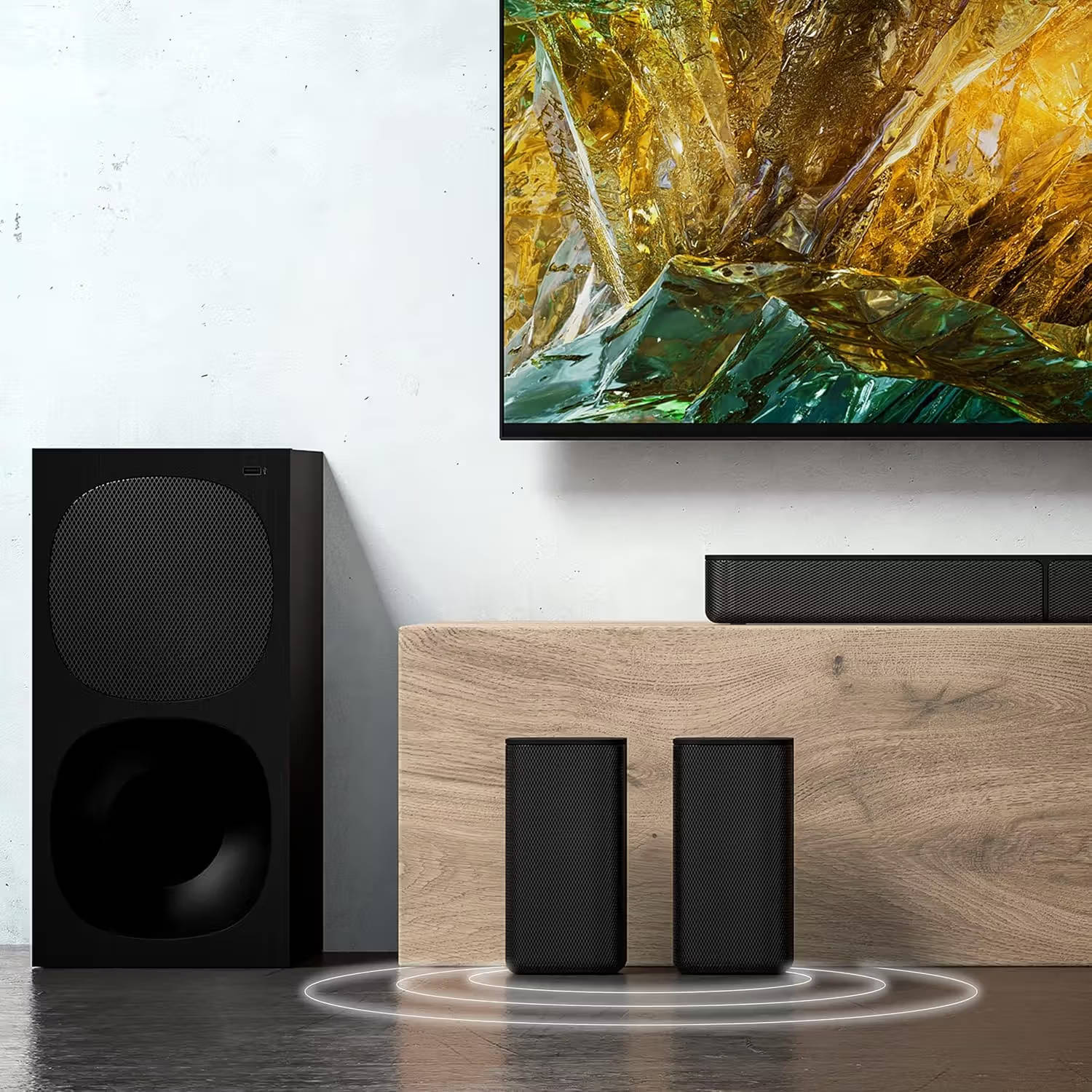
Best for: Households where the TV is also from Sony, and same-brand pairing and after-sales support outweigh the spec gap versus cheaper 5.1 options.
FAQs
- I just bought a new smart TV. Which soundbar should I pair it with?
Check whether your TV has HDMI eARC first. If it does, the boAt Aavante Prime 5000D at ₹11,999 makes full use of it with 500W RMS, real 5.1 sound, and Dolby Audio. If your room makes cable routing difficult, the Zebronics Juke BAR 9510WS PRO’s wireless rear speakers are the better fit, even on HDMI ARC.
- Does it matter if my soundbar only supports HDMI ARC and not eARC?
Yes, if your TV supports eARC. ARC caps the audio quality and format support that can pass from the TV to the soundbar; eARC allows higher-quality and lossless formats through. Pairing an eARC-capable TV with an ARC-only soundbar means you’re not getting everything the TV can send.
- Is it worth buying a soundbar from the same brand as my new TV?
It can simplify remote control and auto-detection behaviour, as with Sony’s HT-S20R alongside a Sony TV, but it isn’t necessary. HDMI ARC and eARC are standard protocols, so soundbars from any brand will work with TVs from any other brand, provided the port types match.
- I bought a new TV, but I live in a rented apartment. Should I avoid soundbars with wired rear speakers?
Not necessarily. Running rear-speaker cables is usually a one-time job that can be tucked along skirting boards or under rugs without any wall damage. But if that’s not workable in your space, a wireless-rear-speaker system like the Zebronics Juke BAR avoids the issue entirely.
- How much RMS output do I need for a large living room with a new big-screen TV?
For most Indian living rooms, 300–500W RMS across a genuine 5.1 setup is enough to fill the space at comfortable movie-watching volume. Beyond that, room acoustics and speaker placement matter more than chasing higher wattage figures.
- Can I use a TV soundbar as a party speaker too?
Yes. All three switch to Bluetooth independently of the TV, so they work as standalone speakers for a house party. The boAt Aavante Prime 5000D has the highest RMS output of the three and Bluetooth 5.3 for the most stable connection, with multiple guests reconnecting their phones. The Zebronics Juke BAR’s wireless rear satellites can also be repositioned around the room for the evening, which a wired system can’t do.
- Is 500W RMS on the boAt Aavante Prime 5000D actually better than 600W on the Zebronics?
In practical terms, yes! RMS is the sustained power a system can hold, while the Zebronics’ 600W is a total rated figure that isn’t measured the same way, so the two numbers aren’t directly comparable. The boAt’s 500W RMS is a more conservative, verifiable figure, which is why it holds volume more consistently at both movie and party levels.
- Does the boAt Aavante Prime 5000D work with older TVs that don’t have eARC?
Yes. It falls back cleanly to standard ARC, Optical, or AUX on TVs that don’t support eARC, so it isn’t a soundbar you’ll outgrow if you upgrade to an eARC TV later. That flexibility is one reason it’s the easiest of the three to recommend regardless of which TV you currently own.
- Sony HT-S20R, boAt Avantante Prime 5.1 5000D, or the Zebronics Juke BAR 9510WS Pro, which is the best all-round pick if I only want to buy one soundbar?
The boAt Aavante Prime 5000D. It’s the only one of the three with HDMI eARC, it has the highest RMS-rated output at 500W, it runs the newer Bluetooth 5.3, and at ₹11,999 it undercuts the Sony by ₹6,000 while beating it on nearly every spec. The Zebronics comes close on price and adds wireless rears, but gives up eARC and a full Bluetooth generation to get there.