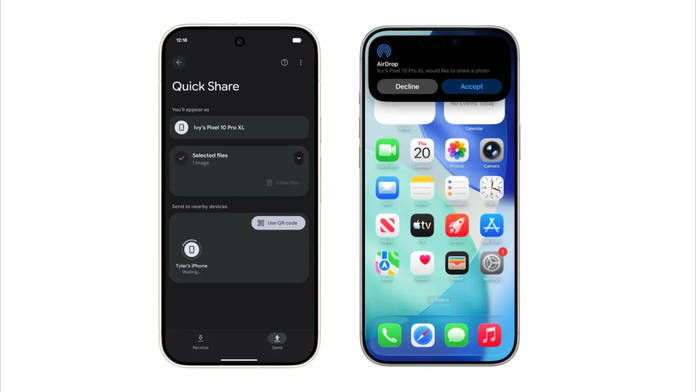
Google just made life extremely easy for people with Pixels and iPhones in their circle. The company has announced that Android users can now securely share files with iPhone users using Quick Share, with full interoperability with Apple’s AirDrop. For now, this works only on the Pixel 10 series, but it’s a major step towards finally breaking the walls between Android and iOS file sharing.
The update effectively lets a Pixel 10 phone act like an iPhone in terms of file sharing, and vice versa. Whether you’re sending a photo to a friend’s iPhone, receiving a document from a MacBook, or sharing videos from an iPad, the process now works just like AirDrop, which is something Android users have been asking for years.
To make it work, all an iPhone user has to do is set AirDrop to ‘Everyone for 10 minutes’, and the Pixel will see the device in Quick Share. After selecting the device, the iPhone or Mac user taps ‘Accept,’ just like a standard AirDrop notification. If you’re receiving a file from an Apple device, the steps are just reversed – make your Pixel discoverable and wait for the AirDrop request. It’s simple, familiar, and more importantly, secure.
According to Google, the feature isn’t a workaround or hack. Instead, it uses a direct peer-to-peer connection, and content is never routed via a server. It is never logged and doesn’t expose extra data.
From a user standpoint, this fixes a very real pain point. Anyone who has ever tried to send a 4K video, RAW photo, or large document between an iPhone and an Android knows how difficult it can be. People usually move to using third-party apps, Telegram, WhatsApp compression, Drive or cloud uploads. With Quick Share finally talking to AirDrop, Pixel 10 users will get a seamless cross-platform sharing experience.
Google says it worked with independent security firm NetSPI to test interoperability and it was rated “notably stronger than other industry implementations.” With AI and large-file content creation rising, fast and secure transfers are becoming an important feature for smartphones, and this update arrives at a time when both ecosystems should look for ways to work better together.
Interestingly, the move didn’t involve Apple whatsoever. Google confirmed to The Verge that it developed the whole implementation on its own. “We accomplished this through our own implementation,” said spokesperson Alex Moriconi, while also adding that Google welcomes future collaboration with Apple to further improve interoperability.
For now, Apple hasn’t commented on the development, and it is not clear whether other Android manufacturers like Samsung, OnePlus, Xiaomi, and Nothing will get access to this feature anytime soon.
If Google keeps the feature pixel-exclusive, it will notably solidify the Pixel 10 lineup’s strengths. Exclusive features like this could help push buyers toward Google’s own hardware. If seamless iPhone interoperability is important to you, this would give the Pixel 10 series a strong lead over other Android phones for now.