


Review Summary
Expert Rating
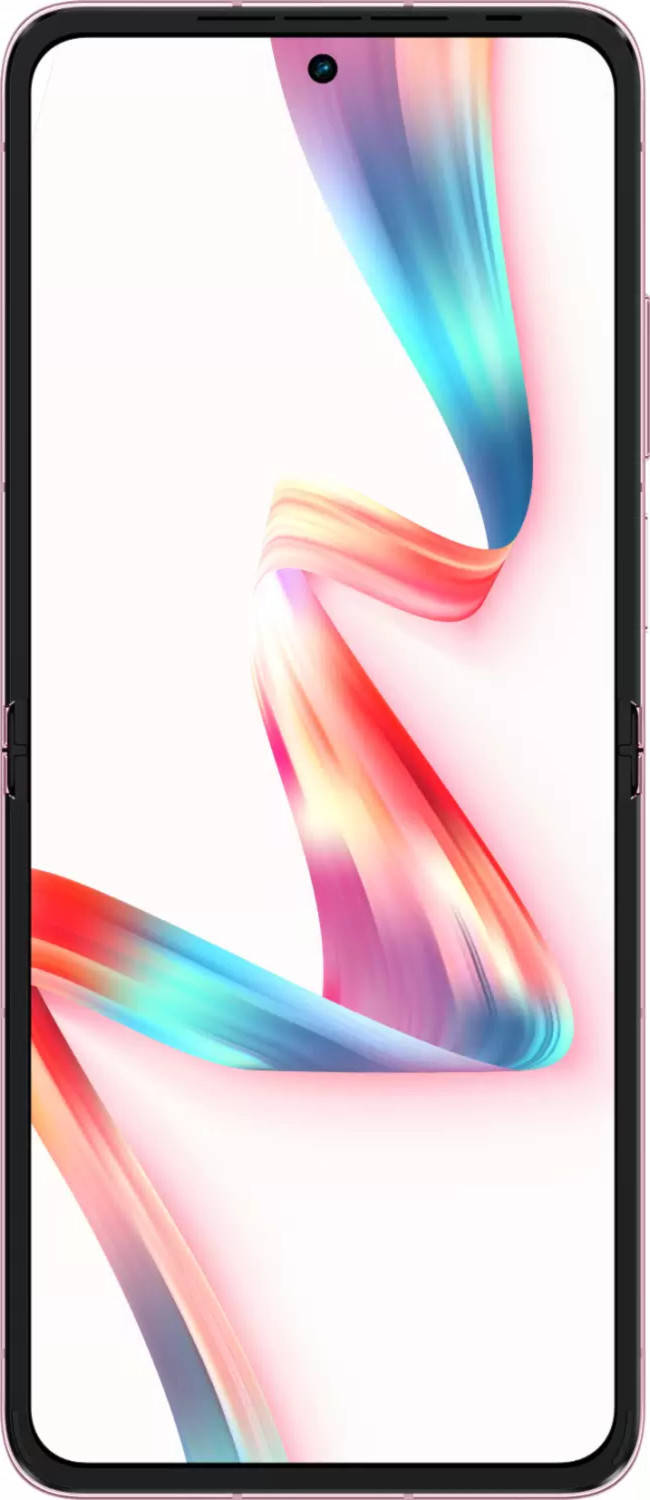
Infinix has outpaced rival affordable brands like Realme and Xiaomi by launching its first foldable smartphone, the Zero Flip, in India. Notably, the flip handset is priced at Rs 49,999—a figure previously unheard of for a foldable device. This is less than half the price of the Samsung Galaxy Z Flip6 (review) and around Rs 15,000 more affordable than the Motorola Razr 50 (review). With such a competitive edge, does the Zero Flip live up to the promise of premium features at an accessible price? Read our detailed review to find out how the smartphone fares in terms of design, performance, and value.
Table of Contents
Verdict
The Infinix Zero Flip isn’t your typical smartphone. Its unique flip form factor distinguishes it from other phones in its price range, appealing to users who prefer a compact design while enjoying the latest tech. While some trade-offs were made to keep it affordable, they’re minor and don’t detract from the overall experience.
Design and displays
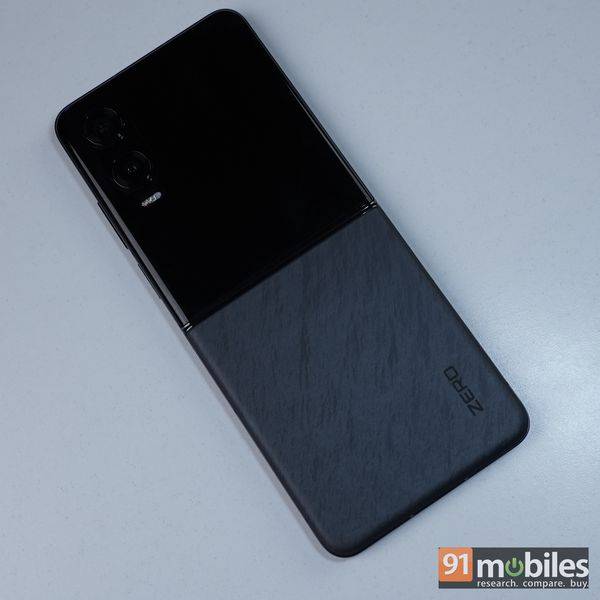
The Infinix Zero Flip is not different from any other flip smartphone available in the market in terms of design. It’s a clamshell-style foldable phone, with a 6.9-inch main display and a 3.64-inch cover display. The cover display is similar to the Motorola Razr 50 with curved edges. However, unlike the Motorola offering, the cameras are positioned vertically on the right side of the screen instead of horizontally. In terms of usability, both phones are quite similar, supporting a comparable number of apps on the cover screen. However, typing and watching YouTube videos are more convenient on the Razr 50’s cover display, which has a more horizontal orientation than its counterpart.
That said, the Infinix Zero Flip is slightly more comfortable to handle than the Razr 50, thanks to its flat edges, which provide a secure grip. Its back panel features a glass layer with a sandblasted finish that resists fingerprints and smudges, enhancing its premium appearance. The phone measures 7.64mm in thickness when unfolded and weighs 195 grams, making it easy to use for extended periods. While Infinix claims the Zero Flip is highly durable, withstanding over 200 folds per day for five years, it lacks an IP rating for water and dust resistance. Although a high-quality two-piece case with a finger holster is included in the box, it’s best to avoid exposing the phone to water, such as near pools or in the rain.
| Infinix Zero Flip | Motorola Razr 50 | |
| Thickness | 7.6mm | 7.3mm |
| Weight | 195 grams | 188.4 grams |
| IP rating | NA | IPX8 |
The Zero Flip’s hinge feels durable and can be adjusted to any angle between 30 degrees and 150 degrees, along with being able to open it fully at 180 degrees. If you’re wondering whether you can flip the phone open with one hand, the answer is no. The hinge is quite firm, making it difficult to get your finger in to open the phone. You will require two hands. The handset features a side-mounted fingerprint scanner, which is accurate and unlocks the device in a jiffy. As of I/O, there is a USB Type-C port on the bottom edge along with a speaker grille and a SIM ejector tray. The bottom-firing speaker is combined with the earpiece to provide a stereo output, which can go up to 82.8 decibels in terms if loudness… slightly higher than the Razr 50. The speakers are fine-tuned by JBL, ensuring that the handset sounds crisp at moderate volumes. However, at maximum volume, they crackle a bit.
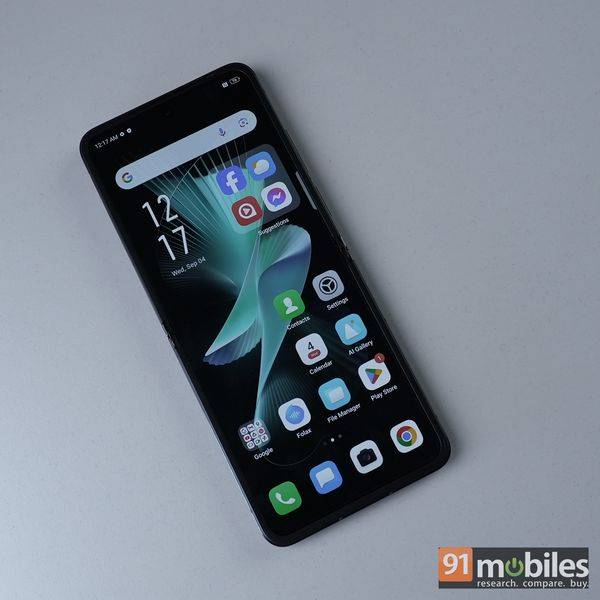
As for the viewing experience, both the 6.9-inch main and 3.64-inch cover displays on the Infinix Zero Flip are of AMOLED variety and support 120Hz refresh rate. The main display comes with LTPO technology that adjusts the refresh rate dynamically between 1Hz and 120Hz depending on the content on the screen to enhance battery backup without compromising on fluency in animation and graphics. The display delivers FHD+ resolution and a peak brightness of 1,400 nits, which is underwhelming for a sub-Rs 50,000 smartphone. During our lab test, the phone could only achieve a maximum brightness of 696 nits in manual mode, whereas its HDR brightness could only stretch to 159.6 nits as measured using a Lux meter. The Motorola smartphone delivers superior results in similar tests, ensuring better visibility outdoors under direct sunlight.
| Infinix Zero Flip | Motorola Razr 50 | |
| Cover display | 3.64-inch AMOLED 120Hz 1056×1066p, 1100 nits, Gorilla Glass Victus | 3.63-inch pOLED 120Hz 1056×1066p, 1700 nits, Gorilla Glass Victus |
| Main display | 6.9-inch FHD+ LTPO AMOLED 120Hz, 2640×1080p, 1400 nits | 6.9-inch FHD+ LTPO AMOLED 165Hz, 2640×1080p, 3000 nits |
Beyond its outdoor visibility, the Infinix Zero Flip provides an enjoyable indoor experience, featuring excellent viewing angles, vibrant colours, and deep blacks. While the crease is barely noticeable, thinner bezels would have further enhanced the immersive viewing experience. The 3.64-inch cover screen leaves a similar impression. Although the display is optimised for 100+ apps, it’s not ideal for watching content on platforms like YouTube and Netflix. At best, the display handles minor tasks—such as checking notifications, setting alarms, initiating calls, controlling music playback, and recording voice notes—quite effectively.
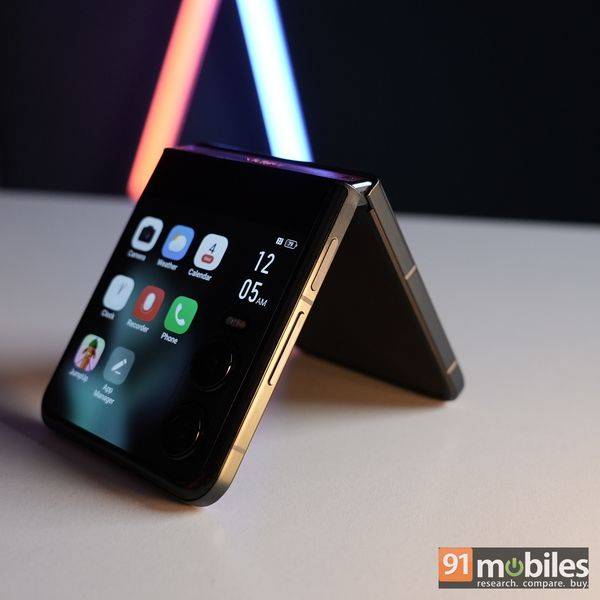
Infinix also offers a ‘3D Cute Pet’ animation with the cover display to enhance its engagement. However, more effort is needed to improve the display’s functionality by adding recent screens for recently launched apps and extending the continuity feature to all apps, rather than just a limited selection, enabling seamless transitions between the cover screen and the main screen or vice versa.
Cameras
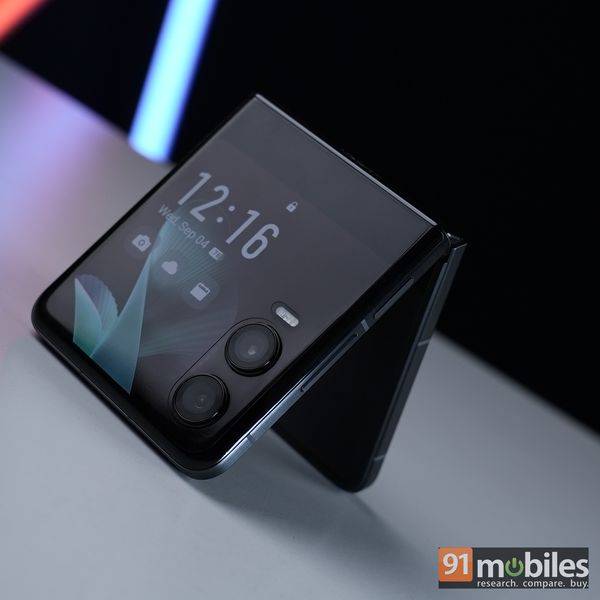
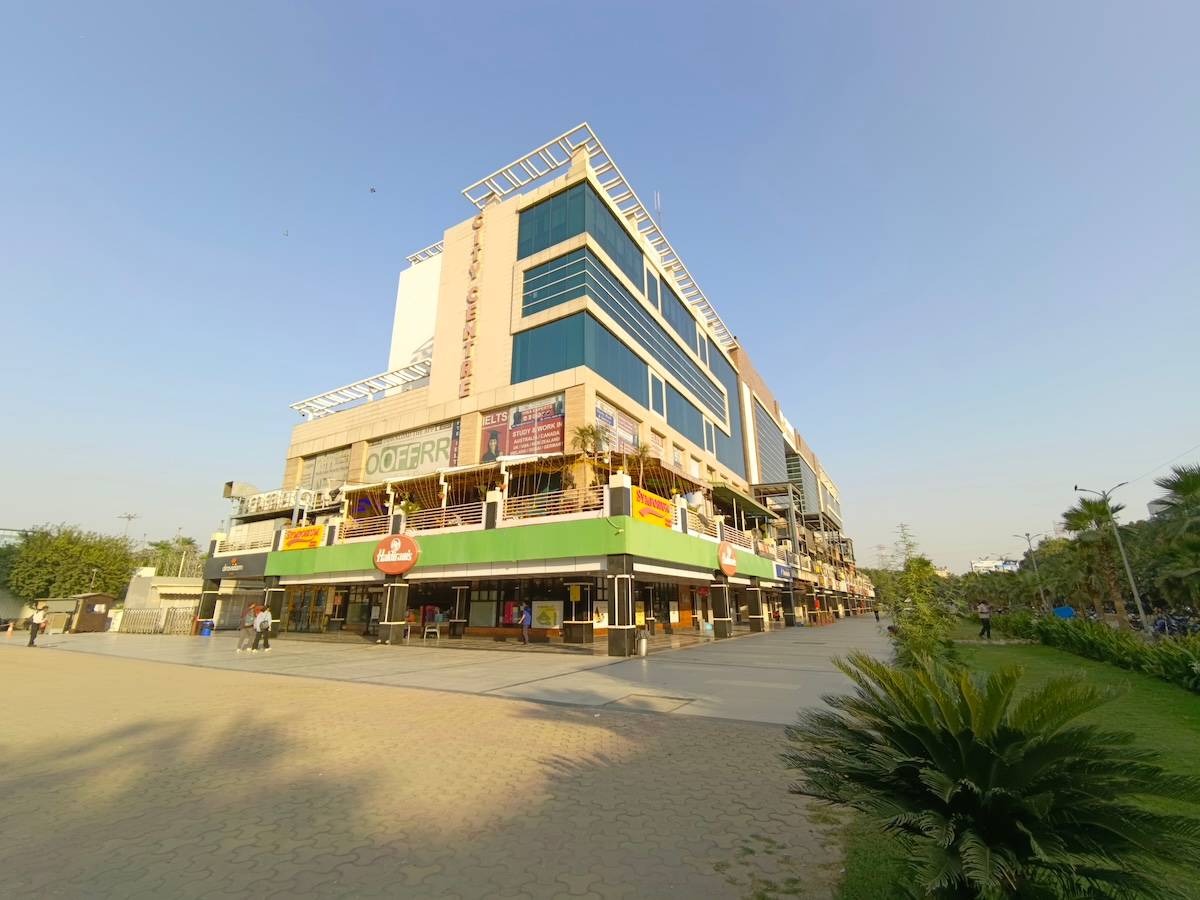
The Infinix Zero Flip is the first flip smartphone to feature a 50MP + 50MP dual rear camera setup, complemented by a 50MP selfie shooter. The larger sensor size gives the Infinix device an advantage over the Motorola Razr 50, particularly in capturing detailed ultrawide shots and selfies. However, there is room for improvement in detail preservation around the shadowy areas where the Motorola smartphone outshines. For a more in-depth analysis, head to our Infinix Zero 50 vs Motorola Razr 50 camera comparison.
To give you a brief overview, the Infinix Zero Flip delivers brighter images with warm tones, though they can occasionally appear overexposed. Additionally, the dynamic range remains underwhelming. While the front camera accurately captures true-to-life skin tones, the rear camera’s portrait mode requires enhancements in edge detection, facial details, and skin tone accuracy. Similar to any other flip phone, the phone’s rear camera can be utilised to capture better selfies. To enhance images, the phone features a bunch of AI capabilities, including an AI eraser to remove unwanted objects from the image, AI focus to focus on subjects, and AI portrait to capture sharper images. They are all on-device tools that work without an internet connection and perform reasonably well.






Performance and software
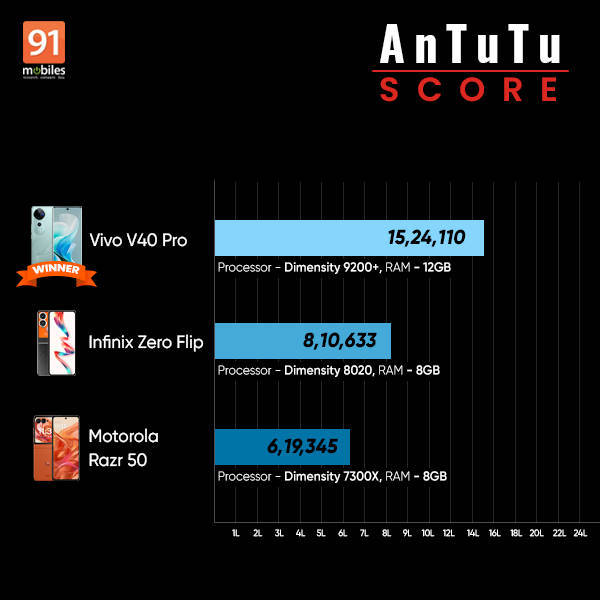
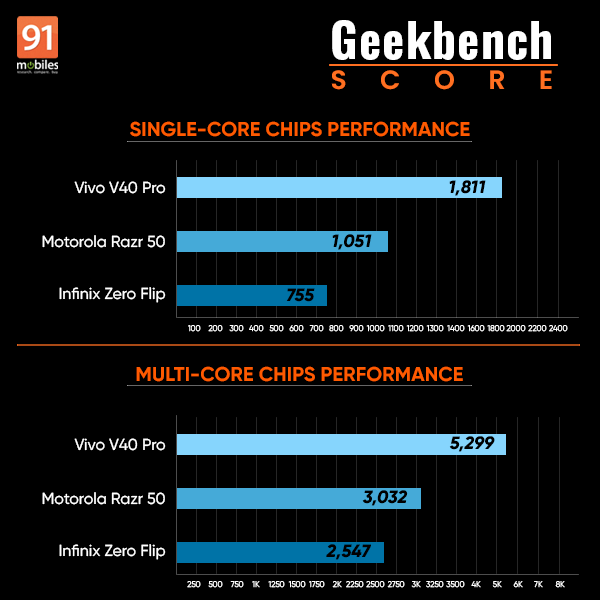
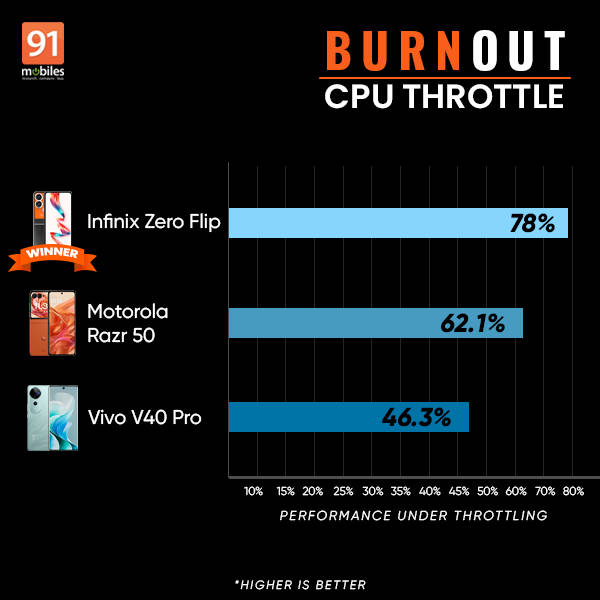
The MediaTek Dimensity 8020 SoC powers the Infinix Zero Flip. The SoC is paired with 8GB of RAM and 512GB UFS 3.1 storage, which is not user-expandable. As observed in our performance comparison, the Infinix smartphone outperforms the more expensive Motorola Razr 50 on AnTuTu by some margin and Burnout CPU throttle tests. The Geekbench performance of the smartphone is low, especially when compared to other smartphones using the same chipset. The Motorola Edge 40 for example, achieved over 1,000 points in single-core and 3,000 in multi-core tests. Be that as it may, the phone demonstrates decent thermal management, with its temperature rising by an average of approximately 6.67 degrees Celsius during our gaming test, which involved playing BGMI, Call of Duty, and Real Racing 3 for 30 minutes each.
As for regular usage, the Infinix Zero Flip is generally smooth with no jitter or lag while scrolling, streaming, and browsing. However, extended usage and multitasking make it stutter a bit. So if you are a power user and looking for a flip phone, increasing your budget and investing in pricier offerings such as Samsung Galaxy Flip6 or the Motorola Razr 50 Ultra coule be a better choice.
On the software front, the Infinix Zero Flip runs Android 14 out of the box, featuring a heavily customised XOS skin that alters the stock Android UI and adds additional apps alongside Google’s offerings. The smartphone comes with a total of 41 pre-installed apps, of which 36 are proprietary and five are third-party. Among the third-party apps is GoPro Quik, which enables users to control and seamlessly integrate footage from a GoPro action camera. While the company has committed to providing two years of major OS updates and three years of security updates for the Zero Flip, this support period is shorter by a year compared to many competitors.
| Infinix Zero Flip | Motorola Razr 50 | |
| Pre-installed apps | 41 | 42 |
| OS upgrades | 2 years major + 3 years security | 3 years major + 4 years security |
While the software requires a bit of refinement, the overall user experience remains intuitive. It comes with some clever features, including a dynamic bar around the punch-hole camera on the cover display for information such as incoming calls, media playback, charging status, and face unlock animations. However, this information isn’t interactive. The Infinix Zero Flip also features its proprietary voice assistant, Folex, alongside AI-powered tools like an image creator and wallpaper generator. The tools are capable of generating images based on text or templates using an internet connection, but the results are not as impressive as the AI generative tools seen on the recent Google Pixel models and Samsung’s flagships.
Battery and charging
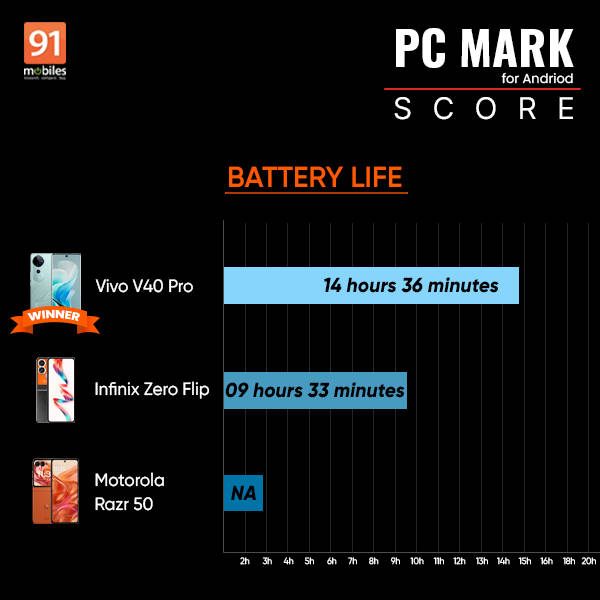
The Zero Flip’s 4,720mAh battery is the largest on a flip smartphone yet. Supporting this large capacity is a 70W charging solution, with a compatible charger provided in the box. It takes approximately 41 minutes to charge the battery from 20 percent to 100 percent fully. According to the PCMark battery test, the Infinix Zero Flip delivers 9 hours and 33 minutes of screen time before the battery drops below 20 percent after running a series of tasks.
| Infinix Zero Flip | Motorola Razr 50 | |
| Charging speed | 70W | 30W |
| Charging time (20-100 percent) | 41 minutes | 50 minutes |
On our YouTube video streaming test, the handset consumed 3 percent battery life after half an hour. This is better than its immediate flip rival Motorola Razr 50, which had a 5 percent drop in battery after streaming the same video in a similar resolution. However, when it came to gaming, both devices were evenly matched. After playing BGMI, Call of Duty, and Real Racing 3 for 30 minutes each, both smartphones’ battery depleted by 23 percent on aggregate. This suggests that similar to any other flip smartphone, the Infinix Flip Zero battery optimisation is suitable for regular usage instead of heavy.
Final verdict
The Infinix Zero Flip impressively combines the appeal of a foldable design with a competitive price point, setting a new standard in affordability for flip smartphones. Its sleek design, solid performance, and thoughtful additions, like a 70W fast-charging solution and a large 4,720mAh battery, make it an attractive option. However, a few limitations are evident. The display, while vibrant indoors, struggles in bright outdoor settings, and the lack of an IP rating raises concerns about durability in harsh conditions. Moreover, the performance and camera quality may feel limited, but it is good enough for its price and form factor. All these aspects make the Infinix Zero Flip a worthwhile option for the price if you are in the market for a flip phone.
Editor’s rating: 8 / 10
Reasons to buy
- It is the most affordable flip smartphone available to buy right now.
- The performance of the smartphone is decent for the price and form factor.
- The front camera offers good selfies with near accurate skin tones and respectable facial details.
- 70W charging solution is fastest for a flip smartphone.
Reasons not to buy
- The smartphone’s outdoor visibility could have been better.
- The smartphone lacks an official IP rating for water and dust resistance.
 | vs |  |