4 reasons to buy and 2 reasons not to buy the iQOO 15


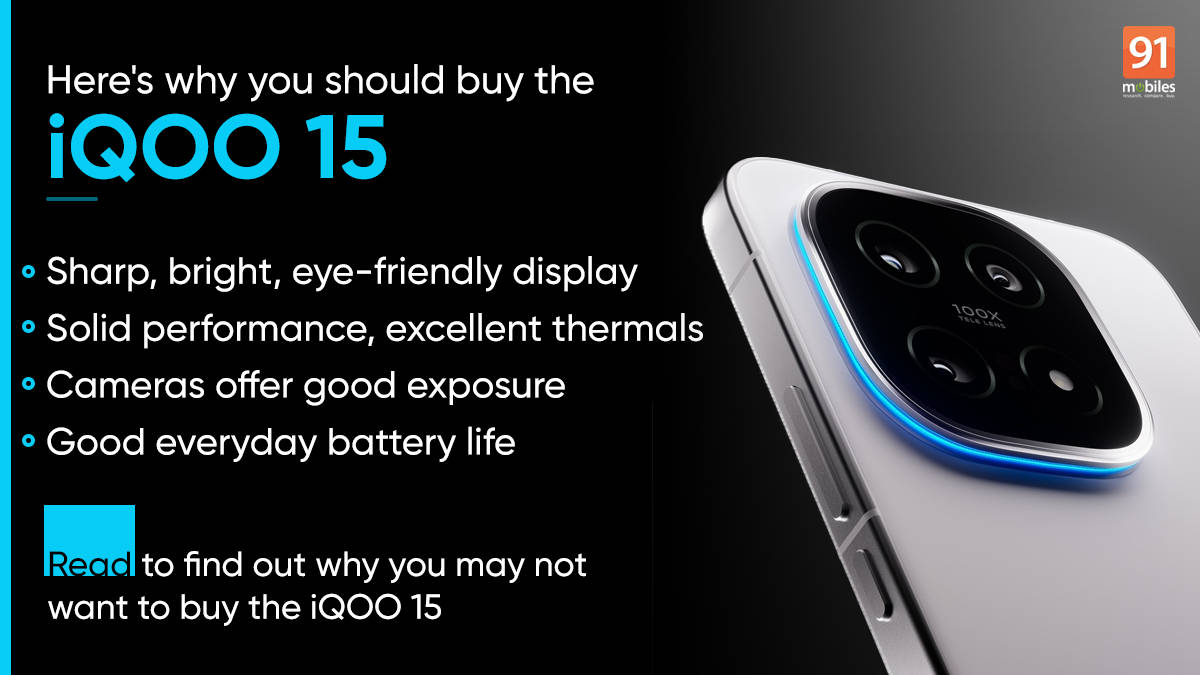
November has been one of the busiest months for flagship launches in India, and the iQOO 15 has entered an already crowded space. As it goes on sale today in the country at Rs 72,999, it joins the OnePlus 15 and Realme GT 8 Pro in the list of Snapdragon 8 Elite Gen 5-powered phones in the country. Moving from its pitch of value flagship to that of sustained performance, the iQOO 15 grabbed quite a few eyeballs when it hiked its prices by Rs 18,000 over last year’s iQOO 13. If you’re wondering whether the price hike is justified and to pick it over the competition or not, here’s a simple breakdown of four reasons to buy it and two reasons you might want to skip it, based on our review of the device.
Show Full Article
Table of Contents
Reasons to buy the iQOO 15
Sharp, bright and eye-friendly display
Displays are increasingly becoming a differentiating factor in the premium segment, and the iQOO 15 clearly wants to stand out here. The phone comes with a new 6.85-inch Samsung 2K M14 Lead AMOLED panel, the same OLED tech expected on next year’s Galaxy S26 series and present on the iPhone 17 series. In everyday use, the display looks crisp, colourful, and clean, with noticeably sharper rendering than the iPhone 16, as our review noted. Legibility under harsh sunlight was also not a problem, as the phone is capable of achieving up to 6,000 nits local peak brightness and 2,600 nits on HBM mode. The display is also the first from iQOO to be Dolby Vision-certified, meaning the phone showed HDR videos with great dynamic range.


The panel uses 2,160Hz PWM dimming, 1-pulse DC dimming, and improved light-emitting materials designed to reduce strain during long scrolling or nighttime reading. This is one of the key upgrades over the iQOO 13, which had a good but not quite as protective display system. The anti-reflective layer, which is a pre-installed screen protector, helps with glare too.
Solid performance with excellent thermals
The iQOO 15 runs Qualcomm’s Snapdragon 8 Elite Gen 5 SoC, with LPDDR5X RAM and UFS 4.1 storage. It’s fast during sustained workloads including long gaming sessions, photo editing, and heavy multitasking. The phone barely heats up, thanks to an 8,000mm2 vapour chamber, which iQOO claims is the largest single-layer system in India. The OnePlus 15, which has a smaller 5,731mm2 cooling system, showed bigger temperature spikes during short gaming tests.
In the Burnout CPU test, the iQOO 15 held 51.7 percent of its peak performance, far outperforming the OnePlus 15’s 33.2 percent. That difference translates into real life leading to less lag, more sustained frame rates, and fewer thermal warnings.
In terms of multitasking, the iQOO 15 does well and its high Geekbench and AnTuTu scores certify that. In internal testing, iQOO’s AnTuTu score was only behind that of Realme GT 8 Pro among the latest Snapdragon flagships. The iQOO 15 showed no signs of stuttering or slowdown while using multiple apps including video streaming and navigation, our reviewer noted.
AnTuTu score


realme GT 8 Pro
Qualcomm Snapdragon 8 Elite Gen 5
3,932,397

iQOO 15
Qualcomm Snapdragon 8 Elite Gen 5
3,842,735

OnePlus 15
Qualcomm Snapdragon 8 Elite Gen 5
3,615,565
AnTuTu assesses a smartphone's CPU, GPU, memory, and overall user experience (higher is better)
Cameras offer good exposure and dynamic range
The iQOO 15 doesn’t completely overhaul its camera hardware. With a 50MP triple setup, it’s a familiar affair, and the 3x periscope lens from the iQOO 12 makes its return here too. Image processing, however, has gotten better in terms of exposure control and dynamic range. In daylight photos, it tends to brighten scenes and boost colours slightly, making images social-media ready even if fine texture isn’t its strongest suit. Compared with the sharper details but warmer tones of the OnePlus 15, the iQOO’s photos often look more vibrant and balanced. The OnePlus 15 edges ahead in low light, but the iQOO 15 still manages realistic sky colours and better highlight control. Here are a few shots from the iQOO 15 for you to gain perspective.
Where the phone noticeably improves over the iQOO 13 is in consistency across lenses. Shadows aren’t crushed, and the 3x periscope maintains stable exposure without overly aggressive processing. For regular shots, especially landscapes, buildings, and bright scenes, the iQOO 15 delivers reliably pleasing results.
Good everyday battery life
The iQOO 15 boasts a 7,000mAh battery, which, even though sitting below the larger 7,300mAh unit of the OnePlus 15, performs quite well. In day-to-day use, this difference is seldom apparent. Both phones lose around 5 percent in a one-hour YouTube session and show similar drops in 30-minute gaming tests. The iQOO 15 should last a full day of mixed use with no issue, including navigation, social media, and streaming.
Where it pushes ahead of the iQOO 13 is endurance under heavy load. The newer chipset and improved cooling help the battery drain more predictably without sudden dips during gaming or use of the camera. Wireless charging, added for the first time in the series, is a welcome bonus. The charging speed is somewhat slower than the OnePlus 15’s 120W, but is still fast at 100W, getting a full charge in under an hour.
Here’s how the phone fared alongside competition in the PCMark test run overnight:
PCMark Battery score (in hours)
OnePlus 15
7300 mAh
17.1
iQOO 15
7000 mAh
13.1
realme GT 8 Pro
7000 mAh
12.8
PCMark battery test measures phone battery life from 100% to 20% (higher is better)
Reasons to not buy the iQOO 15
The front camera needs more refinement
While the rear cameras do a good job exposure-wise, the 32MP selfie camera is a different story. The images often appear oversharpened with slightly washed-out colours, especially in bright light. Compared to the OnePlus 15, which has more natural skin tones, and even the Realme GT 8 Pro, the iQOO 15 feels a step behind here. If selfies matter to you, this isn’t the strongest option.


AI features feel basic, and the price hike doesn’t help
In a year where AI is firmly becoming a selling point, the suite of AI offerings on the iQOO 15 feels small. AI Captions, AI Reflection Remover, and AI Image Expander are good inclusions, but they lack the depth or creativity you get on Samsung and Google’s models. But the real cause of concern for buyers could be the price. The starting price of the iQOO 15 is Rs 72,999, Rs 18,000 more than the iQOO 13. Some of that jump can perhaps be justified through display upgrades, cooling improvements, and added wireless charging, but the hike will still surprise long-time users who remember iQOO as the “value flagship” brand.