Redmi Note 17 Pro Max vs Nothing Phone (4a) Pro: which phone offers more at Rs 50,000?


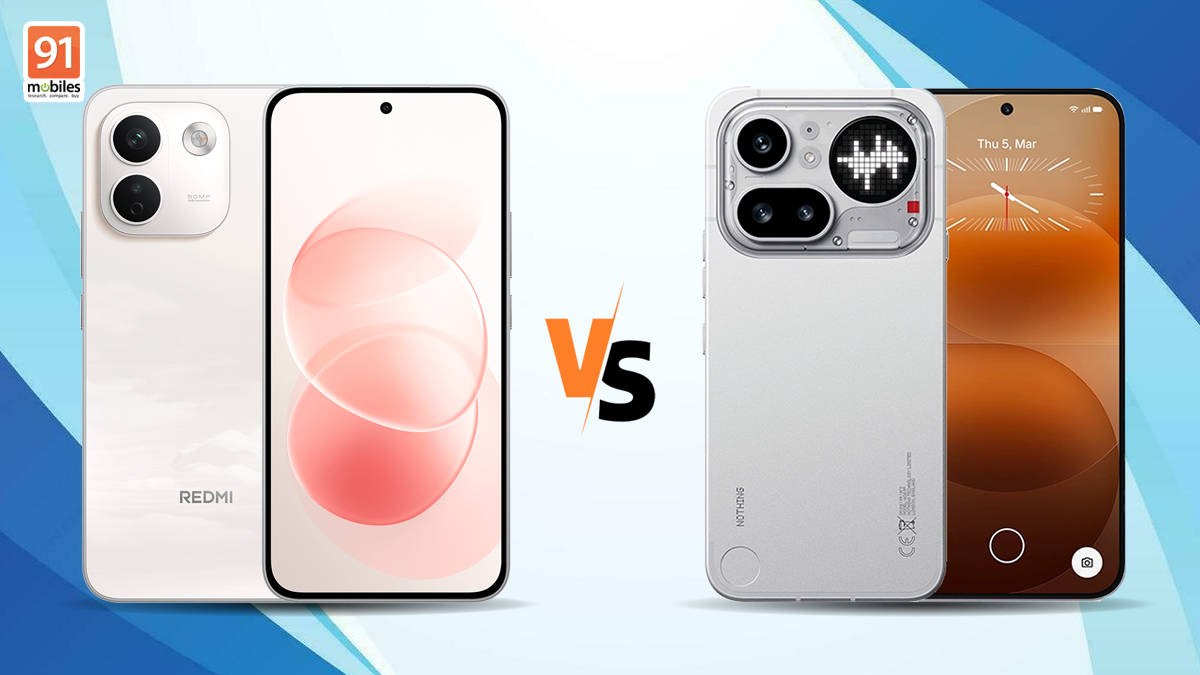
The Redmi Note 17 Pro Max and Nothing Phone (4a) Pro approach the premium mid-range segment from very different directions. Redmi has gone all-in on hardware with a 10,000mAh battery, 100W charging and UFS 4.1 storage, while Nothing puts more emphasis on design, cameras and performance with the Snapdragon 7 Gen 4. The price gap is significant, with the Redmi starting at Rs 49,999 for 256GB while the Nothing Phone (4a) Pro only offers 128GB currently at that rate. Here’s how the two phones compare.
| Specifications | Redmi Note 17 Pro Max | Nothing Phone (4a) Pro |
| Display | 6.83-inch 1.5K AMOLED, 120Hz | 6.83-inch 1.5K flexible AMOLED, 144Hz |
| Processor | Snapdragon 6 Gen 5 | Snapdragon 7 Gen 4 |
| RAM/storage | 8GB/12GB, 256GB UFS 4.1 | 8GB/12GB, 128GB/256GB UFS 3.1 |
| Rear cameras | 50MP OIS + 8MP ultrawide | 50MP OIS + 50MP periscope + 8MP ultrawide |
| Front camera | 32MP | 32MP |
| Battery | 10,000mAh, 100W | 5,400mAh, 50W |
| Software | Android 16-based HyperOS 3 | Android 16-based Nothing OS 4.1 |
| Updates | 4 OS + 6 years security | 3 OS + 6 years security |
| Durability | IP66/IP68/IP69/IP69K, Victus 2 | IP65, Gorilla Glass 7i |
| Weight | 229 gms | 211 gms |
Table of Contents
Redmi Note 17 Pro Max vs Nothing Phone (4a) Pro: price in India
The Redmi Note 17 Pro Max launched in India at Rs 49,999 for 8GB + 256GB and Rs 55,999 for 12GB + 256GB. It’s currently available at those prices.
The Nothing Phone (4a) Pro launched at Rs 39,999 for 8GB + 128GB, Rs 42,999 for 8GB + 256GB and Rs 45,999 for 12GB + 256GB. Its current official prices are considerably higher after a recent hike: Rs 54,999 for 8GB + 128GB, Rs 57,999 for 8GB + 256GB and Rs 55,999 for the 12GB + 256GB variant. However, the official seller Flipkart is currently selling the Phone 4a Pro starting at Rs 49,999 for 8GB + 128GB, Rs 52,999 for 8GB + 256GB, while the 12GB model is out of stock.
| Variant | Redmi Note 17 Pro Max | Nothing Phone (4a) Pro |
| 8GB + 128GB | NA | Rs 49,999 |
| 8GB + 256GB | Rs 49,999 | Rs 52,999 |
| 12GB + 256GB | Rs 55,999 | NA |
Redmi Note 17 Pro Max vs Nothing Phone (4a) Pro: design, display
This is where the two phones look least alike. The Redmi Note 17 Pro Max uses a conventional flat smartphone design with a matte rear panel and an asymmetrical camera housing positioned towards the upper-left corner. The phone is available in Stealth Black, Matcha Green and Secret Sunrise finishes, with the latter using a more distinctive light-toned finish.


The Nothing Phone (4a) Pro continues Nothing’s transparent-inspired design language but moves away from the plastic construction of earlier mid-range A-series models. It features a premium aircraft-grade aluminium unibody design and exposes the mechanical detailing around the camera cluster through a contoured transparent housing. Its standout feature is the Glyph Matrix, a pixel dot-style display located on the rear camera area used to show notifications, visual timers, and battery metrics. Built with an array of 137 precision mini-LEDs, this new Glyph Matrix physically covers a 57 percent larger surface area and is twice as bright as the one found on the flagship Nothing Phone (3), though it uses a lower density of individual LED pixels than the flagship’s 489-LED arrangement.
The Xiaomi Redmi Note 17 Pro Max is the larger and heavier device at 229 grams, compared with 211 grams for the Nothing Phone (4a) Pro. Xiaomi’s phone measures 8.57 mm thick in its white variant and 8.65 mm in other colours, while Nothing’s lightweight polycarbonate chassis comes in slightly thinner at 8.39 mm.
Both phones have 6.83-inch 1.5K AMOLED displays, but Nothing pushes the refresh rate to 144Hz compared to 120Hz on the Redmi. The Phone (4a) Pro also claims up to 5,000 nits peak brightness, while the Redmi goes up to 3,500 nits. The Redmi gets Gorilla Glass Victus 2, while Nothing uses Gorilla Glass 7i. The Redmi, however, has a much more extensive durability rating with IP66, IP68, IP69 and IP69K protection. Nothing’s phone is rated IP65.


The Redmi prioritises a rugged, high-capacity hardware package, while Nothing is making the phone itself part of the product identity. The Glyph Matrix and aluminium construction give the 4a Pro a more distinctive physical character, whereas the Redmi’s design is more focused on practicality.
Redmi Note 17 Pro Max vs Nothing Phone (4a) Pro: processor and storage
The Redmi Note 17 Pro Max uses Qualcomm’s Snapdragon 6 Gen 5, built on a 4nm process, paired with LPDDR5X RAM and UFS 4.1 storage. It comes in 8GB + 256GB and 12GB + 256GB configurations.
The Nothing Phone (4a) Pro steps up to the Snapdragon 7 Gen 4, also built on a 4nm process, with 8GB or 12GB LPDDR5X RAM and UFS 3.1 storage. The 4a Pro therefore has the higher-tier processor, while Redmi uses the newer and faster UFS 4.1 storage standard. Nothing also uses a 5,300 sq mm vapour cooling system and advertises 120fps gaming for extended sessions.
The Snapdragon 7 Gen 4 gives Nothing the more performance-oriented hardware setup, particularly for gaming and heavier workloads. Redmi’s phone is more about the overall hardware package with fast storage, plenty of RAM and enough battery capacity to sustain long sessions.
Redmi Note 17 Pro Max vs Nothing Phone (4a) Pro: cameras
The camera comparison is perhaps the biggest reason to consider the Nothing phone. The Redmi Note 17 Pro Max has a 50MP primary camera with OIS and an 8MP ultrawide camera. It also gets a 32MP front camera and supports 4K video recording at 30fps from both the rear and front cameras.
The Nothing Phone (4a) Pro adds a third rear camera: a 50MP Sony main camera with OIS, a 50MP periscope telephoto camera with 3.5x optical zoom and an 8MP ultrawide. It supports up to 140x digital/AI-enhanced zoom. The front camera is also 32MP, while rear video recording goes up to 4K at 60fps.
Redmi Note 17 Pro Max
Nothing Phone (4a) Pro
The periscope camera changes the nature of the comparison. Redmi has the more extreme battery hardware, but Nothing has built a considerably more versatile camera system. The 3.5x optical zoom gives the 4a Pro a dedicated option for distant subjects that the Redmi simply does not have.
Redmi Note 17 Pro Max
Nothing Phone (4a) Pro
Redmi Note 17 Pro Max
Nothing Phone (4a) Pro
For someone who primarily shoots at 1x and ultrawide, the difference may matter less. But for portraits, stage performances, travel photography or subjects at a distance, the Nothing’s periscope camera adds a capability that is missing on the Redmi.
Redmi Note 17 Pro Max vs Nothing Phone (4a) Pro: battery, charging
This is the Redmi’s biggest hardware advantage by some distance. The Note 17 Pro Max packs a 10,000mAh silicon-carbon battery with 100W HyperCharge and 27W wired reverse charging. Xiaomi also includes a 100W charger with the phone. The Nothing Phone (4a) Pro has a 5,400mAh battery in India and supports 50W wired charging. It also supports 7.5W wired reverse charging, but there is no wireless charging. Nothing claims the battery can retain more than 90 percent of its maximum capacity after 1,200 charging cycles.
On capacity alone, the Redmi battery is almost twice as large. That is the sort of difference that could matter to heavy users, frequent travellers and people who simply do not want to think about charging during the day. The Nothing is much slimmer and lighter, though, and its smaller battery is part of that trade-off. Its 50W charging is also respectable, but the Redmi’s 100W system is aimed at a very different kind of user.
Redmi Note 17 Pro Max vs Nothing Phone (4a) Pro: software and features
The Redmi runs HyperOS 3 and promises four major OS updates and six years of security updates. Nothing OS 4.1 promises three major Android updates and six years of security patches. Nothing’s software experience is closely tied to the hardware. The Glyph Matrix can show live updates and notifications without requiring the user to open the phone, while Nothing OS also integrates Gemini and ChatGPT.
The Redmi, meanwhile, has a broader set of hardware conveniences, including an IR blaster, NFC, eSIM support, stereo speakers with Dolby Atmos and 400 percent volume boost, Bluetooth 6.0 and 27W wired reverse charging.
Nothing integrates its distinctive hardware into the software experience, while Redmi packs in more traditional utility features alongside its unusually large battery.
Who is the Redmi Note 17 Pro Max for?
The Redmi Note 17 Pro Max is aimed at users who want maximum battery life, fast charging, durability and a broad hardware feature set. Its 10,000mAh battery is the defining feature, but the package also includes 100W charging, UFS 4.1 storage, IP69K protection, Victus 2 glass and 27W reverse charging.
The trade-offs are its lower-tier Snapdragon 6 Gen 5 processor, 120Hz display and less versatile camera system.
Who is the Nothing Phone (4a) Pro for?
The Nothing Phone (4a) Pro is aimed at users who want a more distinctive design, stronger performance and a more versatile camera system. Its Snapdragon 7 Gen 4, 144Hz AMOLED display and LPDDR5X RAM make it the more performance-focused phone on paper, while the 50MP periscope camera gives it a significant advantage for zoom photography.
Its 137-LED Glyph Matrix is also a genuine differentiator rather than simply another decorative lighting system. It is integrated into notifications and live updates, making the rear design part of the phone’s interface.
Redmi puts the emphasis on sheer hardware endurance, while Nothing puts more of its budget into performance, cameras and design identity.