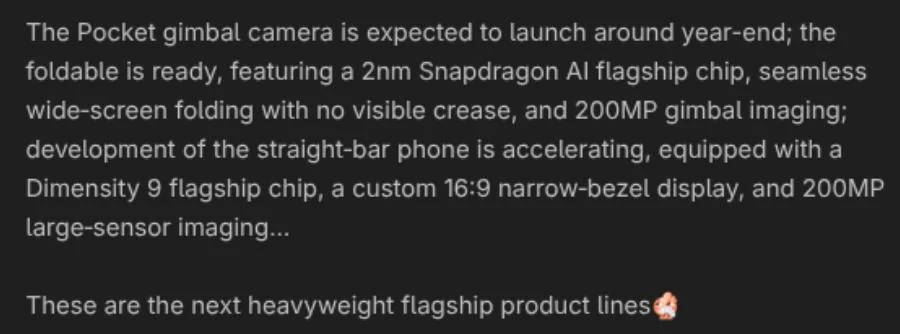
As RAM prices continue to hit record highs, making the smartphone business increasingly challenging for manufacturers, Vivo appears to be looking beyond conventional smartphones for its next big bets. The company is reportedly developing three new flagship products, including a standalone pocket gimbal camera, a next-generation foldable and a wide-screen smartphone.
The information comes from tipster Digital Chat Station (via), who has shared preliminary hardware details of all three products. While Vivo hasn’t confirmed any of the devices, the pocket gimbal camera is reportedly the closest to launch.
Vivo pocket gimbal camera
The standalone camera is expected to debut around the end of 2026 and could feature a 200MP Sony LYT-901 sensor, according to earlier reports. It would compete with DJI’s Osmo Pocket series, which has established itself in the compact handheld camera segment with its integrated gimbal stabilisation and vlogging-focused features.
Vivo already has experience with the technology. The company introduced micro gimbal stabilisation with the Vivo X50 series, bringing mechanical camera stabilisation to smartphones. A dedicated camera would allow it to explore the technology beyond the limitations of a smartphone’s size and design.
Next Vivo X Fold
The second product is reportedly the Vivo X Fold 7, which the tipster claims is already ready. It’s said to use Qualcomm’s 2nm Snapdragon 8 Elite Extreme Gen 6 chipset, alongside a wide inner display with no visible crease and a 200MP camera with gimbal stabilisation. The current Vivo X Fold 6 uses MediaTek’s Dimensity 9500 Super Edition, making it the first model in the series to move away from Snapdragon processors. A return to Qualcomm silicon would therefore be noteworthy.
The reported wider design also fits an emerging trend in foldables. Huawei’s Pura X Max and Xiaomi’s 18 Fold have adopted shorter, wider proportions, offering a more conventional smartphone experience when folded and a landscape-friendly display when opened. Samsung’s Galaxy Z Fold 8 also has wider proportions, alongside the iPhone Duo. Vivo could be looking to follow this approach.
Vivo flagship
The third device is a conventional smartphone with a custom 16:9 display and narrow bezels. It is reportedly progressing faster through development and could feature a flagship Dimensity 9-series processor and a 200MP primary camera with a large sensor. Vivo would not be alone in exploring wider slab smartphones. Huawei has already introduced the Pura X View with a 16:9.5 display, while Xiaomi is reportedly developing a similar non-folding phone. OnePlus is also rumoured to be exploring a wider display for the OnePlus 17.
A wider screen could offer more comfortable video viewing, gaming and multitasking, although it could make one-handed use less convenient. The format will also need software optimisation to make better use of the additional horizontal space.
The developments suggest Vivo is exploring new form factors while continuing to build on its camera technology .For now, none of Vivo’s three products has an official launch date or confirmed specifications. The pocket camera is the most immediate prospect, while the foldable and wide-screen smartphone could take longer to materialise. Buyers considering a flagship upgrade may want to watch these developments if they’re interested in alternatives to conventional smartphone designs., though they’re still some time away.