
POCO M6 Plus
+ Compare


-
Design24

-
Rear Camera11

-
Front Camera4

-
360° View
![360° View]()
-
UI Screenshot16
![UI Screenshot]()
-
Benchmarks3
![Benchmarks]()


Key Specs
Performance
-
Qualcomm Snapdragon 4 Gen 2 Accelerated Edition -
Octa core (2.3 GHz, Dual Core + 1.95 GHz, Hexa Core) -
6 GB / 8 GB RAM, LPDDR4X
Display
-
6.79 inches (17.25 cm); LCD -
1080x2400 px (FHD+) -
120 Hz Refresh Rate -
Gorilla Glass 3 Protection -
Bezel-less with punch-hole display
Rear Camera
-
Dual Camera Setup - 108 MP (upto 10x Digital Zoom) Wide Angle Primary Camera
- 2 MP Macro Camera
-
Ring LED -
Full HD @30 fps Video Recording
Front Camera
-
13 MP Wide Angle Lens -
Screen flash -
Full HD @30 fps Video Recording
Battery
-
5030 mAh, Li-Polymer -
33W Fast Charging; USB Type-C port
General
-
SIM1: Nano, SIM2: Nano (Hybrid) -
5G Supported -
128 GB Storage, Expandable upto 1 TB -
Dust Resistant, Water Resistant
POCO M6 Plus Prices in India
 Flipkart
POCO M6 Plus Compare Camera Samples


POCO M6 Plus Expert Review Summary
Expert Rating:
![Abhik Sengupta]()
Verdict
The POCO M6 Plus is a solid choice for those looking for a reliable smartphone with 5G connectivity. Compared to the POCO M6 Pro and POCO M6, the new iteration offers several upgrades, be it display, battery, and cameras. Compared to some direct competitors, the POCO M6 Plus stands out decently, if not better. However, the iQOO Z9x remains our top recommendation for hardcore gamers in this segment.
Pros
- Reliable performance
- 7 5G bands
- Fast charging
- Tall 120Hz FHD+ display
Cons
- No stereo speakers
- Loads of pre-installed apps
Display and design
+
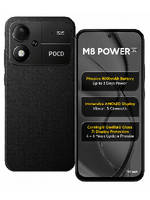
POCO M5 PlusRedmi 13 5GRealme Narzo N65Thickness8.3mm8.3mm8.4mmWeight205g205g190gIP RatingIP53IP53IP54 POCO M6 Plus' large cutouts for the rear cameras may remind you of the POCO M6 Pro. The design also reminds me of the Redmi 13 5G, which Xiaomi launched in India last month.There are some POCO-centric elements, such as the massive POCO branding in silver and dual-tone finish. Similar to its "Pro" sibling, we get standard ports and button options, such as IR blaster, volume rockers, power button, USB-C port, and 3.5mm audio jack.As the smartphone utilises a tall 6.79-inch Full-HD+ (2,400 x 1,080 pixels) display, it may feel slightly overwhelming for those with small hands. To be fair, this size feels ideal for my grip. What sets it apart from most competition is the addition of the glass back, which offers a premium look and feel. Of course, finger smudges may be one of the biggest pain points of this material, but you can always use the transparent case that the box includes.While POCO has been thoughtful about the weight and build material, I am not the biggest fan of the sharp edges. Undoubtedly, the phone feels sturdy in your hand, but the edges can feel uncomfortable, especially during prologue usage. I appreciate the purple colourway, as it may appeal to users of different age groups. Interestingly, POCO has skipped the brand's signature yellow colour and instead offers options like "Ice Silver" and "Graphite Black". A white variant for the POCO M6 Plus could have been a great addition, especially with its dual-tone finish.You might also notice a small design change on the front panel compared to the POCO M6 Pro. The POCO M6 Plus now features a hole-punch cutout, offering a slightly less interrupted viewing experience over the U-shaped notch. However, the bezels on this iteration remain prominent. Additionally, the POCO M6 Plus uses an IPS display instead of an AMOLED, which might not deliver the punchiest viewing experience.POCO M6 PlusRedmi 13 5GRealme Narzo 65Display size6.79-inch (IPS)6.79-inch (IPS)6.67-inch (IPS)Peak brightness550 nits550 nits625 nits The brand's compensation includes an increased 120Hz refresh rate for a smooth scrolling experience. There is also Gorilla Glass 3 protection on the front. I also like that POCO has offered the option to customise the refresh rate for select apps, which can improve the battery backup. I am happy to see the L1 Widevine certification that ensures HD streaming support on compatible OTTs. While there's no HDR playback, the viewing experience on YouTube, Instagram and Netflix is decent, thanks to the FHD+ resolution. My favourite remains HyperOS' (previous version called MiUI) reading mode, which even includes a paper-like textured finish for a more versatile viewing experience.I compared the POCO M6 Plus' viewing experience against the Redmi 13 5G and Realme Narzo N65 (review). All three smartphones boast an IPS panel; therefore, the black and red areas won't look as punchy as you'd find on AMOLED or pOLED screens. The Narzo N65 offered more brightness under harsh sunlight, but indoors it'd be difficult to distinguish the viewing experience across these three rivals.
Read More
Cameras
+
While POCO continues to skip the ultra-wide camera on its budget offerings, the new POCO M6 Plus gets a 108MP primary camera utilising Samsung's ISOCELL HM6 primary camera with an aperture size of f/1.75. There's also a 2MP macro camera on the back. At the front, there's a 13MP shooter.Typically, the POCO M6 Plus prioritises shots with high brightness and vibrancy, at least those under decent lighting conditions. As a result, the photos may look more pleasing and more social media-ready. Images in low-light conditions are decent, but you will notice some degree of softening to reduce noise. Photos in extremely low light can be a hit-and-miss, and you may need to tweak lighting and colours via the native editing app to get the desirable output.We've also compared its shots with Redmi 13 5G and Realme Narzo N65.Daylight and low-lightThese photos by the POCO M6 Plus and Redmi 13 5G look identical, that's also because the two smartphones share the same camera specifications. Redmi's photos may appear slightly balanced, though the details in both images are almost similar.Even if you look at the photos below, you will notice almost the same treatment. The walls in Redmi's image may appear slightly boosted, but overall, differences are hard to distinguish.Even in low-light conditions, their images look almost identical. Given the price of these smartphones, I'm mostly pleased with the results. You can turn on HDR for a punchier output, though it's best to keep your expectations realistic.PortraitWe are again checking out the portrait shots by POCO M6 Plus and Redmi 13 5G, and the differences are negligible. Redmi's image continues to feature a red tint, which at least looks good with my complexion. This colour treatment is easily achievable via the native editing app on the POCO M6 Plus.I am also pleased by both smartphone's edge detection, which is quite good considering the price. While the facial details are decent, I can notice slightly higher grains on the image by POCO M6 Plus. Otherwise, I find both photos appealing and even worthy of uploading on my social media.Selfie (portrait)For the selfie shot, I am comparing POCO M6 Plus' output against Realme Narzo N65. The colour treatment in both images is visibly different.I like POCO M6 Plus' natural tone approach while maintaining facial details. The Realme Narzo 65 captures more facial details, though its image features a strong red tone. Aesthetically, Realme's output looks better.The bokeh effect on both phones may appear slightly artificial. However, in extreme low-light conditions, both smartphones struggle big time. Images consist of a lot of grains and the details are also sketchy. The Realme Narzo N65 controls light better, though it loses focus on the shirt and surrounding area. The POCO M6 Plus shows more details of the outfit and the subject, though the light on the face gets overexposed.VideosThe POCO M6 Plus supports full HD recording at 30fps from both the rear and front cameras. In daylight, the output is surprisingly good in terms of colours and contrast. However, stability could be an issue since there's no OIS (Optical Image Stabilisation) or EIS (Electronic Image Stabilisation). To achieve a more aesthetically pleasing result, it's advisable to be mindful of stability or to rest the phone on a flat surface during recording.
Read More
Performance and software
+
Similar to the Redmi 13 5G, the POCO M6 Plus boasts Qualcomm's Snapdragon 4 Gen 2 AE SoC. The "AE" in the moniker stands for Accelerated Edition, meaning you get a slightly boosted clock speed of up to 2.3GHz instead of 2.2GHz. As mentioned, the POCO M6 Plus also offers 128GB of storage across the two storage variants. The base model with 6GB RAM costs Rs 12,999 and the top variant, which I am also reviewing, carries a sticker price of Rs 14,499.Overall, POCO M6 Plus' specifications remain modest, and the smartphone offers sufficient juice for basic tasks, such as social media browsing, reading, WhatsApp, and watching movies. Enabling the 120Hz refresh rate may also enhance the experience, especially with scrolling. You may notice minor lag while opening or switching between apps, but that's the case with almost all smartphones in the sub-Rs 14,000 segment. The phone also gets seven essential 5G band support, which is quite good considering the price.Based on our benchmarks, the Snapdragon 4 Gen 2 AE SoC offers considerable leaps over last year's Snapdragon 4 Gen 2 SoC-powered POCO M6 Pro. Even compared to the MediaTek Dimensity 6100+ SoC-powered POCO M6, the benchmark scores attained by POCO M6 Plus are much improved.SmartphoneAnTuTuPOCO M6 Plus433376POCO M6 Pro426559POCO M6385207However, when pitted against some immediate rivals, the scores are decent at best. The Redmi 13 5G with the same chipset performed better in AnTuTu. The iQOO Z9x with the Snapdragon 6 Gen 1 and the same memory configuration has the highest score in our AnTuTu benchmark. Interestingly, the POCO M6 Plus performed better in Geekbench's single-core test than the iQOO Z9x.When it comes to heavy tasks such as gaming, the POCO M6 Plus offers decent performance, though the IPS panel does not provide the best visual experience. POCO could've considered adding dual speakers if it was limited to using an IPS panel to keep the pricing aggressive. One may argue that connecting wired earphones may offer some respite, though the audio jack may cause some issues with the grip. POCO may suggest using its new TWS POCO X1 Buds for a seamless gaming experience.In terms of gaming performance, you can play Battlegrounds Mobile India with smooth graphics at "Ultra" FPS settings. After 30 minutes of gameplay, the average FPS was recorded at 27.5, placing the POCO M6 Plus in the same league as most of its competitors.Thermal management, at least while running BGMI for 30 minutes, wasn't ideal. We noticed a similar trend on the Redmi 13 5G.Pre-installed appsOS UpdatesPOCO M6 Plus642 years OS + 4 years security updatesRedmi 13 5G532 years OS + 4 years security updatesRealme Narzo 5G532 years OS + 3 years security updatesiQOO Z9x542 years OS + 3 years security updates
Read More
Battery
+
As mentioned, the battery size on the POCO M6 Plus has been slightly increased, but there's also faster charging support over the POCO M6 Pro.Due to its modest specifications and IPS display, the POCO M6 Plus can last full-day with heavy usage. My use cases included social media browsing, mild gaming, and plenty of camera tests. I had also enabled the 120Hz refresh rate on the smartphone. You can extend the backup with moderate settings enabled.SmartphonePOCO M6 PlusRedmi 13 5GiQOO Z9xBattery5,030mAh5,030mAh6,000mAhCharging time63 minutes (33W)86 minutes (33W)61 minutes (44W) However, the POCO M6 Plus appears to be not fully optimised for PCMark's battery test. It ran the test for nearly nine hours, which is an average performance, especially for a smartphone with a 5,030mAh battery. Rivals like Redmi 13 5G and Narzo N65 showcased better performance in the same PCMark test.Notably, POCO M6 Plus took less time to charge from 20 to 100 percent than its competitors.
Read More
Read full Review

Verdict
The POCO M6 Plus is a solid choice for those looking for a reliable smartphone with 5G connectivity. Compared to the POCO M6 Pro and POCO M6, the new iteration offers several upgrades, be it display, battery, and cameras. Compared to some direct competitors, the POCO M6 Plus stands out decently, if not better. However, the iQOO Z9x remains our top recommendation for hardcore gamers in this segment.
- Reliable performance
- 7 5G bands
- Fast charging
- Tall 120Hz FHD+ display
Pros
- No stereo speakers
- Loads of pre-installed apps
Cons
Display and design
+POCO M5 PlusRedmi 13 5GRealme Narzo N65Thickness8.3mm8.3mm8.4mmWeight205g205g190gIP RatingIP53IP53IP54 POCO M6 Plus' large cutouts for the rear cameras may remind you of the POCO M6 Pro. The design also reminds me of the Redmi 13 5G, which Xiaomi launched in India last month.There are some POCO-centric elements, such as the massive POCO branding in silver and dual-tone finish. Similar to its "Pro" sibling, we get standard ports and button options, such as IR blaster, volume rockers, power button, USB-C port, and 3.5mm audio jack.As the smartphone utilises a tall 6.79-inch Full-HD+ (2,400 x 1,080 pixels) display, it may feel slightly overwhelming for those with small hands. To be fair, this size feels ideal for my grip. What sets it apart from most competition is the addition of the glass back, which offers a premium look and feel. Of course, finger smudges may be one of the biggest pain points of this material, but you can always use the transparent case that the box includes.While POCO has been thoughtful about the weight and build material, I am not the biggest fan of the sharp edges. Undoubtedly, the phone feels sturdy in your hand, but the edges can feel uncomfortable, especially during prologue usage. I appreciate the purple colourway, as it may appeal to users of different age groups. Interestingly, POCO has skipped the brand's signature yellow colour and instead offers options like "Ice Silver" and "Graphite Black". A white variant for the POCO M6 Plus could have been a great addition, especially with its dual-tone finish.You might also notice a small design change on the front panel compared to the POCO M6 Pro. The POCO M6 Plus now features a hole-punch cutout, offering a slightly less interrupted viewing experience over the U-shaped notch. However, the bezels on this iteration remain prominent. Additionally, the POCO M6 Plus uses an IPS display instead of an AMOLED, which might not deliver the punchiest viewing experience.POCO M6 PlusRedmi 13 5GRealme Narzo 65Display size6.79-inch (IPS)6.79-inch (IPS)6.67-inch (IPS)Peak brightness550 nits550 nits625 nits The brand's compensation includes an increased 120Hz refresh rate for a smooth scrolling experience. There is also Gorilla Glass 3 protection on the front. I also like that POCO has offered the option to customise the refresh rate for select apps, which can improve the battery backup. I am happy to see the L1 Widevine certification that ensures HD streaming support on compatible OTTs. While there's no HDR playback, the viewing experience on YouTube, Instagram and Netflix is decent, thanks to the FHD+ resolution. My favourite remains HyperOS' (previous version called MiUI) reading mode, which even includes a paper-like textured finish for a more versatile viewing experience.I compared the POCO M6 Plus' viewing experience against the Redmi 13 5G and Realme Narzo N65 (review). All three smartphones boast an IPS panel; therefore, the black and red areas won't look as punchy as you'd find on AMOLED or pOLED screens. The Narzo N65 offered more brightness under harsh sunlight, but indoors it'd be difficult to distinguish the viewing experience across these three rivals.
Read MoreCameras
+While POCO continues to skip the ultra-wide camera on its budget offerings, the new POCO M6 Plus gets a 108MP primary camera utilising Samsung's ISOCELL HM6 primary camera with an aperture size of f/1.75. There's also a 2MP macro camera on the back. At the front, there's a 13MP shooter.Typically, the POCO M6 Plus prioritises shots with high brightness and vibrancy, at least those under decent lighting conditions. As a result, the photos may look more pleasing and more social media-ready. Images in low-light conditions are decent, but you will notice some degree of softening to reduce noise. Photos in extremely low light can be a hit-and-miss, and you may need to tweak lighting and colours via the native editing app to get the desirable output.We've also compared its shots with Redmi 13 5G and Realme Narzo N65.Daylight and low-lightThese photos by the POCO M6 Plus and Redmi 13 5G look identical, that's also because the two smartphones share the same camera specifications. Redmi's photos may appear slightly balanced, though the details in both images are almost similar.Even if you look at the photos below, you will notice almost the same treatment. The walls in Redmi's image may appear slightly boosted, but overall, differences are hard to distinguish.Even in low-light conditions, their images look almost identical. Given the price of these smartphones, I'm mostly pleased with the results. You can turn on HDR for a punchier output, though it's best to keep your expectations realistic.PortraitWe are again checking out the portrait shots by POCO M6 Plus and Redmi 13 5G, and the differences are negligible. Redmi's image continues to feature a red tint, which at least looks good with my complexion. This colour treatment is easily achievable via the native editing app on the POCO M6 Plus.I am also pleased by both smartphone's edge detection, which is quite good considering the price. While the facial details are decent, I can notice slightly higher grains on the image by POCO M6 Plus. Otherwise, I find both photos appealing and even worthy of uploading on my social media.Selfie (portrait)For the selfie shot, I am comparing POCO M6 Plus' output against Realme Narzo N65. The colour treatment in both images is visibly different.I like POCO M6 Plus' natural tone approach while maintaining facial details. The Realme Narzo 65 captures more facial details, though its image features a strong red tone. Aesthetically, Realme's output looks better.The bokeh effect on both phones may appear slightly artificial. However, in extreme low-light conditions, both smartphones struggle big time. Images consist of a lot of grains and the details are also sketchy. The Realme Narzo N65 controls light better, though it loses focus on the shirt and surrounding area. The POCO M6 Plus shows more details of the outfit and the subject, though the light on the face gets overexposed.VideosThe POCO M6 Plus supports full HD recording at 30fps from both the rear and front cameras. In daylight, the output is surprisingly good in terms of colours and contrast. However, stability could be an issue since there's no OIS (Optical Image Stabilisation) or EIS (Electronic Image Stabilisation). To achieve a more aesthetically pleasing result, it's advisable to be mindful of stability or to rest the phone on a flat surface during recording.
Read MorePerformance and software
+Similar to the Redmi 13 5G, the POCO M6 Plus boasts Qualcomm's Snapdragon 4 Gen 2 AE SoC. The "AE" in the moniker stands for Accelerated Edition, meaning you get a slightly boosted clock speed of up to 2.3GHz instead of 2.2GHz. As mentioned, the POCO M6 Plus also offers 128GB of storage across the two storage variants. The base model with 6GB RAM costs Rs 12,999 and the top variant, which I am also reviewing, carries a sticker price of Rs 14,499.Overall, POCO M6 Plus' specifications remain modest, and the smartphone offers sufficient juice for basic tasks, such as social media browsing, reading, WhatsApp, and watching movies. Enabling the 120Hz refresh rate may also enhance the experience, especially with scrolling. You may notice minor lag while opening or switching between apps, but that's the case with almost all smartphones in the sub-Rs 14,000 segment. The phone also gets seven essential 5G band support, which is quite good considering the price.Based on our benchmarks, the Snapdragon 4 Gen 2 AE SoC offers considerable leaps over last year's Snapdragon 4 Gen 2 SoC-powered POCO M6 Pro. Even compared to the MediaTek Dimensity 6100+ SoC-powered POCO M6, the benchmark scores attained by POCO M6 Plus are much improved.SmartphoneAnTuTuPOCO M6 Plus433376POCO M6 Pro426559POCO M6385207However, when pitted against some immediate rivals, the scores are decent at best. The Redmi 13 5G with the same chipset performed better in AnTuTu. The iQOO Z9x with the Snapdragon 6 Gen 1 and the same memory configuration has the highest score in our AnTuTu benchmark. Interestingly, the POCO M6 Plus performed better in Geekbench's single-core test than the iQOO Z9x.When it comes to heavy tasks such as gaming, the POCO M6 Plus offers decent performance, though the IPS panel does not provide the best visual experience. POCO could've considered adding dual speakers if it was limited to using an IPS panel to keep the pricing aggressive. One may argue that connecting wired earphones may offer some respite, though the audio jack may cause some issues with the grip. POCO may suggest using its new TWS POCO X1 Buds for a seamless gaming experience.In terms of gaming performance, you can play Battlegrounds Mobile India with smooth graphics at "Ultra" FPS settings. After 30 minutes of gameplay, the average FPS was recorded at 27.5, placing the POCO M6 Plus in the same league as most of its competitors.Thermal management, at least while running BGMI for 30 minutes, wasn't ideal. We noticed a similar trend on the Redmi 13 5G.Pre-installed appsOS UpdatesPOCO M6 Plus642 years OS + 4 years security updatesRedmi 13 5G532 years OS + 4 years security updatesRealme Narzo 5G532 years OS + 3 years security updatesiQOO Z9x542 years OS + 3 years security updates
Read MoreBattery
+As mentioned, the battery size on the POCO M6 Plus has been slightly increased, but there's also faster charging support over the POCO M6 Pro.Due to its modest specifications and IPS display, the POCO M6 Plus can last full-day with heavy usage. My use cases included social media browsing, mild gaming, and plenty of camera tests. I had also enabled the 120Hz refresh rate on the smartphone. You can extend the backup with moderate settings enabled.SmartphonePOCO M6 PlusRedmi 13 5GiQOO Z9xBattery5,030mAh5,030mAh6,000mAhCharging time63 minutes (33W)86 minutes (33W)61 minutes (44W) However, the POCO M6 Plus appears to be not fully optimised for PCMark's battery test. It ran the test for nearly nine hours, which is an average performance, especially for a smartphone with a 5,030mAh battery. Rivals like Redmi 13 5G and Narzo N65 showcased better performance in the same PCMark test.Notably, POCO M6 Plus took less time to charge from 20 to 100 percent than its competitors.
Read MoreCompetitors For POCO M6 Plus
View Alternatives




Popular Comparisons
 POCO M6 Plus
 Xiaomi Redmi 13 5G
POCO M6 Plus
 POCO M6 Pro 5G
POCO M6 Plus
 iQOO Z9x
POCO M6 Plus
 OPPO K12x
POCO M6 Plus
 Moto G64
POCO M6 Plus
 POCO M6 Pro 5G 128GB


POCO M6 Plus Specifications
General |
|
|---|---|
| Launch Date | August 2, 2024 (Official) |
| Operating System | Android v14 |
| OS Updates | 2 Years |
| Security Updates | 4 Years |
| Custom UI | HyperOS |
Performance
(Good)
|
||||
|---|---|---|---|---|
| Chipset | Qualcomm Snapdragon 4 Gen 2 Accelerated Edition | |||
| Processor | Octa core (2.3 GHz, Dual core, Cortex A78 + 1.95 GHz, Hexa Core, Cortex A55) | |||
| Architecture | 64 bit | |||
| Fabrication | 4 nm | |||
| Graphics (GPU) | Adreno 613 | |||
| RAM | 6 GB / 8 GB | |||
| RAM Type | LPDDR4X | |||
|
Gaming Test Results

* after 30 mins of gaming
|
||||
Benchmark Screenshots

AnTuTu Benchmark

Graphics Benchmark

Geekbench6 Benchmark
|


Display
(Excellent)
|
|
|---|---|
| Display Type | LCD |
| Screen Size | 6.79 inches (17.25 cm) |
| Resolution | 1080x2400 px (FHD+) |
| Peak Brightness | 550 nits |
| HBM Brightness | 550 nits |
| Refresh Rate | 120 Hz |
| Touch Sampling Rate | 240 Hz |
| Pixel Density | 388 ppi |
| Screen to Body Ratio (calculated) | 86.55 % |
| Screen Protection | Corning Gorilla |
| Bezel-less Display | Yes with punch-hole display |
| Screen to Body Ratio (claimed by the brand) | 91.20 % |
UI Screenshots

Lock Screen

Home Screen

Screen With Widgets

Dialer Screen

App Drawer

Notification Panel

Quick Settings Panel

Settings Screen

OS Version

Storage

Battery

Camera On

Camera Options

Camera Settings

Picture Size Options

Video Size Options
|
Design |
|
|---|---|
| Height | 168.6 mm |
| Width | 76.28 mm |
| Thickness | 8.3 mm |
| Weight | 205 grams |
| Build Material | Back: Mineral Glass |
| Water Resistance | Yes, Splash proof, IP53 |
| Ruggedness | Dust proof |
|
Click to View

|
Rear Camera
(Very Good)
|
||||||||||||||||||||||||
|---|---|---|---|---|---|---|---|---|---|---|---|---|---|---|---|---|---|---|---|---|---|---|---|---|
| Resolution | ||||||||||||||||||||||||
|
||||||||||||||||||||||||
| Autofocus | Yes | |||||||||||||||||||||||
| Flash | Yes, Ring LED | |||||||||||||||||||||||
| Image Resolution | 12000 x 9000 Pixels | |||||||||||||||||||||||
| Settings | Exposure compensation, ISO control | |||||||||||||||||||||||
| Shooting Modes |
Continuous Shooting High Dynamic Range mode (HDR) Beautify Macro Mode |
|||||||||||||||||||||||
| Camera Features |
10 x Digital Zoom Auto Flash Custom Watermark Face detection Filters Touch to focus Voice Shutter |
|||||||||||||||||||||||
| Video Recording |
Full HD @30 fps HD @30 fps |
|||||||||||||||||||||||
| Video Recording Features |
Macro Video Short Video Mode |
|||||||||||||||||||||||
Rear Camera Samples

Portrait Shot

Night Mode OFF

Night Mode ON

Close Up

Low Light

Low Light With Flash

Colour Variance

Daylight Auto / HDR OFF

Daylight / HDR ON

AI ON

Macro
|
Front Camera
(Very Good)
|
||||||||
|---|---|---|---|---|---|---|---|---|
| Resolution | ||||||||
|
||||||||
| Flash | Yes, Screen flash | |||||||
| Video Recording |
Full HD @30 fps HD @30 fps |
|||||||
Front Camera Samples

Selfie

Selfie Portrait

Selfie Low Light

Selfie Low Light With Flash
|
Battery
(Very Good)
|
||||
|---|---|---|---|---|
| Capacity | 5030 mAh | |||
| Battery Type | Li-Polymer | |||
| Quick Charging | Yes, 33W Fast Charging | |||
|
Battery Test Results
|
Storage |
|
|---|---|
| Internal Storage | 128 GB |
| Storage Type | UFS 2.2 |
| Expandable Storage | Yes, Up to 1 TB |
Network & Connectivity |
|
|---|---|
| SIM Slot(s) | Dual SIM |
| SIM Type | SIM1: Nano, SIM2: Nano (Hybrid) |
| Network Support | 5G, 4G |
| VoLTE | Yes |
| SIM 1 |
5G bands, 4G bands
Expand
|
| SIM 2 |
5G bands, 4G bands
Expand
|
| SAR Value | Head: 0.855 W/kg, Body: 0.848 W/kg |
| Wi-Fi | Yes, Wi-Fi 5 (802.11 a/b/g/n/ac) 5GHz |
| Wi-Fi Features | Mobile Hotspot |
| Bluetooth | Yes, v5.0 |
| GPS | Yes with A-GPS, Glonass |
| NFC | No |
Multimedia |
|
|---|---|
| Audio Jack | 3.5 mm |
Sensors |
|
|---|---|
| Fingerprint Sensor | Yes |
| Fingerprint Sensor Position | Side |
| Other Sensors | Light sensor, Proximity sensor, Accelerometer, Compass, Gyroscope |
POCO M6 Plus User Reviews
POCO M6 Plus Key Highlights
| Processor | Qualcomm Snapdragon 4 Gen 2 Accelerated Edition |
| RAM & Storage | 6 GB RAM + 128 GB 8 GB RAM + 128 GB |
| Display | 6.79", 1080 x 2400 Resolution |
| Rear Camera | 108 MP + 2 MP |
| Front Camera | 13 MP |
| Battery | 5030 mAh |

























POCO M6 Plus Price In India
| Product Name | Store | Price |
|---|---|---|
| POCO M6 Plus (6 GB + 128 GB) | Flipkart | ₹13,499 |
| POCO M6 Plus (8 GB + 128 GB) | Flipkart | ₹14,499 |
Popular Links
- All Upcoming Phones
- Upcoming POCO Phones
- vivo V80 5G
- OPPO F35 Pro
- vivo S2 FE 5G
- OPPO Find X10
- OPPO F35
- Samsung Mobiles
- Motorola Mobiles
- vivo Mobiles
- OPPO Mobiles
- Tecno Mobiles
- realme Mobiles
- Xiaomi Mobiles