Remember when buying a gaming laptop felt like signing an unofficial agreement with thermodynamics? More performance meant more wattage, chunkier chargers, louder fans, and enough heat output to make summer gaming feel like a survival challenge. For years, that was simply the rule. If a laptop wanted to push higher frame rates, it had to brute-force its way there with more power.
But somewhere along the way, NVIDIA decided brute force was getting a little old-fashioned. Instead of just pushing GPUs harder, the company started teaching them how to think smarter. That shift gave us DLSS, short for Deep Learning Super Sampling, and honestly, it has completely changed how gaming laptops behave in the real world. Modern GPUs no longer rely purely on raw horsepower. AI now plays a huge role in how games are rendered, how frames are generated, and ultimately, how smooth gameplay feels.
To see just how dramatic that shift has become, we put three popular laptop GPUs head-to-head: the RTX 3060, RTX 4060, and the brand-new RTX 5060. On paper, this sounds like a straightforward generational showdown. In reality, the results turned into something far more interesting. Older GPUs suddenly gained a second life, mid-range cards started punching above their weight, and the RTX 50-series showed just how absurd AI-assisted gaming is becoming.
Table of Contents
The benchmark setup and why these numbers matter
For testing, we used three gaming laptops equipped with NVIDIA’s RTX 3060, RTX 4060, and RTX 5060 Laptop GPUs. The games selected were intentionally brutal on hardware, including Cyberpunk 2077, Black Myth: Wukong, Forza Horizon 5, and Resident Evil: Requiem. We tested across multiple scenarios, including native rendering, DLSS upscaling, Ray Tracing, Frame Generation, and Multi-Frame Generation, where supported.


As for the laptops used, we went with an RTX 3060-powered MSI Pulse GL66 11UEK with a TGP of 85W, an RTX 4060-powered MSI Sword 15 A12VF-401IN with a TGP of 105W, and finally, the Dell Alienware 16 Aurora AC16250 with an RTX 5060 with 80W of TGP.
Note: Laptop GPU performance heavily depends on TGP, cooling, and power allocation. A higher-powered RTX 4060 can outperform a lower-wattage RTX 5060 in native workloads, and all testing here was conducted independently using units available to us at the time.
Turns out, older RTX laptops still have a lot of life left
Before getting distracted by shiny new silicon, let’s talk about the biggest surprise from this entire test: the RTX 3060 is aging way better than most people probably expected.
Traditionally, gaming laptops tend to age like milk once newer AAA titles start piling on advanced effects and heavier rendering pipelines. A GPU that once felt powerful slowly gets pushed into the “medium settings only” category. But DLSS has completely disrupted that cycle.
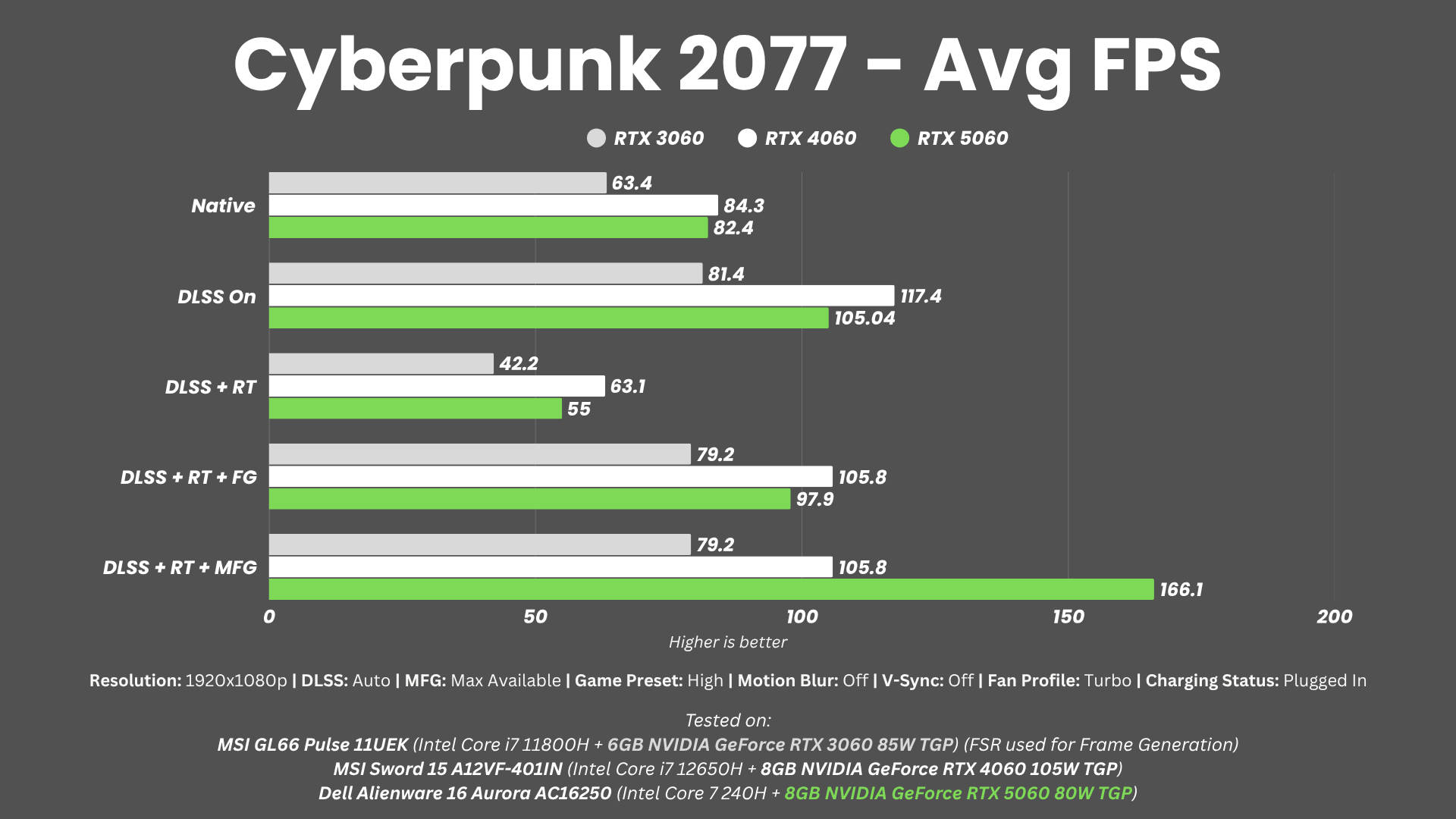
Take Cyberpunk 2077 as an example. Running the game natively at High settings, the RTX 3060 delivered 63.4 FPS. Perfectly playable, but not exactly ideal for a fast-paced shooter-RPG hybrid where responsiveness matters. Turn DLSS on, though, and performance jumps to 81.4 FPS. Suddenly, the experience feels dramatically smoother without sacrificing visual quality in any meaningful way.
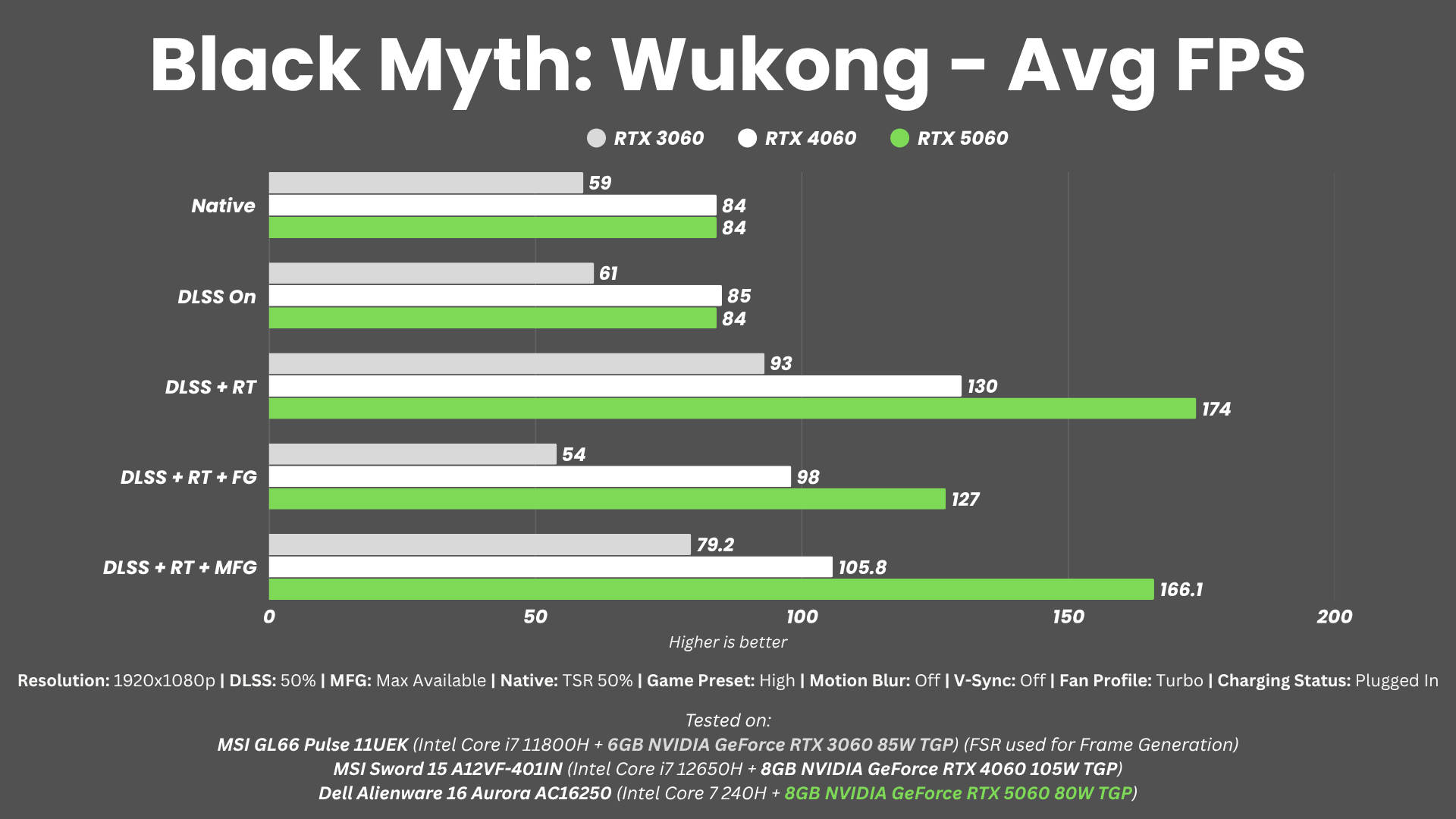
Things get even more interesting once Frame Generation enters the chat. Officially, RTX 30-series GPUs do not support NVIDIA’s DLSS 3 Frame Generation, but thanks to community workarounds using AMD’s FSR Frame Generation, the RTX 3060 still pulled off some surprisingly impressive results. In Cyberpunk 2077 with Ray Tracing enabled, performance jumped from a rough 42.2 FPS to a much smoother 79.2 FPS, while Black Myth: Wukong climbed all the way to 93 FPS with Frame Generation enabled. It’s a great example of how modern upscaling tech is not just improving newer GPUs, but also giving older gaming laptops a serious second wind.
For gamers still holding onto RTX 3060 laptops, this is genuinely good news. No, these machines are not magically competing with flagship hardware. But they are far from obsolete. With a little settings tweaking and smart use of AI-assisted rendering, they still deliver a surprisingly solid gaming experience in some of the heaviest modern titles available today.
How did the RTX 4060 beat the RTX 5060, though?
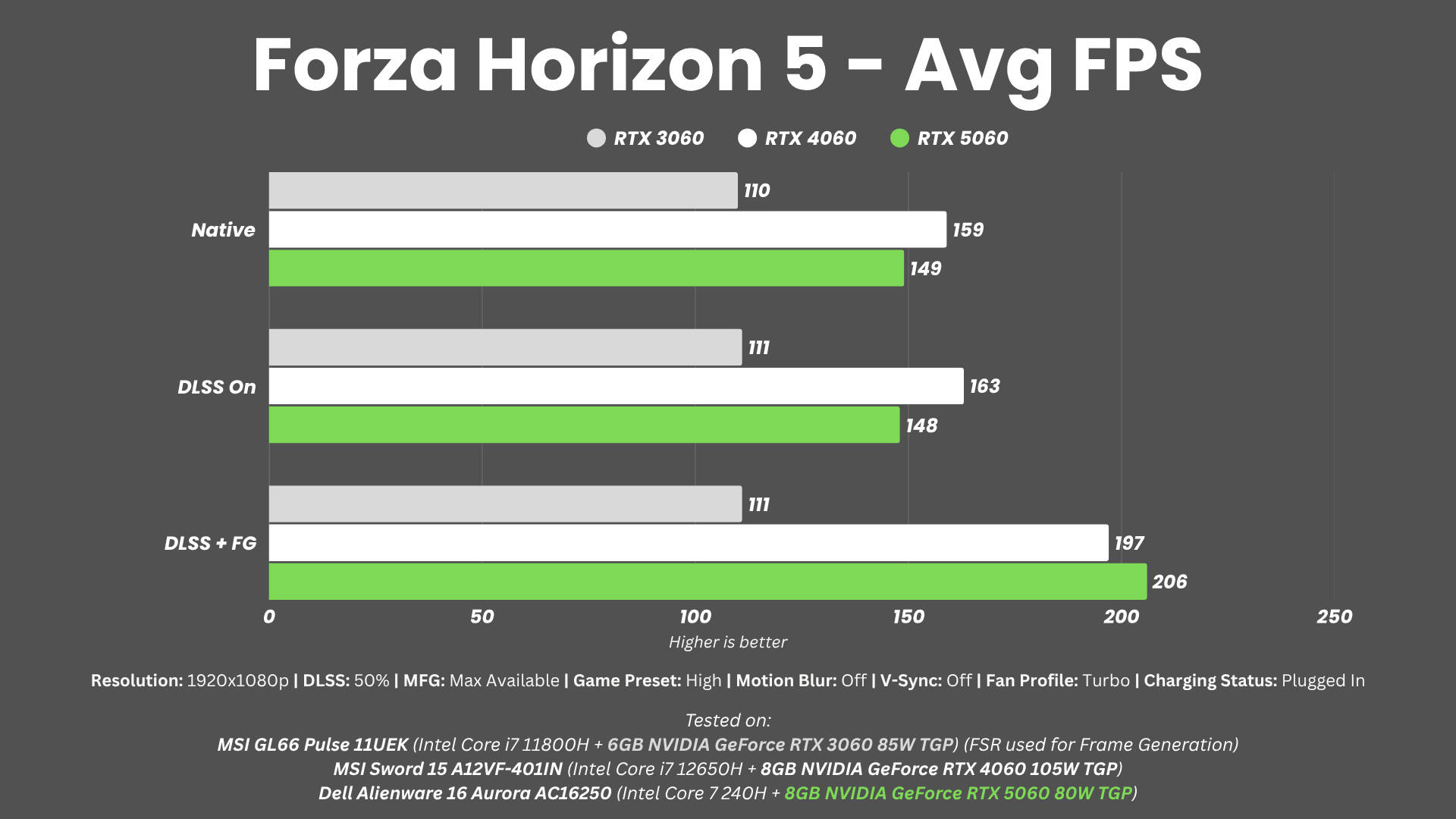
One of the biggest surprises from our testing was seeing the RTX 4060 occasionally outperform the newer RTX 5060 in native gaming workloads. In Cyberpunk 2077 at High settings, the RTX 4060 delivered 84.3 FPS, slightly ahead of the RTX 5060’s 82.4 FPS, with a similar trend appearing in Forza Horizon 5 as well.
As strange as that sounds, the reason is fairly simple. Our RTX 4060 laptop was configured with a much higher 105W TGP, while the RTX 5060 machine operated at a lower 80W power limit. In traditional rasterized workloads without heavy AI assistance, raw power still plays a huge role, and the RTX 4060 simply had more room to brute-force higher frame rates. It’s also a reminder that gaming laptop performance is no longer just about the GPU name. A well-cooled, higher-powered older GPU can absolutely outperform a newer chip in certain scenarios, especially when the newer laptop is designed around efficiency, thermals, or battery life.
But then we enabled Multi-Frame Generation. And the entire story changed.
RTX 50-series and the absurdity of Multi-Frame Generation
The moment Multi-Frame Generation entered the picture, the RTX 5060 basically stopped caring about its lower TGP. This is where NVIDIA’s AI strategy starts looking genuinely futuristic. In Cyberpunk 2077 with Ray Tracing enabled, the RTX 5060 using DLSS and Multi Frame Generation shot up to 166.1 FPS. For context, the RTX 4060 topped out at 105.8 FPS using standard Frame Generation.
That is not a small difference. That is a gigantic leap in smoothness from a laptop GPU running at significantly lower power. And the craziest part is that the RTX 5060 is not achieving this through traditional rendering alone. Instead of brute-forcing every frame conventionally, NVIDIA is essentially using AI as a performance multiplier, allowing thinner and more efficient laptops to deliver frame rates that previously required much larger and hotter systems.
Black Myth: Wukong showed the same behavior. Under standard DLSS workloads, the RTX 4060 and RTX 5060 were basically neck-and-neck around the mid-80 FPS mark. The moment Frame Generation was enabled, though, the RTX 5060 surged ahead to 174 FPS, while the RTX 4060 settled at 130 FPS. Even with Ray Tracing enabled, the RTX 5060 maintained a buttery-smooth 127 FPS.
That is the real story of modern AI-assisted gaming. Raw raster performance still matters, absolutely. But increasingly, the real differentiator is how effectively a GPU can leverage AI acceleration technologies. And right now, NVIDIA’s latest 50-series hardware is operating on a completely different level in that department.
So, which RTX gaming laptop actually makes the most sense?
After spending hours benchmarking these machines, one thing became very clear: there is no universally “bad” option here anymore. DLSS has fundamentally changed how gaming laptops age and perform.
If someone already owns an RTX 3060 laptop, upgrading immediately probably is not necessary unless there is a need for cutting-edge Ray Tracing or ultra-high refresh competitive gaming. DLSS and modern upscaling technologies are doing an incredible job keeping these GPUs relevant, and the performance gains from software alone are honestly impressive.
RTX 4060 laptops, meanwhile, continue to hit a sweet spot for value. The ecosystem is mature, drivers are stable, performance is predictable, and the GPU handles modern games extremely well. Native rendering performance is still excellent, especially on higher-TGP implementations, and DLSS Frame Generation gives these systems plenty of extra breathing room.
But the RTX 5060 represents where gaming laptops are clearly heading next. Even at lower wattages, it delivers absurdly high frame rates once Multi Frame Generation is enabled. More importantly, it does this while remaining relatively efficient compared to older gaming laptop designs. That matters because nobody really misses the era of gigantic, overheating gaming laptops that sounded like industrial cooling systems.
DLSS is the real winner here
The biggest takeaway from all this testing is that DLSS is no longer just a fancy graphics feature hidden in settings menus. It has become one of the single most important technologies shaping modern PC gaming. It can rescue older GPUs, dramatically improve mid-range hardware, and completely transform what newer GPUs are capable of.