MediaTek has showcased what the future of mobile computing could look like with its Dimensity 9600 Pro SoC, which will power several next-generation flagship smartphones. As MediaTek’s first 2nm and a ‘Pro’ SoC, it promises improvements across performance, on-device AI, gaming, and power efficiency over last year’s Dimensity 9500. The Dimensity 9600 Pro also introduces several firsts for MediaTek, including a dual-Prime-Core CPU architecture, dual NPUs, native INT4 acceleration, and deeper AI integration across the CPU, GPU, and ISP.
We got to experience the new SoC’s capabilities on a reference device running Android 17 at MediaTek’s office in Noida, India. The device wasn’t backed by an OEM and lacked an active cooling system, giving us an early look at the chipset’s capabilities before it makes its way into commercial smartphones. MediaTek is confident the final devices will perform like the reference device.
Here’s everything you need to know about the MediaTek Dimensity 9600 Pro SoC.
Key specs
- Process: TSMC 2nm (N2P line)
- CPU cluster: 2 + 3 + 3
- Memory and storage: up to LPDDR6 and UFS 5
- Cache: up to 34.5MB total system cache
- GPU: 12-core Mali G2 Ultra NX
Table of Contents
Smaller node, bigger gains
The MediaTek Dimensity 9600 Pro is the first in-house SoC to be built on TSMC’s 2nm process node. This is an upgrade from the 3nm process used by its predecessor, the Dimensity 9500 SoC, allowing the new SoC to pack more transistors and support the new architecture. The MediaTek Dimensity 9600 Pro features MediaTek’s fourth-generation All-Big-Core CPU architecture, but takes it a step further with two ultra-high-performance Prime Cores.
- 2x C2 Ultra Prime cores at 4.55GHz
- 3x C2 Pro performance cores at 4.35GHz
- 3x C2 Pro efficiency cores at 3.1GHz
The dual-Prime-Core configuration is a first for MediaTek and marks a departure from the single Prime Core design used on the previous-generation chipset. This provides additional performance headroom for demanding workloads while retaining the efficiency benefits of the remaining CPU cores.
This was apparent in Geekbench scores, which measure a smartphone’s processing capabilities.
MediaTek Dimensity 9600 Pro Geekbench performance
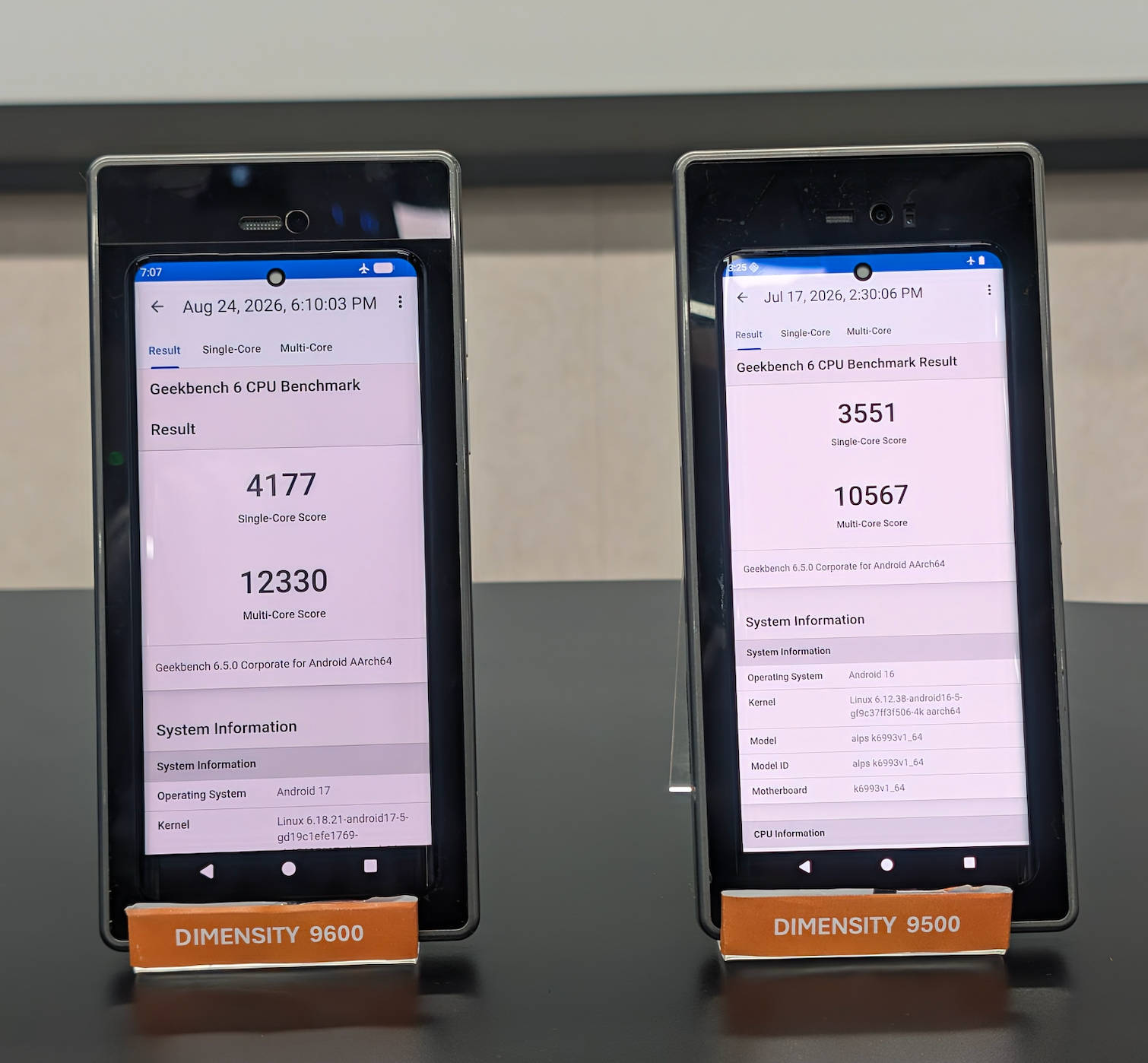
The move to a smaller process node and the new CPU architecture translate into higher performance, at least according to MediaTek’s early benchmark results. On Geekbench 6, the Dimensity 9600 Pro showed roughly an 18 percent increase in single-core performance and a 16 percent improvement in multi-core performance over the Dimensity 9500.
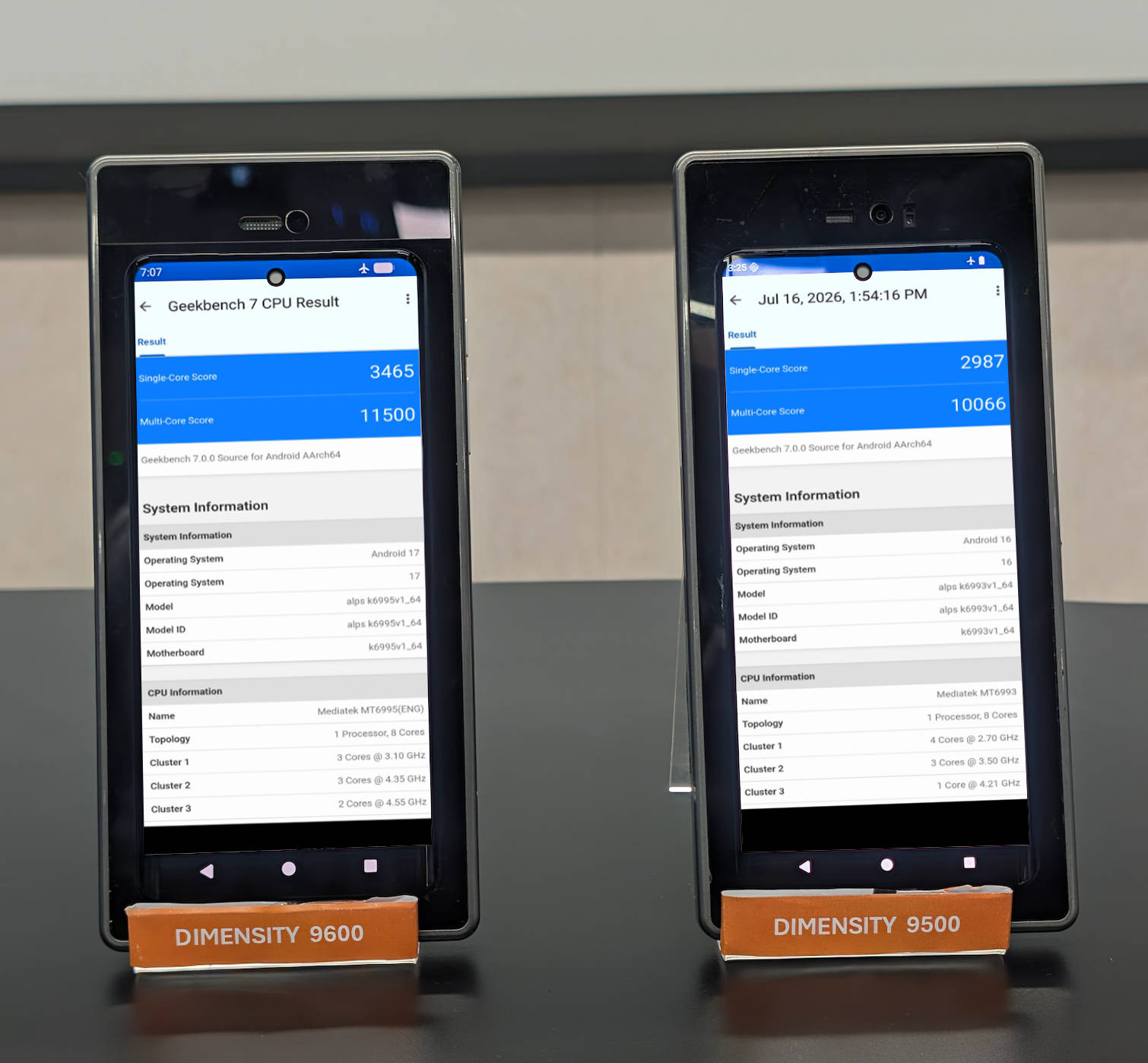
Early testing on the latest Geekbench v7 also points to an advantage in both single-core and multi-core performance over the Dimensity 9500. However, the difference is less pronounced at roughly 13 percent compared to the Geekbench 6 results. This is likely due to the revised scoring methodology and heavier workloads in the latest version of the benchmark. This doesn’t change the Dimensity 9600 Pro’s overall performance advantage.
The performance gains aren’t limited to synthetic benchmarks. MediaTek highlights 13 percent faster task completion in the 2.5W workload category, which covers everyday workloads such as UX scrolling and video playback, on the Dimensity 9600 Pro. The mid-tier 5W category delivers a claimed 12 percent improvement over the Dimensity 9500, while the 10W category gets a 10 percent performance boost for heavier workloads such as 4K video recording and intensive gaming.
AI at its cores, graphics, and more
With AI becoming an increasingly important smartphone selling point, MediaTek is putting more emphasis on the chipset itself. With the Dimensity 9600 Pro, the chipmaker is taking a more integrated approach to AI, bringing AI capabilities beyond the dedicated NPU and into the SoC’s major processing blocks. The company calls this its Native AI Architecture, which brings hardware and software together to enable more on-device AI capabilities.
The architecture integrates AI across four key areas:
- AI Compute Fusion Architecture: The CPU and NPU work together to handle computing workloads and support MediaTek’s Dimensity Sensing Foundation and NeuroPilot SDKs.
- Neural Graphics Architecture: The GPU and NPU work together to bring AI acceleration into the graphics pipeline, enabling AI-assisted graphics processing and rendering.
- AI Imaging Fusion Architecture: The ISP gets its own AI integration through dedicated blocks such as the Semantic Analysis Engine, True Colour Engine, and Fast-Focus Engine, which are designed to improve computational photography.
- Connectivity + AI: AI is also integrated into the connectivity stack to optimise modem and data paths, aiming to maintain more stable, low-latency connections.
The Dimensity 9600 Pro also uses a dual-NPU setup comprising the Super-efficient eNPU 2.0, which includes an integrated SensorHub, and the 10th-generation Super Performance NPU 1090.
MediaTek Dimensity 9600 Pro AI benchmark score
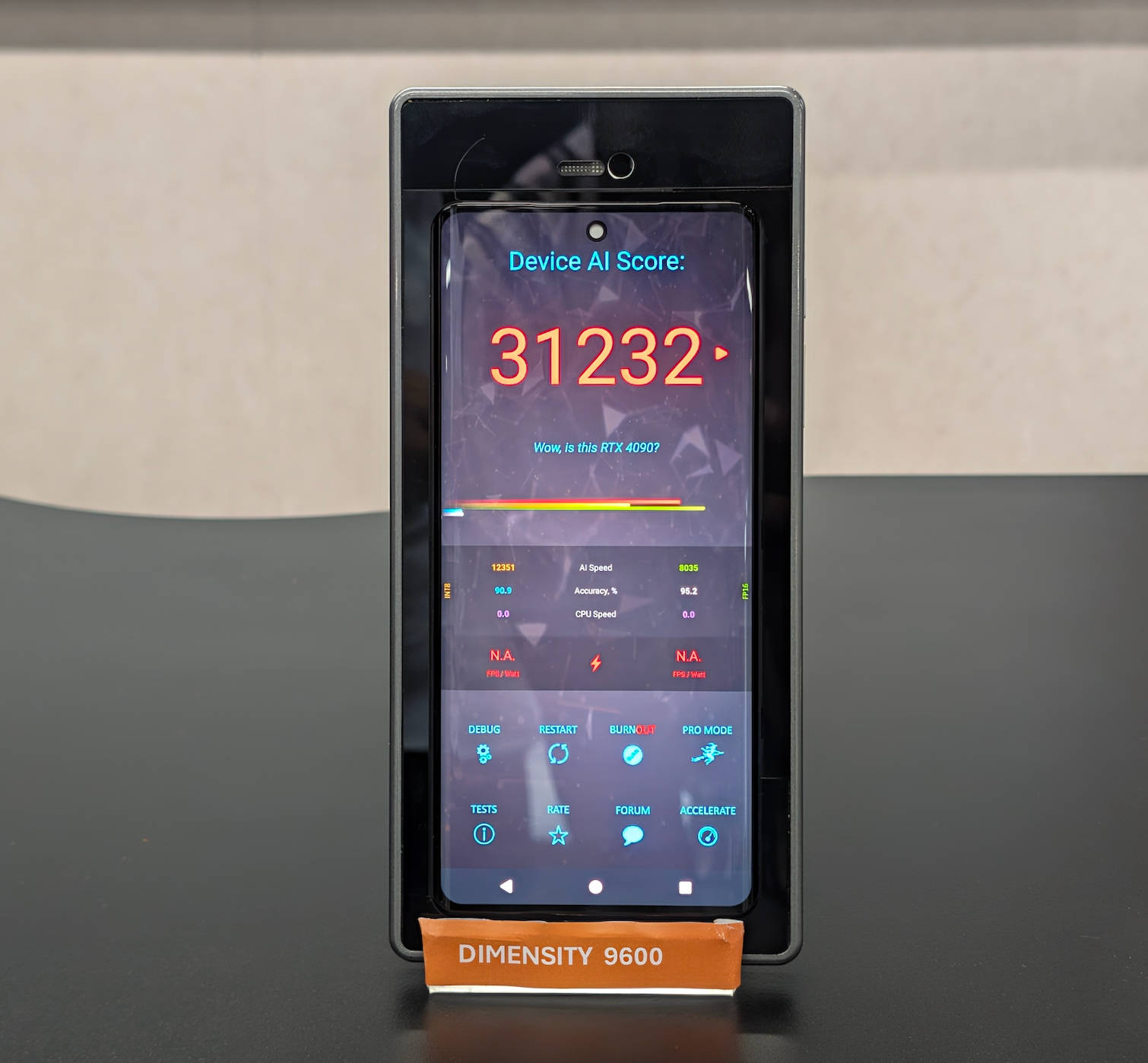
The AI improvements of the MediaTek Dimensity 9600 Pro are also reflected in its ETH Zurich AI benchmark results. The test evaluates AI performance across factors such as speed, reasoning, and accuracy through a series of workloads. While the overall Device AI score stands at 31,232, the SoC managed to achieve 20,455, which is roughly 18 percent higher than the Dimensity 9500’s SoC AI score.
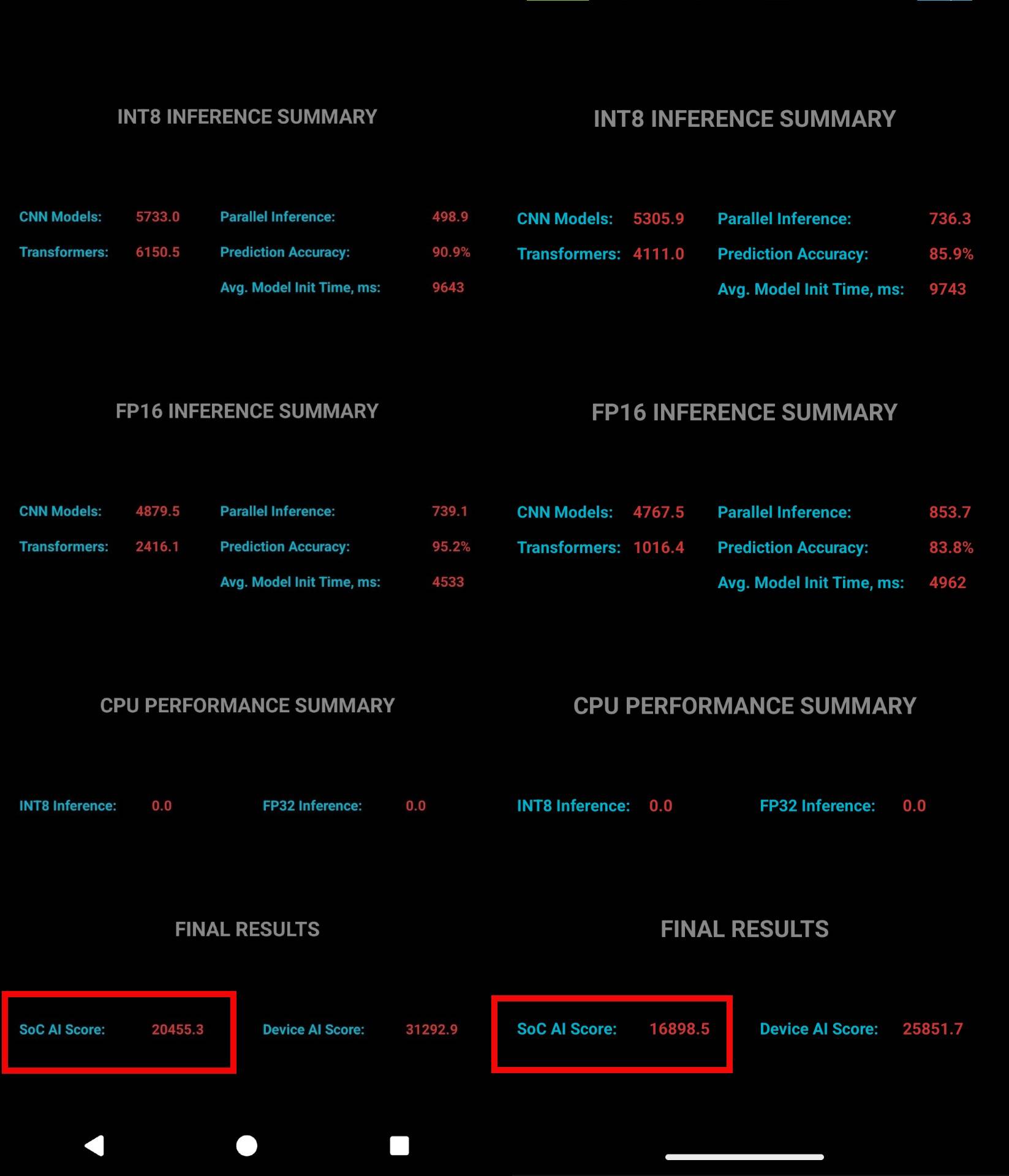
The higher score can also be attributed to the chipset’s native INT4 acceleration.
INT4 acceleration
The INT4 acceleration is another major highlight of the Dimensity 9600 Pro SoC. It’s a native four-bit integer precision format for on-device AI computation, which halves the bit-width compared with the previous-gen INT8 and roughly one-quarter that of FP16, for on-device Agentic AI and GenAI workloads such as image generation and real-time text generation.
INT4 uses lower-precision data to reduce the amount of memory and computational resources required to run AI models. MediaTek backed this with its TTFT (Time Taken First Token) test on a sample smartphone, which evaluates on-device Large Language Models (AI) by measuring how long it takes to output the first word or character after a request is sent. When contrasted with standard INT8 or FP16 tasks in Llama2 running at 12.7ms per token, the INT4 test drops initialisation times to under 10 milliseconds.
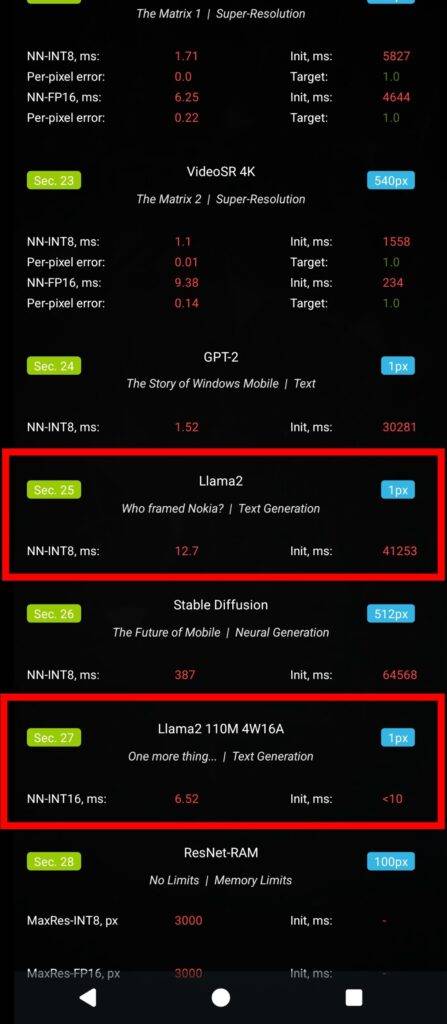
MediaTek says the Dimensity 9600 Pro can handle on-device Mixture of Experts (MoE) LLM inference, and its native INT4 support improves the efficiency of running these models on the device. The company claims up to 51 percent faster LLM performance and 40 percent better power efficiency.
For users, the bigger takeaway is that more AI processing can happen directly on the smartphone rather than relying entirely on the cloud. This could translate into faster responses and greater privacy for supported AI features, while the efficiency improvements should help limit the impact on battery life.
Gaming, ray tracing, and solar ray tracing
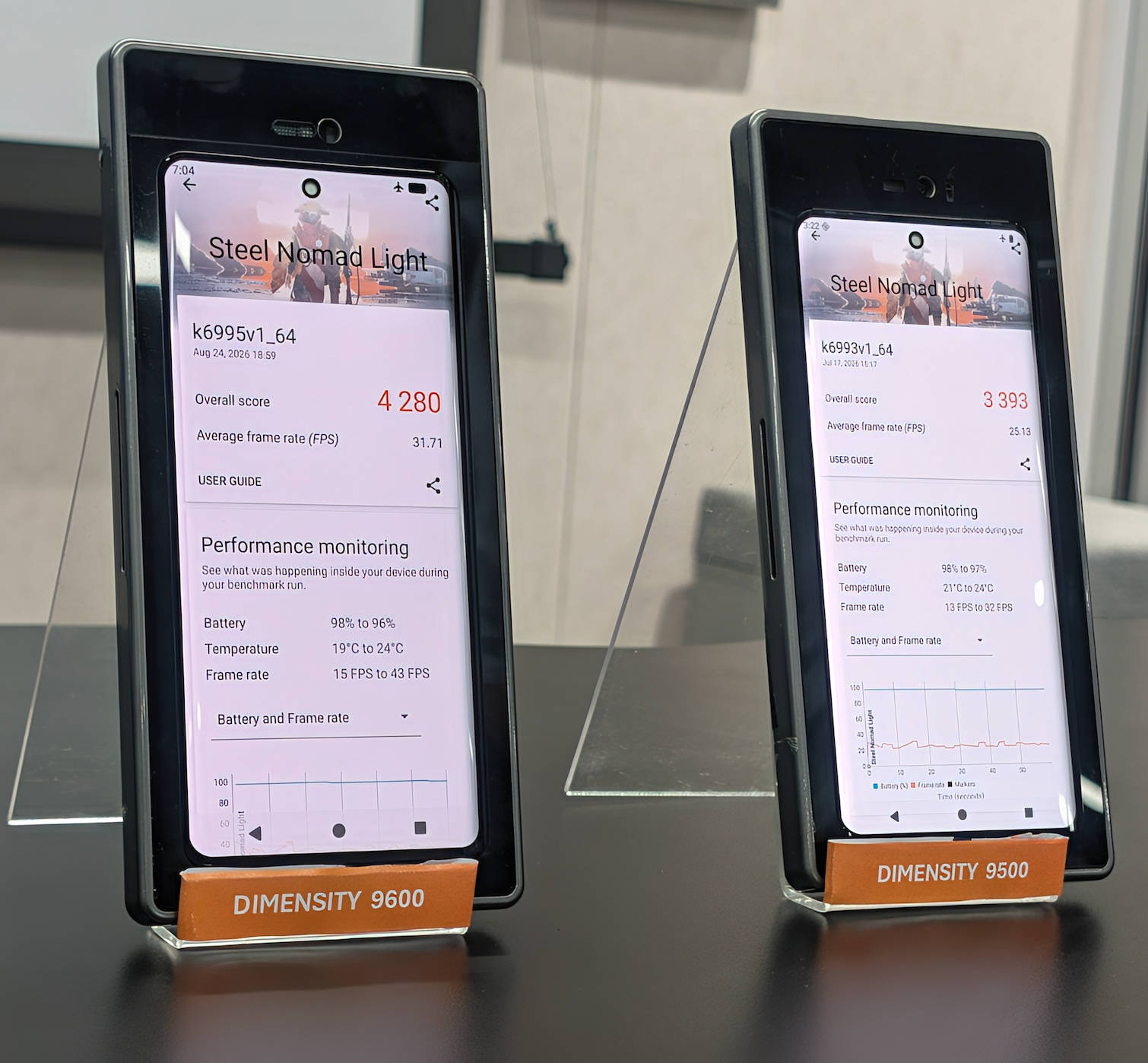
For flagship SoCs, one of the biggest challenges is handling demanding workloads like gaming over extended periods. To test the Dimensity 9600 Pro’s graphics performance, we used the 3DMark Solar Bay Extreme and Steel Nomad Light tests, which are designed to showcase improvements in graphics performance and hardware-accelerated ray tracing.
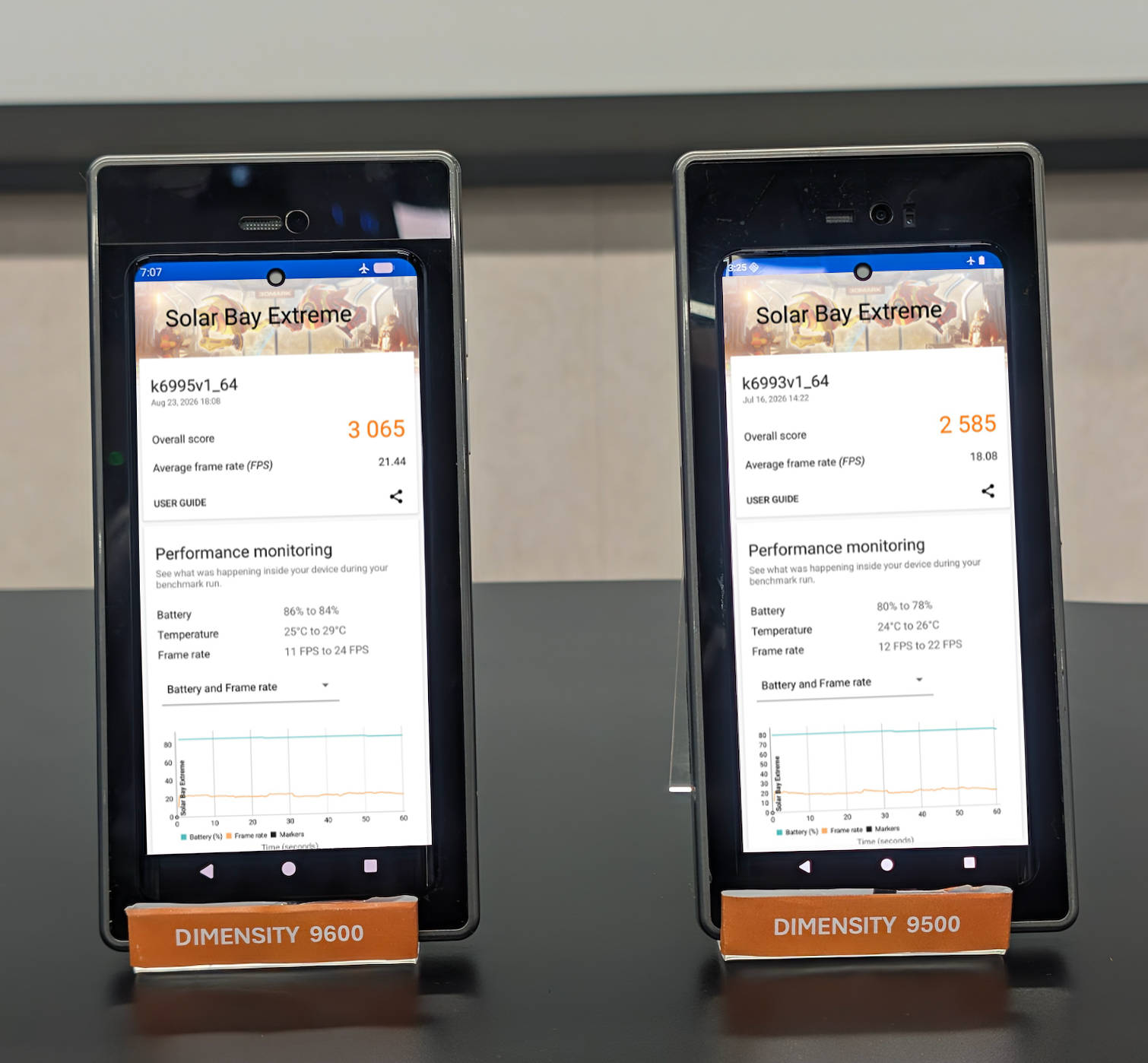
Both tests showed a notable improvement over the Dimensity 9500, with the Dimensity 9600 Pro scoring around 15 percent higher in Solar Bay Extreme and 26 percent higher in Steel Nomad Light. The tests also favour the new flagship SoC in terms of frame rates, which should translate into a smoother gaming experience. Based on our early testing, the Dimensity 9600 Pro appears capable of delivering on that promise.
The SoC features a 12-core Mali G2 Ultra NX GPU and Neural Graphics Architecture, with support for hardware-accelerated ray tracing. The aim is to deliver higher frame rates while also improving the quality of lighting, shadows and reflections in supported games.
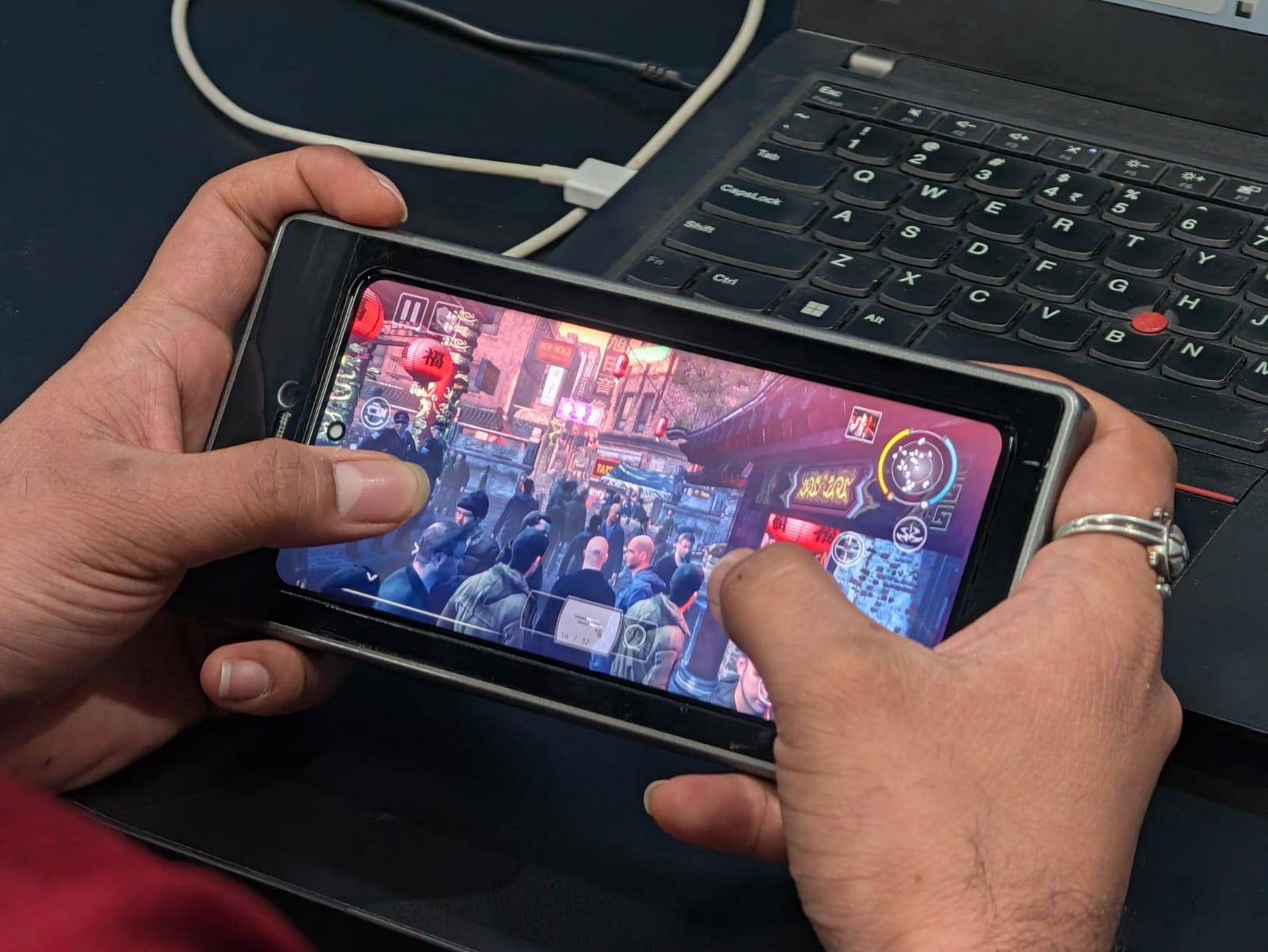
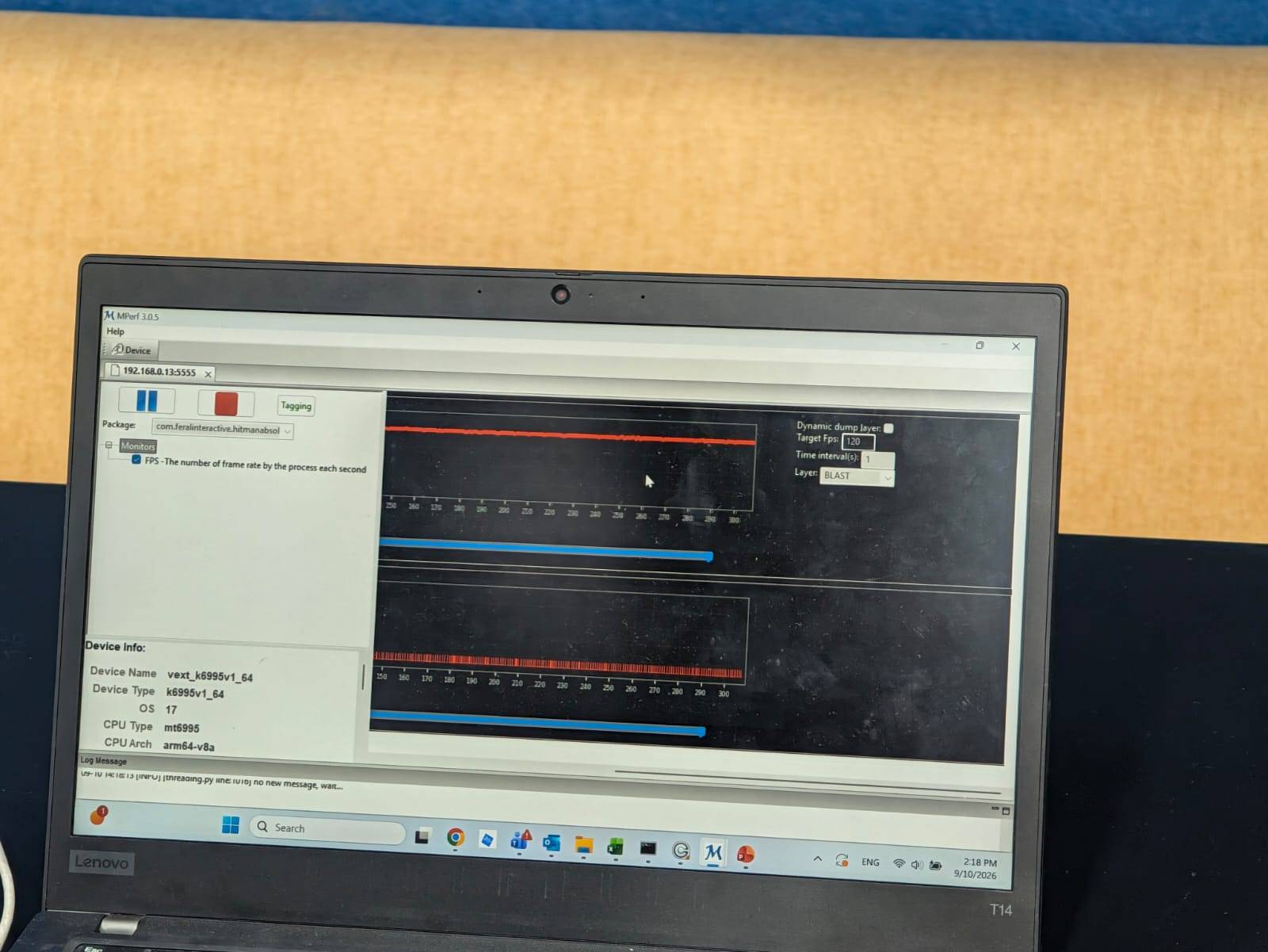
We tried a few games on the reference smartphone, which, notably, did not have an active cooling solution. The results were promising, with the Dimensity 9600 Pro sustaining maximum frame rates in demanding titles for 30 minutes or more. BGMI and Hitman Absolution maintained a consistent 120fps for an hour and 30 minutes, respectively, while Genshin Impact and Wuthering Waves remained locked at 60fps during their 30-minute sessions.
| Title | Session | FPS |
| Genshin Impact | 30 minutes | 60 |
| Wuthering Waves | 30 minutes | 60 |
| Hitman Absolution | 1 hour | 120 |
| BGMI | 1 hour | 120 |
Neural upscaling and 4K 240fps slow-mo video recording support
MediaTek is also using AI to address one of the biggest challenges in mobile gaming: balancing visual quality with performance and power consumption. Through its Neural Graphics Architecture, the Dimensity 9600 Pro can use dedicated AI acceleration to upscale lower-resolution game renders. For instance, a game could render at 540p and then upscale to 1080p output, reducing the GPU workload while maintaining a sharper image.
As a result, the games, with the MediaTek chipset, should deliver higher visual quality without requiring the GPU to render every frame at the target resolution. It could also help reduce power consumption and thermal load during extended gaming sessions. MediaTek claims that the Dimensity 9600 Pro’s power consumption is 24 percent less than its predecessor.
Furthermore, the MediaTek Dimensity 9600 Pro can handle more advanced computational photography and video-processing workloads. The SoC supports 4K 240fps slow-motion video recording, thanks to its upgraded ISP, AI processing capabilities, and memory architecture.
Thoughts…
The Dimensity 9600 Pro represents a major shift in the flagships MediaTek will power next year. By moving to TSMC’s 2nm process, using a dual-Prime-Core setup, and adding larger caches, MediaTek aims to deliver better performance and efficiency. With the addition of the dual-NPU setup and Native AI Architecture, the SoC also puts greater emphasis on on-device AI.
Our experience with the reference smartphone also suggests that the chipset has the performance headroom needed for demanding gaming and other intensive workloads, even without active cooling. However, the final experience will ultimately depend on how smartphone manufacturers tune the chipset, manage thermals and optimise their software.
With support for next-generation memory and storage standards, advanced ray tracing, on-device AI and high-frame-rate video capture, the Dimensity 9600 Pro is shaping up to be a substantial upgrade over the Dimensity 9500.