


Review Summary
Expert Rating

Xiaomi entered 2026 with a renewed sense of purpose for the Indian market, and nowhere is that more evident than in how it has approached the Redmi Note series this year. Instead of the usual one-shot launch, Xiaomi staggered releases, giving each model its own moment in the spotlight. The base Redmi Note 15 (review) arrived first, followed by the Pro (review) and Pro+ variants.
The Redmi Note 15 Pro+ sits at the top of this lineup and represents Xiaomi’s idea of a complete mid-range smartphone in 2026. Prices are no longer as disruptive as older Redmi Notes, partly due to the ongoing global memory chip crisis, but Xiaomi believes the Note 15 Pro+ delivers the best possible balance of features at its price point. After spending a few days with the device, here’s my full review.
Table of Contents
Design: familiar, but tougher than before
At first glance, the Redmi Note 15 Pro+ looks very similar to its predecessor. Xiaomi hasn’t experimented much with the overall design language, sticking to curved edges and the centrally aligned squircle camera module at the back. The Mocha Brown variant I tested features a leather finish that offers a grippy, premium in-hand feel. Personally, I like this finish over the Realme 16 Pro+’s soft-touch silicone back.
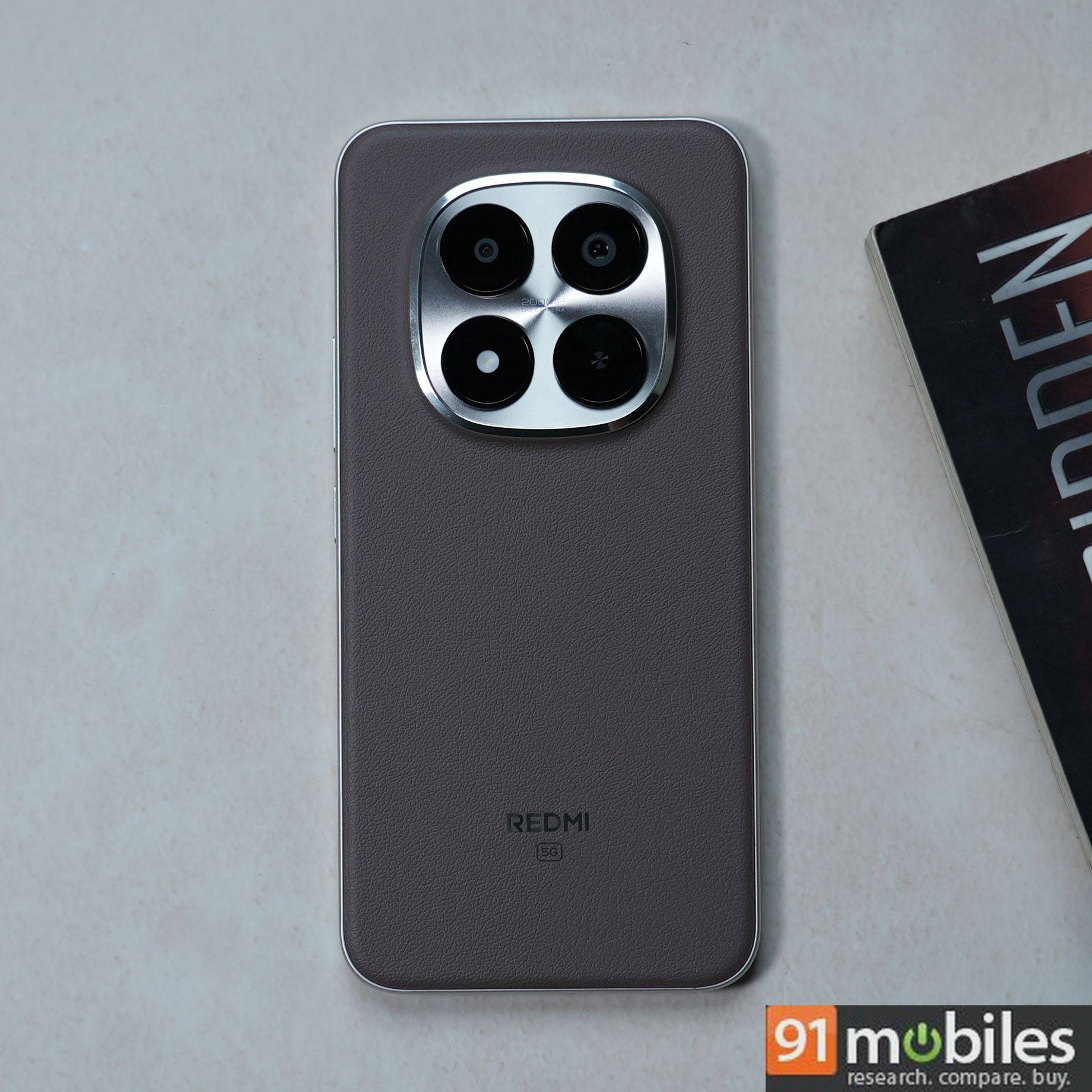
Where Xiaomi has made meaningful changes is under the hood. The new Redmi Titan Structure reinforces the phone’s internals to better withstand drops and bending forces. Durability has also been taken up a notch with an impressive set of ingress protection ratings — IP66, IP68, IP69, and IP69K. Compared to the IP68 rating on the previous model, this makes the Note 15 Pro+ one of the most rugged phones in its segment, at least on paper. I wasn’t able to test the phone in extreme conditions, but there is a greater sense of peace of mind knowing that it should withstand dust over time and splashes of water, whether you’re in the rain or underwater.
Display: big, bright, and immersive
The Redmi Note 15 Pro+ is unmistakably a big phone. Its 6.83-inch AMOLED display is larger than the 6.67-inch panel on the Note 14 Pro+ and is clearly aimed at users who prefer expansive screens for media consumption and gaming.

For watching videos and scrolling through social media, the display delivers a pleasing, immersive experience. The curved edges might not appeal to everyone, especially as premium phones move towards flatter designs, but in the mid-range segment, this aesthetic still seems to have strong appeal.
Performance: incremental but reliable
Powering the Redmi Note 15 Pro+ is the Snapdragon 7s Gen 4 chipset, an incremental upgrade over the Snapdragon 7s Gen 3 found in the previous generation. Built on a 4nm process, the processor offers peak clock speeds of up to 2.7GHz and promises roughly a 7 percent performance uplift.
In real-world use, the performance gains aren’t dramatic, but that’s not necessarily a bad thing. The phone handles everyday tasks like browsing, messaging, and media consumption smoothly. Apps open and close about as quickly as you can expect from a sub-Rs 40,000 phone. And switching between apps is quick, with no noticeable slowdowns during regular use.




Gaming performance is respectable for the segment. Popular titles run well at medium to high settings, though this isn’t a phone designed for sustained high-end gaming. Thermal management is decent, and while the phone does warm up during longer gaming sessions, it never becomes uncomfortable to hold.
But if raw performance is what you’re after, then the Redmi Note 15 Pro+ might not be the phone for you. In this segment, you have the likes of the OPPO K13 Turbo Pro, OnePlus Nord 5, Realme GT 7, and POCO F7, which are significantly faster, though slightly older now.
Software: Android 16 would have been nice
The Redmi Note 15 Pro+ runs Xiaomi’s HyperOS 2 layered over Android 15. In everyday use, the software feels stable and predictable, with fluid animations and no major hiccups during my time with the phone. Like most Xiaomi devices, it ships with a fair amount of pre-installed apps, though it’s easy enough to uninstall the ones you don’t need and silence unnecessary notifications for a cleaner setup.

That said, Xiaomi does make up for it in long-term support. The Redmi Note 15 Pro+ is promised four major Android updates and six years of security patches, which should keep the phone relevant well into the Android 19 era.
Cameras: the 200MP gamble
Cameras are where Xiaomi has made its biggest bet this year. The Redmi Note 15 Pro+ features a new 200MP HPE primary sensor with optical image stabilisation. This sensor enables 2x and 4x optical-level zoom, relying on high-resolution cropping rather than a dedicated telephoto lens. Alongside the main camera is an 8MP ultra-wide lens. There’s no telephoto camera this time, which is a slight downgrade on paper, but Xiaomi is confident the high-resolution primary sensor can make up for it.



The 2x and 4x zoom modes are usable, delivering clean results that hold up well for social media and casual viewing. The ultra-wide camera is serviceable but clearly a step behind the primary sensor in terms of detail and colour consistency.







I wasn’t too pleased with the portraits I captured in daylight. While they look fine on first glance with good colour tuning, a closer look reveals softer facial details and a lack of fine texture, especially when capturing human subjects. My colleague Dhruv noticed the same issue on the Redmi Note 15 Pro, which makes sense considering both phones have identical rear cameras.
Low-light performance is also a mixed bag. While the main camera can capture usable images with night mode enabled, results aren’t always consistent, and details can take a hit in very dim conditions. The upgraded 32MP front camera, up from 20MP on the previous model, delivers sharper selfies with better facial detail, especially in good lighting.
Another thing worth noting is that switching between shooting modes, especially between Photo and Portrait, on the Redmi Note 15 Pro+ took considerably longer than on the Realme 16 Pro+. This added wait time does hamper the photography experience, especially when you’re trying to capture a fleeting moment. One hopes the brand is able make this more seamless via a software update.
Here’s a quick look at how the Redmi Note 15 Pro+ holds up against the Realme 16 Pro+ in various scenarios.
Daylight
In daylight, the Realme 16 Pro+ captures a brighter image with better colour reproduction and dynamic range. Details are better, too, with the red tiles on the building looking sharper and better defined when zooming in.


Wide-angle
Both the Redmi Note 15 Pro+ and Realme 16 Pro+ use a similar 8MP wide-angle lens for ultrawide shots. However, the Redmi phone pulls slightly ahead by capturing sharper ultrawide shots with a slightly better dynamic range.


Portraits
Here, the lack of a telephoto lens does make a difference, as a portrait captured by the Redmi Note 15 Pro+ shows poor facial details and edge detection compared to the one captured by the Realme 16 Pro+.


Selfie
Selfies look clearer and sharper, especially of the face and hair, on the Realme 16 Pro+ owing to the 50MP sensor compared to the 32MP camera on the Redmi Note 15 Pro+.


Low-light
In low-light scenes with night mode enabled, the Realme 16 Pro+ handles exposure well, producing a brighter, clearer image than the Redmi Note 15 Pro+, with less lens flare.


Battery and charging: better endurance, faster charging
Battery life has always been a strong point of the Redmi Note series, and the Note 15 Pro+ continues that tradition. The phone packs a 6,500mAh battery, up from the 6,200mAh unit on its predecessor.



Charging speeds have also been upgraded. The phone supports 100W fast charging, up from 90W previously. In testing, the Redmi Note 15 Pro+ charges from 20 to 100 percent in about 38 minutes, which is among the fastest in the segment. The only phones that charge faster are the older phones like the Realme GT 7, iQOO Neo 10, and Vivo T4 Ultra, based on our in-house testing.
Verdict: Should you buy the Redmi Note 15 Pro+?
As a sub-Rs 40,000 phone, the Redmi Note 15 Pro+ is a solid all-rounder that builds on what made the Redmi Note 14 Pro+ work. It doesn’t try to outmuscle rivals on raw performance, nor does it radically rethink the Redmi Note formula. Instead, it focuses on areas that matter to a large chunk of mid-range buyers: a big and bright display, excellent battery life, fast charging, and a reassuringly durable build.
The 200MP camera is a calculated upgrade that mostly pays off for still photography, even if portraits and low-light consistency leave room for improvement. Performance is dependable rather than exciting, and while HyperOS remains stable, the lack of Android 16 out of the box feels like a miss at this price.
Overall, the Redmi Note 15 Pro+ is an easy choice for anyone looking for a large, long-lasting, and well-rounded mid-range phone with strong fundamentals. If you’re currently using the Redmi Note 14 Pro+, consider upgrading only if a larger battery and long-term software support are your priorities. If you’re using an older Redmi phone, the base Redmi Note 15 Pro might offer more value as it gets the same rear camera system, display, and durability as the Pro+. And for those seeking raw power, you might want to consider slightly older rivals, such as the OPPO K13 Turbo Pro, OnePlus Nord 5, or POCO F7.
Editor’s rating: 8.1 / 10
Pros:
- Large, bright AMOLED display with excellent outdoor visibility
- Solid battery life with very fast 100W charging
- Improved durability with multiple IP ratings
- Strong daylight photography from the 200MP primary camera
Cons:
- Performance lags behind some similarly priced rivals
- Portrait and human subject detail could be better
- No telephoto camera
- Ships with Android 15 instead of Android 16
 | vs |  |
| vs |  |