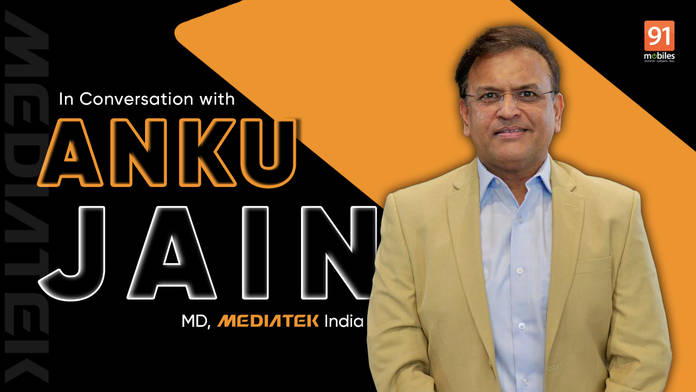
MediaTek has just announced the launch of its flagship mobile SoC, the Dimensity 9500, with the OPPO Find X9 series being the first set of smartphones to rock this new chipset. Apart from raw performance, the new chip promises unmatched capabilities in a bunch of areas, including on-device AI, gaming, and power efficiency. We caught up with Anku Jain, Managing Director, MediaTek India, at IMC 2025 to get his side of the story, with the conversation covering chipset capabilities, OEM partnerships, AI evolution, R&D efforts, and more.
Q: Can you tell us about the Dimensity 9500 and what makes it stand out?
The Dimensity 9500 is MediaTek’s latest flagship chipset, launched last month and showcased recently at IMC. It focuses on performance and power efficiency, thanks to its advanced architecture. However, what truly stands out is its gaming and AI performance.
The chipset offers console-level gaming experiences. Powered by the Mali-G720 Ultra GPU, it supports ray tracing and demanding titles like Arena Breakout at 60 fps. It contains twice the number of ray tracing units (RTUs) compared to its predecessor, allowing for realistic lighting and reflections. Gamers will immediately notice smoother graphics and more immersive gameplay.
Q: And what about AI features — how has MediaTek advanced in this area?
The Dimensity 9500 introduces a new architecture called SME2, a matrix multiplication mechanism that allows certain AI workloads to run directly on the CPU instead of being offloaded to the NPU. This improves both performance and energy efficiency. The chipset can even create 4K-quality images on-device without cloud processing, showcasing its on-edge AI capabilities.
It delivers around 52 percent better power efficiency compared to the previous generation, with major gains in computing performance across CPU and GPU tasks.
Q: You mentioned partnerships and upcoming flagship devices. Which OEMs are adopting the Dimensity 9500?
MediaTek’s flagship journey began with the Dimensity 9000 series, and the company now partners with major brands including OPPO, Vivo, Xiaomi, Samsung (for tablets), Realme, and iQOO. The newly announced OPPO Find X9 series will be among the first to feature the Dimensity 9500, with more launches expected soon.
Q: OPPO and Vivo have consistently used MediaTek chips in their flagships. How do you view this continued trust?
It’s a strong reflection of confidence in our technology. These brands have been using MediaTek’s flagship platforms to power their top-tier devices, proving that performance, AI, camera, and gaming capabilities meet global flagship standards.
Q: Speaking of AI, how do you see consumer AI features evolving in smartphones?
The quality of AI functions like summarisation, translation, and transcription is improving rapidly. We can now record meetings and generate instant summaries or highlights. Over the next year, we expect significant quality improvements as underlying large and small language models evolve. The Dimensity 9500 is designed to support advanced on-device AI and large model execution efficiently.
Q: Let’s talk about MediaTek’s R&D presence in India. What’s happening on that front?
MediaTek has over 4,000 engineers across Bengaluru and Noida working on hardware and software design. Indian R&D teams contribute directly to global projects across chipsets for smartphones, smart TVs, routers, and connectivity solutions. The India centres are integral to MediaTek’s global innovation network.
Q: Beyond smartphones, what are some of the other product segments where MediaTek is active?
Smartphones make up about 50 percent of MediaTek’s global revenue (around $17.4 billion last year). The rest comes from segments like smart TVs—where MediaTek is the global leader—Chromebooks, routers, Wi-Fi solutions, and projectors like those from Lumio. MediaTek powers devices across a wide range of consumer electronics categories.
Q: What about the automotive segment?
MediaTek is steadily expanding in automotive electronics, focusing on in-car entertainment and telematics. Partnerships already exist with brands like Tata and Jaguar Land Rover. Automotive, along with data centres and custom ASICs, are identified as future growth engines for the company.
Q: What’s your view on India’s semiconductor manufacturing ecosystem?
MediaTek remains a fabless company, meaning it designs but does not manufacture chips. However, India’s growing semiconductor ecosystem is promising. After many false starts, we’re now seeing tangible progress with investments and fab construction. This will strengthen the local supply chain and could lead to future synergies with companies like MediaTek.