
Movie |
World War Ii
Disclaimer: All content and media belong to original content streaming platforms/owners like Netflix, Disney+ Hotstar, Amazon Prime Videos, JioCinema, SonyLIV etc. 91mobiles entertainment does not claim any rights to the content and only aggregate the content along with the service providers links.

1951
Best Film Editing | 1950
Best Director | 1950 | William A.
Best Actor in a Supporting Role | 1950 | James
Best Picture | 1950
Best Written American Drama | 1950
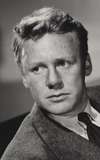
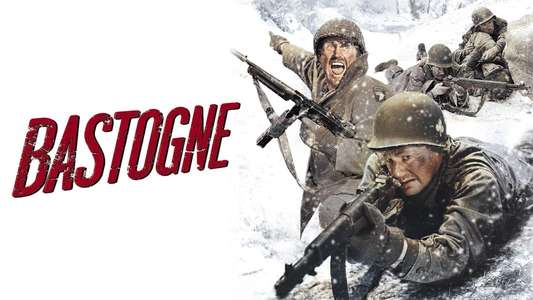
James Arness (Garby) served in World War II and is the most decorated of the actors in the film. He received the Bronze Star, the Purple Heart, the European-African-Middle Eastern Campaign Medal with three bronze campaign stars, the World War II Victory Medal, and the Combat Infantryman Badge for his service.
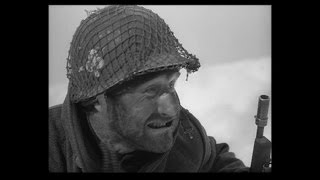
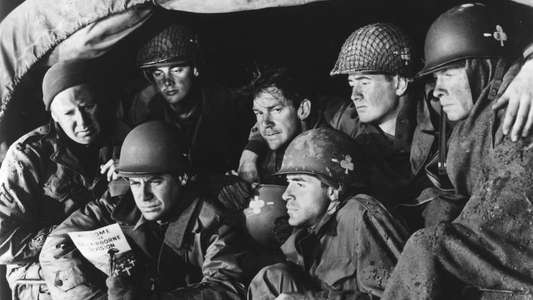
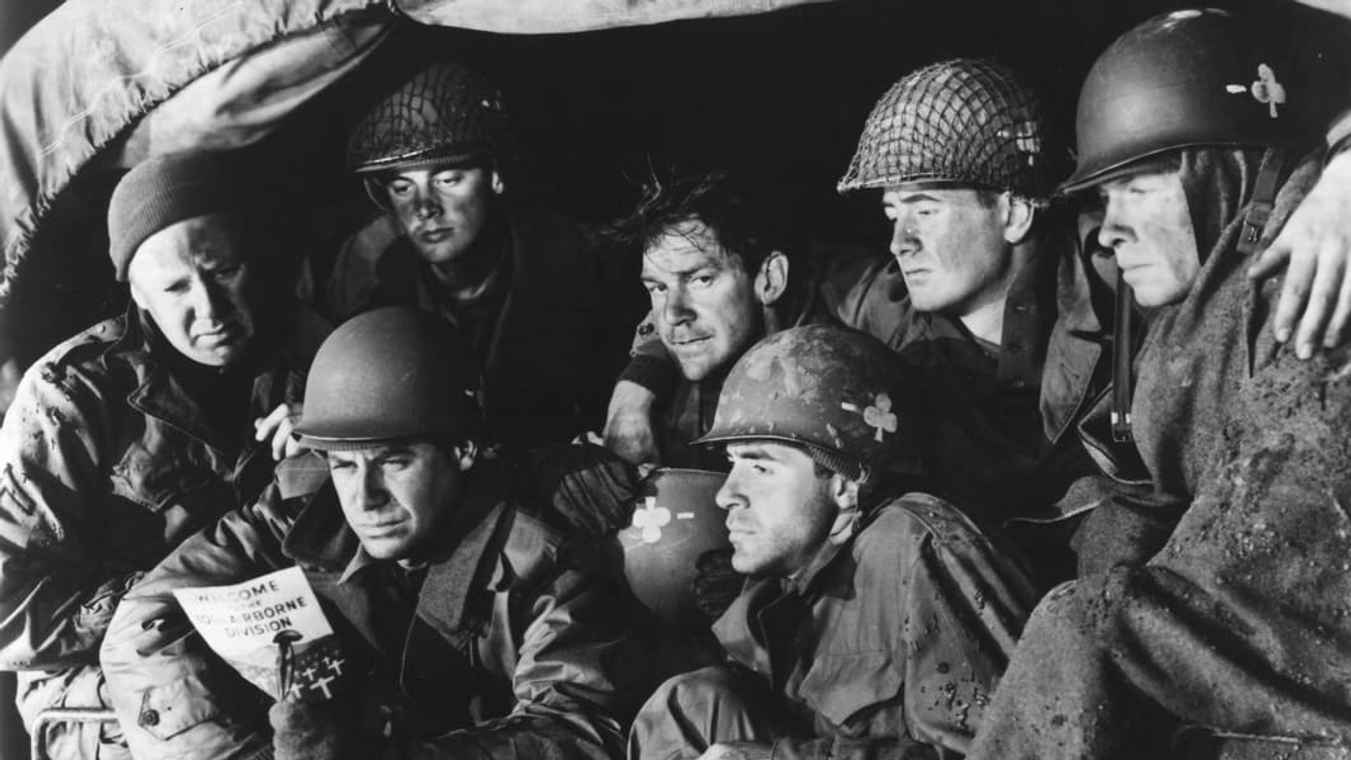
The white "card suit" stencils on the sides of the soldier's helmets in the film are accurate. The World War II 101st Airborne Division used the different suits to identify their three parachute infantry (diamonds, hearts, and spades) and one glider infantry (clubs) regiments. A white "tic" at either the twelve, three, six or nine o'clock positions around the suit indicated Headquarters, 1st, 2nd, or 3rd Battalions, respectively. The soldiers in this film wear the club suit of the 101st's 327th Glider Infantry Regiment, with a "tic" at the nine o'clock position, indicating they belong to that regiment's 3rd Battalion.
Douglas Fowley (Private Kippton, he of the continually lost false teeth) served in the Navy in the South Pacific in World War II, and lost all of his own teeth in an explosion aboard his aircraft carrier during battle.
Screenwriter Robert Pirosh based this story on his experiences as an infantryman during the Battle of the Bulge. Pirosh did not serve with the 101st Airborne, and wanted to create a script that was faithful to their experiences. He used his first-hand knowledge of the battle to write the script. This was done with the blessing of General Anthony McAuliffe, who was commanding the 101st during the siege of Bastogne. Consequently, many of the incidents in the film, such as Private Kippton's habit of always losing his false teeth, or the Mexican-American soldier from Los Angeles, California, who had never seen snow until he got to Belgium, that have always been derided as "typical Hollywood phony baloney" actually happened.
Twenty veterans of the 101st Airborne, who fought in the Bastogne area, were hired to train the actors, and were also used as extras.
"[last lines] Holley: [as they begin marching from the battlefield, passing their replacements as they enter] Hey, Kinnie - what ever happened to Jody? Sgt. Kinnie: All right, come on! Come on! What do you want these guys to think, you're a bunch of WACs? Alright, alright pick it up now. Hut, two, three. Hut, two, three, four. Hut, two, three, four. You had a good home but you left... I Company: You're right! Sgt. Kinnie: You had a good home but you left... I Company: You're right! Sgt. Kinnie: Jody was there when you left... I Company: You're right! Sgt. Kinnie: Your Baby was there when you left... I Company: You're right! Sgt. Kinnie: Sound off! I Company: One, two Sgt. Kinnie: Sound off! I Company: Three, four. Sgt. Kinnie: Cadence Count I Company: One, two, three, four. One, two, three, four! Sgt. Kinnie: Your baby was lonely - as lonely as could be... I Company: 'Til Jody provided company! Sgt. Kinnie: Ain't it great to have a pal... I Company: Who works so hard to keep up morale! Sgt. Kinnie: Sound off! I Company: One, two Sgt. Kinnie: Sound off! I Company: Three, four. Sgt. Kinnie: Cadence Count I Company: One, two, three, four. One, two, three, four! Sgt. Kinnie: You ain't got nothing to worry about... I Company: He'll keep her happy till I get out! Sgt. Kinnie: But you won't get home 'til the end of the war... I Company: In nineteen hundred and seventy-four! Sgt. Kinnie: Sound off! I Company: One, two. Sgt. Kinnie: Sound off! I Company: Three, four..."
"The Chaplain: [at an interfaith service for the soldiers] Now it's nearly Christmas... and here we are in beautiful Bastogne enjoying the winter sports. And the $64 question is: "Was this trip necessary?" I'll try to answer that. But my sermons, like everything else in the army... depend on the situation and the terrain. So I assure you this is going to be a quickie. Was this trip necessary? Let's look at the facts. Nobody wanted this war but the Nazis. A great many people tried to deal with them, and a lot of them are dead. Millions have died... for no other reason except that the Nazis wanted them dead. So, in the final showdown, there was nothing left to do except fight. There's a great lesson in this. Those of us who've learned it the hard way aren't going to forget it. We must never again let any force dedicated to a super-race... or a super-idea, or super-anything... become strong enough to impose itself upon a free world. We must be smart enough and tough enough in the beginning... to put out the fire before it starts spreading. My answer to the sixty-four dollar question is yes, this trip was necessary. As the years go by, a lot of people are going to forget. But you won't. And don't ever let anybody tell you you were a sucker to fight in the war against fascism. And now, Jerry permitting, let us pray. Almighty God... [artillery drowns him out] The Chaplain: The organist is hitting those bass notes a little too loud for me to be heard. So let each of us pray in his own way, to his own God."