
Movie |
Part Live Action | Live Action And Animation
Disclaimer: All content and media belong to original content streaming platforms/owners like Netflix, Disney+ Hotstar, Amazon Prime Videos, JioCinema, SonyLIV etc. 91mobiles entertainment does not claim any rights to the content and only aggregate the content along with the service providers links.

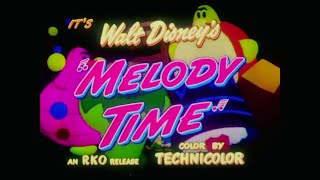
1948 | Walt
Budget 2,000,000 USD
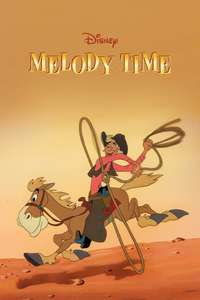
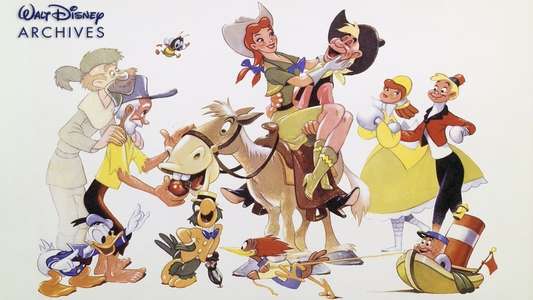
Because of the controversy about cowboys smoking, the "Pecos Bill" segment was heavily edited for release to DVD. In the original film Bill is seen smoking a cigarette in several sequences. The cigarette was edited out in each case, resulting in the removal of almost the entire tornado sequence and some odd hand and mouth movements for Bill throughout. These scenes have since been restored in a recent American Blu-ray release.
The segment "The Legend of Johnny Appleseed" is one of the rare Disney animated works based on a historical figure. Johnny Appleseed is the historic nickname of John Chapman (1774-1845), a frontiersman credited with introducing the apple tree to the areas of modern Illinois, Indiana, Ohio, Ontario, Pennsylvania, and West Virginia.
During the making of this movie, when composer Ken Darby presented the music for the "Johnny Appleseed" segment to Walt Disney, Walt scorned the music, as sounding "like New Deal music," to which an enraged Darby shouted back, "THAT is just a cross-section of one man's opinion!" Darby would not be at the studio much longer after that.
As the real John "Johnny Appleseed" Chapman strictly followed his church's dietary doctrine, he could not use techniques like grafting to improve his apples, and had to grow them from the seeds; hence, they were useless as food due to the small size and bitter taste and could only be used for making cider. They could never have been used for making pies as the apple song claims. The cider was actually far more nutritious and safe to drink than the water available in the areas Johnny visited, so by selling his apple seeds to the locals, Johnny actually saved hundreds of lives.
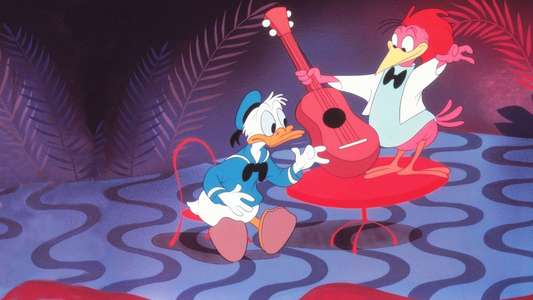
This was the third film to team up Donald Duck and José Carioca, following Saludos Amigos (1942) and The Three Caballeros (1944).
"[introduction to "Blame It On the Samba"] Master of Ceremonies: The intoxicating rhythm of the samba. A talented miss serves a musical cocktail with a true Latin American fling. So if three boisterous birds of a feather fall under the influence of this torrid tropical tempo, don't blame them, blame it on the rhythm of the samba."
"[introduction to "Little Toot"] Master of Ceremonies: There's drama, there's excitement, and there's harmony for three in a story of adventure on the sea. Now, featured in this epic is a ship of proud design. No, it's not this ocean liner. We take a different line. So with a huff and a puff and a chug-chug-chug, and a perky little hoot, we introduce our hero, the tugboat, Little Toot."