
HTC Desire 816G
+ Compare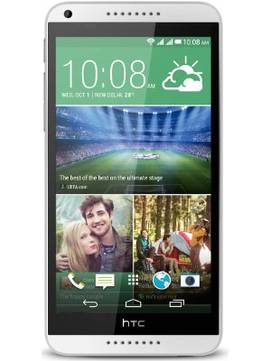
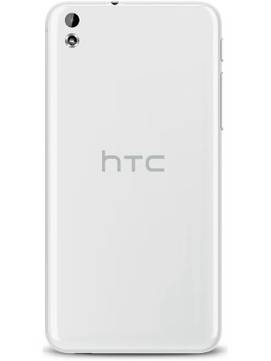
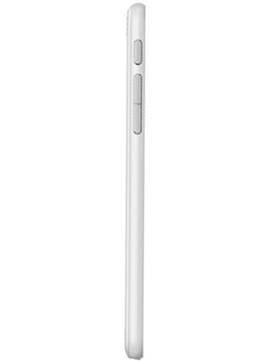
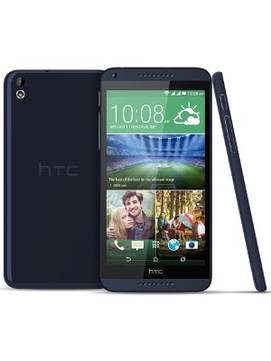
-
Design4

-
Rear Camera8

-
UI Screenshot14

-
Benchmarks8
![Benchmarks]()
-
Videos1
![Videos]()

Key Specs
Performance
-
MediaTek MT6582 -
Quad Core, 1.3 GHz -
1 GB RAM
Display
-
5.5 inches (13.97 cm); S-LCD -
720x1280 px (HD)
Rear Camera
-
Single Camera Setup - 13 MP Primary Camera
-
LED Flash -
Full HD @30 fps Video Recording
Front Camera
-
5 MP -
Full HD @30 fps Video Recording
Battery
-
2600 mAh, Li-Polymer
General
-
SIM1: Nano -
5G Not Supported -
8 GB internal storage, Expandable upto 32 GB
HTC Desire 816G Prices in India
 Flipkart
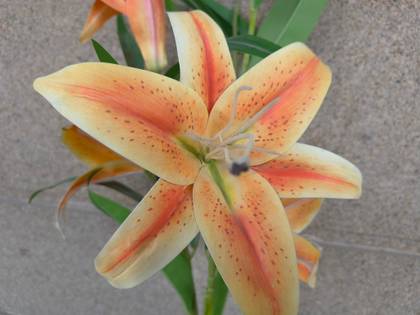
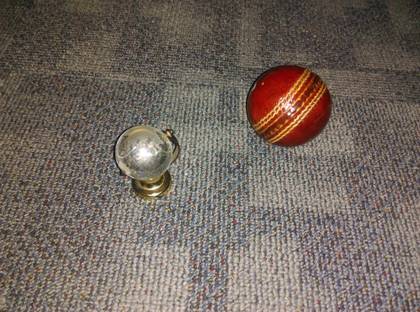
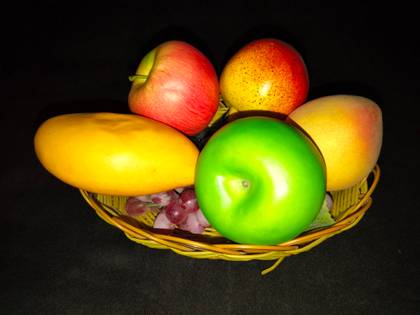
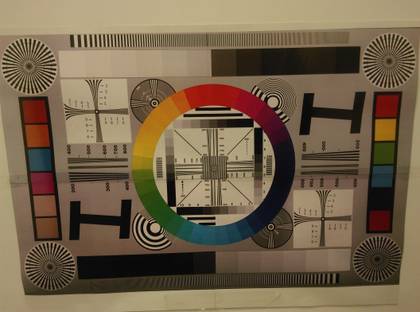
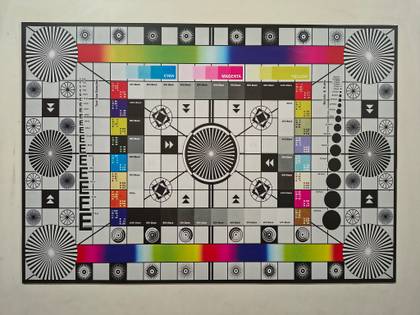
HTC Desire 816G Compare Camera Samples




HTC Desire 816G Expert Review Summary
Expert Rating:
![Nitansh Rastogi]()
Verdict
Compared to HTC of 2013, this year the brand seems to be willing to make more bets. It has jumped on several trends like selfies, 64-bit processing as well as launching a number of variants of its products. Phablets being a hot category these days, HTC took an interesting approach to reach more consumers by introducing a lower-priced variant of the extremely popular Desire 816. What s further appreciable is the fact that the Desire 816G doesn t come across as a watered-down variant of its siblin
Pros
- Good design
- Lightweight
- Good imaging experience
Cons
- Glossy body
- Slightly low on performance compared to its sibling
Specs at a glance
+
156.6 x 78.7 x 8mm 158g 5.5-inch display, 1,280 x 720 pixels (~267ppi) 1.3GHz quad-core processor 1GB RAM 8GB onboard storage, expandable up to 32GB 13-megapixel rear camera with an LED flash 5MP front-facing camera Dual-SIM support with 3G compatibility on first slot Wi-Fi, Bluetooth 4.0 and GPS 2,600mAh battery Android 4.4 with HTC’s Sense customisation
Read More
What's the same: design, display and cameras
+
Phablets are in vogue these days, and the Desire 816G falls in the same category with its large 5.5-inch display. The display bears a resolution of 1,280 x 720 pixels and offers excellent visuals, even though the pixel density is slightly on the lower side at 267ppi. In terms of design, the device is a carbon copy of its sibling, with the front being home to the display, flanked by BoomSound speakers at the top and bottom. All the buttons are placed on the left edge, whereas the right spine hides slots for the SIM cards and a microSD card behind plastic flaps. Since most of the devices offer the power button on the right side, it takes some time getting used to this placement on the Desire 816G. It's also quite difficult to reach for when the smartphone is being used one-handed, since it's placed high up on the side. Even though it's a phablet, the 816G's weight makes you believe otherwise, since it is well-distributed, tipping the scales at 158g – 7g lesser than its sibling. It's also quite thin at 8mm. The unibody smartphone fits well in the hand, although the glossy finish makes it quite slippery. The camera duo on both the phones is also the same, with a 13-megapixel sensor at the back and a 5-megapixel camera in the front. The camera app's interface in the Desire 816G is also same as the 816, allowing you to choose between different modes and manipulate settings like ISO, exposure, etc.Both the snappers result in decent photographs. Here's a look at a few of the images captured with the Desire 816G.
Read More
What's different: hardware and connectivity
+
Interestingly, while both the devices run Android KitKat 4.4 as the underlying OS, it seems that their Sense overlays stand at different versions. The Desire 816 features the latest Sense 6 customisation, whereas the 816G gets the older version. It doesn't impact the usability at all, but we're still wondering why the brand has gone with the older Sense iteration on the newer device. To make the Desire 816G more affordable, HTC has traded the Snapdragon 400 chipset in its sibling for a MediaTek MT6572 SoC. The MediaTek chip is a popular choice amongst Indian manufacturers for their budget offerings, and houses four cores running at 1.3GHz. The RAM has also been reduced to a gigabyte from 1.5GB.But that's not to say you should be worried about the performance. The phablet offers a smooth user experience, with no lags encountered in normal usage. There were no problems while switching between different tasks or browsing a heavy website either. However, one area where we felt the phone didn't do full justice was on the gaming front. In more intensive titles like Riptide GP2, we noticed that the rendering wasn't as smooth as it should be. For some reason, there were also instances where the game started looping between two frames constantly. Like all MediaTek-powered phones, the device heats up in minutes when playing a game.Internal storage remains the same as 8GB, out of which the end user will be able to access 4.33GB. There's also an option to extend it further up to 32GB via a microSD card. In comparison, its pricier brother supported memory cards of up to 128GB. With the USB OTG support, you can make use of flash drives to connect to the HTC Desire 816G.There's also a difference in the two handsets when it comes to the connectivity aspect. The Desire 816 is one of the best smartphones if you're looking for CDMA compatibility. The Desire 816G on the other hand, has the usual cellular connectivity with support for 3G on the first SIM slot and the other SIM compatible with 2G networks. Wi-Fi, Bluetooth 4.0 and GPS round off the connectivity department.The change in internals does seem to impact the battery life of the phablet. Although it delivered a day's worth of backup on moderate usage, in our standard battery test, the HTC Desire 816G churned out an average result of six hours and 30 minutes when we played back a 720p video on loop.
Read More
Read full Review

Verdict
Compared to HTC of 2013, this year the brand seems to be willing to make more bets. It has jumped on several trends like selfies, 64-bit processing as well as launching a number of variants of its products. Phablets being a hot category these days, HTC took an interesting approach to reach more consumers by introducing a lower-priced variant of the extremely popular Desire 816. What s further appreciable is the fact that the Desire 816G doesn t come across as a watered-down variant of its siblin
- Good design
- Lightweight
- Good imaging experience
Pros
- Glossy body
- Slightly low on performance compared to its sibling
Cons
Specs at a glance
+156.6 x 78.7 x 8mm 158g 5.5-inch display, 1,280 x 720 pixels (~267ppi) 1.3GHz quad-core processor 1GB RAM 8GB onboard storage, expandable up to 32GB 13-megapixel rear camera with an LED flash 5MP front-facing camera Dual-SIM support with 3G compatibility on first slot Wi-Fi, Bluetooth 4.0 and GPS 2,600mAh battery Android 4.4 with HTC’s Sense customisation
Read MoreWhat's the same: design, display and cameras
+Phablets are in vogue these days, and the Desire 816G falls in the same category with its large 5.5-inch display. The display bears a resolution of 1,280 x 720 pixels and offers excellent visuals, even though the pixel density is slightly on the lower side at 267ppi. In terms of design, the device is a carbon copy of its sibling, with the front being home to the display, flanked by BoomSound speakers at the top and bottom. All the buttons are placed on the left edge, whereas the right spine hides slots for the SIM cards and a microSD card behind plastic flaps. Since most of the devices offer the power button on the right side, it takes some time getting used to this placement on the Desire 816G. It's also quite difficult to reach for when the smartphone is being used one-handed, since it's placed high up on the side. Even though it's a phablet, the 816G's weight makes you believe otherwise, since it is well-distributed, tipping the scales at 158g – 7g lesser than its sibling. It's also quite thin at 8mm. The unibody smartphone fits well in the hand, although the glossy finish makes it quite slippery. The camera duo on both the phones is also the same, with a 13-megapixel sensor at the back and a 5-megapixel camera in the front. The camera app's interface in the Desire 816G is also same as the 816, allowing you to choose between different modes and manipulate settings like ISO, exposure, etc.Both the snappers result in decent photographs. Here's a look at a few of the images captured with the Desire 816G.
Read MoreWhat's different: hardware and connectivity
+Interestingly, while both the devices run Android KitKat 4.4 as the underlying OS, it seems that their Sense overlays stand at different versions. The Desire 816 features the latest Sense 6 customisation, whereas the 816G gets the older version. It doesn't impact the usability at all, but we're still wondering why the brand has gone with the older Sense iteration on the newer device. To make the Desire 816G more affordable, HTC has traded the Snapdragon 400 chipset in its sibling for a MediaTek MT6572 SoC. The MediaTek chip is a popular choice amongst Indian manufacturers for their budget offerings, and houses four cores running at 1.3GHz. The RAM has also been reduced to a gigabyte from 1.5GB.But that's not to say you should be worried about the performance. The phablet offers a smooth user experience, with no lags encountered in normal usage. There were no problems while switching between different tasks or browsing a heavy website either. However, one area where we felt the phone didn't do full justice was on the gaming front. In more intensive titles like Riptide GP2, we noticed that the rendering wasn't as smooth as it should be. For some reason, there were also instances where the game started looping between two frames constantly. Like all MediaTek-powered phones, the device heats up in minutes when playing a game.Internal storage remains the same as 8GB, out of which the end user will be able to access 4.33GB. There's also an option to extend it further up to 32GB via a microSD card. In comparison, its pricier brother supported memory cards of up to 128GB. With the USB OTG support, you can make use of flash drives to connect to the HTC Desire 816G.There's also a difference in the two handsets when it comes to the connectivity aspect. The Desire 816 is one of the best smartphones if you're looking for CDMA compatibility. The Desire 816G on the other hand, has the usual cellular connectivity with support for 3G on the first SIM slot and the other SIM compatible with 2G networks. Wi-Fi, Bluetooth 4.0 and GPS round off the connectivity department.The change in internals does seem to impact the battery life of the phablet. Although it delivered a day's worth of backup on moderate usage, in our standard battery test, the HTC Desire 816G churned out an average result of six hours and 30 minutes when we played back a 720p video on loop.
Read MoreCompetitors For HTC Desire 816G
View Alternatives
Popular Comparisons
HTC Desire 816G Specifications
General |
|
|---|---|
| Launch Date | October 9, 2014 (Official) |
| Operating System | Android v4.4.2 (KitKat) |
| Custom UI | HTC Sense |
Performance |
|
|---|---|
| Chipset | MediaTek MT6582 |
| Processor | Quad core, 1.3 GHz, Cortex A7 |
| Architecture | 32 bit |
| Graphics (GPU) | Mali-400 MP2 |
| RAM | 1 GB |
Benchmark Screenshots
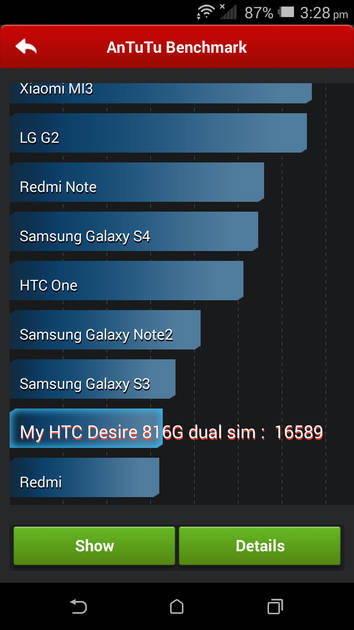
AnTuTu Benchmark
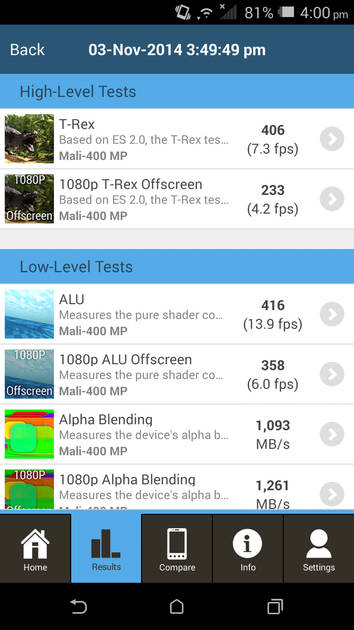
Graphics Benchmark
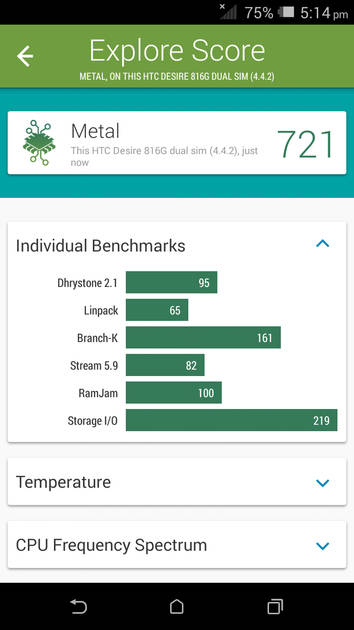
Vellamo Metal Benchmark
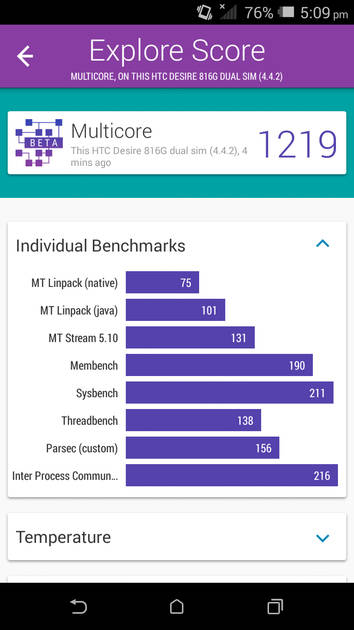
Vellamo Multicore Benchmark
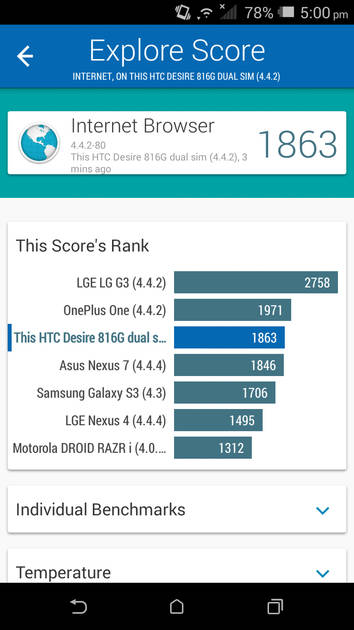
Vellamo Browser Benchmark
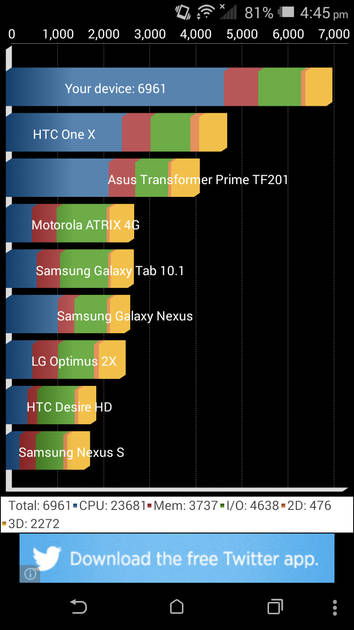
Quadrant Benchmark
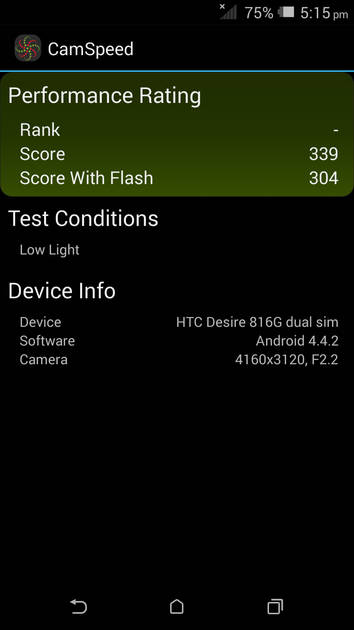
Camera Speed Benchmark
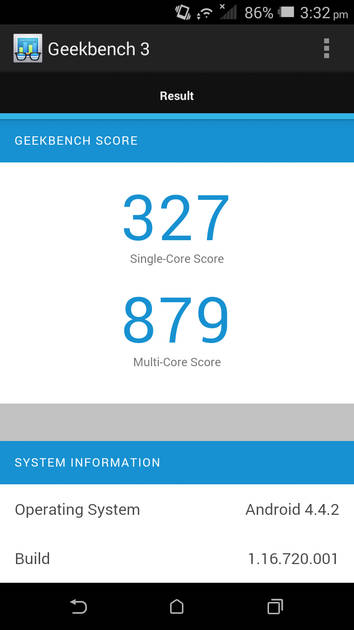
Geekbench3 Benchmark
|

Display |
|
|---|---|
| Display Type | S-LCD |
| Screen Size | 5.5 inches (13.97 cm) |
| Resolution | 720x1280 px (HD) |
| Pixel Density | 267 ppi |
| Screen to Body Ratio (calculated) | 67.51 % |
UI Screenshots
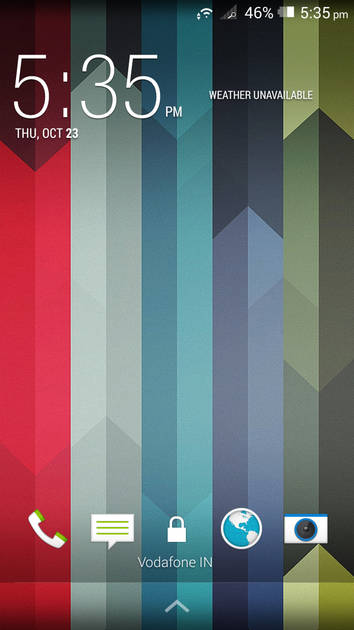
Lock Screen
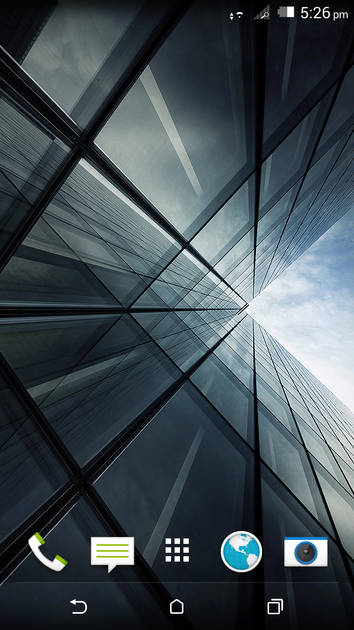
Home Screen
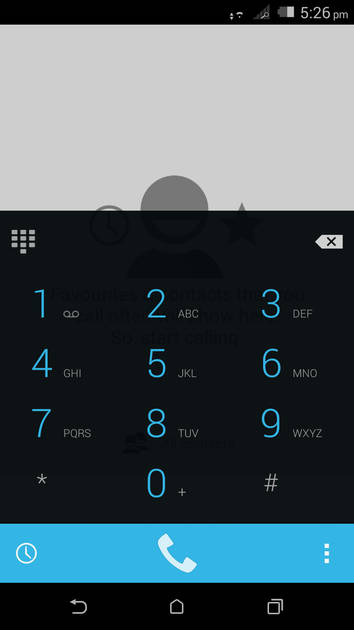
Dialer Screen
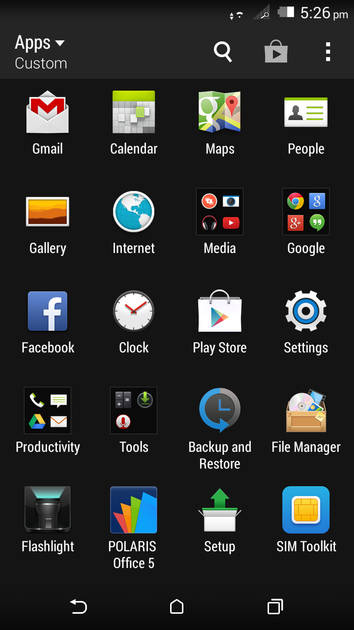
App Drawer
Notification Panel
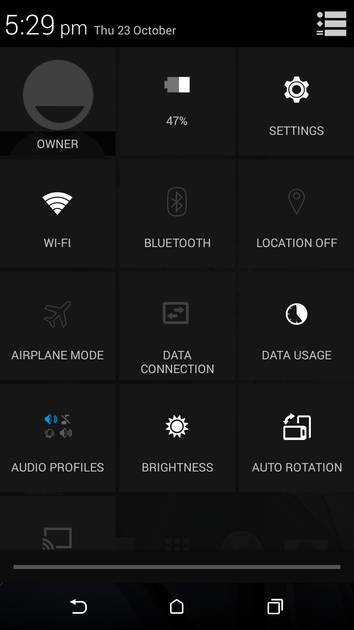
Quick Settings Panel
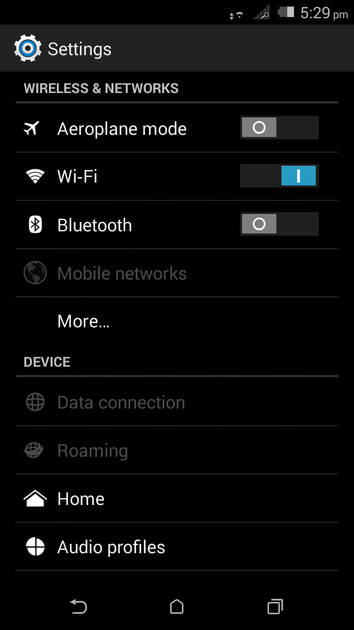
Settings Screen
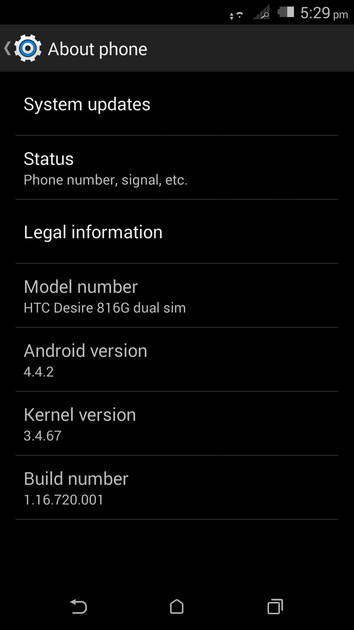
OS Version
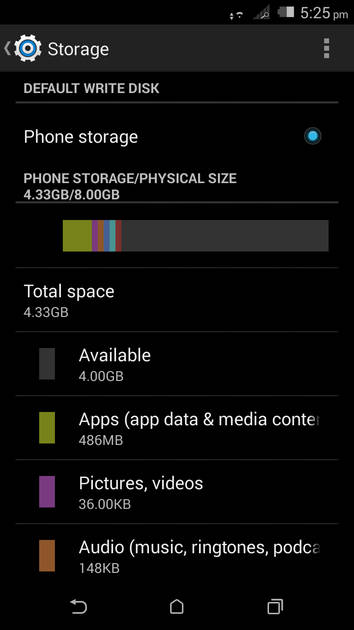
Storage
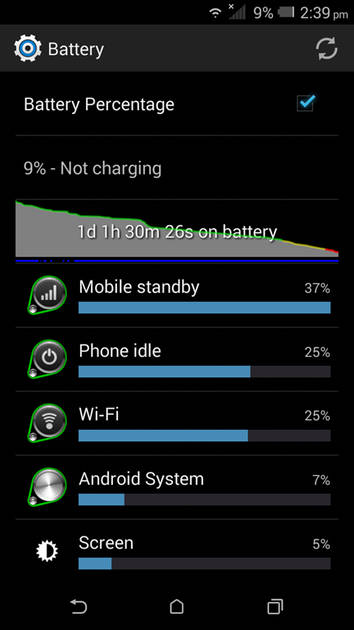
Battery
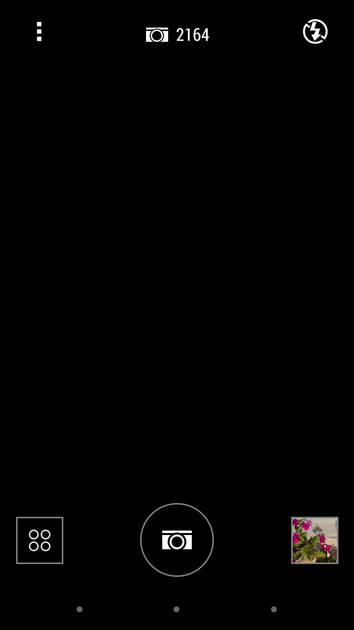
Camera On
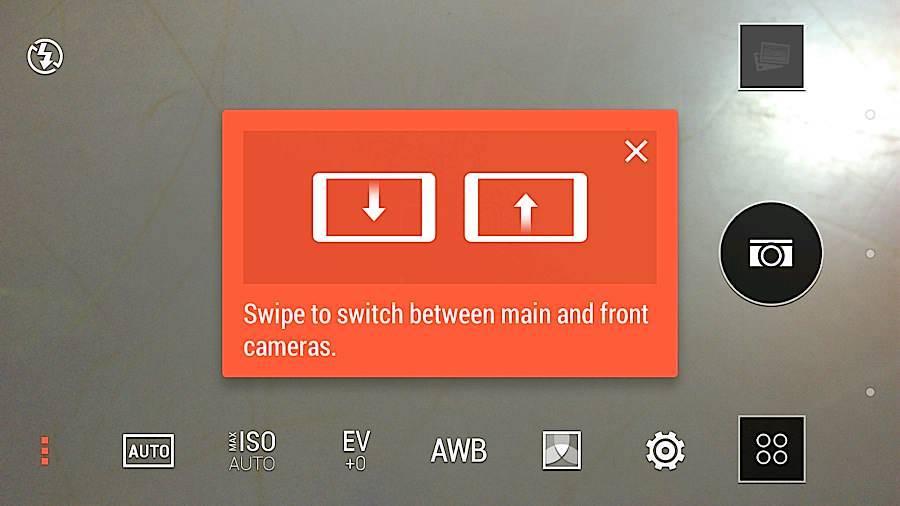
Camera Options
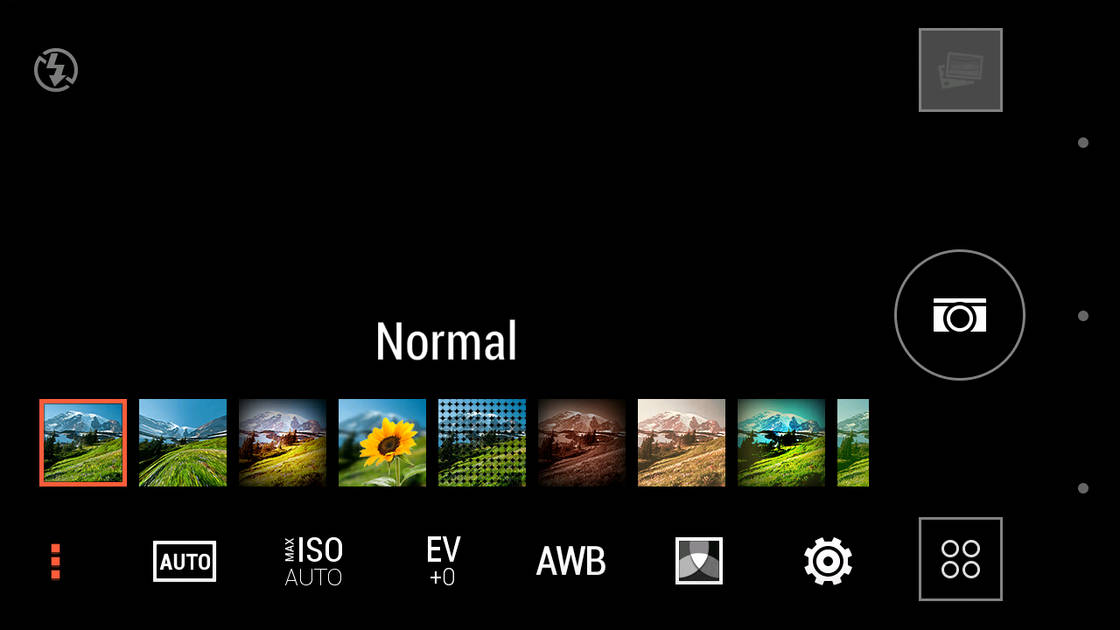
Camera Modes
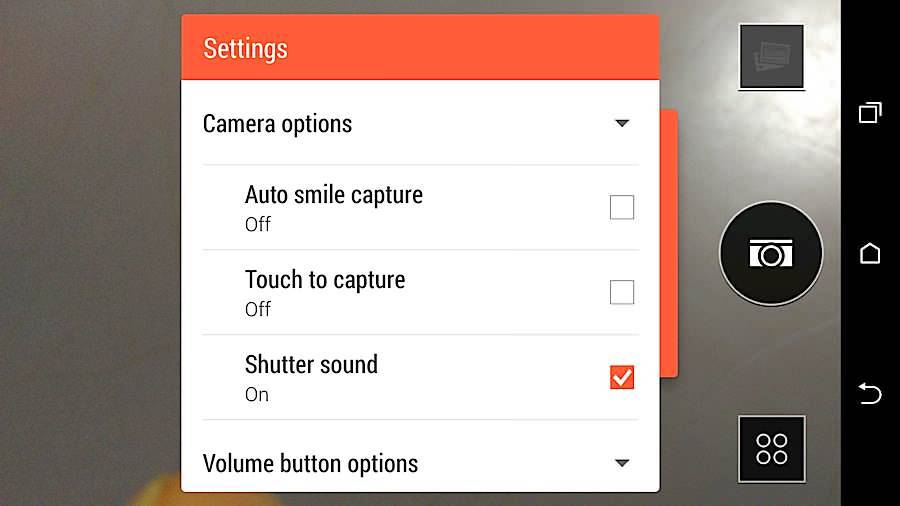
Camera Settings
|
Design |
|
|---|---|
| Height | 156.6 mm |
| Width | 78.7 mm |
| Thickness | 8 mm |
| Weight | 158 grams |
Rear Camera |
||||||||
|---|---|---|---|---|---|---|---|---|
| Resolution | ||||||||
|
||||||||
| Autofocus | Yes | |||||||
| Flash | Yes, LED Flash | |||||||
| Image Resolution | 4160 x 3120 Pixels | |||||||
| Settings | Exposure compensation, ISO control | |||||||
| Shooting Modes | High Dynamic Range mode (HDR) | |||||||
| Camera Features |
Digital Zoom Face detection Simultaneous HD video and image recording Touch to focus |
|||||||
| Video Recording | FHD @30 fps | |||||||
| Video Recording Features | Video HDR | |||||||
Rear Camera Samples
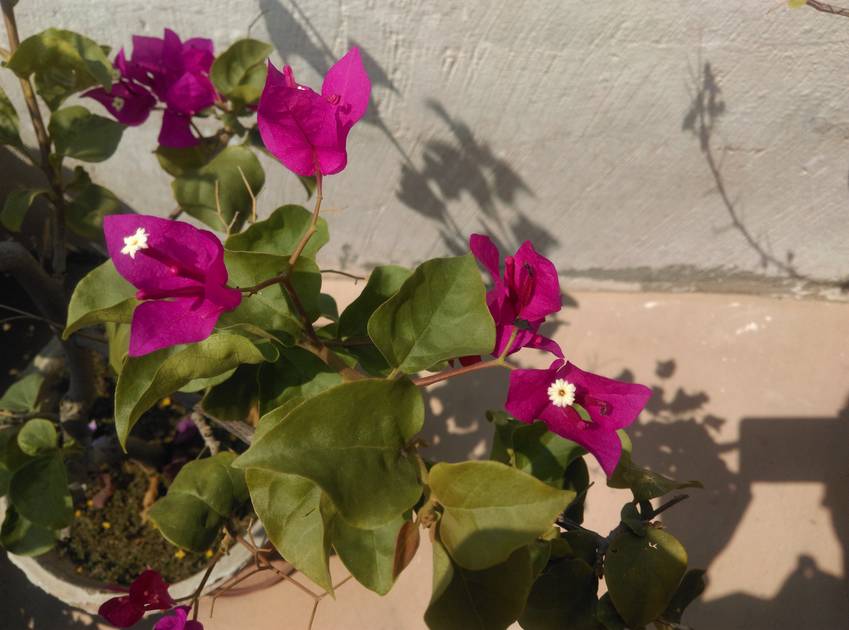
Close Up
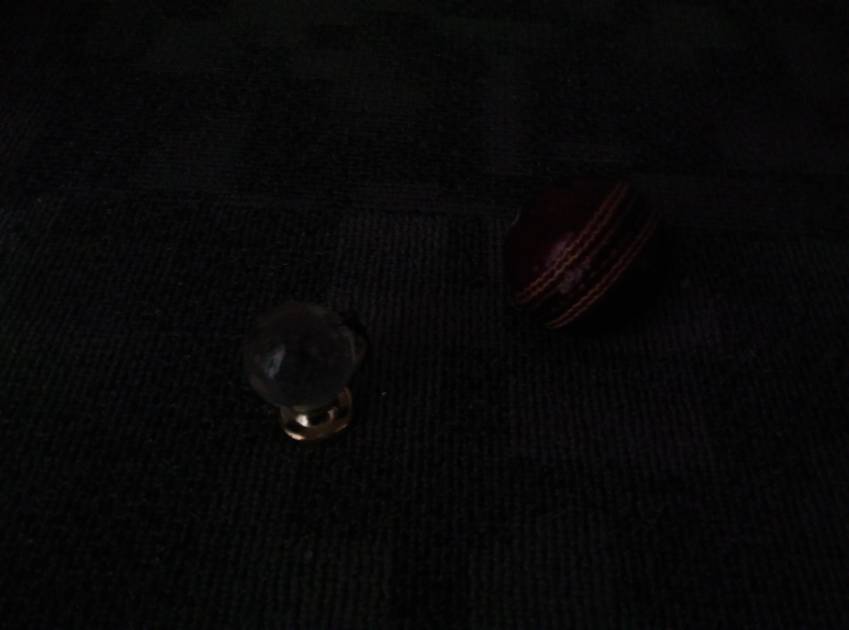
Low Light
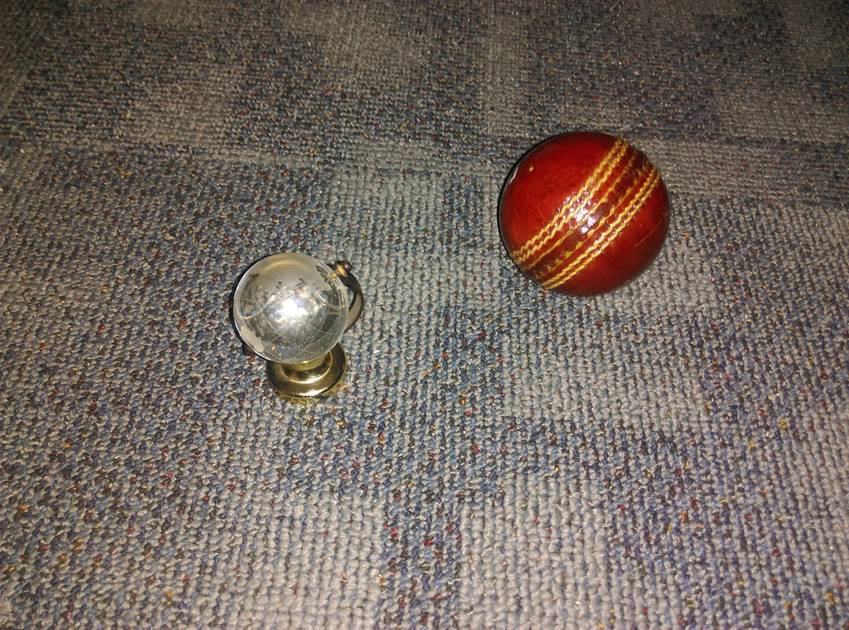
Low Light With Flash
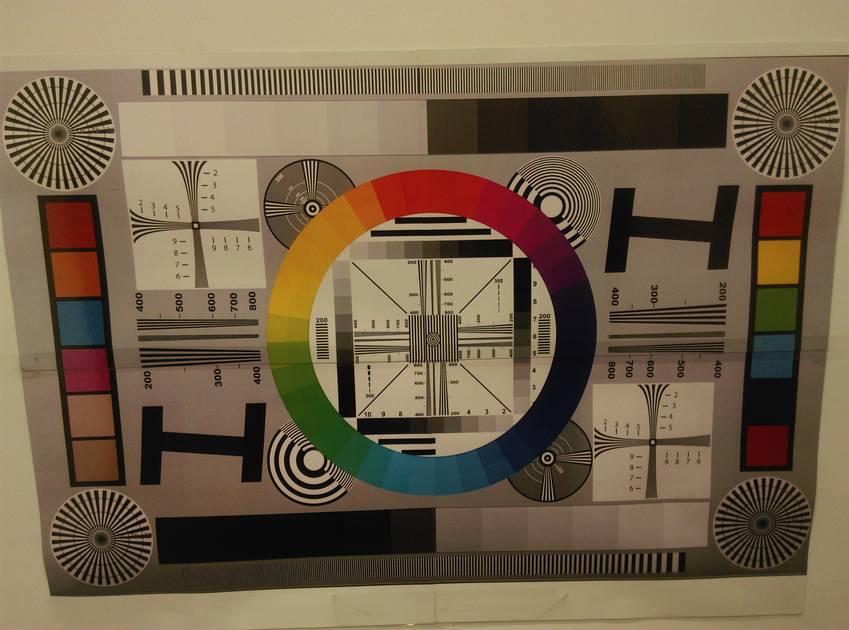
Colour Variance
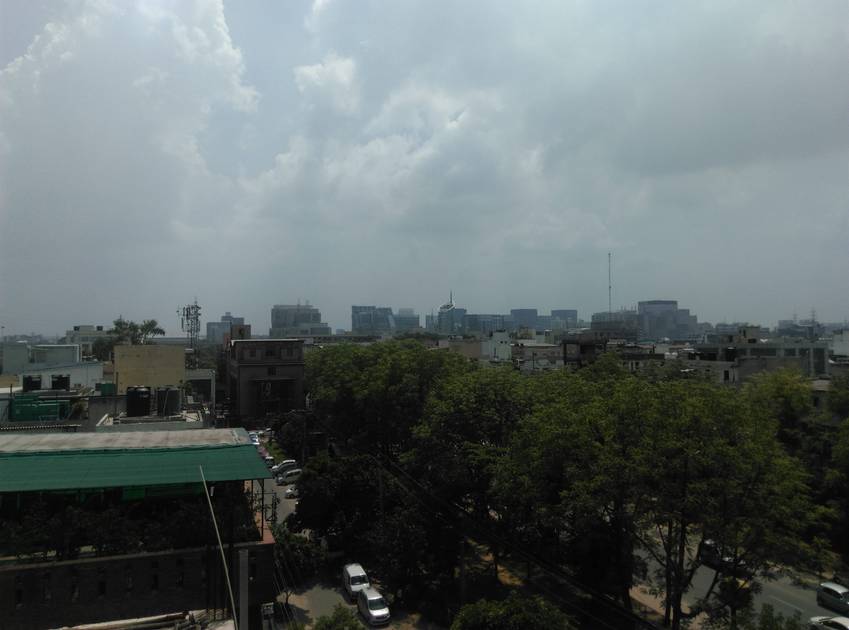
Long Shot
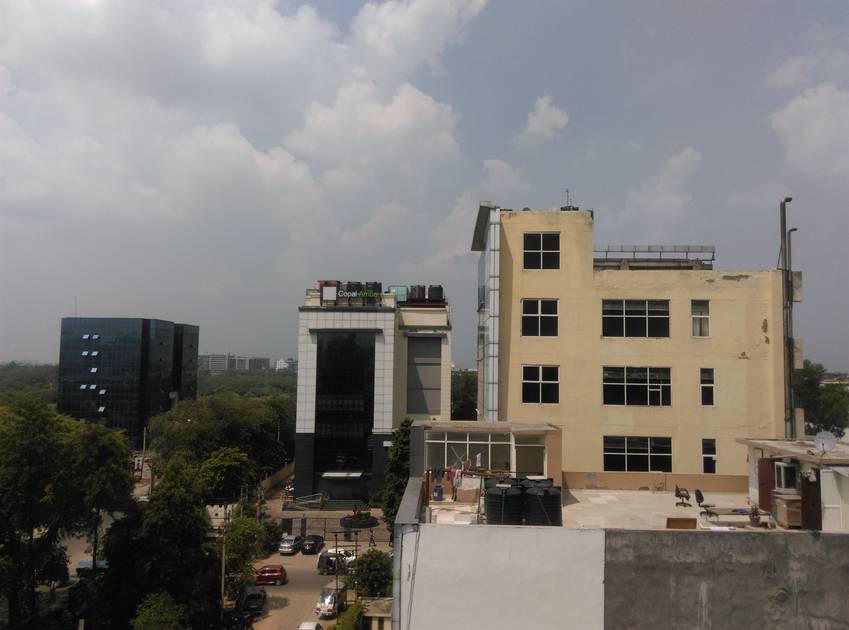
HDR Off
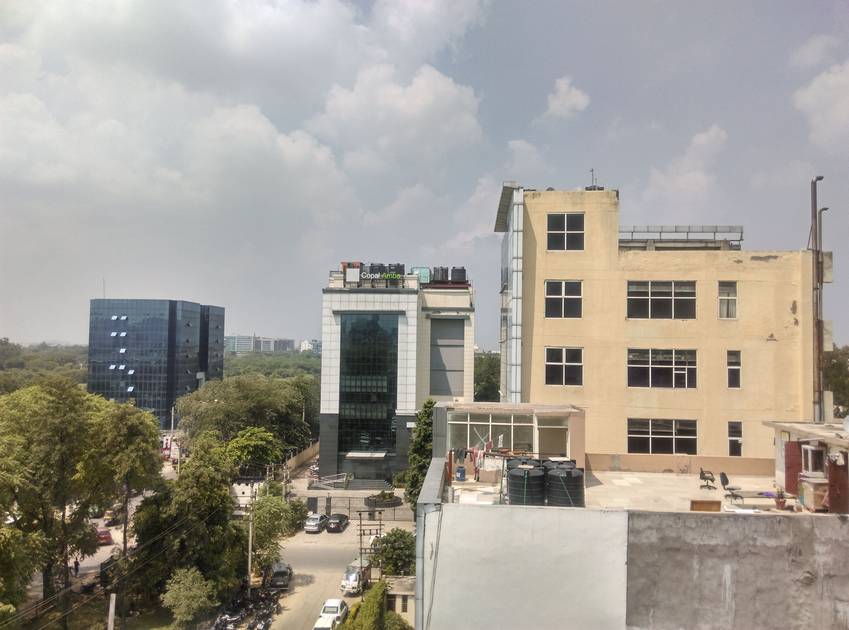
HDR On
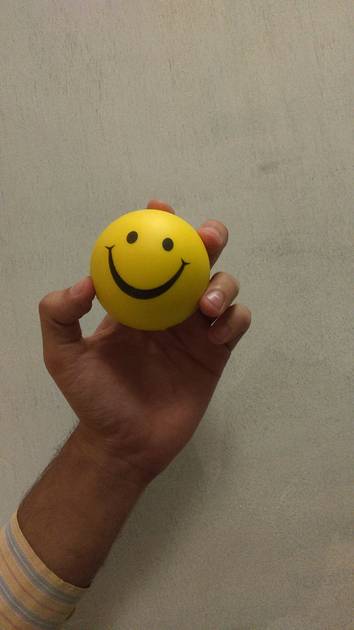
Front Shot
|
Front Camera |
||||
|---|---|---|---|---|
| Resolution | ||||
|
||||
| Video Recording | FHD @30 fps |
Battery |
|
|---|---|
| Capacity | 2600 mAh |
| Battery Type | Li-Polymer |
| TalkTime | Up to 10 Hours(3G) |
Storage |
|
|---|---|
| Internal Storage | 8 GB |
| Expandable Storage | Yes, Up to 32 GB |
Network & Connectivity |
|
|---|---|
| SIM Slot(s) | Dual SIM |
| SIM Type | SIM1: Nano |
| Network Support | 5G Not Supported |
| Wi-Fi | Yes, Wi-Fi 4 (802.11 b/g/n) |
| Wi-Fi Features | Mobile Hotspot |
| Bluetooth | Yes, v4.0 |
| GPS | Yes with A-GPS, Glonass |
Multimedia |
|
|---|---|
| Audio Jack | 3.5 mm |
Sensors |
|
|---|---|
| Fingerprint Sensor | No |
| Other Sensors | Light sensor, Proximity sensor, Accelerometer |
HTC Desire 816G User Reviews
HTC Desire 816G Key Highlights
| Processor | MediaTek MT6582 |
| RAM & Storage | 1 GB + 8 GB |
| Display | 5.5", 720 x 1280 Resolution |
| Rear Camera | 13 MP |
| Front Camera | 5 MP |
| Battery | 2600 mAh |

HTC Desire 816G Price In India
| Product Name | Store | Price |
|---|---|---|
| HTC Desire 816G (1 GB + 8 GB) | Flipkart | ₹21,999 |
Popular Links
- All Upcoming Phones
- vivo X500
- vivo X500 Pro Max
- Nothing Phone 4a
- Karbonn Rebel Pro 4G
- Nothing Phone 4b 6GB RAM
- Samsung Mobiles
- Motorola Mobiles
- vivo Mobiles
- OPPO Mobiles
- Tecno Mobiles
- realme Mobiles
- OnePlus Mobiles