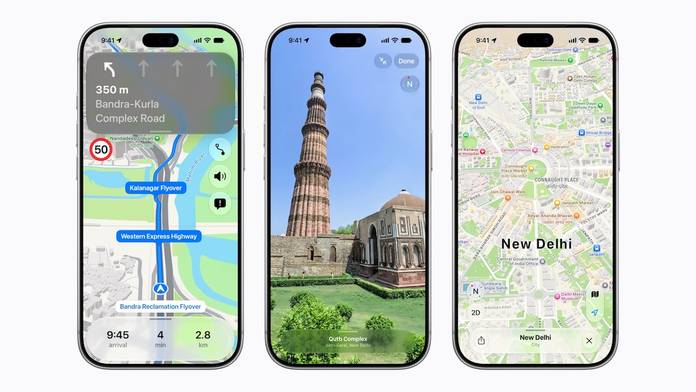
If you’re an iPhone user who’d deleted the native Maps app on your phone, it’s maybe time to rethink your decision. Apple has rolled out a redesigned Maps experience in India, bringing a lot of features that had been available in other markets to local users. The update adds interactive street-level imagery, augmented reality (AR) walking directions and more detailed maps, alongside features designed around how people navigate Indian roads. The changes are significant for Apple Maps, which has long played second fiddle to Google Maps in India.
Apple Maps features in India: what’s new
The biggest additions include Look Around, Apple’s version of Google Street View, and more than 300 three-dimensional landmarks. Users can explore locations through high-resolution street-level imagery, while AR Walking Directions overlays step-by-step guidance on the iPhone camera view.
Apple has also adapted Natural Language Guidance for Indian roads. Instead of relying only on street names and distances, directions can refer to familiar landmarks, such as a petrol pump or a numbered flyover pillar. Lane guidance should help drivers pick the correct lane before a turn or elevated road, while multi-stop routing supports up to 15 destinations.
Another addition is dual-language map labels. These combine English with the local language of the region, with support for Hindi, Bengali, Gujarati, Kannada, Malayalam, Marathi, Tamil, Telugu, Punjabi, Odia and Urdu. Users can also share their ETA, report road incidents through Siri, and plan cycling routes with elevation and bike-lane information.
Apple Maps also supports public transport planning in Ahmedabad, Bengaluru, Chennai, Delhi, Hyderabad, Kolkata, Mumbai and Pune, along with Indian Railways. Commuters can pin routes and receive alerts when it is time to get off.
Apple Maps vs Google Maps
Google Maps remains the more established navigation option in India. It already offers real-time traffic information, Street View, lane guidance and Live View walking directions, which uses AR overlays to help users orient themselves. Its extensive local business listings and user-contributed information are also difficult for Apple to match overnight.
However, Apple’s update does close some of the feature gap on paper. Look Around brings it closer to Street View, while AR Walking Directions takes on Google’s Live View. The more interesting difference is how Apple has adapted spoken directions and map labels for India. Directions that refer to petrol pumps or flyover pillars could be useful in areas where street names are unreliable.
For now, Google Maps remains the safer default for people who depend on frequent navigation, local business information and traffic updates. iPhone users, however, have more reason to try Apple Maps, especially for exploring unfamiliar places and planning journeys across Apple’s devices. The quality and coverage of its new map data will determine whether users make the switch.