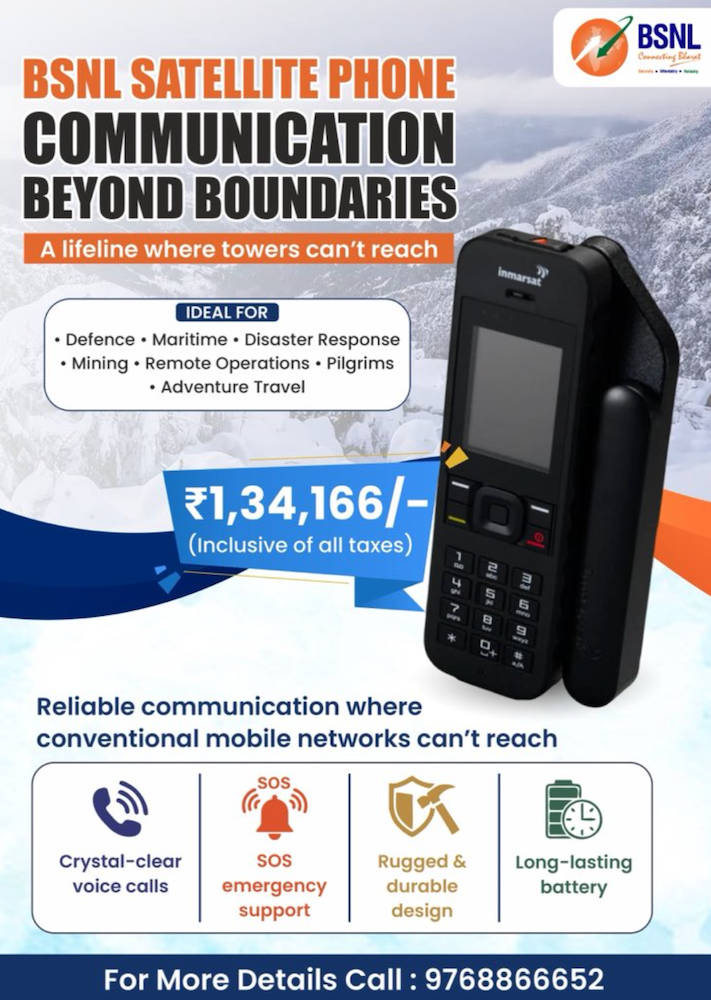
At around Rs 1.35 lakh, you’d normally expect a phone that can shoot cinematic videos, edit photos with AI, translate conversations in real time, and remind you to drink water. This one has a far more ambitious goal – making sure you can simply make a phone call from places where there isn’t a mobile tower for miles. No, we’re not talking about a rugged smartphone. The device in question is BSNL’s newly launched Satellite Phone, priced at Rs 1,34,166, just a few hundred rupees less than Apple’s iPhone 17 Pro. The similarity ends with the price tag.
BSNL launches satellite phone
Unlike conventional smartphones that rely on cellular towers, the BSNL Satellite Phone connects through satellite networks, allowing users to make voice calls even in areas with little or no mobile coverage. According to BSNL, the device is designed for sectors where uninterrupted communication is critical, including defence, maritime operations, disaster response, mining, remote operations, and adventure travel.
Can you buy a satellite phone for personal use in India?
Yes, but not quite like buying a regular smartphone. Unlike an iPhone or an Android phone that can be ordered online in a few clicks, satellite phones in India are heavily regulated. BSNL has been offering Global Satellite Phone Service (GSPS) to both the general public and enterprises since 2018, but subscribers must complete the prescribed customer verification process and disclose details such as the intended place, period, and purpose of use as per Department of Telecommunications (DoT) guidelines. This also explains why BSNL’s announcement directs interested buyers to contact the company or visit a BSNL office instead of offering the phone through a typical online retail channel.
While the price inevitably puts it alongside premium flagship smartphones, the BSNL Satellite Phone serves an entirely different purpose. It’s a specialised communication device for users who work or travel in locations where even 4G and 5G networks can’t be relied upon. Dedicated satellite phones have long been used by organisations operating in remote environments, while newer flagship smartphones have introduced limited satellite messaging features in select markets (not including India). BSNL’s offering, however, is aimed at users who need dependable satellite-based voice communication rather than emergency messaging alone.
For most users, spending over Rs 1.3 lakh on a phone that isn’t a smartphone replacement would be difficult to justify. However, if your work regularly takes you beyond the reach of conventional mobile networks, the ability to stay connected could outweigh features like flagship cameras, AI tools, or the latest processor.