India’s smartphone market is shrinking, but how are Samsung and Apple holding their ground?


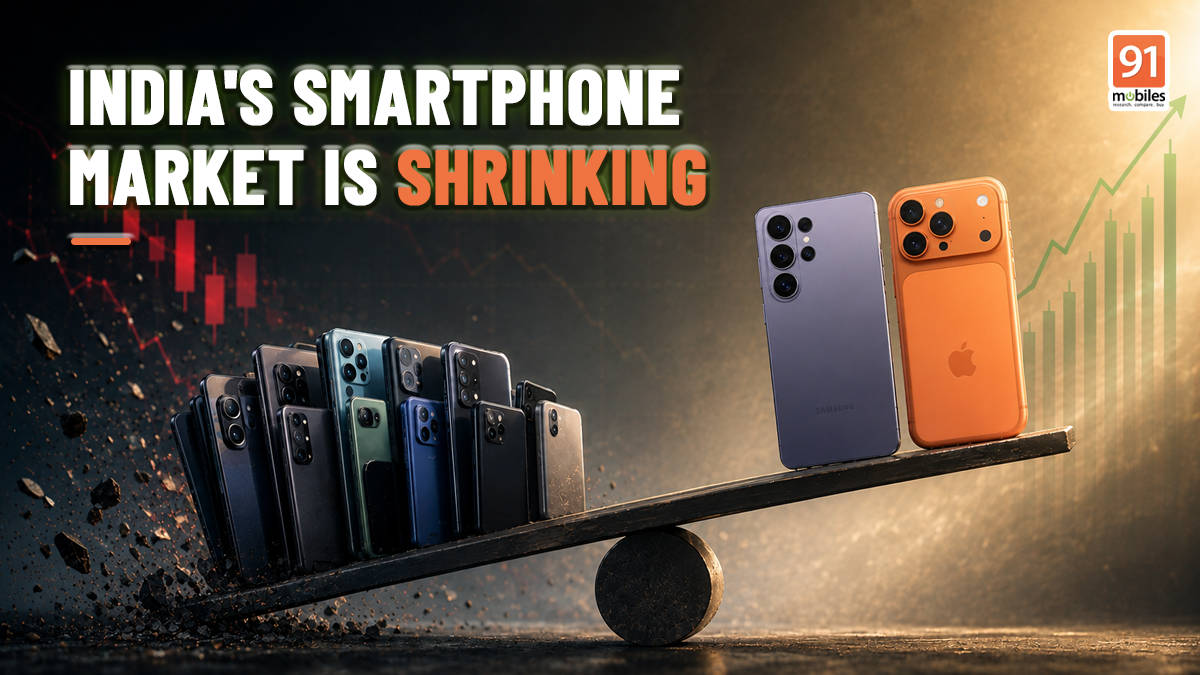
India’s smartphone market is going through an awkward phase. People are buying fewer phones, prices are going up, discounts are disappearing, and cheap 5G smartphones are becoming an endangered species. And yet, two of the biggest names in the business, Samsung and Apple, are looking remarkably unbothered.
IDC’s Q2 2026 data shows the contrast. Smartphone shipments in India fell 11.1 percent year over year to 33.2 million units, but Samsung’s shipments were almost flat, declining only in relative terms as its market share rose from 14.5 percent to 16.4 percent. Apple did even better, with shipments up 0.7 percent and share increasing from 7.5 percent to 8.5 percent. Meanwhile, Vivo, Realme and Xiaomi posted double-digit declines, while iQOO shipments plunged a whopping 61 percent.
On the surface, this looks like another quarter in which the premium players won while the rest of the market struggled, but the more interesting story is why. As the memory crisis changes the economics of the smartphone business, some of the characteristics Samsung and Apple built over the years – scale, premium positioning and supply leverage – matter much more.
Table of Contents
The cheapest phones are taking the biggest hit
The global memory shortage was supposed to be a problem for the entire smartphone industry, but in practice, it has been much crueler to some parts of it than others. India’s sub-USD 100 (under Rs 9,500) smartphone segment collapsed 74.3 percent in Q2, with its share of the market falling from 15.6 percent to just 4.5 percent. At the same time, the USD 400 – USD 600 (around Rs 38,000 to Rs 57,000) segment grew 60.3 percent, while the USD 600 – USD 800 (Rs 57,000 to Rs 76,000) segment remained flat and the USD 800-plus (over Rs 76,000) segment declined only 5 percent.
That is a rather convenient market structure for Samsung and Apple. The two companies have spent years trying to convince consumers that a smartphone costing over Rs 70,000 or even over Rs 1 lakh is not a bad idea. Now the memory crisis is doing some of that marketing for them. Consumers suddenly haven’t developed a taste for expensive phones, but much of the movement is being forced by the economics of making cheaper ones. Memory costs have risen across the board, but a Rs 10,000 phone has much less room to absorb a cost increase compared to a Rs 70,000 one. Brands can either raise prices and risk losing the buyer or cut specifications and margins. Neither is particularly attractive.
When the cheapest phones become significantly more expensive, the psychological gap between a budget phone and a better-speced mid-ranger gets smaller. And when the entire market is becoming more expensive anyway, paying a premium for an established brand doesn’t feel outrageous. IDC had already seen this in Q1, when India’s shipments fell 4.1 percent but market value grew 5.8 percent, with the average selling price reaching a record USD 302 (around Rs 28,800).
Premiumisation is happening partly because consumers want better phones and partly because the industry is making the cheapest phones harder to sell. That is rather convenient for Samsung and Apple, as they’re automatically well-positioned for the market the memory crisis is creating.
Samsung has the luxury of being almost everywhere
Samsung’s resilience is particularly interesting because it’s not simply an Apple-style premium proposition. The company has phones across several price bands, from its mass-market Galaxy M, F, A series to the Galaxy S range and foldables, giving it multiple ways to respond as consumers move up the price ladder. IDC specifically attributes Samsung’s resilience to its scale and diversified portfolio, which have helped it absorb rising costs without sacrificing as much volume or margin as some competitors.


There is another interesting advantage – memory. IDC’s global research says Samsung and Apple entered the crisis with stronger leverage over memory supply. Samsung’s position is such because it’s not merely a buyer of memory components, it’s also one of the industry’s major memory suppliers. However, that doesn’t mean Samsung gets free RAM while everyone else bargains. But it does mean the company has considerably more muscle in a supply crunch than a smaller smartphone brand which has to negotiate for every component.
In Q1 2026, Samsung’s smartphone shipments grew 2.9 percent globally while the overall market fell 2.9 percent. IDC attributed the performance partly to the Galaxy S26 Ultra, consistent pricing and the early availability of its A-series models.
Apple has an easier game to play
Apple has a simpler advantage compared to Samsung – it has very little reason to care about the bottom of the market because it’s not there. The company doesn’t need to figure out how to make a sub-USD 100 smartphone profitable while memory prices are rising. Its challenge is persuading consumers who are already considering an iPhone to continue spending on one. In the current environment, that’s a nicer problem to have.
So far, that seems to be working. Apple’s India shipments grew 0.7 percent in Q2, lifting its share from 7.5 percent to 8.5 percent. IDC says Apple continues to lead India’s smartphone market by value, with a 27 percent share, up 22.2 percent year over year.
That’s Apple’s secret – 8.5 percent of the phones, but 27 percent of the money. The Q1 numbers told a similar story. Apple had a 9 percent shipment share but commanded 28 percent of the Indian smartphone market by value. The iPhone 17 alone accounted for 4 percent of total smartphone shipments.


Apple is therefore insulated from one of the biggest problems facing the rest of the industry – volume. That’s the advantage of being Apple in a market like this. When the market’s average selling price is climbing, a company that already lives near the top has considerably less catching up to do.
What happened to the Chinese brands?
Companies such as Vivo, Realme, Xiaomi and OPPO have historically relied on giving consumers a lot of hardware for the money. These companies made their name by offering aggressive specifications at aggressive prices, but they’re now being forced to raise prices. That is an awkward request when your entire brand proposition has been built around giving consumers more for less.
In Q2, Vivo shipments fell 13.9 percent, Realme fell 14.2 percent, Xiaomi fell 10 percent and OPPO fell 8.5 percent. iQOO was hit especially hard, with shipments down 61 percent. There is an obvious caveat here, as this isn’t simply about Android vs Apple. Samsung is still an Android manufacturer competing in many of the same segments. The difference is that it has greater scale and a much broader portfolio, while Apple has largely sidestepped the low-end problem altogether.
There’s also the discount playbook which Chinese OEMs have traditionally relied on to drive sales. The script’s been consistent in India – launch the phone, announce an exciting price, wait for sales, add a bank offer, add exchange bonus, wait for festive season, and then cut price again. The memory crisis is making that much harder to execute. In previous years, a weak quarter could be patched up with a sale, a bank offer, an exchange bonus and, eventually, festive discounts. But when memory costs are squeezing margins, brands cannot pretend that Rs 2,000 off is unsubstantial. Apple has the brand pull to sell an iPhone without turning every launch into a discount festival. Samsung has enough scale and enough price points to offer financing, trade-ins and promotions without having to alter the economics of its entire portfolio.
IDC’s global outlook says the divide will remain. It expects Android shipments to fall sharply in 2026 but says Samsung should gain share by expanding in premium and the mid-range, helped by secured memory supply. Apple, meanwhile, has also secured the memory supply it needs early and is expected to see its share rise even as the broader market contracts.
IDC forecasts a more than 15 percent shipment decline in H2 2026, taking full-year Indian smartphone shipments to roughly 128-130 million units. It also warns that memory costs, a weaker rupee and declining mass-market viability could keep prices elevated. Samsung has the scale to absorb shocks, the supply-chain muscle to secure components and enough premium credibility to move consumers upwards without abandoning the mid-range. Apple, on the other hand, has spent years convincing consumers that expensive phones are worth buying. Now that the entire market is getting expensive, that is a useful skill to have.
The ironic part is that India’s smartphone market has spent years rewarding companies for giving consumers more for less. The memory crisis is now posing a very different question – what happens when “less for more” becomes the only business model floating around.