Redmi Note 14 battery review: reliable backup with fast charging


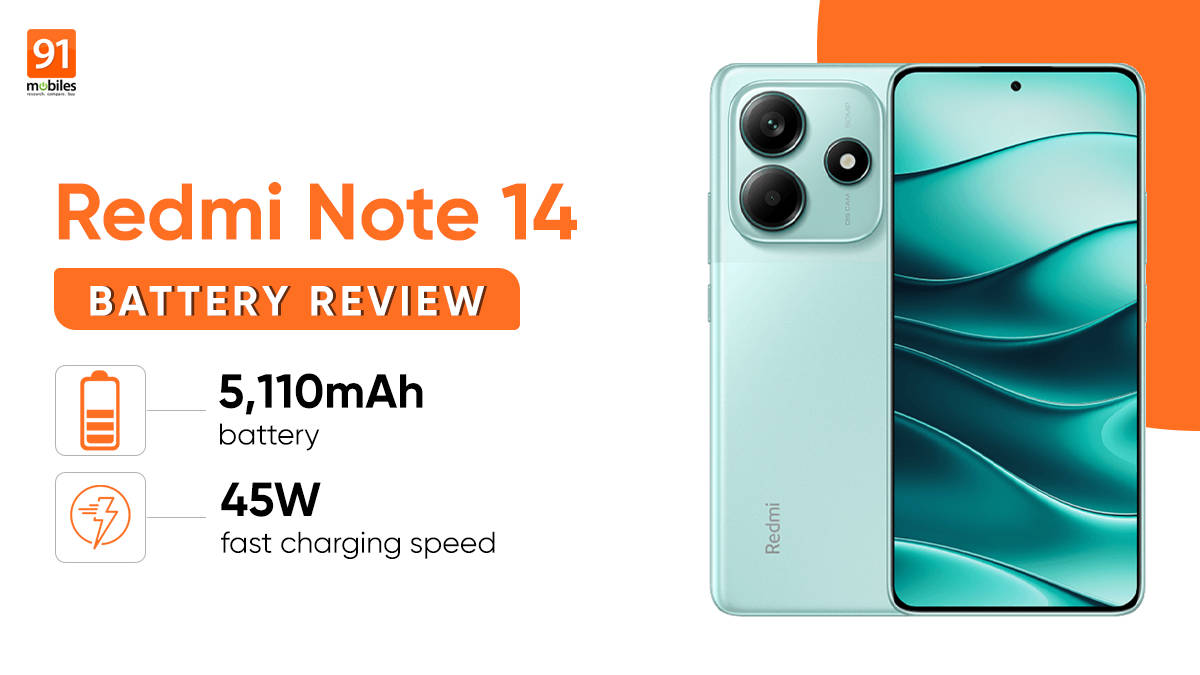
The all-new Redmi Note 14 boasts a notable upgrade with its 5,110mAh battery, an improvement over the 5,000mAh capacity found in its predecessor, the Note 13 (review). Additionally, the charging speed has been enhanced to 45W, promising faster power-ups. But what do these upgrades translate to in real-world usage and synthetic benchmarks?
In this Redmi Note 14 battery review, we dive into its performance and efficiency. To provide a broader perspective, we’ve also compared its battery performance against two of its closest competitors under Rs 20,000—the iQOO Z9s (review) and the Realme 13 (review). Keep reading to see how it fares.
Table of Contents
Verdict
The Redmi Note 14 is well-optimised to provide reliable battery backup and impressive charging speeds for everyday use. However, heavy users, such as avid gamers or frequent video streamers, may find it lacking in comparison to its immediate rivals.
Pros
- Efficient in the PCMark battery test
- Remarkable charging speeds
Cons
- Could have been better optimised for gaming & video streaming
Redmi Note 14 battery review at a glance
| Test | Result |
| PCMark battery test | Rank 1– Redmi Note 14 Rank 2– iQOO Z9s Rank 3– Realme 13 |
| YouTube video streaming | Rank 1– Realme 13/ iQOO Z9s Rank 2– Redmi Note 14 |
| Gaming | Rank 1– iQOO Z9s Rank 2– Realme 13 Rank 3– Redmi Note 14 |
| Charging test | Rank 1– Redmi Note 14 Rank 2– Realme 13 Rank 3– iQOO Z9s |
Our series of tests analysed the Redmi Note 14 battery efficiency, which involved running a PCMark battery stress test and real-world activities such as YouTube video streaming and high-end gaming sessions. We also conducted a charging test in a similar environment.
PCMark battery test


Winner: Redmi Note 14
The Redmi Note 14 excels in the PCMark battery test, delivering a superior performance after completing a series of tasks until its battery level drops from 100 percent to below 20 percent. Remarkably, this was achieved with a smaller 5,110mAh battery in comparison to iQOO Z9s’ 5,500mAh capacity.
Real-world context: The above result highlights the Redmi Note 14’s exceptional battery optimisation, outperforming the iQOO Z9s and Realme 13. This infers that the smartphone is well-suited for moderate all-day use.
YouTube video streaming
30-minute YouTube streaming test to check battery drain (lower is better)
| Smartphones | Battery drop % and absolute numbers (mAh) |
| Redmi Note 14 | 4 percent (204.4mAh) |
| Realme 13 | 3 percent (165mAh) |
| iQOO Z9s | 3 percent (150mAh) |
Winner: Realme 13/ iQOO Z9s
In our YouTube video streaming test, the Redmi Note 14 consumed more battery, both in percentage and absolute terms.
During a 30-minute video stream at the same resolution, brightness, and volume levels, the Redmi device used over 200mAh of battery. In comparison, the iQOO Z9s and Realme 13 demonstrated better optimisation, consuming similar amounts despite their different battery capacities of 5,500mAh and 5,000mAh, respectively.
Real-world context: This isn’t a deal breaker for the Redmi Note 14 as long as you are not a heavy video streamer. Despite streaming videos for a couple of hours during the day, the phone lasted for me an entire day between charges.
Gaming
| Smartphones | Total battery drop % (in mAh) |
| Redmi Note 14 | 18 percent (919.8mAh) |
| Realme 13 | 17 percent (850mAh) |
| iQOO Z9s | 16 percent (880mAh) |
Winner: iQOO Z9s
The Redmi Note 14 falls short in battery performance compared to the iQOO Z9s and Realme 13 in our gaming test. It recorded the highest battery consumption while running three graphically demanding games—BGMI, Real Racing 3, and Call of Duty—for 30 minutes each. We also ensured identical graphics and frame rate settings on each smartphone for a fair contest.
The iQOO Z9s’ absolute numbers are higher than the Realme 13, but it has a bigger battery capacity ensuring a superior backup for power-hungry users. This is reflected in its percentage drop.
Real-world context: The iQOO Z9s will deliver superior optimisation for power-hungry users. The Redmi Note 14 and Realme 13, on the other hand, will appeal to casual users with basic gaming needs.
Charging speeds
Charging test to see time taken to charge from 20 to 100 percent
| Smartphones | Charging time |
| Redmi Note 14 | 32 minutes |
| Realme 13 | 63 minutes |
| iQOO Z9s | 66 minutes |
Winner: Redmi Note 14
All three phones come with similar charging speeds.
The Redmi Note 14 and Realme 13 boast 45W charging support, whereas the iQOO Z9s offers up to 44W charging speeds. All three devices come with a compatible charger in the box.The Redmi Note 14 charges nearly twice as fast as the competing iQOO and Realme models, taking significantly less time to go from 20 to 100 percent. This can be credited to its ‘Speed Up’ charging feature, which can be activated through the settings menu. While the option delivers on its promise, it does cause a slight increase in the phone’s temperature during charging.
Real-world context: The Redmi Note 14’s upgraded 45W fast charging ensures you can quickly power up your device, allowing for substantial use within just 30 minutes of charging. This feature is especially convenient when you’re in a rush and need to revive a low battery on short notice.
Final verdict
The Redmi Note 14 leads the way in the PCMark battery test and charging speeds, achieving full charge in just 32 minutes.
- However, for power users, especially gamers and heavy video streamers, the Redmi Note 14 may not be the best option.
- The smartphone’s battery consumption during gaming and video streaming trails behind that of competitors like the iQOO Z9s and Realme 13, which offer better endurance and efficiency in those areas.
- Nevertheless, the Redmi Note 14 remains a solid choice for those who need dependable all-day battery life without constant recharges.
| Smartphones | Starting price |
| Redmi Note 14 | Rs 18,999 |
| Realme 13 | Rs 17,999 |
| iQOO Z9s | Rs 19,999 |