Review Summary
Expert Rating
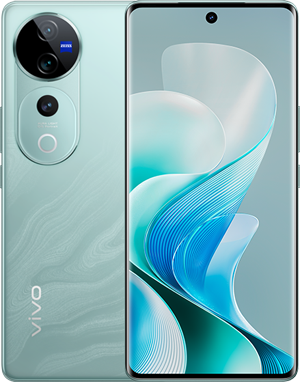
The Vivo V30 series that came out earlier this year marked the first time Vivo brought its ZEISS partnership to the more affordable V series. The idea was to make ZEISS-powered cameras more accessible to the masses. And the V30 Pro did the camera bit well indeed, with our review calling the V30 Pro a “great choice for camera enthusiasts”. But it wasn’t a perfect phone as it lacked stereo speakers and only offered an IP54 rating. Five months later, the Vivo V40 Pro is here to fill those gaps and in doing so, get closer to becoming that perfect mid-range phone.
Table of Contents
Verdict
While the Vivo V40 Pro comes just a few months after the V30 Pro, it brings several improvements and upgrades that justify its existence. The two areas where the V30 Pro felt lacking have been fixed in the successor: stereo speakers and better IP rating. The Vivo V40 Pro also gets a bigger battery, some good ZEISS-backed cameras, and an impressive Dimensity 9200+ chipset. But these upgrades also mean a higher starting price of Rs 49,999.
Design and display
| Vivo V40 Pro | Vivo V30 Pro | Xiaomi 14 Civi | |
| Thickness | 7.58mm | 7.45mm | 7.75mm |
| Weight | 192 grams | 188 grams | 179.3 grams |
| IP rating | IP68 | IP54 | IP54 |
Design has been a key aspect for Vivo no matter the series, but the company does tend to push things with the V series in particular. The V40 Pro is the slimmest phone with a 5,500mAh battery, measuring 7.58mm in thickness. It is also one of the lightest phones with a 5,500mAh battery at 192 grams.
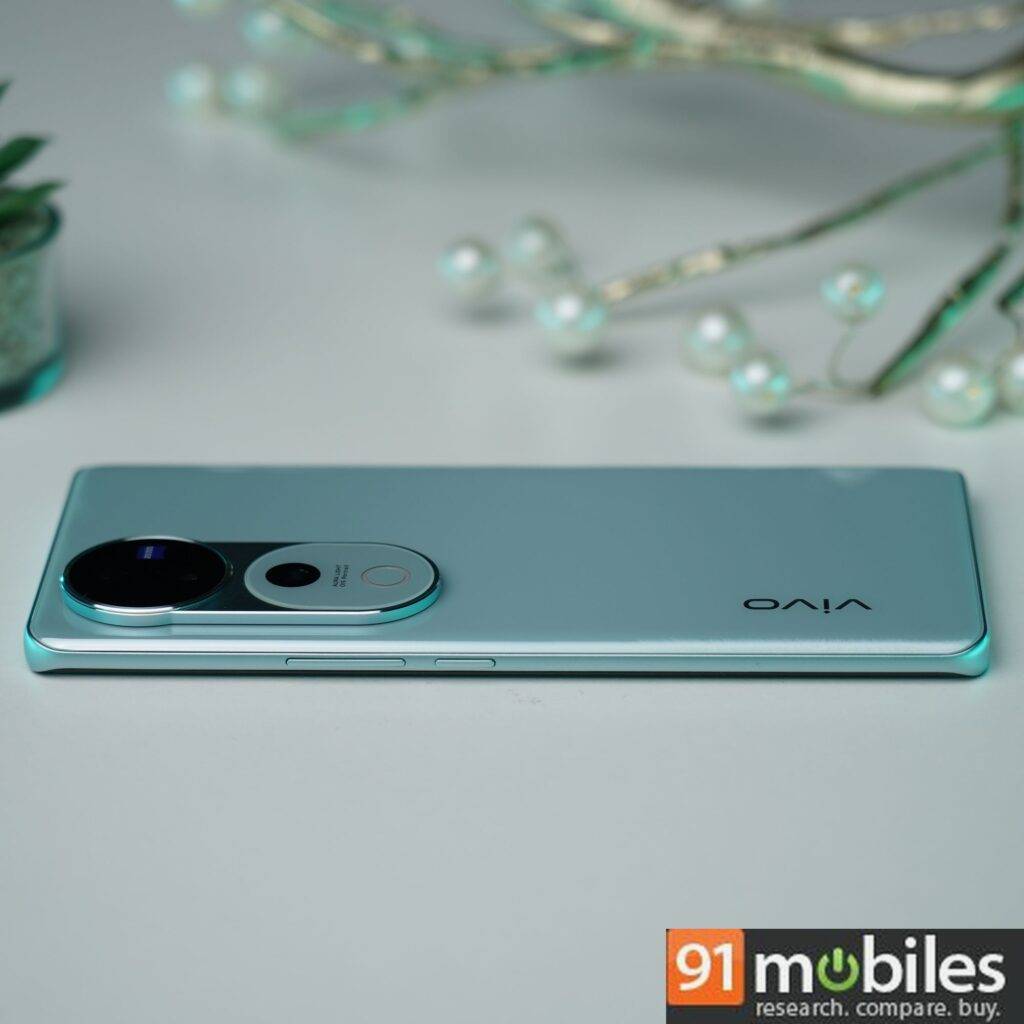
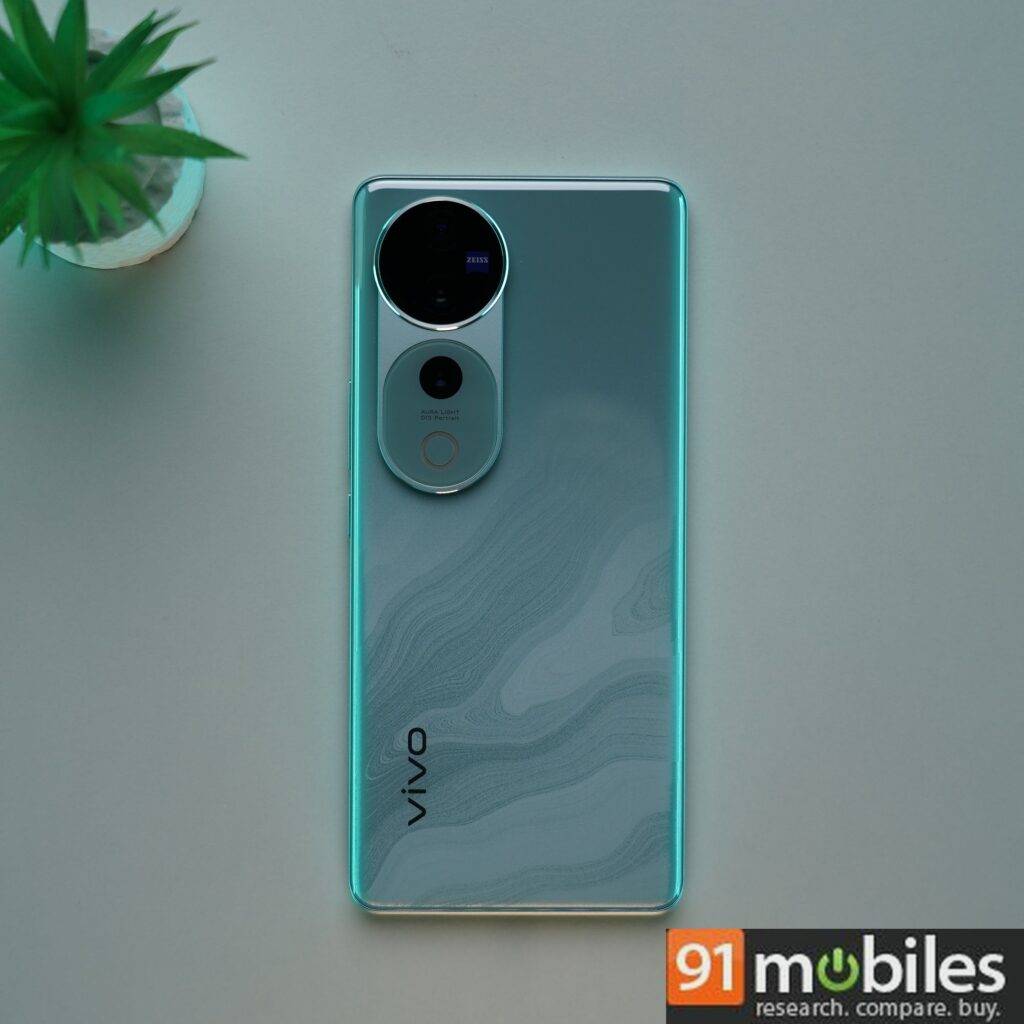
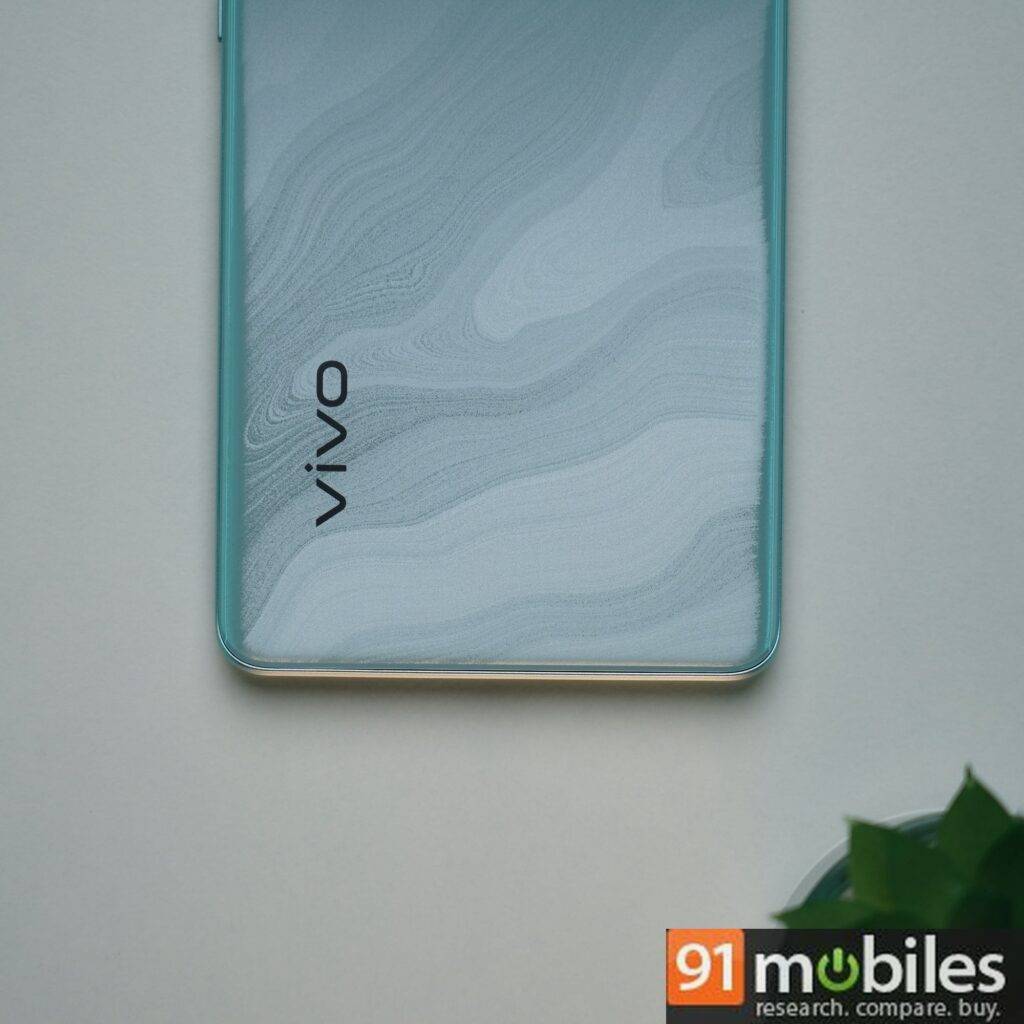
Both the front and back glass panels are curved at the edges while the frame is rounded as well, giving a good in-hand feel without feeling sharp or heavy. The glossy back of the Ganges Blue variant that we received enables a good grip, but I wasn’t a fan of the wavy pattern. The Titanium Grey variant looks cleaner and might be better suited for those looking for a subdued yet classy look.
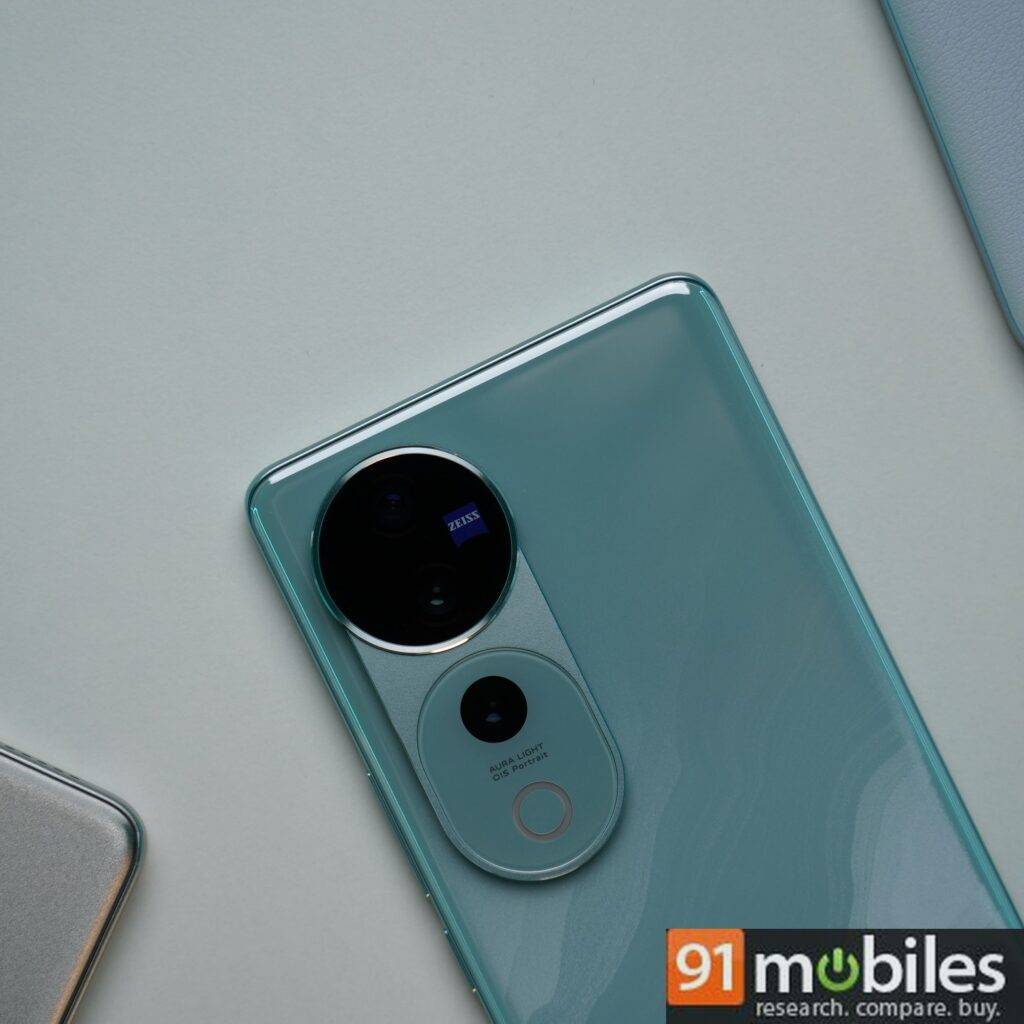
The most noticeable design change is the shape of the rear camera module. While the V30 Pro went with a square-ish look, the V40 Pro’s camera module is more circular. Vivo calls it the Infinity Eye Camera Module design and it’s sort of a pendulum shape with two cameras housed in the top circular module and a third camera and aura LED ring in the bottom one. Interestingly, the auro ring is much smaller compared to the large square-shaped enclosing on the V30 Pro. However, Vivo claims the V40 Pro’s Aura light is 33 percent brighter.
When we reviewed the V30 Pro, two aspects disappointed us: no stereo speakers and only an IP54 rating. Well, it looks like Vivo heard us because the V40 Pro has improved on both. It gets stereo speakers and a much better IP rating: IP68 dust and water resistance.
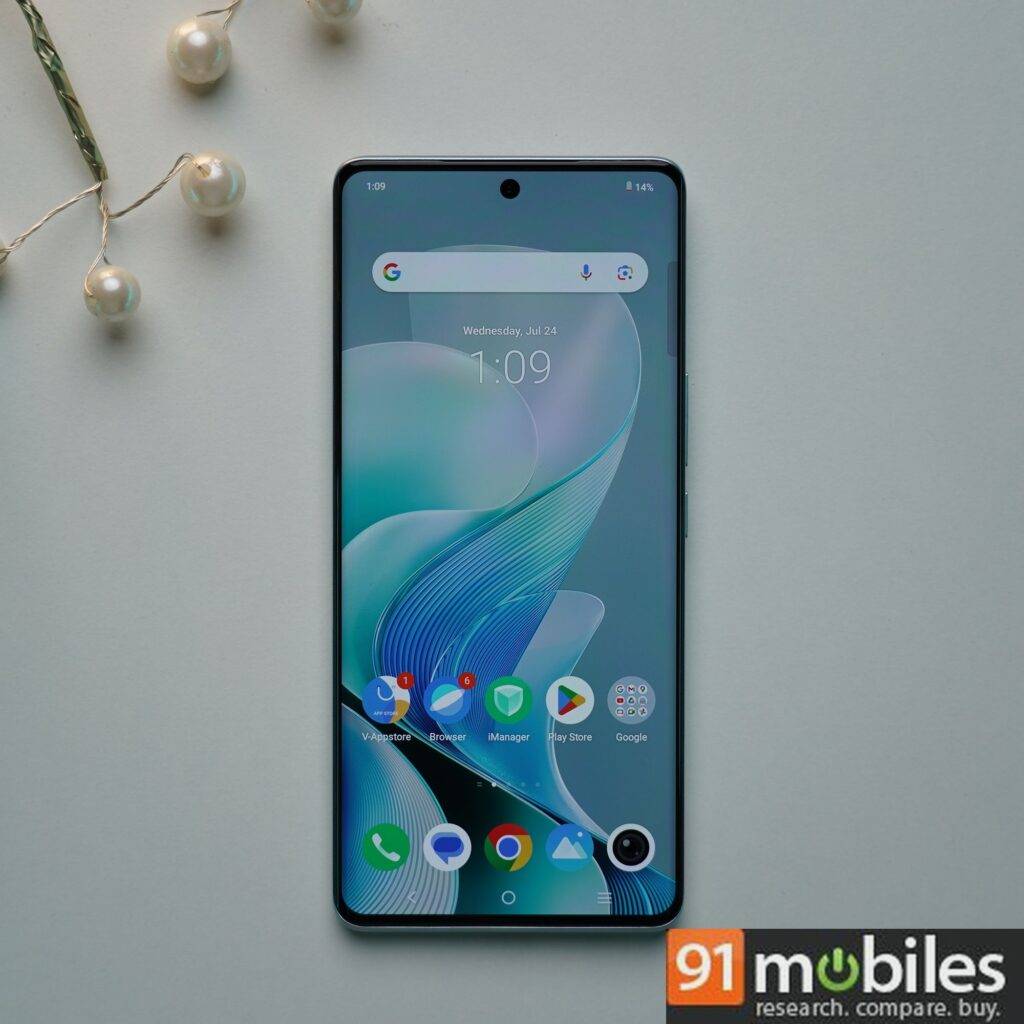
Apart from bumping up the peak brightness, the display on the Vivo V40 Pro is more or less similar to the one on its predecessor. It’s a 6.78-inch FHD+ (2,800 x 1,260) AMOLED display with 120Hz refresh rate. The peak brightness support goes up to 4500 nits, up from 2800 nits. Suffice it to say that the screen gets plenty bright outdoors and while watching HDR content on supported platforms like Netflix. Overall, it’s an attractive display with good viewing angles and colours.
Much like the V30 Pro, the V40 Pro also uses a sheet of Schott Alpha Glass to protect the display. The bezels around the screen are quite thin, offering what is probably the highest screen-to-body ratio in this segment at 93 percent. Overall, the V40 Pro offers a tall and wide display for consuming content, excellent brightness and viewing angles outdoors, and a light yet sturdy build quality for a good in-hand feel.
Cameras
The V30 Pro had a terrific camera system, so Vivo didn’t have to change things too much on the V40 Pro. You get a 50MP primary camera that uses Sony’s IMX921 sensor with optical image stabilisation, a 50MP portrait Sony IMX816 lens with support for 2x optical zoom and 50x digital zoom, a 50MP wide-angle lens, and a 50MP selfie camera, for a total of four 50MP cameras, all backed by ZEISS. Vivo brought its partnership with ZEISS to the V series first with the V30 Pro and now to the V40 and V40 Pro, making it more accessible to the masses and giving the Leica-backed Xiaomi 14 Civi a run for its money.
The ZEISS partnership enables the Vivo V40 series to offer features like Multifocal Portrait photography, which essentially lets you conveniently capture portraits and different focal lengths (24mm, 35mm, 50mm, 85mm, and 100mm). Then you have the ZEISS portrait styles such as Biotar, B-speed, Sonnar, Planar, Distagon, Cine-flare, and Cinematic that offer unique background blur styles to suit your taste. These are nice features to have, especially if you like to take a lot of portraits.
Daylight
The V40 Pro’s cameras are excellent in most conditions. In daylight conditions, the Vivo V40 Pro captures pleasing shots that are very social media-ready. The camera tends to boost colours like the reds and greens in the comparison shot below, whereas the Xiaomi 14 Civi goes for more natural-looking colours.

Portrait
The Vivo V40 Pro is terrific for portrait shots thanks to the many ZEISS multi-focal options and bokeh styles to play around with. The quality of portraits is top-notch as you can see in the comparison shot below with the Xiaomi 14 Civi’s portrait mode. While the Xiaomi 14 Civi does a good job of offering a natural background blur, the colour of the shirt, skin tone, and sharpness are better on the Vivo V40 Pro.

The Aura ring light is handy when capturing portraits in low-light conditions or in situations where artificial light can seem overpowering.
Lowlight
Both the Vivo V40 Pro and Xiaomi 14 Civi perform similarly in low-light conditions in that they both do a pretty good job. The Xiaomi 14 Civi leans towards a warmer tone, while the Vivo V40 Pro takes a cooler photo. We found that the Vivo V40 Pro does a slightly better job at sharpness as it was able to capture the ‘Halidram’ text clearer, and it also captures the reds and greens more naturally.

Selfie
Next, we compared the 50MP selfie camera of the Vivo V40 Pro with the 32MP front camera of the Realme GT 6. Surprisingly, the Realme GT 6’s selfie looked as sharp as what we got on the Vivo V40 Pro despite using a lower-resolution sensor. We also prefer the skin tones captured by the Realme GT 6 compared to the slightly brighter and more saturated colours captured by the Vivo phone.

The Vivo V40 Pro can also capture macro photos, but you will need to tap the supermacro flower icon above the viewfinder to enable macro photography. The camera does not automatically switch to macro mode when taking close-up shots.


Performance and software
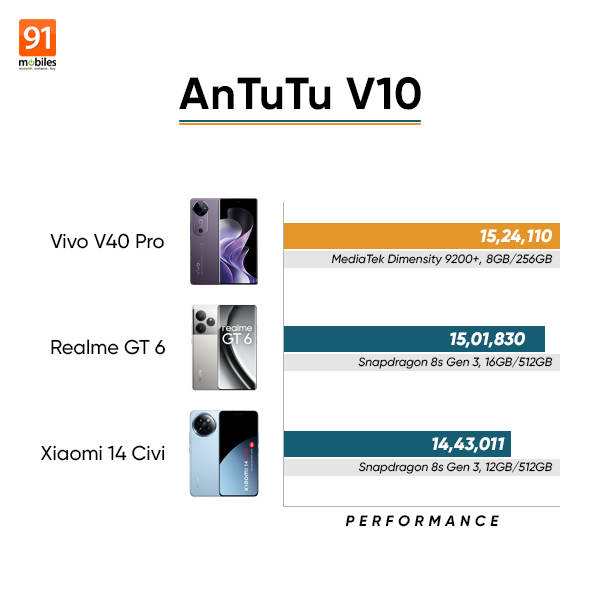
The MediaTek Dimensity 9200+ chipset powering the Vivo V40 Pro was announced last year as a more powerful version of the older Dimensity 9200 SoC. Interestingly, the V40 Pro is the first model to launch with this year-old chipset in India. It offers a 10 percent CPU and GPU improvement over its predecessor. The octa-core chip offers a peak clock speed of 3.35GHz and that’s enough power to make the Vivo V40 Pro one of the fastest phones in this segment, outscoring the likes of the Snapdragon 8s Gen 3-powered Realme GT 6 in the sub-Rs 50,000 segment.
In the AnTuTu benchmark test, the V40 Pro’s Dimensity 9200+ outscored the Realme GT 6 and Xiaomi 14 Civi, both of which are powered by the Snapdragon 8s Gen 3. The score is also significantly higher than the Dimensity 8200-powered Vivo V30 Pro, which recorded 9,48,361 on AnTuTu.
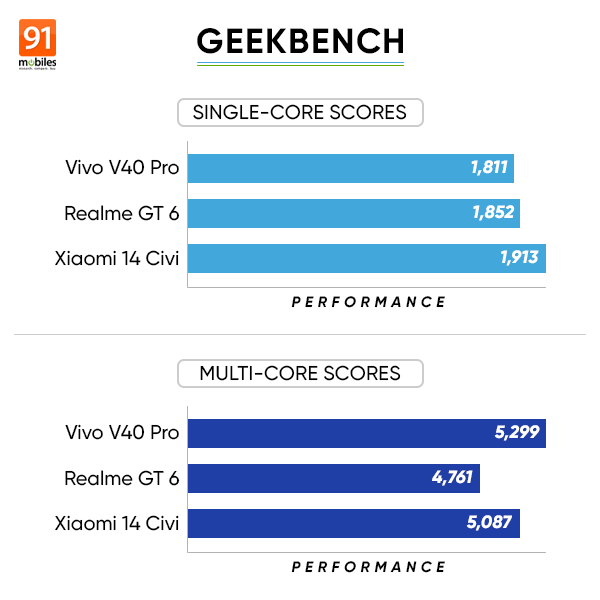
In the Geekbench test, the Vivo V40 Pro was lower than its rival in the single-core test but managed to outscore the other in the multi-core test, suggesting that the Vivo phone can handle complex tasks better.
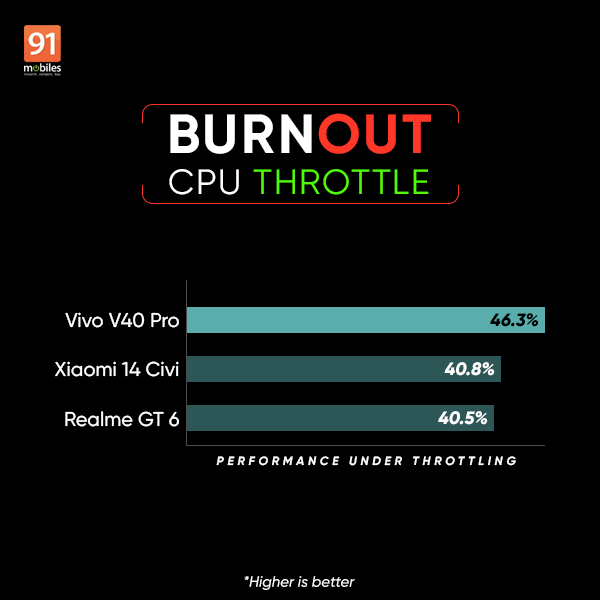
Even in our Burnout CPU throttle test, the Vivo V40 Pro managed to perform slightly better at performance throttling compared to the Realme and Xiaomi phones, though all three devices dropped down to around 40 percent of their peak performance under stress.
Based on these benchmark tests, the Dimensity 9200+ seems to be a better chipset overall compared to the Snapdragon 8s Gen 3. You can read our in-depth performance comparison of the Vivo V40 Pro with the Realme GT 6 and Xiaomi 14 Civi here. Talking about real-world usage, the Vivo V40 Pro felt extremely smooth. Animations are fluid and I did not face any noticeable lag while switching apps or browsing through them.
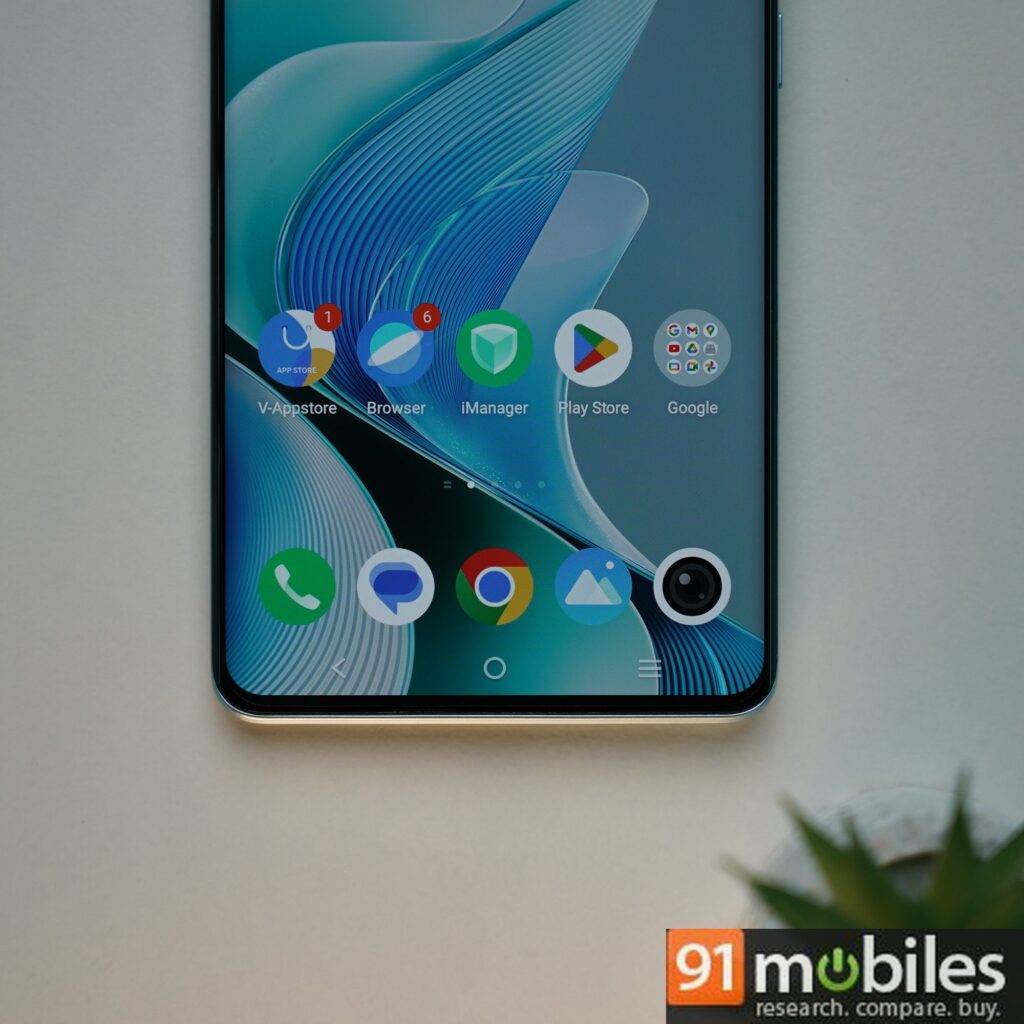
Coming to the software side of things, the Vivo V40 Pro runs on Android 14 with Funtouch OS 14 on top. It comes with its fair share of pre-loaded apps, 50 to be exact, which is only marginally less than what the Realme GT 6 and Xiaomi 14 Civi come with. Funtouch OS might take a while to get used to for people not familiar with the OS. Swiping down from the top edge brings up the control centre and notification panel, you can customise the lock screen clock style and themes based on Material You, have a mini window pop-up for quick replies and access if you’re in another app, and more.
| Model | Pre-loaded apps | Software updates (in years) | Security updates (in years) |
| Vivo V40 Pro | 50 | 3 | 4 |
| Realme GT 6 | 53 | 3 | 4 |
| Xiaomi 14 Civi | 53 | 3 | 4 |
Vivo is promising 3 years of major OS updates and 4 years of security patches with the Vivo V40 Pro, which is similar to what most other phones in this price range offer, including the Realme GT 6 and Xiaomi 14 Civi.
Now, in a time where most phones, especially high-end ones, tout AI features for various day-to-day use cases like summarising a page, prompt-based image generator, native Gemini AI assistant, and so on, the Vivo V40 Pro is surprisingly light on these. You do get a few AI features for the camera, but nothing beyond that.
Battery
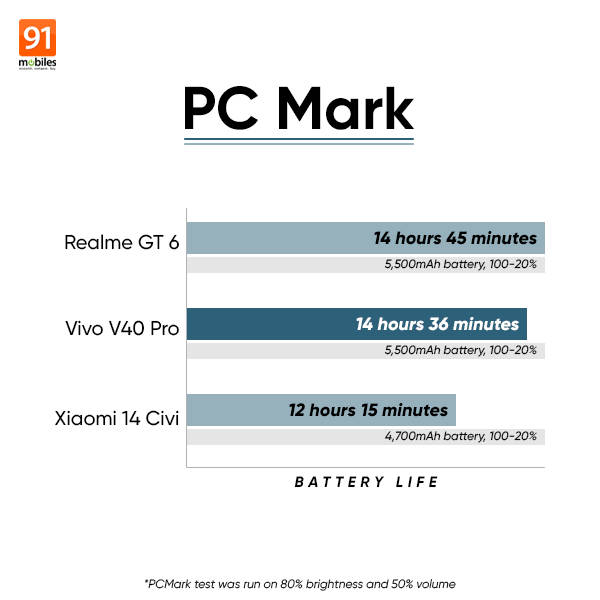
Vivo has bumped the battery capacity of the Vivo V40 Pro to 5,500mAh from 5,000 in the V30 Pro. This 500mAh increase is welcome as it should mean improved battery life in day-to-day usage. You can now comfortably go through over a full day of usage on a single charge and still have enough in the tank by the end of the night. In our PCMark battery test, the Vivo V40 Pro managed to last 14 hours and 36 minutes from 100 to 20 percent on 80 percent brightness. This is among the best in the sub-Rs 50,000 segment, with only the Realme GT 6T performing marginally better at 14 hours and 45 minutes.
A quick top-up in the morning before leaving for work is enough to take you through a full day. The phone supports 80W charging much like its predecessor and can charge the device from 20 to 100 percent in about 37 minutes and it takes exactly 50 minutes to charge from 1 to 100 percent.
| Charging time | Battery percentage |
| 15 minutes | 30 percent |
| 30 minutes | 60 percent |
| 45 minutes | 90 percent |
| 50 minutes | 100 percent |
Final verdict
Starting at Rs 49,999, the Vivo V40 Pro is priced a few notches higher than its predecessor. But this price hike is justified with some meaningful upgrades, including the addition of stereo speakers and a much better IP rating. The Dimensity 9200+ chipset is the dark horse that surprised us with its performance, outscoring Snapdragon 8s Gen 3 phones like the Realme GT 6 and Xiaomi 14 Civi in benchmarks.
The V40 Pro’s pricing could deter potential buyers, especially when you have phones like the Realme GT 6 and Xiaomi 14 Civi available at a cheaper price point. That said, the Vivo V40 Pro offers a complete package that includes a big and bright display, sturdy and light design, impressive performance, terrific ZEISS-backed cameras, and a dependable battery life. It is truly a worthy successor to the V30 Pro.
Editor’s rating: 8 / 10
Pros:
- Fast and smooth performance
- Reliable ZEISS-backed cameras
- Good battery life
- Stereo speakers and IP68 rating
Cons:
- Limited AI features
- Expensive