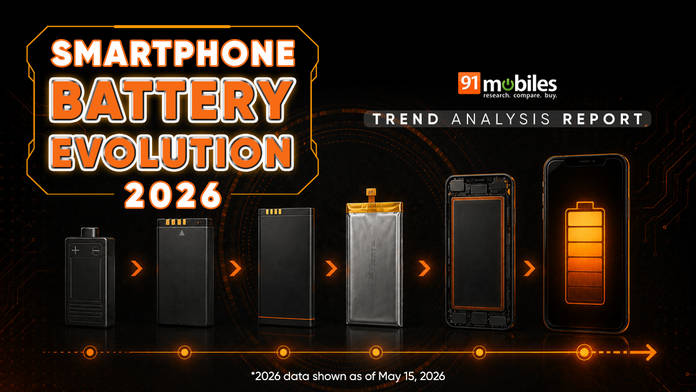
Not too long ago, a 5,000mAh battery was something brands put in a press release and underlined twice, think as recent as 2024. Today, in 2026, it barely gets a mention or is often skipped altogether. India’s current smartphone market is in the middle of a battery arms race with no signs of slowing down, with 7,000mAh as the new baseline, 9,000mAh as a highlight-worthy specification, and at least one phone having crossed the 10,000mAh barrier already. The battery size that once defined a power user’s ideal is now what you get in a device as low as Rs 15,000.
But all this didn’t happen overnight, and the jump from modest 5,000mAh cells to the enormous batteries stuffed into phones today is the result of a specific chain of events. Largely, a slew of launches that changed expectations, a new battery chemistry that made it physically possible, and a set of market pressures that gave brands every reason to keep pushing the number up. This is a look at how India’s smartphones got so big, so fast, and what’s driving them.
Table of Contents
How it started
Big batteries in phones are not exactly a new idea. Samsung was already experimenting with oversized cells back in 2020, putting 6,000mAh into the Galaxy M21 and Galaxy M31, and pushing the Galaxy M51 all the way to 7,000mAh. But these phones also had an obvious problem. The Galaxy M51 was 9.5mm thick and weighed 213 grams. Conventional lithium-ion cells hold only so much energy per gram, so fitting a bigger cell into a phone meant fitting more physical material. The bulk was simply the price of a bigger number on the spec sheet.
Motorola tried something similar with the Moto G24 Power in January 2024, fitting a 6,000mAh Li-ion pack with 30W TurboPower charging into the budget segment. At 9mm thick and 197 grams, it was slightly more manageable, but still what you’d call a chunky device.
While this was playing out in India, Chinese manufacturers were already testing something different. Honor had been working on silicon-carbon battery technology since 2023 with the Magic5 Pro (Chinese variant), and by 2024, OPPO shipped the Find X8 and X8 Pro with explicit silicon-carbon cells that fit into a slimmer frame than any comparable Li-ion device at the time.
Silicon-carbon anodes can theoretically store over ten times the energy per gram compared to traditional graphite, so manufacturers could now push capacity up without increasing the thickness. China was getting its first look at what this chemistry could do in a real product, and India was soon to follow.
In 2025, major mid-range launches like the Realme 14 Pro series and Redmi Note 14 Pro series, the Poco X7 Pro, the Realme P3 Pro, and the Motorola Edge 60 Pro, among others, arrived with similar silicon-anode batteries. In the flagship segment, phones like iQOO 15, OnePlus 13, Vivo X200, and Xiaomi 15 all arrived in India within months of each other, with each brand explicitly mentioning silicon-carbon batteries as a key feature.
This new wave of launches addressed the biggest complaint about large-battery phones. A massive battery no longer meant that the device would be heavy or thick, making these silicon-anode batteries the new trend for smartphones.
The tech behind it
To understand why silicon-carbon batteries suddenly became mainstream, you first need to know how Li-ion cells work. Traditional batteries use graphite as the anode material, the part that holds the negative charge and stores energy when the battery charges. It is made of graphite, which is reliable, but it has an energy limit: it can store roughly 372mAh of energy per gram. Manufacturers have been working with that limit for years, which is why getting more capacity meant making the battery physically bigger.
Using silicon, however, helps alleviate that problem. It can theoretically store over 4,000mAh per gram, more than ten times what graphite can manage. But there’s a catch: pure silicon expands by up to 300 percent every time the battery charges, which cracks the electrode and degrades the cell quickly. Silicon-carbon batteries solve this problem by embedding silicon particles into a carbon matrix. The carbon structure acts like a sponge, absorbing and cushioning the expansion, keeping it to around 10-20 percent and preserving the electrode over hundreds of charge cycles.
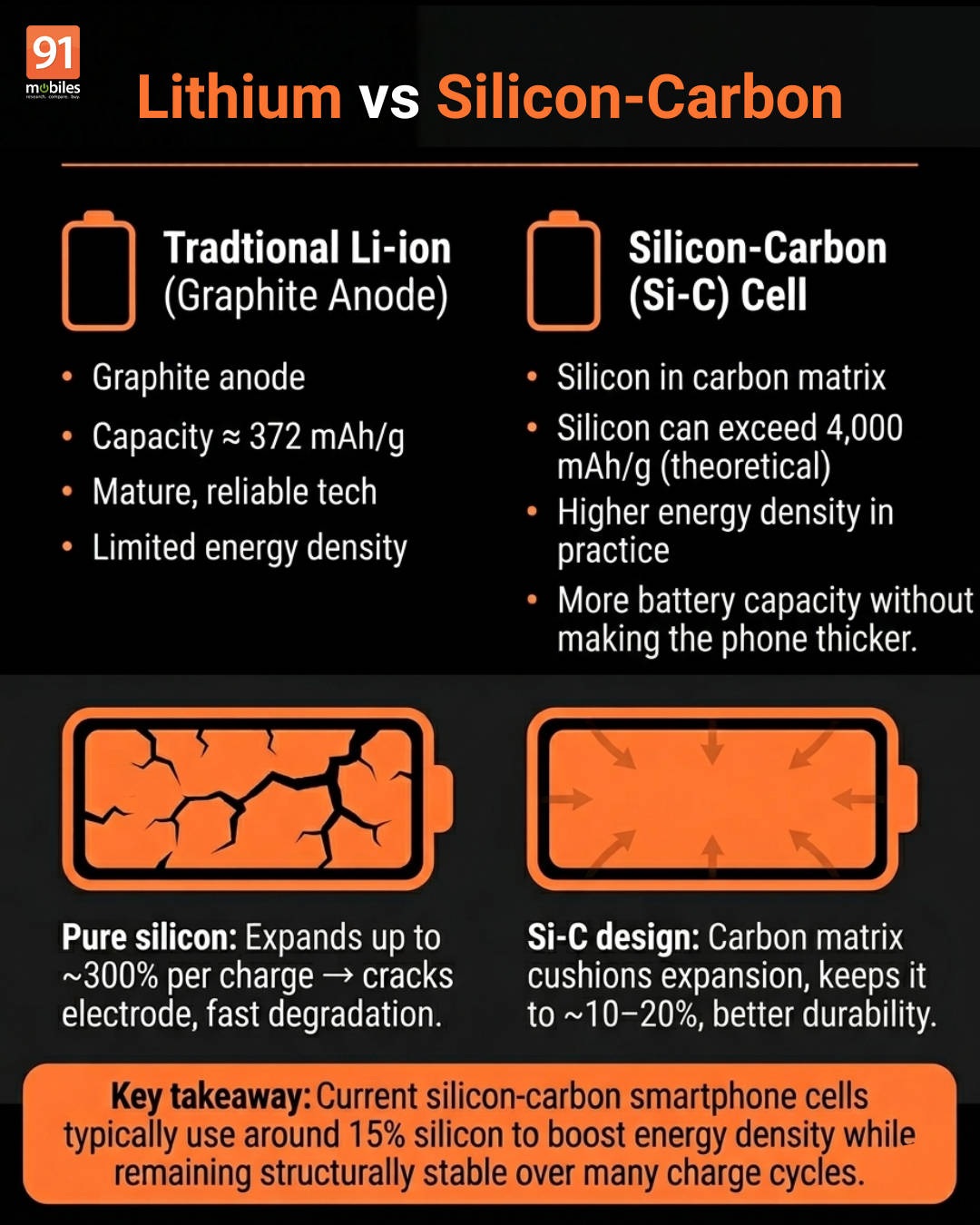
The result is a silicon-carbon cell that can deliver significantly more energy in the same physical volume as a conventional Li-ion pack or maintain the same capacity in a smaller, lighter form. Brands no longer have to choose between a high mAh count and a device people actually want to carry.
The current generation of commercial silicon-carbon cells typically uses around 15 percent silicon by composition, enough to deliver a measurable jump in energy density without pushing the structural instability that higher concentrations could cause. As manufacturing matures and that percentage climbs, the gap between silicon-carbon phones and conventional Li-ion devices will only widen. Neware has a detailed breakdown of the chemistry if you want deeper insights into how the technology works.
Is there an actual upside?
This year, we have seen some phones with exceptionally large batteries that put them closer to a power bank than a smartphone. The Vivo T5 Pro, the OnePlus Nord 6, and last year’s Realme P4 Power all fall into that category, with the P4 Power currently holding the top position as the biggest battery phone in India. We’ve also compiled extensive data from the phones we’ve tested in the last couple years to give you an idea of how the batteries have grown in size since 2024. Check it out below:
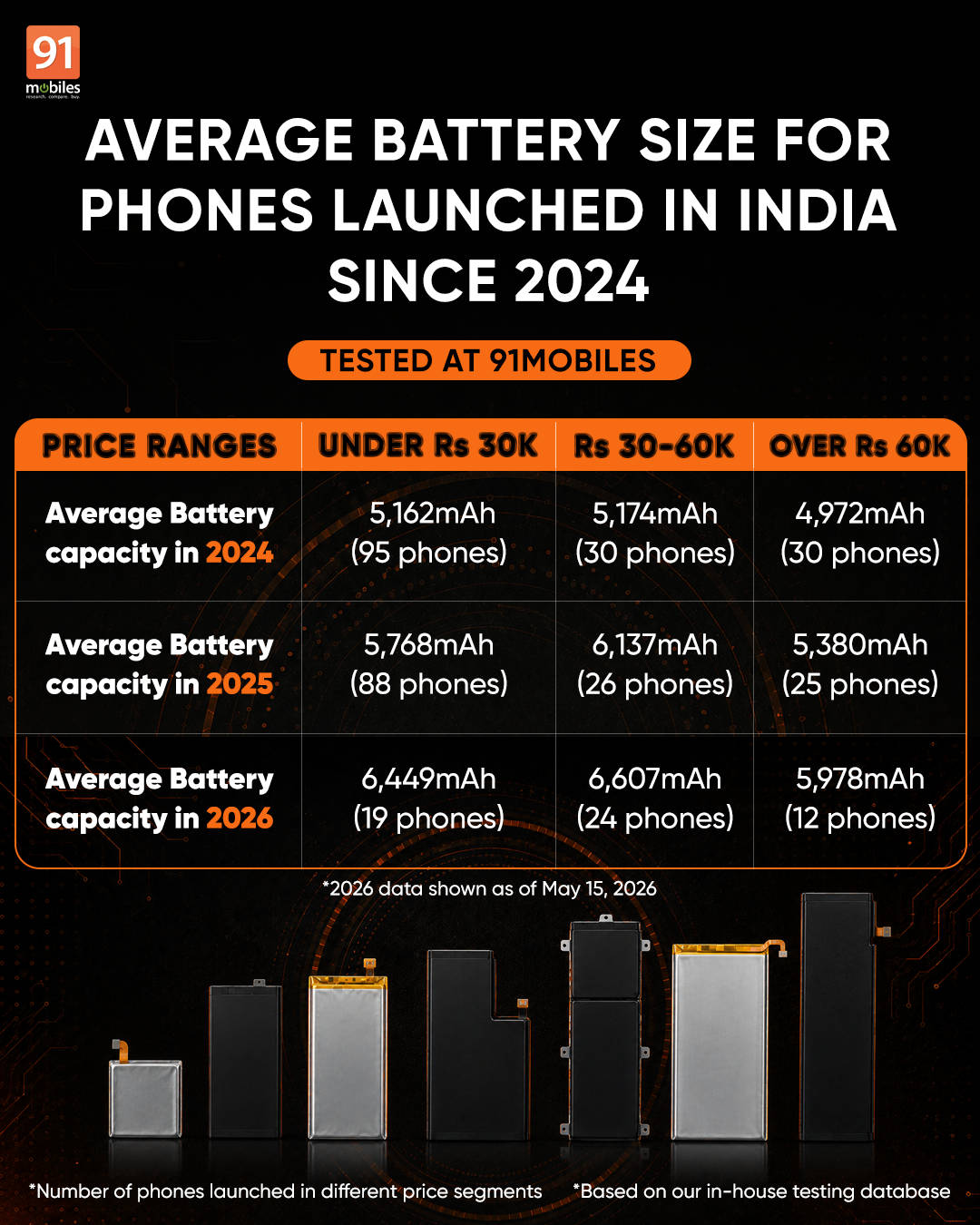
Average battery sizes have grown across every price segment, with budget and mid-range phones seeing the biggest jumps of around 25 to 28 percent over two years. Even flagships above Rs 60,000 have added over 1,000mAh on average since 2024, a 20 percent increase despite already starting with larger cells.
Now, you may be asking: is there truly an upside to having such a large battery? The answer is yes. Our testing team at 91mobiles regularly benchmarks a variety of tests across all major smartphone aspects, and we have a lot of legacy battery data from older launches that gives us a good comparison point against these new battery giants.
PCMark battery benchmark
This is a standard test that we employ, which helps us gauge the estimated time a battery will last in a phone with heavy usage. On average, a phone in 2024 delivered about 13 hours of runtime, which increased to roughly 14 hours in 2025. In 2026, however, the average PCMark runtime on a device has climbed to 15.5 hours, a significant increase thanks to these bigger batteries.
A PCMark score above 20 hours indicates the device will easily last over 1.5 days, and quite often in real-world use it goes beyond that. When we benchmark these phones, the test runs continuously at 80 percent brightness, which is not fully indicative of real-world usage. With automatic brightness and typical usage habits, most phones sit around the 50-70 percent level, so the test is more rigorous than what most people actually experience.
This is especially true for phones with higher peak brightness levels, like the Nord 6, Realme P4 Power, and Vivo T5 Pro. Here is how they compare against some of the best scorers from 2024 and 2025:




Do note that while the Vivo T3x’s result is exceptional, it uses a lower-resolution panel with a lower maximum brightness level compared to its peers. That makes a significant difference in battery life, allowing it to deliver such a result.
Battery drop while gaming
Another demanding aspect is battery performance on gaming, where the power draw is usually the highest compared to even the most rigorous use cases. We’ll compare the average battery drop in CoD: Mobile and BGMI for the top performers in 2024, 2025 and 2026 to show how things have improved.
Top performers in 2024
| Battery drop over 30mins | Realme 14X | Vivo T3x |
| CoD: Mobile battery drop | 6% | 5% |
| BGMI battery drop | 5% | 6% |
Top performers in 2025
| Battery drop over 30mins | Realme P4 Power | Realme 16 Pro+ |
| CoD: Mobile battery drop | 4% | 7% |
| BGMI battery drop | 5% | 6% |
Top performers in 2026
| Battery drop over 30mins | Vivo T5 Pro | OnePlus Nord 6 |
| CoD: Mobile battery drop | 4% | 4% |
| BGMI battery drop | 4% | 4% |
The results above will make it abundantly clear that while brands have definitely inflated the battery size of their new offerings, battery efficiency, on average, has seen a significant improvement.
Major phones with big batteries (brand by brand)
| Brand | Phone | Battery |
|---|---|---|
| Realme | P4 Power | 10,001mAh |
| GT 8 Pro | 7,000mAh | |
| 16 Pro+ | 7,000mAh | |
| OnePlus | Nord 6 | 9,000mAh |
| 15R | 7,400mAh | |
| 15 | 7,300mAh | |
| POCO | X8 Pro Max | 8,500mAh |
| F7 | 7,550mAh | |
| M7 Plus | 7,000mAh | |
| iQOO | 15R | 7,600mAh |
| Z10 | 7,300mAh | |
| Z11x | 7,200mAh | |
| Motorola | Edge 70 Fusion | 7,000mAh |
| G86 Power | 6,720mAh | |
| Edge 60 Pro | 6,000mAh | |
| Vivo | T5 Pro | 9,020mAh |
| T5x | 7,000mAh | |
| V70 Elite | 6,500mAh | |
| Xiaomi/Redmi | Redmi Note 15 Pro | 6,580mAh |
| Redmi Note 15 Pro+ | 6,500mAh | |
| Xiaomi 17 | 6,330mAh |
Analysing the table above, you’d notice a few things. Realme and iQOO are arguably the most aggressive brands overall in terms of battery, with 7,000mAh or higher capacities across most of their lineups. Realme, in fact, currently holds the fort with the biggest smartphone battery in India yet, with a 10,001mAh phone.
You’d look at OnePlus and wonder why the mid-range Nord 6 carries a larger battery than the flagship OnePlus 15. That is because mid-range phones have fewer competing hardware priorities, which gives brands more room to push battery capacity without significantly adding to the cost. For example, the POCO’s X8 Pro Max at 8,500mAh in the sub-flagship segment reflects how far that approach has gone in a relatively short time.

The Xiaomi 17 ships with a 7,000mAh silicon-carbon battery in China but comes with a 6,330mAh cell in the Indian variant, with the Ultra following a similar pattern. Battery sizing is clearly a market-specific decision, and the Indian specification does not always match what Chinese buyers receive.
Counterpoint
According to Counterpoint Research, smartphones with 6,000mAh or larger batteries made up 29 percent of all global smartphone sales in January 2026, up from just 10 percent in January 2025. That is nearly a three-fold increase in market share within a single year. Six of the ten best-selling phones in that segment used silicon-carbon cells, and every single one of the top ten came from a Chinese brand.
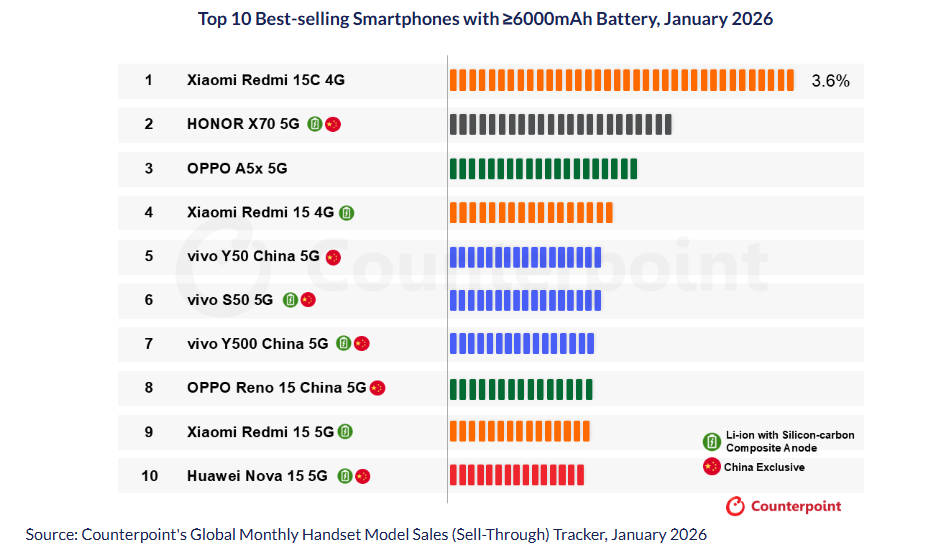
There is another detail worth paying attention to, as six of those top ten phones were China-exclusive models, meaning global markets, including India, were not even seeing the full extent of the trend. The big battery wave that Indian buyers are experiencing in 2026 is, in many ways, a filtered version of what has already been playing out in China for the better part of two years.
The brands leading this shift are almost entirely manufacturers of Chinese origin. The bigger global names, Apple, Samsung, and Google, are watching from the sidelines.
Why key players like Apple, Samsung, and Google aren’t in yet
The brands leading the silicon-carbon charge in India are almost entirely Chinese-origin manufacturers. The bigger global names, Apple, Samsung, and Google, are all still shipping comparatively modest batteries on conventional lithium-ion chemistry, and here’s why:
Samsung has been the most transparent about its non-adoption of silicon-carbon technology. At a roundtable around the Galaxy S26 launch, the company’s smartphone R&D chief, Sung-Hoon Moon, said silicon-carbon cells had not yet passed Samsung’s internal validation standards and that the team would only make the switch when they could demonstrate a clear improvement in real-world user experience. Samsung ships at a scale that most Chinese brands do not, and even a small failure rate on batteries can be an enormous absolute number of affected devices.
Apple has not commented on the silicon-carbon decision, but its track record makes the reasoning fairly obvious. The company has consistently waited for hardware trends to mature before committing, whether those are high refresh rate displays, fast charging, or foldables. When Apple does eventually make a move, it gets more attention than most other brands, which means a battery that degrades faster or swells prematurely would be a far bigger story for Apple. It stands to reason that the brand intends to wait until the tech is mature enough for implementation in its products without any potential negative caveats.
Google’s Pixel 10 series ships with a conventional Li-ion cell, and Google has not addressed silicon-carbon publicly in any capacity. The company has always argued that hardware numbers only tell part of the story and that the Tensor chip combined with software-level optimisation delivers competitive battery life without needing a bigger cell. That argument has some truth to it, but it gets harder to make every year when mid-rangers at a third of the Pixel’s price are comfortably running two full days on silicon-carbon cells.
Conclusion
The battery arms race in India shows no signs of slowing down in the near term. If the jump from 5,000mAh to 7,000mAh happened in under two years, 8,000mAh becoming routine before the end of 2026 seems like a reasonable expectation. Samsung has already confirmed it is working on silicon-carbon batteries for future Galaxy devices. When that happens, and Apple eventually follows, the technology will get a level of mainstream visibility it does not currently have, which will likely push the baseline even higher across the board.
The question is whether this trend has a foundation beyond the current moment or it is just a product of specific market conditions? Memory prices are expected to remain elevated through most of 2026, and as long as brands are under pressure to justify higher retail prices, the battery capacity is one of the easiest ways to deliver more value. If memory prices stabilise and RAM and storage specs start recovering, the situation is likely to change as well. Brands may not need a 10,000mAh battery to sell a phone anymore when they can deliver more competitive specs with a stabilising market.
That makes the next two years quite an interesting time for the smartphone market. The silicon-carbon technology is maturing fast, and consumer appetite for longer battery life is not going away. But whether 2026’s obsession with bigger batteries reflects a permanent shift in what buyers prioritise or a temporary overcorrection driven by hardware constraints is a question the market has yet to fully answer.