Best Mini LED TVs under Rs 80,000 in India right now


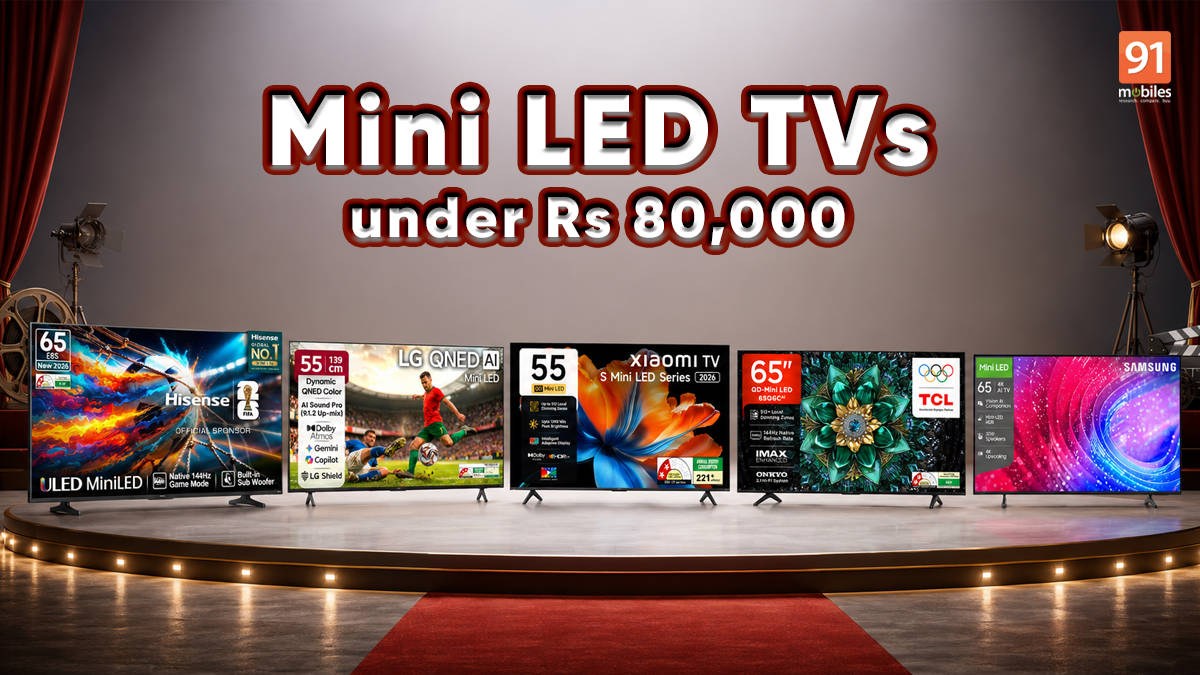
Mini-LED stopped being a premium-only technology sometime in the last year. It used to mean dropping Rs 1.5 lakh-plus for real dimming zones and proper brightness control. But Xiaomi’s newest launch just broke that assumption, and it’s worth examining what actually changed when hunting for the best mini-LED TVs under Rs 80,000 in India right now.
A genuinely good mini-LED TV at this price needs to clear a few real bars. For starters, it needs enough local dimming zones to control contrast scene by scene rather than one giant backlight zone doing all the work. It also needs HDR format support that actually includes Dolby Vision rather than settling for HDR10 alone, and a refresh rate that holds up for both movies and gaming, along with audio that doesn’t feel bolted on as an afterthought. Most budget “mini-LED” TVs in India cut at least one of these corners to hit their price.
Table of Contents
Xiaomi TV S Mini LED Series (65-inch) – Best overall TV
Price: Rs 71,999


Most brands treat mini-LED and colour accuracy as separate purchases. You either get precise local dimming or a proper Quantum Dot colour layer, rarely both at a mid-range price. Xiaomi’s TV S Mini LED Series refuses that trade-off by pairing genuine QD Mini-LED backlighting with a full HDR stack most competitors reserve for their flagship tiers. For anyone searching for the best mini-LED TV under ₹80,000 in India in 2026, it resets what “budget mini-LED” is supposed to mean.
Specifications:
- 65-inch QD Mini-LED, 4K UHD, 384 local dimming zones
- 1200 nits peak brightness, 94% DCI-P3 colour coverage
- Dolby Vision, HDR10+, HLG, Dolby Atmos + DTS:X
- 144Hz refresh rate, AI Game Boost, MEMC
- 34W quad speakers, Google TV, 32GB storage
| Pros | Cons |
| Full Dolby Vision + Atmos + DTS:X stack, uncommon at this price | AI Local Dimming can overcorrect in high-contrast scenes |
| Genuinely competitive 144Hz panel with real gaming support | Processor tier isn’t built for heavy multitasking |
| 200+ free live channels, no subscription needed |
TCL Q6C (65-inch) – Best for gaming
Price: Rs 76,990


Most budget mini-LED TVs advertise “mini-LED” without publishing an actual dimming zone count, leaving buyers to take contrast performance on faith. TCL doesn’t do that here because the Q6C ships with 512+ Precise Dimming Zones and TCL’s All-domain Halo Control Technology, specifically built to suppress the blooming and halo effects that plague cheaper mini-LED panels. It’s also backed by Dolby Vision IQ and a genuine 144Hz panel rather than a lower refresh rate dressed up as premium.
Specifications:
- 65-inch QD-Mini LED, 4K UHD, 512+ Precise Dimming Zones
- 144Hz refresh rate, Dolby Vision IQ, HDR10, TCL All-domain Halo Control Technology
- 46W speakers, Dolby Atmos, DTS Virtual:X
- AiPQ Pro Processor, AMD FreeSync Premium, MEMC 120Hz, HDMI 2.1
- Google TV, 3GB RAM, 32GB storage, 178° viewing angle
| Pros | Cons |
| 512+ dimming zones with dedicated halo-control tech, rare specificity at this price | No HDR10+ support, unlike Hisense’s dual-format approach |
| Genuine 144Hz panel with HDMI 2.1 and AMD FreeSync Premium | 3GB RAM is on the lighter side for heavy app multitasking |
| Dolby Vision IQ adapts picture to room lighting automatically |
Hisense E8S (65-inch) – Best audio
Price: Rs 76,990


Audio is the corner where most mini-LED TVs cut hardest at this price. Brands will spend on the panel and ship a thin 20W speaker setup that undoes half the viewing experience the moment dialogue or bass shows up. Hisense doesn’t take that shortcut with the E8S. A 61W system tuned by Devialet is a genuinely unusual inclusion in this bracket, backed by Dolby Vision IQ and HDR10+ Adaptive on the picture side, so the TV isn’t leaning on one strength while quietly starving the other.
Specifications:
- 65-inch Hi-QLED Mini-LED, 4K UHD, 144Hz refresh rate
- Dolby Vision IQ, HDR10+, HDR10+ Adaptive, Filmmaker Mode, 500 nits (peak 700 nits)
- 61W speaker system tuned by Devialet, Dolby Atmos, AI Sound, built-in subwoofer
- AMD FreeSync Premium, ALLM, VRR, Gaming in Dolby Vision
- VIDAA OS, built-in Alexa, AirPlay2, 4 HDMI ports, Bluetooth 5.4
| Pros | Cons |
| 61W Devialet-tuned audio is a genuine step above every other TV on this list | Native contrast ratio (8500:1) is modest next to TCL’s dimming zone count |
| Dolby Vision IQ + HDR10+ Adaptive covers both major dynamic HDR formats | VIDAA’s app library remains thinner than Google TV or Tizen |
| Full gaming stack (AMD FreeSync Premium, ALLM, VRR, Dolby Vision gaming) | 700 nits peak brightness trails Xiaomi’s 1200 nits by a wide margin |
Samsung M2EH (65-inch) – Best display
Price: Rs 79,990


Most mini-LED TVs squeeze into a 65-inch price point by trimming something you don’t notice until you’re already watching. Screen size, panel technology, or picture processing – all get quietly downgraded to hit the number. Samsung’s M2EH doesn’t take that route. Supreme Mini LED Dimming and Pure Spectrum Colour arrive at full 65-inch scale, no asterisk attached. What actually gets sacrificed here is speed. Refresh rate ties for the slowest on this list, alongside the LG, which reframes who this TV is actually built for: someone watching a film or a match, not someone chasing frame rates in a shooter.
Specifications:
- 65-inch Mini LED, 4K UHD, 60Hz refresh rate
- Mini LED HDR, HDR10+, Pure Spectrum Color, Supreme Mini LED Dimming
- 30W sound output, Object Tracking Sound Lite, Q-Symphony
- Vision AI Companion, Football Mode, Auto Game Mode (ALLM), VRR, HGiG
- Samsung Knox Security, 150+ free channels via Samsung TV Plus
| Pros | Cons |
| Full 65-inch Mini LED panel under Rs 80k without a size or panel-tech downgrade | Refresh rate ties for slower side |
| Samsung Knox security and India’s most established after-sales network among these five | No Dolby Vision or Dolby Atmos, a genuine gap against Xiaomi, TCL, and Hisense |
LG QNED65 (55-inch) – Best software
Price: Rs 58,499


Not every buyer shopping for a mini-LED TV wants to spend right up to the ₹80,000 ceiling – some are looking for the cheapest entry into the category that doesn’t feel like a compromise the moment the remote is in hand. LG’s QNED65 answers that specific search. It settles for a 60Hz panel to hit this price, but webOS 26 running underneath is anything but stripped down. It is loaded with AI Concierge, a working chatbot, and Copilot-powered search, which are the kind of smart TV software most brands only bother building for their flagship tier.
Specifications:
- 55-inch QNED Mini LED, 4K UHD, 60Hz refresh rate
- Dolby Vision, HDR10, HLG, α7 AI Processor 4K Gen9, Dynamic Tone Mapping
- 20W 2.0-channel speakers, Dolby Atmos, AI Sound Pro (Virtual 9.1.2 Up-mix), WOW Orchestra
- webOS 26, AI Concierge, AI Chatbot, AI Search with MS Copilot, LG Shield
- 3 HDMI (eARC, ALLM), Wi-Fi 5, Bluetooth 5.3, FILMMAKER Mode
| Pros | Cons |
| webOS 26’s AI feature set (Concierge, Chatbot, Copilot search) outclasses every smart platform on this list | Priced below the Rs 60k-80k bracket entirely, an outlier against the rest of this roundup |
| WOW Orchestra and the virtual 9.1.2 up-mix pull real depth out of a modest 20W speaker setup | 60Hz refresh and 1.5GB RAM are the thinnest hardware numbers here |
Which TV do we recommend?
| TV | Best for | Price |
| Xiaomi TV S Mini LED | Best overall | Rs 71,999 |
| TCL Q6C | Best for gaming | Rs 76,990 |
| Hisense E8S | Best audio | Rs 76,990 |
| Samsung M2EH | Best display | Rs 79,990 |
| LG QNED65 | Best software | Rs 58,499 |
The Xiaomi TV S Mini LED at Rs 71,999 is the only TV here running Dolby Vision, Atmos, and DTS:X together on a 144Hz panel, and it does it for less than every other entry on this list except the LG. That’s the easiest recommendation of the five.
If dimming zones and raw contrast control matter more than any single brand name, the TCL Q6C’s 512+ zones and dedicated halo-control tech make the strongest case, provided the missing HDR10+ doesn’t bother you.
The Hisense E8S argues the opposite position just as well: fewer disclosed dimming zones, but a 61W Devialet-tuned sound system nothing else here comes close to matching, and it covers both Dolby Vision IQ and HDR10+ where TCL only manages one.
Samsung’s M2EH is the one to pick if screen size is the priority that can’t be compromised, a full 65-inch panel where Samsung’s usual tier would otherwise shrink to 55-inch, but that 65-inch commitment costs the TV its refresh rate, tied for the slowest of the five.
And the LG QNED65 sits slightly outside this bracket on price, cheaper than everything else here, but it earns that price with the sharpest webOS software experience on the list, at the cost of the thinnest hardware spec sheet. There isn’t one TV that wins outright, but there’s a TV for whichever trade-off actually matters to the person buying it.