iPhone 16 Pro Max after a year: the highs, the lows, and the 17 Pro Max-sized question


I’ve been living with the iPhone 16 Pro Max for close to a year now. I say “living with” and not just “using,” because as a reviewer, I’m constantly switching between different phones. Yet, the 16 Pro Max has been the one I’ve come back to most often and is my most consistent daily driver. With the iPhone 17 Pro Max about to hit store shelves, and with the festive sales around the corner, this feels like the right moment to revisit the 16 Pro Max. Here’s what I still love about it, what I wish I could have loved more, and what I’ve stopped loving altogether.
Table of Contents
Stellar battery life even after a year
Let’s talk about the battery first, as that’s the one that tends to age the most in a year. It’s also the one thing most readers and buyers would want to know about – how does the battery life look after a year? I’m pleased to report that the battery life on the iPhone 16 Pro Max remains exceptional. It gets me through a full day and then some, and I’ve never had battery anxiety when I’ve used the device.


The best way to ensure battery health doesn’t drop quickly is to set a charge limit less than 100%. Apple now gives you more charge limit options, so you can set it to anywhere between 80% to 95%, ensuring the battery never charges to 100%, which can speed up battery ageing. I kept the charge limit to 90% on the iPhone 16 Pro Max.
Living with iOS 26 on the iPhone 16 Pro Max
I’ve been running iOS 26 public beta on my iPhone 16 Pro Max, and it feels like Apple’s boldest visual update in years. The new Liquid Glass design gives the interface a translucent, floating effect across the lock screen, apps, and widgets. It looks striking on the Pro Max’s large display, though I still find notifications harder to read at times. Apple has fine-tuned the transparency in recent betas, and you can always dial it back in settings if you prefer the old iOS feel.

Beyond the visuals, some redesigns actually make the phone easier to live with. The new unified Calls app puts favourites and recents on one screen, while Photos now emphasises the library with bigger, cleaner thumbnails. The Camera app is also simpler, with modes tucked away but video controls like resolution and frame rate right where you need them. Add in smaller tweaks, such as the bottom-placed search bar and Visual Intelligence for screenshots, and iOS 26 feels like one of the most meaningful updates in years.
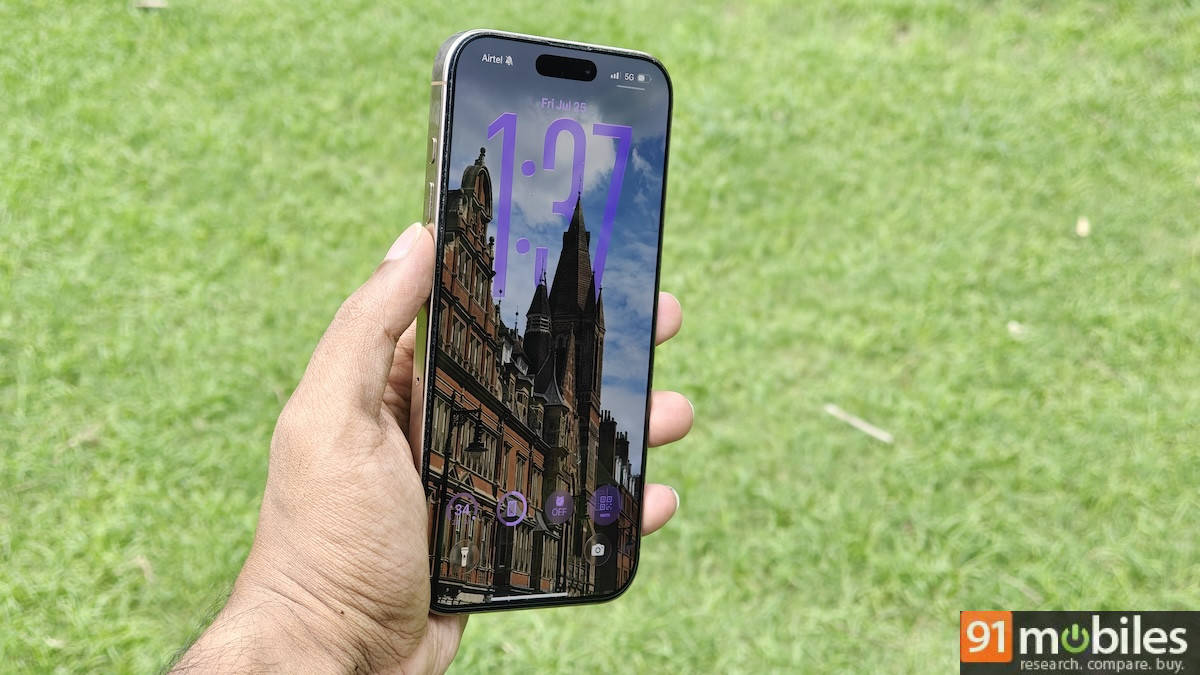
On the 16 Pro Max specifically, iOS 26 runs smoothly – the A18 Pro handles all the animations without breaking a sweat. That said, I did notice a dip in battery life with the early betas, though things have stabilised with recent updates. Compared to iOS 18 at launch, this feels like a phone that has gained more polish over time, not lost it. If you want to go deeper into iOS 26, you can read my hands-on here.
Apple Intelligence is a mixed bag
Apple Intelligence was supposed to be Apple’s big AI push to take on Google and Samsung. At the time of its announcement last year, Apple couldn’t stop talking about the many AI features coming with Apple Intelligence. A year later, some of those features are yet to arrive, and the company barely mentioned AI at this month’s iPhone 17 event. It’s not surprising – Apple doesn’t seem to have made meaningful strides in AI.


A year in, that’s the story of Apple Intelligence – flashes of potential, but nothing that feels transformative in daily use. In fact, I found myself leaning on Google’s AI features when reviewing the Pixel 10 Pro XL far more than Apple’s on the iPhone, which says a lot about where the company stands today. Unless Apple surprises with major updates down the line, AI still feels like a “checklist feature” on the 16 Pro Max rather than something that defines the experience.
A18 Pro was fast then, and it is fast now
Every new Apple chip delivers significant performance gains over the previous generation to the point that it is almost ridiculous how overpowered iPhones have become. And most users won’t ever use the chipset’s full potential. Last year’s A18 Pro was a blazing-fast processor for everyday usage, and it belted out impressive benchmark scores to take on the Snapdragon 8 Gen 3 and MediaTek Dimensity 9300 last year. A year later, the A18 Pro won’t defeat the newer Snapdragon 8 Elite and Dimensity 9400 chips, but that’s quite all right because the chip still delivers exceptional performance for everyday usage.
AnTuTu score


vivo X200 Pro
MediaTek Dimensity 9400
2,518,928

Samsung Galaxy S25 Ultra
Qualcomm Snapdragon 8 Elite
2,209,231

Apple iPhone 16 Pro Max
Apple A18 Pro
1,774,620
AnTuTu assesses a smartphone's CPU, GPU, memory, and overall user experience (higher is better)
What stands out after a year is just how consistent the A18 Pro has been. Even with storage filling up and iOS 26 betas running on the phone, I haven’t noticed any meaningful slowdown in day-to-day use. Performance dips only when the phone heats up, a typical iPhone issue, and something that’s more noticeable during long video shoots in hot weather. The battery health drop that I mentioned earlier hasn’t led to any major throttling in sustained use. I don’t really game a lot on the phone, but I can confidently say the A18 Pro will handle popular games like BGMI and CoD Mobile or any of the Apple Arcade games with ease. This might have been solved to some extent on the new aluminium iPhone 17 Pro models that come with a vapour chamber.
Cameras hold up well, kind of
When we reviewed the iPhone 16 Pro Max last year, we said that the cameras were generally excellent in capturing crisp and clean daylight shots with accurate colour reproduction and contrast. It did struggle in low-light scenes, especially with lens flare. The 16 Pro Max’s telephoto lens also supports 5x optical zoom, which has been bumped to 8x on the 17 Pro Max.


That said, the reason I keep coming back to the iPhone 16 Pro Max is simply because its cameras consistently and reliably perform well in most lighting conditions. Even after a year, there’s no noticeable shutter lag, and focus remains snappy in daylight and well-lit scenes. And photographic styles add a helpful layer of personalisation that makes the iPhone feel a bit more “yours.” It might not top the chart anymore, but it still earns trust when it matters, whether that’s a family gathering or travel photos.

And while we’re on the subject of cameras, I barely used the Camera Control button over the past year. Given that the button is still present on the 17 Pro Max, it seems there are people who find the button useful.
The big iPhone 17 Pro Max-sized question
To cut a long story short, the iPhone 16 Pro Max is still a terrific iPhone, worth its price (which is expected to drop below Rs 1,30,000 during festive sales). The battery life continues to remain solid, the ProMotion display still looks great, the cameras are still pro-grade, and its chipset and software will keep you happy for years to come. This begs the question: Should you buy the newer iPhone 17 Pro Max, or should you save some money and buy the 16 Pro Max?
If this were a long-term review of the iPhone 16, I would tell you that the base iPhone 17 is absolutely worth upgrading to – it’s a solid upgrade through and through. But I can’t say the same for the Pro Max. The 17 Pro Max doesn’t offer the kind of gains over the 16 Pro Max that the base model does over the 16. Yes, the return to aluminium design should offer better thermal performance, the cameras are slightly better with upgraded 48MP telephoto and 18MP front cameras, and the battery life is expected to be marginally better, but these are minor upgrades that might not be enough to sway buyers.
Adding to that, iPhones hold their value extremely well, and the 16 Pro Max is no exception – it still commands strong resale prices even after a year, which makes it a smarter buy if you’re cost-conscious. My unit is still comfortably getting me through a full day despite a year of charging cycles, with battery health sitting at 98%, which is reassuring if you’re planning to keep it long term. And of course, the promise of years of iOS updates means you’re not missing out on the peace of mind that comes with future-proofing.