OnePlus Nord 6 vs Motorola Edge 70 Pro vs Redmi Turbo 5: which phone performs best?


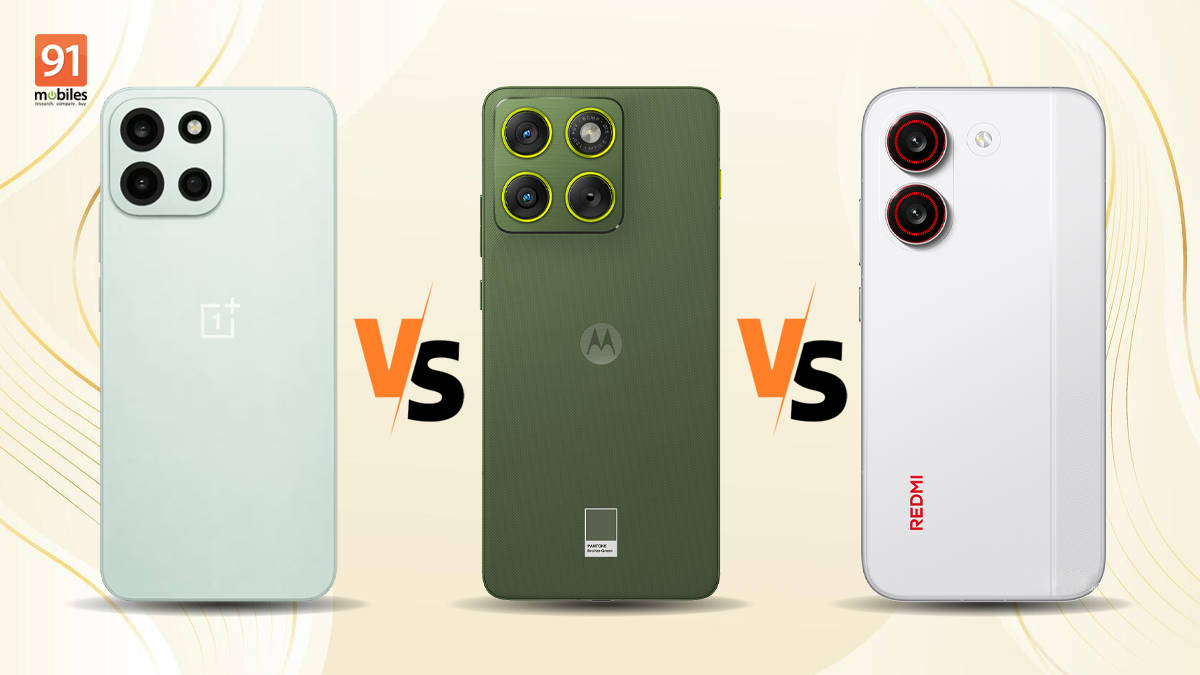
The mid-range segment for phones priced around Rs 40,000 and slightly higher is a sweet spot for buyers who want performance-focused phones. This price segment currently has phones that offer fast performance, capable of handling graphics-intensive games and heavy-duty stuff like video editing and all. Some of our popular picks from this category are the OnePlus Nord 6 (Rs 44,999), Motorola Edge 70 Pro (Rs 39,999), and Redmi Turbo 5 (Rs 41,999). These three phones have the highest performance benchmark scores, putting them at the top of the list.
Based on these benchmark tests conducted by our in-house team and experiences from reviews, here’s a performance comparison between the OnePlus Nord 6, Motorola Edge 70 Pro, and Redmi Turbo 5.
Before that, here’s a quick look at the key specs of all three phones.
| Specification | OnePlus Nord 6 | Motorola Edge 70 Pro | Redmi Turbo 5 |
| Processor | Qualcomm Snapdragon 8s Gen 4 | MediaTek Dimensity 8500 Extreme | MediaTek Dimensity 8500 Ultra |
| RAM/Storage | 8GB/12GB LPDDR5X RAM; 256GB UFS 4.1 storage | 12GB LPDDR5X RAM; 256GB UFS 4.1 storage | 8GB LPDDR5X/12GB LPDDR5X Ultra RAM; 256GB UFS 4.1 storage |
| Cooling system | 33,147mm² graphene cooling system | 4,600mm2 vapour chamber | 5,300 mm² stainless steel layer, Graphite Layer |
Table of Contents
OnePlus Nord 6 vs Motorola Edge 70 Pro vs Redmi Turbo 5: AnTuTu, CPU Burnout
To better understand their performance, we put the three phones through several popular benchmark tests. One of these is AnTuTu, which evaluates performance across the CPU, GPU, memory, and user experience. The OnePlus Nord 6 comes out on top, scoring 23,66,913 points. The Motorola Edge 70 Pro follows with 21,94,258 points, while the Redmi Turbo 5 scores 21,35,669 points. Based on these results, the Nord 6 has the strongest overall performance potential among the three.
AnTuTu score


OnePlus Nord 6
Qualcomm Snapdragon 8s Gen 4
2,366,913

Motorola Edge 70 Pro 5G
MediaTek Dimensity 8500 Extreme
2,194,258

Xiaomi Redmi Turbo 5
MediaTek Dimensity 8500 Ultra
2,135,669
AnTuTu assesses a smartphone's CPU, GPU, memory, and overall user experience (higher is better)
Interestingly, the Redmi Turbo 5 performs the best in the Burnout test, which pushes the CPU, GPU, and NPU to their limits to assess sustained performance, thermal throttling, and power efficiency. The OnePlus Nord 6 scores 45.40 percent, narrowly ahead of the Motorola Edge 70 Pro with 43.6 percent.
Burnout Score
Xiaomi Redmi Turbo 5
49.1%
OnePlus Nord 6
45.4%
Motorola Edge 70 Pro 5G
43.6%
Burnout assesses CPU throttling and sustained performance under heavy load (higher is better)
Overall, the OnePlus Nord 6 leads in peak performance, the Redmi Turbo 5 handles sustained heavy workloads the best, and the Edge 70 Pro falls between the two in the AnTuTu benchmark.
OnePlus Nord 6 vs Motorola Edge 70 Pro vs Redmi Turbo 5: Geekbench
Geekbench is another popular benchmark used to evaluate a phone’s raw CPU performance. It measures single-core and multi-core performance to assess how well a chipset handles different computing tasks. The single-core test evaluates the performance of an individual CPU core, while the multi-core test measures how all available CPU cores perform together. Higher scores indicate better performance.
In our tests, the Motorola Edge 70 Pro achieved the highest multi-core score of 6,864, while the OnePlus Nord 6 led the single-core test with 2,040 points. The Redmi Turbo 5 secured the second-highest multi-core score, followed by the Nord 6. In the single-core test, the Edge 70 Pro and Redmi Turbo 5 delivered closely matched results.
| Phone | Geekbench multi-core | Geekbench single-core |
| OnePlus Nord 6 | 6520 | 2040 |
| Motorola Edge 70 Pro | 6864 | 1749 |
| Redmi Turbo 5 | 6657 | 1725 |
Overall, the Motorola Edge 70 Pro has an advantage in multi-core performance, making it better suited to heavily multi-threaded workloads, while the OnePlus Nord 6 takes the lead in single-core performance. The Redmi Turbo 5 remains competitive, delivering results close to the Edge 70 Pro in single-core testing.
OnePlus Nord 6 vs Motorola Edge 70 Pro vs Redmi Turbo 5: reviews
Benchmarks provide a useful indication of a phone’s performance, but they don’t always reflect real-world usage. Having reviewed all three phones, we found that each delivers reliable performance, albeit with some differences.


The OnePlus Nord 6 is powered by the Qualcomm Snapdragon 8s Gen 4 chipset, paired with up to 12GB of LPDDR5X RAM and 256GB of UFS 4.1 storage. The processor is known for its strong performance in the mid-range segment, and the Nord 6 handles everyday tasks and demanding workloads with ease. It also stands out for gaming, achieving up to 165fps in BGMI and COD Mobile with Pro Gamer Mode and Adaptive Frame Booster enabled. The phone can get slightly warm during extended gaming sessions, but it never becomes uncomfortably hot.


The Motorola Edge 70 Pro isn’t specifically designed as a gaming-focused phone, but it still delivers solid performance. It packs the MediaTek Dimensity 8500 Extreme chipset, paired with up to 12GB of LPDDR5X RAM and 256GB of UFS 4.1 storage. The phone feels snappy during everyday use and handles demanding tasks well. However, pushing it harder can cause it to heat up quickly, partly due to its smaller vapour chamber. While this doesn’t take away from its overall performance, users should be prepared for some heating during intensive workloads.


The Redmi Turbo 5, meanwhile, is powered by the MediaTek Dimensity 8500 Ultra chipset, paired with up to 12GB of LPDDR5X Ultra RAM and 256GB of UFS 4.1 storage. It features Redmi’s 3D IceLoop cooling system, which the brand claims offers better cooling than a conventional vapour chamber. In our testing, the phone delivered smooth performance during everyday use and gaming. It also maintained 120fps gameplay in BGMI and COD Mobile during extended sessions with Wild Boost enabled. Although the phone didn’t become uncomfortably hot, we noticed some warmth around the camera module.
| Phone | Price |
| OnePlus Nord 6 | Rs 44,999 (8GB + 256GB) |
| Motorola Edge 70 Pro | Rs 39,999 (8GB + 256GB) |
| Redmi Turbo 5 | Rs 41,999 (8GB + 256GB) |
Overall, the OnePlus Nord 6 is the best choice for high-frame-rate gaming, while the Motorola Edge 70 Pro delivers snappy performance but is more prone to heating under heavy loads. The Redmi Turbo 5, meanwhile, offers smooth gaming with consistent frame rates and effective thermal management. However, the Nord 6 is also the most expensive of the three. If gaming is your top priority, it’s worth considering; otherwise, the Edge 70 Pro and Redmi Turbo 5 are more affordable alternatives that deliver reliable performance.