The POCO X8 Pro Max is easily the brand’s most ambitious smartphone to date. For starters, it’s the first in the X-series lineup to carry the “Pro Max” moniker. To that end, the handset packs a seriously impressive set of specifications that promise enough headroom to handle demanding AAA titles while breezing through everyday tasks.
But does all that translate into the smooth, reliable gaming experience that mobile gamers truly care about? In this POCO X8 Pro Max gaming review, we put the phone through its paces, evaluating its sustained performance, thermal efficiency, and stability during extended gaming sessions.
Table of Contents
How is POCO X8 Pro Max a gaming phone?
Gaming-focused chipset
The POCO X8 Pro Max is powered by the 3nm MediaTek Dimensity 9500s SoC, a slightly toned-down version of the flagship Dimensity 9500. While the 9500s may not match its higher-end sibling in outright performance, it still appears promising on paper, featuring an octa-core CPU clocked at up to 3.73GHz, a 12-core Arm Immortalis-G925 GPU, and MediaTek’s 8th-generation NPU, among other features.



With the Dimensity 9500s, MediaTek takes the fight to its rival, Qualcomm Snapdragon 8 Gen 5, with a higher GPU frequency, greater memory bandwidth, and more. The POCO X8 Pro Max backs the chipset with its 3D IceLoop cooling system, which comprises a large 5,800 mm2 vapour chamber and an 11,000 mm2 graphite layer to efficiently dissipate heat. The system is rated to reduce the temperature by up to 3 degrees Celsius, preventing the phone from throttling.
POCO has paired the X8 Pro Max’s chipset with 12GB of LPDDR5X Ultra RAM and up to 512GB of UFS 4.1 storage. These are among the fastest memory and storage configurations available in a modern smartphone, at least in India. In practice, this translates to quicker app launch times and faster data transfer speeds.
Mammoth battery to keep gaming
Moving on, the POCO X8 Pro Max packs a 9,000mAh battery. The handset uses a silicon-carbon tech to fit that high-density battery in a relatively slim 8.2mm thickness and handheld device. The smartphone weighs 220 grams, which looks comfortable to manage. POCO claims that the X8 Pro Max can last more than three days between charges. The handset supports 100W wired fast charging, bypass charging, and 27W reverse charging for quick top-up times.
Gaming-optimised software and display
To manage this hardware, the POCO X8 Pro Max runs HyperOS 3.0 layered on top of Android 16. The software not only optimises battery life and performance but also introduces features such as WildBoost, designed to deliver higher, more stable frame rates. In fact, the OEM claims the smartphone can achieve up to 120 FPS for smoother gameplay and animations, but only with select titles. In our case, it was BGMI and COD: Mobile.
| Smartphone | Display | Peak Brightness |
| POCO X8 Pro Max | 6.83 inches - AMOLED | 3500 nits |
| iQOO 15R | 6.59 inches - AMOLED | 5000 nits |
| vivo X300 | 6.31 inches - AMOLED | 4500 nits |
All this isn’t possible without a good display. The POCO X8 Pro Max may not have the most power-efficient display, but you get a 6.83-inch LTPS AMOLED panel that bears a 1.5k resolution, 3,500 nits peak brightness, up to 120Hz adaptive refresh rate, HDR10+ support, and 2,650Hz instant touch sampling rate. The phone also offers dual speakers with Dolby Atmos for an immersive listening experience.
POCO X8 Pro Max real-world gaming performance
With those specifications, the POCO X8 Pro Max shouldn’t have any trouble handling anything thrown at it. But how is its actual gaming performance? To test that, we put the smartphone through titles such as BGMI, Call of Duty (COD): Mobile, Tomb Raider, and Hitman: Absolution, and analysed its average FPS, temperature rise, and battery drain. Anyone considering this device, especially for gaming, will know just how graphically intensive these games can be.
Strong graphics, but not flawless
Tomb Raider and Hitman: Absolution are not your high frame rate games, at least for smartphones. Instead, they are more graphics-oriented, emphasising the GPU and, to some extent, the CPU and memory performance of the smartphone.
The POCO X8 Pro Max delivers smooth and consistent performance with balanced battery drain, but slight drops in frame rates and poor haptics.
Tomb Raider
The POCO X8 Pro Max handles the game well, with only a mild temperature rise that doesn’t affect performance. Gameplay remains smooth in both performance and graphics modes, and the frame rate remains consistent at 30 FPS, according to the third-party Scene8 app. It’s fine, but only half of what the game promises for small-screen devices.

Battery drain stands at 8 percent in performance mode and a more modest 6 percent in graphics mode after 40 minutes of play. Be that as it may, the haptic motor feels a bit muted, which takes away from the experience, something you wouldn’t expect in story-driven titles designed to be immersive.
Hitman: Absolution
Hitman: Absolution is another graphically intensive title designed for high-end smartphones. While the game typically runs at 60 FPS, the POCO X8 Pro Max couldn’t quite maintain that level of performance. That said, it consistently maintained frame rates above 40 FPS, which still made for a smooth and enjoyable experience.

However, the phone heated up more than expected, to the point that I had to adjust my grip a few times during a 30-minute session. What stands out, though, is that despite rising temperatures, the handset maintained stable performance without noticeable stutters or dips below 40 FPS. Battery drain was also reasonable, with the level dropping by around 8 percent over the same period.
Consistent frame rates
To test the frame rate consistency, we played BGMI and COD: Mobile on the POCO X8 Pro Max. For better context, we also compared the performance against its closest rival, the iQOO 15R (review).
The POCO X8 Pro Max has a strong hold in thermals and stable performance, but trails in battery efficiency.
BGMI
| Smartphone | FPS | Temp increase | Battery drop |
| POCO X8 Pro Max | 39.7 fps | 1.9° C | 4 percent |
| iQOO 15R | 39.7 fps | 7.1° C | 3 percent |
One of the most popular mobile games, BGMI, on the POCO X8 Pro Max at Ultra HDR graphics and HDR frame rate settings delivered an average frame rate of 39.7 with a temperature hike of 1.9 degrees Celsius and 4 percent battery drop. The 39.7 FPS is on par with the iQOO 15R, which does have an edge with slightly better efficiency (dropping 3 percent for a similar duration) but loses out on thermal efficiency with a 7.1 degrees Celsius increase in temperature for the same duration.
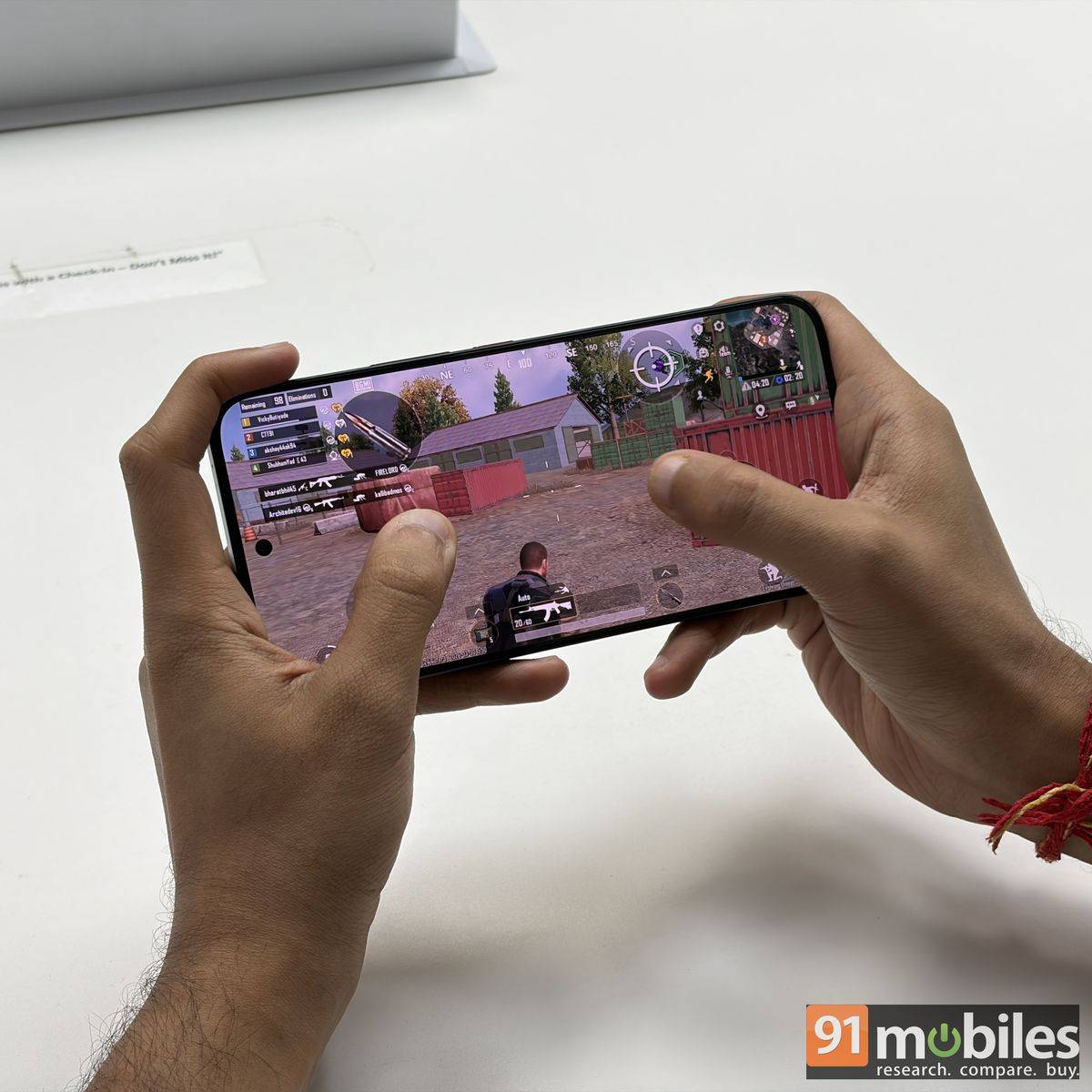
With the highest frame rate settings (Ultra Extreme) enabled in BGMI, both smartphones come close to their claimed figures: 120 FPS on the X8 Pro Max and 144 FPS (via the in-built game mode) on the iQOO 15R. The POCO device does hold an edge in thermal efficiency, recording a temperature rise of 3.4 degrees Celsius compared to 7.5 degrees Celsius on its rival. However, the iQOO 15R proves slightly more efficient in terms of battery, dropping by 5 percent versus 6 percent on the POCO X8 Pro Max.
COD: Mobile
| Smartphone | FPS | Temp increase | Battery drop |
| POCO X8 Pro Max | 56.5 | 2.7° C | 5 percent |
| iQOO 15R | 58 | 7° C | 4 percent |
A similar observation can be made for the POCO X8 Pro Max’s performance while playing COD: Mobile. Its frame rate drops marginally to 56.5 FPS, compared to its counterpart’s 58 FPS at Maximum graphics. However, the POCO smartphone still has better thermal efficiency, heating up by 2.7 degrees Celsius after 30 minutes, compared to the iQOO 15R, which heats up by almost 7 degrees Celsius.

At maximum frame-rate settings, the POCO X8 Pro Max and iQOO 15R deliver up to 120 FPS and 144 FPS, respectively. After a 40-minute session, both smartphones record an identical 6 percent battery drop. However, the POCO device runs cooler, which helps sustain performance over longer gaming sessions with minimal throttling – an important factor for any AAA game.
Gaming performance while charging
The POCO X8 Pro Max supports bypass charging, which, in theory, takes the load off the battery by powering the device directly. This reduces heat generation, delivers more consistent performance, and can also help extend the battery’s lifespan.
To test that, we played BGMI at its maximum frame rate settings, ‘Ultra Extreme’, and ‘Smooth’ graphics while the smartphone was plugged in for charging. The handset maintained consistent frame rates even during intense moments on the push towards a ‘Chicken Dinner’.
It was similar for Hitman: Absolution, and one can expect the same results for the Tomb Raider, Call of Duty, and other titles.
Battery and audio insights while gaming
Before I get to the verdict, here are a few things you need to know:
- The games were played with 80 percent brightness and 50 percent volume level.
- Speaking of audio, the POCO X8 Pro Max comes equipped with stereo speakers backed by Dolby Atmos. They deliver clear and crisp sound at moderate levels, but for a truly immersive gaming experience, a good pair of earphones is still the better choice. At maximum volume, the speakers tend to lose clarity and can sound slightly muffled, which may cause you to miss subtle in-game cues like footsteps or the rustling of leaves, which you don’t want to overlook while gaming.
- The POCO X8 Pro Max’s battery dropped by 28 percent over two and a half hours of gaming. Extrapolated, that translates to over seven hours of screen-on time. To put that into perspective, most smartphones achieve similar endurance under regular usage, making this a notably strong result for sustained gaming.
- It’s worth noting that the games were played without any mobile network, which can also take a toll on the battery. If you want to know the smartphone’s real-world endurance, stay tuned for the full review.
- The smartphone supports 100W fast charging, with a charger provided in the box. It can juice up the device to 100 percent from almost 20 percent in around 70 minutes.
POCO X8 Pro Max gaming verdict: who should buy?
The POCO X8 Pro Max largely delivers on its promise of being a performance-first smartphone. Backed by a powerful chipset, fast memory, and an effective cooling system, the device handles demanding titles with confidence. More importantly, it maintains stable frame rates and better thermal efficiency than its closest rivals, which is crucial for extended gaming sessions.
However, there are a few shortcomings worth pointing out. While peak frame rates are achievable, they aren’t always sustainable across all titles, and aspects like haptics and display tuning slightly dampen the overall immersive experience. Additionally, while battery endurance during gaming is impressive, it isn’t the most efficient.
Still, the combination of strong, sustained performance, effective thermals, and thoughtful features like bypass charging makes the POCO X8 Pro Max a compelling option for mobile gamers.