Redmi Turbo 5 first impressions: a strong start for Redmi Turbo series


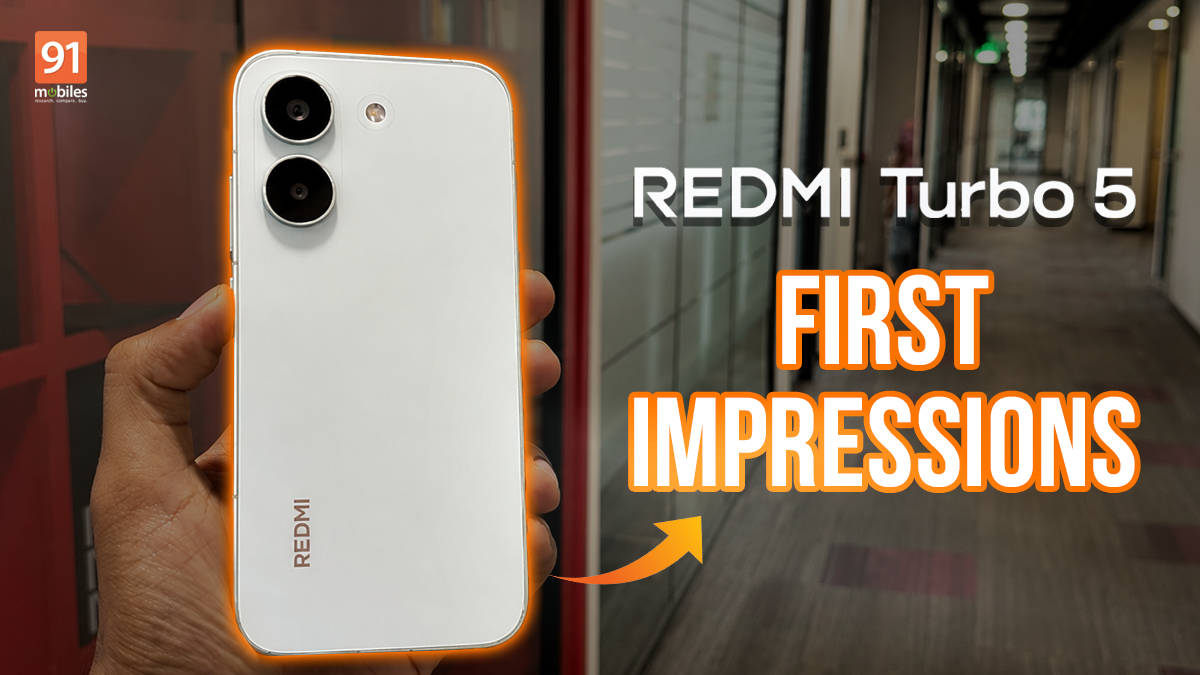
The first Redmi Turbo-series smartphone, the Redmi Turbo 5, has debuted in India. Positioned as a performance-focused powerhouse, the handset is designed to handle intensive multitasking and gaming without slowing down. To support this claim, Redmi has equipped the Turbo 5 with its fastest processor yet, its largest battery, and one of its brightest displays. The handset is powered by MediaTek Dimensity 8500 Ultra SoC, sports up to 3,500 nits bright AMOLED display, and houses a 7,540mAh battery.
While its true capabilities will be evaluated in our full review, here are our first impressions of the Redmi Turbo 5 after spending some time with the device.
Table of Contents
Design: practical and durable
The Redmi Turbo 5 adopts a modern design with flat edges and two individually housed rear camera rings, giving it a clean and minimalist look. The camera rings feature Redmi Pixel Matrix for light effects for notifications, gaming, charging, and more. The smartphone is available in two colour options: Turbo White, Nitro Blue, and Asphalt Black. We received the Nitro Blue variant, which has a cool, understated aesthetic and a matte finish that does a good job of resisting fingerprints and smudges.


The smartphone delivers a premium in-hand feel, thanks to its glass back panel and aluminium frame. The build feels reassuringly solid, giving the impression that it can withstand the occasional bump or drop during everyday use. Adding to its durability credentials, Redmi claims the Turbo 5 comes with flagship-grade protection, including an IP69K rating for resistance against high-pressure and high-temperature water jets. The handset also carries IP69, IP68, and IP66 certifications for protection against water and dust ingress.
Measuring 157.5 x 75.2 x 8.2mm, the Redmi Turbo 5 feels relatively compact for a smartphone in its segment and sits comfortably in the hand. While its 204-gram weight isn’t particularly light, the device feels well-balanced and never cumbersome during use. The power button and volume rocker are positioned on the right edge within easy reach, while the USB Type-C port is located at the bottom, flanked by the speaker grille and SIM card tray. The top end features an IR blaster for remote control of home appliances.

One area where the Redmi Turbo 5 could have been better is its optical in-display fingerprint scanner. Positioned quite low on the display, it doesn’t feel as natural or convenient to use as an ultrasonic fingerprint scanner placed higher up, where the thumb would typically rest while holding the device. That said, this is an understandable compromise considering the smartphone’s pricing.
What is harder to overlook is the bundled protective case. While the accessory itself feels sturdy and well-made, its design doesn’t complement the phone’s colour scheme, making it look somewhat out of place and taking away from the otherwise cohesive aesthetic of the device.
Specifications: speak volumes

The Redmi Turbo 5 features a 6.59-inch AMOLED display with a centred punch-hole cutout. The panel offers a 1.5K resolution, Dolby Vision, a 120Hz refresh rate, HDR10+ support and a peak brightness of up to 3,200 nits, making it one of the more impressive displays in its segment on paper. The display is surrounded by razor-thin bezels, which help maximise the screen-to-body ratio and contribute to a more immersive viewing experience when watching videos, gaming, or browsing content. There is Corning Gorilla Glass 7i guarding the display.
During our brief time with the device, the display delivered a pleasing visual experience with vibrant colours and good sharpness. However, we will be putting it through more rigorous testing across a variety of indoor and outdoor conditions to evaluate its brightness, colour accuracy, and overall performance in our full review.

Under the hood, the Redmi Turbo 5 is powered by the MediaTek Dimensity 8500 Ultra SoC, paired with up to 12GB of LPDDR5X Ultra RAM and 256GB of UFS 4.1 storage. On paper, the hardware package appears well-equipped for the segment and should comfortably handle demanding multitasking, gaming, and everyday workloads.
The chipset previously made its debut on the Xiaomi 17T, where it delivered a strong balance of performance and efficiency for its target audience. As a result, expectations are high for the Redmi Turbo 5, particularly when it comes to sustained gaming performance and handling resource-intensive tasks. To keep temperatures in check and minimise thermal throttling during extended sessions, Redmi has equipped the smartphone with a 3D Ice-Loop Cooling system that features a large 5,300mm2 heat dissipation area.
Powering the Redmi Turbo 5 is a massive 7,540mAh silicon-carbon battery, which should comfortably deliver extended battery life even for power users. The smartphone supports 100W wired fast charging, allowing users to top up the battery quickly when needed. It also offers 27W wired reverse charging, enabling the device to function as a power bank for charging compatible smartphones, accessories, and other gadgets on the go.

Binding everything together is Xiaomi’s latest HyperOS 3 skin atop Android 16 out of the box. The company promises several features with the software, including intuitive design, Xiaomi HyperIsland, Lock Screen personalisation, and cross-ecosystem experience, among other things. The cameras don’t look like it’s a major USP, but they should be serviceable, thanks to the 50MP Sony IMX882 primary sensor with OIS+EIS and 8MP ultrawide lens. The front camera is a 20MP shooter for selfies and video calling.
Other features of the smartphone include Wi-Fi 7 and Bluetooth v6.0 for wireless connectivity. The Redmi Turbo 5 also sports an IR Blaster.
My takeaway…

The Redmi Turbo 5 leaves a strong first impression as a smartphone that prioritises performance and endurance above everything else. The handset gets several fundamentals right, including a comfortable in-hand feel, robust durability credentials, and modern connectivity options. Furthermore, its combination of strong build, upper mid-range chipset, a large battery, and bright display makes it a compelling package for power users and mobile gamers alike.
However, specifications only tell part of the story. The Redmi Turbo 5 is priced in India starting at Rs 37,999. In this segment, the handset’s closest competitor seems to be the Motorola Edge 70, which may not have a massive battery capacity but packs a variant of the same chipset used on the Redmi smartphone. While our initial impressions are that the Redmi Turbo 5 has all the ingredients of a strong contender in its segment, we’ll reserve our final judgement for the full review.