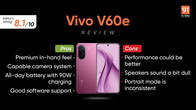
The Vivo V60e (review) is the latest arrival in the hotly contested sub-Rs 30,000 price segment. This price bracket has become a real battleground, with all major brands pushing out their mid-tier devices. Some notable launches in this price range include the Nothing Phone (3a) Pro (review), iQOO Neo10R (review), and Realme P3 Ultra (review).
Even with all this competition, the Motorola Edge 60 Pro (review) has managed to stand out, and for good reason. It’s one of the most well-rounded smartphones you can get for this price. In this article, we’ll be pitching it against the new Vivo V60e to see which one offers better value for money.
Table of Contents
Design and durability: a close call
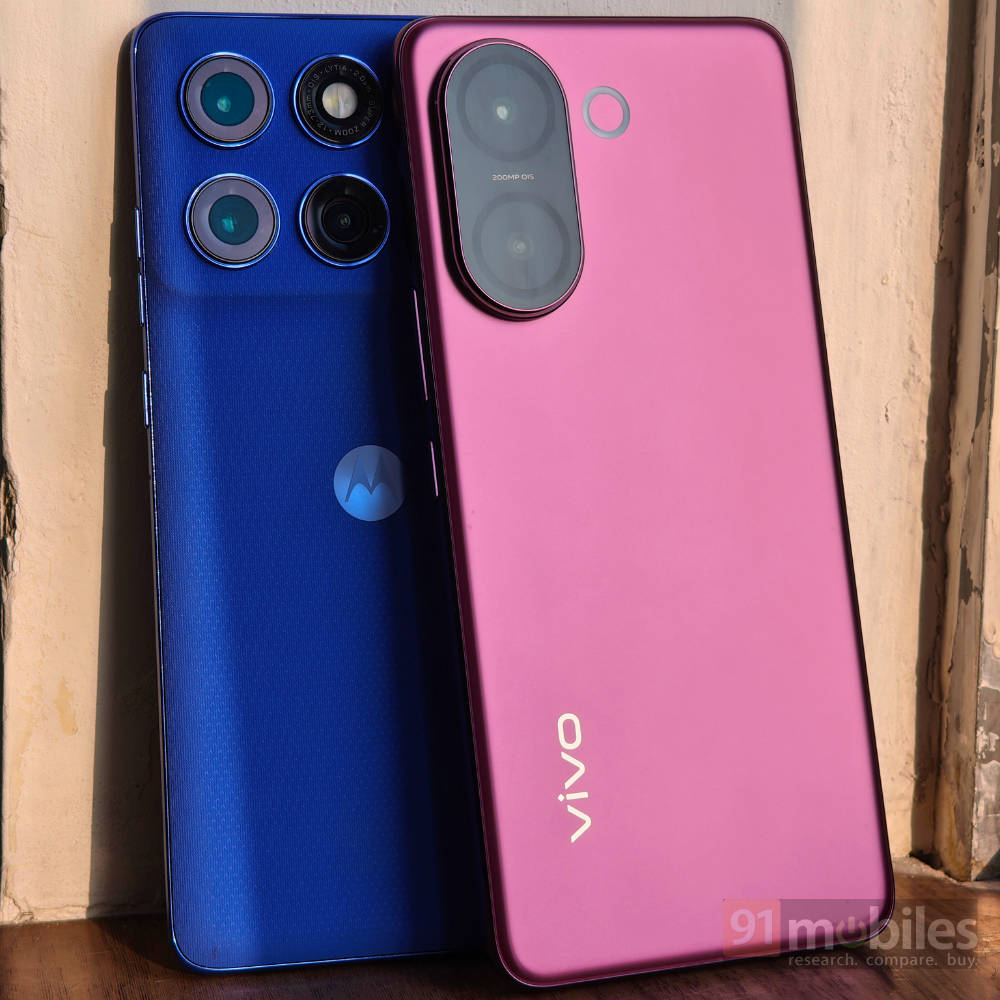
When it comes to design, the Vivo V60e and Motorola Edge 60 Pro share some key similarities, starting with durability. Both phones come with IP68 and IP69 certifications, which is great to see. To put it simply, these ratings measure a smartphone’s resistance to dust and water. The IP69 rating is particularly impressive, as it means the device can withstand high-pressure, high-temperature water jets. So on the protection front, both phones are on equal footing. Where they differ is in screen protection.
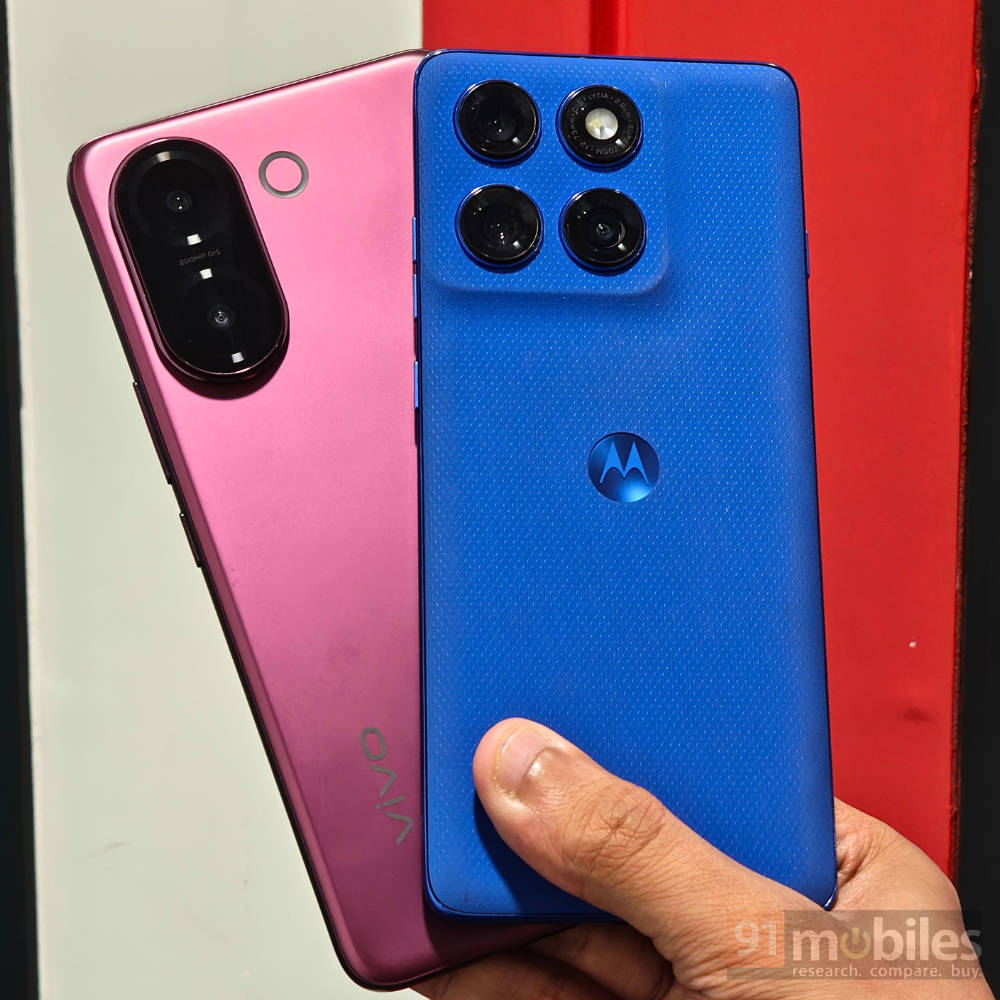
The Motorola Edge 60 Pro offers Corning Gorilla Glass 7i, while the Vivo V60e comes with its own Diamond Shield Glass. While I can’t comment on the durability of Vivo’s glass, I did find that the Gorilla Glass 7i on the Edge 60 Pro has some issues with scratch resistance. After just 10 or so days as my primary phone, it picked up a decent number of scuffs and scratches.
| Smartphone | Thickness | Weight | IP Rating |
| vivo V60e | 7.49 mm | 190 grams | IP68 +IP69 |
| Motorola Edge 60 Pro | 8.24 mm | 186 grams | IP68 +IP69 |
Now, let’s talk about how these phones feel in the hand. The Vivo V60e is slightly heavier and has rounded corners due to its quad-curved display. It’s definitely comfortable to hold, and the weight feels balanced, but it pales in comparison to the Edge 60 Pro. Thanks to its 3D curved display, the Moto phone is thinner at the edges and feels much more comfortable in the hand. With its lighter build and smaller width, the Motorola Edge 60 Pro takes this round.
Screen, sound, and substance
When it comes to the media experience, let’s start with the visuals. Both phones feature a curved panel, but they take different approaches. The Edge 60 Pro features an aggressive 3D curve, more pronounced on the sides, whereas the Vivo V60e employs a more subtle curve on all four edges. While the viewing experience is great on both with no major issues with viewing angles, the Edge 60 Pro is a step ahead in sharpness.
Motorola’s phone packs a 2712 x 1220p display compared to the V60e’s 2392 x 1080p panel. The difference isn’t only on paper. I watched the same 1080p HDR YouTube video on both phones simultaneously, and the Edge 60 Pro’s image was indeed slightly sharper and maintained better clarity.
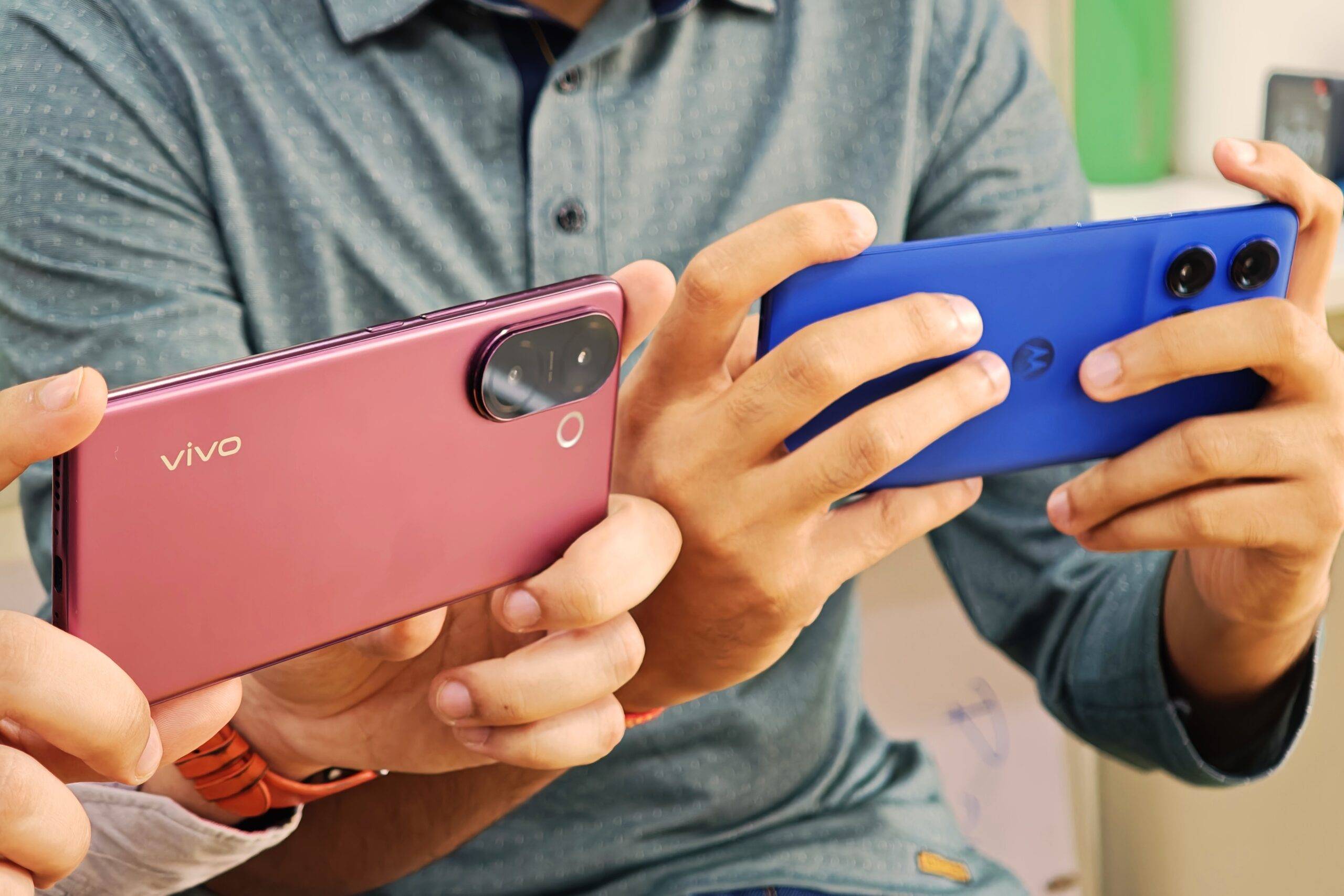
The brightness comparison is more nuanced. The Vivo V60e’s display maxes out at 1600 nits, while the Moto Edge 60 Pro reaches a higher 2000 nits. This gives the Moto an advantage in HDR playback, where videos look brighter and more vibrant. However, for standard content and in general day-to-day usage, I found that the Vivo V60e actually outperforms its counterpart, offering better usable brightness.
| Smartphone | Display | Peak Brightness |
| vivo V60e | 6.77 inches - AMOLED (Curved Display) | 1600 nits |
| Motorola Edge 60 Pro | 6.7 inches - P-OLED (Curved Display) | 4500 nits |
Both phones support modern standards like a wide DCI-P3 colour gamut and HDR10+. But the Edge 60 Pro takes the overall lead, and the deciding factor is its speakers. The audio on the Edge 60 Pro just sounds fuller and offers better channel separation. In comparison, the Vivo V60e’s speakers lack depth and show distortion at max volume, making the Edge 60 Pro the clear winner for an immersive media experience.
OS, AI, and updates: the everyday experience
The day-to-day experience on these phones is quite different, and the OS plays a big part in that. Vivo’s Funtouch OS, while feature-rich and stable, looks quite dated and lacks modern animations. On the other hand, the Edge 60 Pro’s Hello UI has a more contemporary aesthetic but is riddled with minor bugs and feels less polished. For instance, it lacks its own Gallery or file manager app, forcing you to use the Google suite, as it is quite close to stock Android. As someone who isn’t a big fan of Google’s apps, I found that to be a bit of a bummer.
The experience with the Vivo V60e was largely issue-free, but the Motorola Edge 60 Pro had a few bugs, app crashes, and some camera lag right from the start. So while I may prefer the aesthetics of Hello UI, I’m definitely more comfortable with the reliability of Funtouch OS.
When it comes to AI features, neither phone has a lot to offer right now. Motorola gives you features like ‘Remember this’ to save notes and ‘Update Me’ to summarise notifications. ‘Update Me’ is a good idea, but its execution is lacking, often producing grammatical errors that make it less reliable. Vivo, instead, focuses its AI on camera-centric features like Reflection Erase, Photo Enhance, and AI Image Expander. Since I work with images a fair bit, I find Vivo’s suite of AI features more useful.
| Smartphone | Pre-Installed Apps | Software Support |
| vivo V60e | 54 | 3 Years OS Updates + 5 Years Security Updates |
| Motorola Edge 60 Pro | 39 | 3 Years OS Updates + 4 Years Security Updates |
Looking towards the future, both phones promise three major OS updates, which will take them all the way to Android 18. However, Vivo has promised five years of security patches, meaning the phone will remain secure until 2030, compared to 2029 for the Edge 60 Pro. While Motorola’s history with software updates hasn’t been the best, the Edge 60 Pro has been receiving regular updates, as I mentioned in my long-term review, so it is still a worthwhile investment. At the time of writing, the Edge 60 Pro has received the Android 16 update, ahead of several prominent competitors.
Performance: there’s a clear winner
This is one area where there’s a clear winner, which should come as no surprise. The Vivo V60e’s performance is not its strong suit, especially for the price. It comes with a rather modest MediaTek Dimensity 7360 SoC, paired with older LPDDR4X RAM and UFS 2.2 storage. Compare that against the Edge 60 Pro’s powerful Dimensity 8350 SoC, LPDDR5X RAM, and UFS 4.0 storage, and there’s a massive gap in raw power.
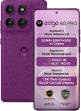

In day-to-day use, the Motorola Edge 60 Pro feels more seamless and smooth. Apps open faster, multitasking is improved, and the overall experience has a snappy feel, thanks to the superior hardware. Surprisingly, however, the gaming performance for heavier titles like BGMI and COD: Mobile is quite comparable when set to medium graphics. This suggests the Vivo V60e has likely been well-optimised for these popular games.
I don’t game on smartphones all that often, except for Hay Day, which is a less demanding title. Both of these devices are more lifestyle-aligned, so top-tier gaming isn’t their main priority. If you’re a casual gamer who plays titles like Clash of Clans or racing simulators, you won’t face any issues on either phone.
Cameras: it boils down to personal preferences
When it comes to the cameras, these two phones have very different philosophies. I’ve already done a detailed comparison in my Vivo V60e review, so you can check that out for all the nitty-gritty details. I’ve shared the key insights below:
In daylight, the Vivo V60e is the clear winner. It captures a brighter, sharper image and produces images with a vibrant, punchy, social media-ready look. The Motorola Edge 60 Pro goes for a more high-contrast style, but it ends up crushing the blacks and losing detail in the shadows. The story is similar for the ultrawide, where the Vivo has better colour consistency, though the Moto’s image is better detailed thanks to its 50MP sensor. Check out some camera samples from Vivo V60e:


However, the Motorola Edge 60 Pro is the decisive winner for portraits and selfies. It just performs better across the board, delivering more pleasing and natural skin tones with significantly better detail. The Vivo V60e, in comparison, produces an artificially brightened image that washes out skin tones, and its bokeh effect isn’t applied correctly. In low light, the Moto again does a better job of controlling light and maintaining natural colours, even if its shot is darker overall.
Vivo’s low-light shots are more vibrant and detailed, albeit with unnatural colours. Although they do look appealing, if that’s more your style, the Vivo V60e might suit you better. Here are some camera samples from the Edge 60 Pro:


So, it really comes down to what you want from your images. If you want photos that pop and are ready to be shared instantly, the Vivo V60e is a great pick. But if you shoot a lot of people and prefer a more true-to-life look, the Motorola Edge 60 Pro is the way to go.
Evenly matched in battery life and charging
Battery life and charging speed are other aspects where both phones are quite evenly matched. The Vivo V60e packs a slightly larger 6,500mAh cell compared to the 6,000mAh cell in the Edge 60 Pro. Both support up to 90W fast charging and, notably, include a compatible charger in the box. In terms of charging speed, the Vivo V60e takes about 40 minutes to top up from 20 to 100 percent, while the Edge 60 Pro is just a hair faster at 36 minutes.
The difference isn’t really noticeable in daily use, as both phones charge extremely fast. Now, here’s where it gets interesting. In the PCMark battery benchmark, the Vivo V60e drastically outperforms the Edge 60 Pro. However, my real-world usage numbers tell a different story. I put both phones through two hours of demanding use, including streaming and gaming. The Vivo V60e registered a battery drop of 20 percent, while the Edge 60 Pro showed a drop of just 19 percent, nearly identical.
This trend continued during normal usage. Both phones consistently gave me around 8 hours of screen-on-time with mixed 5G and Wi-Fi use. Based on this, the Motorola Edge 60 Pro seems to have slightly better battery optimisation out of the box. However, the Vivo V60e is new, and I believe its battery life will likely improve over time as the software adapts to the user’s patterns.
Which phone should you buy under Rs 30,000?
So, after all that, which phone should you buy? Both the Vivo V60e and the Motorola Edge 60 Pro are good devices that happen to excel in completely different areas. The overall winner here is the Motorola Edge 60 Pro, since it wins in key categories like performance, cameras (for portraits), and design. However, the more detailed answer is a bit more nuanced, as it ultimately comes down to what you value most in a smartphone.
The Motorola Edge 60 Pro, priced at around Rs 29,999, is the clear winner in terms of performance and in-hand feel. It has a more powerful processor, faster RAM/storage, and a display that’s a bit sharper, making it feel snappier in day-to-day use. It also excels in portrait and selfie photography, producing more natural and detailed shots. If you’re someone who prioritises raw power, a comfortable design, and true-to-life human shots, the Edge 60 Pro is the way to go.
On the other hand, the Vivo V60e, priced similarly at Rs 29,999, has reliable software and vibrant cameras. Its Funtouch OS is far more stable out of the box, and its camera-focused AI features are quite useful. Although its performance isn’t as strong on paper, it excels in popular games. The cameras here deliver vibrant, punchy daylight photos that are ready to share without any editing. If you value a dependable, bug-free experience and a camera that produces eye-catching shots, the Vivo V60e is a good recommendation.