Raising the Bar: How the Motorola Razr Fold Stacks Up Against Samsung’s Galaxy Z Fold7


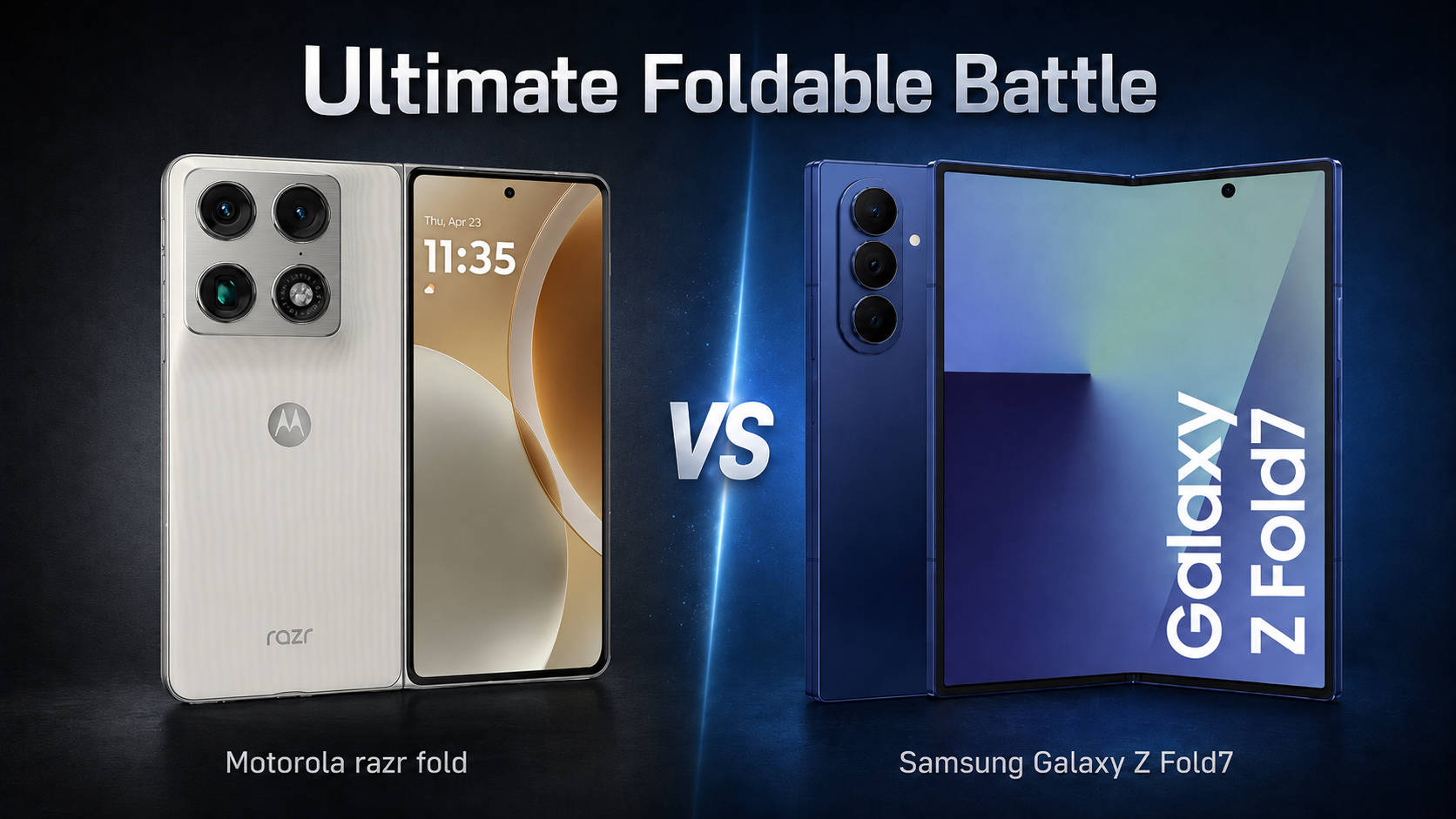
The book-style foldable category has long been dominated by Samsung, but Motorola’s entry into the segment with the Motorola Razr Fold changes the conversation in some meaningful ways. While the Galaxy Z Fold7 refines a familiar formula, the Razr Fold, as one of the latest Motorola foldable phones to enter the premium segment, arrives with a spec sheet that aims to address many of the long-standing complaints foldable users have voiced for years. Here’s how the two devices stack up across the categories that matter most.
Head on comparison: Spec Sheet
Specification | Motorola Razr Fold | Samsung Galaxy Z Fold7 |
Main Display | 8.1-inch LTPO extreme AMOLED (120Hz, 6,200 nits) | 8.0-inch Dynamic AMOLED 2X (120Hz) (2,600 nits) |
Cover Display | 6.6-inch LTPO extreme AMOLED (165Hz, 6,000 nits) | 6.5-inch Dynamic AMOLED 2X (120Hz) |
Processor | Snapdragon 8 Gen 5 | Snapdragon 8 Elite |
RAM | 12GB, 16GB | 12GB, 16GB |
Storage Options | 256GB, 512GB | 256GB, 512GB, 1TB |
Rear Cameras | 50MP Main (Sony LYTIA 828) / 50MP Ultrawide / 50MP Telephoto (3x Optical) | 200MP Main / 12MP Ultrawide / 10MP Telephoto (3x Optical) |
Front Cameras | 32MP (Inner) + 20MP (Cover) | 10MP (Inner) + 10MP (Cover) |
Battery Capacity | 6,000 mAh (Silicon Carbon) | 4,400 mAh |
Charging Speeds | 80W Wired / 50W Wireless | 25W Wired / 15W Wireless |
Weight | 243g | 215g |
Thickness (Folded) | 9.89mm | 8.9mm |
Software OS | Android 16 (7 years of updates) | Android 16 (7 years of updates) |
In-depth comparison: Deep dive
Battery Life: A Decisive Lead
One of the most striking differences between these two foldables is the battery capacity. The Razr Fold packs a massive 6,000mAh silicon-carbon cell, while the Galaxy Z Fold7 sticks with a 4,400mAh battery, the same capacity Samsung has used across several generations.


That’s a 36% larger battery on the Motorola, and the use of silicon-carbon chemistry is significant. The technology allows for higher energy density without proportionally increasing thickness, which has historically been the trade-off that kept foldables small in the battery department. For a form factor that drives two displays and is often used for productivity, the extra capacity should translate directly into meaningfully longer screen-on time, reinforcing the Razr Fold’s appeal as one of the best foldable phones for productivity and multitasking. Motorola rates the Razr Fold for up to 43 hours of standard use.
Charging Speeds: Not Even Close
The gap widens further when you plug in. The Razr Fold supports 80W wired and 50W wireless charging, along with 5W reverse wireless power sharing, while the Galaxy Z Fold7 offers 25W wired and 15W wireless. Motorola claims a full day’s worth of power from a 10-minute top-up, and a larger battery that also charges more than three times faster is a combination that fundamentally changes the day-to-day ownership experience.
A More Balanced Camera System (Now DxOMark’s Top-Ranked Foldable)
Both phones come with triple rear camera setups, but the philosophy behind them differs quite a lot. Samsung leans heavily on a 200MP primary sensor, paired with a relatively modest 12MP ultrawide and a 10MP 3x telephoto. The headline number is impressive, but the supporting cast leaves you wanting for more.


Motorola takes a more uniform approach: a 50MP main built around the advanced Sony LYTIA 828 sensor with a 1/1.28″ sensor size, 2.44μm Ultra Pixel, and 3.5° OIS, paired with a 50MP ultrawide (with macro capability) and a 50MP 3x periscope telephoto powered by the Sony LYTIA 600. the trio is well-matched, which generally translates to more consistent image quality across focal lengths. The setup also brings 100x AI Super Zoom Pro, 8K Dolby Vision recording, and Pantone-validated colour and skin tones.
The independent verdict is telling: DxOMark has ranked the Razr Fold as the world’s top-rated foldable camera system with a score of 164, ahead of the the Galaxy Z Fold7 (145). In side-by-side tests, the lab specifically highlighted the Razr Fold’s better exposure and lower noise in low light, and its superior detail retention in tele-zoom shots compared to the Fold7. Strengthening its credentials as a contender for the best camera phone 2026 among premium foldables.
The front-facing cameras follow the same pattern. The Razr Fold offers a 32MP inner and 20MP cover camera, while the Z Fold7 settles for 10MP on both. For a phone where the cover camera often doubles as the primary selfie shooter, the higher resolution is a genuine advantage.
Display: Brighter, Smoother, and More Durable
The main displays are closely matched in size – 8.1 inches on the Motorola against 8.0 inches on the Samsung, both at 120Hz, but the Razr Fold’s internal 2K LTPO panel hits 6,200 nits of peak brightness, which Motorola says is the brightest in any foldable. Combined with 10-bit colour and Dolby Vision support, it’s a meaningful step up in outdoor visibility and HDR playback.

The cover display is where most foldable users actually spend the majority of their time, and Motorola has clearly recognised that. The Razr Fold’s 6.6-inch LTPO pOLED panel refreshes at up to 165Hz and pushes a peak brightness of 6,000 nits, while the Galaxy Z Fold7’s 6.5-inch Dynamic AMOLED 2X tops out at 120Hz. Samsung’s panel is excellent in its own right, but 165Hz pushes the Razr Fold into territory typically reserved for gaming-focused devices, and the smoothness is noticeable in scrolling and animations.
Durability gets the same attention. The Razr Fold is the first foldable to use Corning’s latest Gorilla Glass Ceramic 3, which Corning claims delivers up to 75% better drop durability and improved scratch resistance over the previous generation. It also carries IP46/IP48/IP49 ratings — among the most comprehensive water and dust protection on any foldable – backed by a titanium-reinforced hinge engineered for years of opening and closing, and a creaseless inner display.
Design and Build: Two Different Personalities
To be clear, the Galaxy Z Fold7 isn’t without its strengths. It’s the lighter device at 215g compared to the Razr Fold’s 243g, and it’s slimmer when folded at 8.9mm versus 9.89mm. For users who prioritise pocketability and one-handed feel, that’s a meaningful difference, though it’s worth noting that the Razr Fold’s extra weight comes largely from its substantially bigger battery.


Where Motorola pulls ahead is in design expression, giving the Motorola foldable phone a distinct identity in a category where many devices tend to look increasingly similar. The Razr Fold is available in a PANTONE™ Blackened Blue diamond piqué-inspired finish and a PANTONE™ Lily White satin-inspired finish. These fashion-forward options help the Motorola foldable phone stand apart from the more conventional designs typically seen in the category. Motorola has also launched a special FIFA World Cup 2026 Edition of the Razr Fold, which adds exclusive FIFA UI customisations, the bundled FIFA Heroes game, and 24-karat FIFA logo plating on the back panel, a genuine collector’s piece for football fans that has no parallel in Samsung’s lineup. That said, build quality on both phones is top-notch and entirely worthy of the flagship segment; the difference lies in the personality each device chooses to project.
Samsung also offers a 1TB storage tier that Motorola caps at 512GB, which will matter to power users storing large media libraries or working with high-bitrate video. And the Snapdragon 8 Elite in the Z Fold7 is, on paper, a slightly more refined chip than the Snapdragon 8 Gen 5 in the Razr Fold, especially in Geekbench single-core and multi-core benchmark tests. However, as shown by AnTuTu benchmark scores – where the Motorola handset registers a higher score of 3.2 million to balance things out – real-world performance between flagship Qualcomm chips is rarely distinguishable in typical use. The Razr Fold also leans on a 6,002mm² vapour chamber paired with copper mesh and liquid metal cooling to keep temperatures roughly 4.4°C lower under load, which should help sustained performance during gaming or extended camera use.
Audio: A First-of-its-Kind Bose Partnership
Audio is another area where Motorola has done something genuinely new. The Razr Fold is the first foldable to feature Sound by Bose tuning, paired with dual stereo speakers, Dolby Atmos, and Hi-Res Audio certification.


The Galaxy Z Fold7 also offers Dolby Atmos via its stereo speakers, but the Bose collaboration gives the Razr Fold a clear point of differentiation, and for users who consume a lot of media on their foldable, the difference in tuning and clarity is the kind of thing that matters in daily use.
AI and Creator-Focused Features
Both phones ship with Android 16 and promise seven years of updates, but Motorola has invested heavily in making AI a first-class citizen on the Razr Fold, positioning it as a compelling Motorola AI foldable phone for users who want more than basic AI assistance. The phone comes with a dedicated AI key and an on-device multi-platform AI experience built in, with native integration of Google Gemini, Microsoft Copilot, and Perplexity alongside Motorola’s own Moto AI suite. Samsung’s Galaxy AI is mature and well-integrated with One UI, but Motorola’s open, multi-assistant approach gives users more flexibility to pick the platform they prefer rather than being locked into a single ecosystem, an advantage that helps differentiate this AI foldable phone from many of its rivals.


For creators, the Razr Fold makes a particularly strong case, especially for users looking for a foldable phone with the best camera for video recording. The triple 50MP rear camera system records up to 8K in Dolby Vision on the main sensor and 4K at 60fps across all sensors with stabilisation, with 3.5° OIS angle and adaptive stabilisation working together to deliver what Motorola is positioning as unmatched video stability in the segment. Combined with the Pantone-validated colour science, this is a setup that’s clearly aimed at users producing content for a living, not just casual shooters. Motorola’s optional Pen Ultra accessory adds pressure sensitivity, tilt detection, palm rejection, and low latency for drawing and annotation on the large internal canvas, a creator-friendly toolset that the Z Fold7 doesn’t match out of the box.
Signature Club App
Extending the experience beyond hardware, motorola Razr Fold users can also access services through the Signature Club app, unlocking curated experiences across travel, dining, wellness, shopping, business support, and more designed to elevate everyday lifestyles with greater convenience and exclusivity.


Software: A Genuine Tie
On the broader software experience, Samsung’s One UI has historically been the more polished foldable software, with mature multitasking features and deep ecosystem integration. Motorola’s Hello UI is closer to stock Android with thoughtful additions, showcasing how a premium foldable Android phone can balance multitasking capabilities with a clean software experience. And it brings its own well-developed split-screen system supporting up to three apps simultaneously, plus Laptop Mode and Desk Mode that take genuine advantage of the form factor. As UI and software features are subjective in nature and might appeal to different users, neither of the two platforms can be called objectively better and it comes down to taste.
Conclusion
The Galaxy Z Fold7, with several refinements in the series over the years, offers a lighter and thinner design, and the handset is backed by Samsung’s reliable foldable-friendly software features too. In comparison, the Razr Fold answers more of the questions that have held foldables back from mainstream appeal: it lasts longer, charges dramatically faster, takes more consistent photos and videos across focal lengths (with DxOMark’s top foldable camera ranking and upto 8k Dolby vision recording to back it up), offers a brighter and smoother cover display protected by the toughest glass in any foldable, brings genuine audio differentiation through Bose tuning, and gives creators and AI users more meaningful tools out of the box.
Pricing brings the contrast into focus. The Galaxy Z Fold7 starts at Rs 1,74,999, while the Motorola Razr Fold launches at Rs 1,49,999. This Rs 25,000 gap is hard to overlook given everything the Motorola brings to the table. For buyers prioritising real-world usability over the thinnest possible profile, the Razr Fold makes a strong case as the foldable that finally feels like a complete flawless flagship in some key departments. Clearly, Motorola has arrived with substance in areas where it leaves a lasting mark.