Which MSI Laptop Fits Your Demands? Three Laptops for Three Very Different Needs


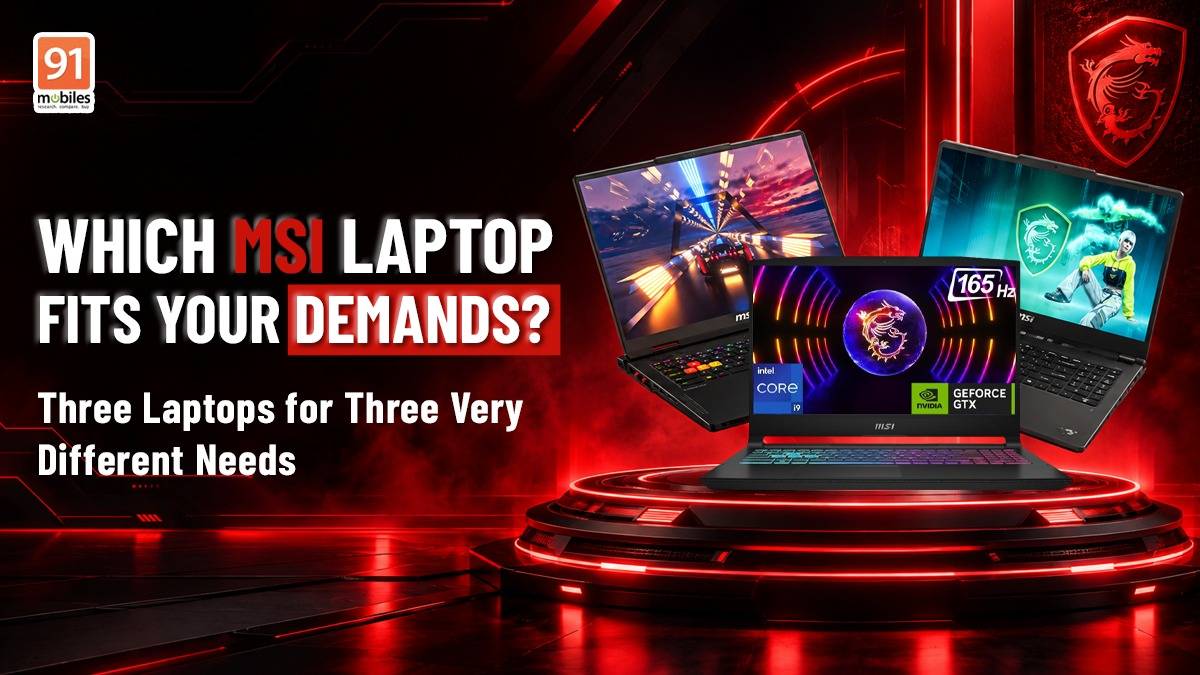
Buying a laptop based purely on specifications is easy. Finding one that fits how you’ll use it is a little more complicated. A gamer seeking maximum performance has very different demands than someone who carries a laptop between college and home, while another user may want one machine that handles work, study, creative applications, and gaming. MSI’s gaming lineup caters to these different requirements with laptops that take very different approaches to performance, portability, and everyday usability.
Table of Contents
Quick answer: Which MSI laptop fits which demand?
If the main demand is… | Consider | Why it fits |
Maximum performance and desktop-class capability | MSI Raider 18 Max HX | Flagship-level CPU and GPU hardware, 18-inch UHD+ MiniLED display, and extensive performance headroom |
Gaming performance that can travel | MSI Cyborg 15 Max | Compact 15.6-inch form factor, RTX 50-series graphics, 144Hz display, and 100% sRGB coverage |
One laptop for work, study, and gaming | MSI Katana 15 HX | Powerful HX-series processor, RTX graphics, QHD 165Hz display, and practical everyday features |
MSI’s own positioning broadly follows this distinction: Raider sits in its high-end gaming and creation category, while Katana focuses on mainstream high-performance everyday gaming and creation, and Cyborg combines everyday gaming with a more compact, accessible design.
Those Who Refuse to Compromise on Performance: MSI Raider 18 Max HX
There is a particular kind of laptop buyer for whom “enough performance” doesn’t really exist. If the demand is to replace a desktop, run demanding creative applications, or simply get as much performance as possible from a laptop, the MSI Raider 18 Max HX is designed around precisely that requirement.


It starts with the Intel Core Ultra 9 290HX Plus, paired with either an NVIDIA GeForce RTX 5080 Laptop GPU with 16GB GDDR7 or the RTX 5090 Laptop GPU with 24GB GDDR7. Add 32GB of DDR5 memory and a 2TB PCIe Gen5 SSD, and this is hardware designed for workloads where additional performance genuinely matters. High-resolution video production, 3D rendering, large creative projects, AI-assisted applications, and demanding AAA gaming all stand to benefit from this level of hardware.
Why choose the Raider 18 Max HX?
- Up to RTX 5090 Laptop GPU with 24GB GDDR7
- Intel Core Ultra 9 290HX Plus processor
- 32GB DDR5 memory and 2TB PCIe Gen5 SSD
- 18-inch UHD+ 3840 x 2400 MiniLED display
- 120Hz refresh rate and 100% DCI-P3 coverage
- Killer Wi-Fi 7 and SteelSeries per-key RGB keyboard
- 99.99Wh battery
The display is equally important to the experience. At 18 inches, the 16:10 UHD+ panel offers a 3840 x 2400 resolution, 120Hz refresh rate, MiniLED backlighting, and 100% DCI-P3 coverage. For creators, that combination provides both resolution and colour range for detailed visual work. For gaming, the larger panel makes the Raider feel closer to a desktop setup than a conventional laptop. MSI also positions the Raider as a high-end machine for gaming, streaming, content creation, and extended workloads.
MSI has carried the same thinking into the rest of the machine. There is a SteelSeries per-key RGB keyboard, Killer Wi-Fi 7, and a 99.99Wh battery, alongside the connectivity expected from a desktop-replacement class machine. The point isn’t really to make the Raider 18 Max HX something that gets carried everywhere. It is to give users a system that can move when required while sacrificing as little performance as possible compared to a high-performance desktop setup.
Best suited for:
Hardcore gamers, streamers, content creators, 3D users, and performance enthusiasts who prioritise maximum performance over portability.
On-the-Go Gamer: MSI Cyborg 15 Max
Not every gamer has the luxury of leaving a gaming setup on a desk. College, work, travel, and hybrid schedules can mean the same laptop needs to be packed into a bag in the morning and ready for gaming later in the day. That is where the Cyborg 15 Max takes a different approach.


The Platinum Gray exterior and white backlit keyboard give it a relatively restrained appearance, which works well when the laptop is going to spend as much time in classrooms, offices, or cafés as it does running games. More importantly, that portability does not mean stepping back to basic graphics hardware.
Depending on the configuration, the Cyborg 15 Max combines an Intel Core 7 240H or Core i7-13620H with an NVIDIA GeForce RTX 5050 or RTX 5060 Laptop GPU. Both GPUs come with 8GB of GDDR7 memory, bringing NVIDIA’s newer RTX 50-series architecture into a machine intended to move between gaming and everyday use. The same GPU acceleration can also be useful for editing, rendering, and other lighter creator workloads.
Why choose the Cyborg 15 Max?
- Up to RTX 5060 Laptop GPU with 8GB GDDR7
- Intel Core 7 240H or Core i7-13620H
- 16GB DDR5 memory
- 512GB PCIe Gen4 SSD
- 15.6-inch Full HD display with 144Hz refresh rate
- 100% sRGB colour coverage
- Wi-Fi 6E and 60Wh battery
- Compact design aimed at everyday mobility
There is a sensible match between the graphics hardware and display, too. The 15.6-inch Full HD IPS-level panel runs at 144Hz, allowing faster-paced games to take advantage of higher frame rates. Its 100% sRGB coverage also matters outside gaming, particularly for photography, video editing, or design work. MSI positions the Cyborg family around everyday gaming, light creation, portability, and accessible AI-ready workloads.
With 16GB of DDR5 memory, a 512GB PCIe Gen4 SSD, Wi-Fi 6E, and a 60Wh battery rounding things out, the Cyborg 15 Max addresses a straightforward demand: getting current-generation gaming hardware into a laptop that still makes sense away from the gaming desk.
Best suited for:
Students, everyday gamers, and users who want RTX gaming performance in a compact laptop that can move between campus, work, travel, and home.
Built for Everyday Work, Study & Play: MSI Katana 15 HX
Then there is perhaps the most common laptop demand of all: needing one computer to do practically everything.

The morning might involve browser tabs, documents, spreadsheets, or online classes. The afternoon could involve coding, editing a project, or running a heavier application. When the work is finished, the same laptop becomes the gaming machine. For this kind of workload, the Katana 15 HX takes a more balanced approach, combining high-performance hardware with features designed for everyday gaming and creation.
Processor options extend up to the Intel Core i9-14900HX, while graphics scale to an NVIDIA GeForce RTX 5060 Laptop GPU with 8GB of GDDR7 memory. That gives the Katana enough CPU and GPU performance to move between productivity, creator workloads, and modern games rather than being optimised around just one use case.
Why choose the Katana 15 HX?
- Up to Intel Core i9-14900HX
- Up to RTX 5060 Laptop GPU with 8GB GDDR7
- 16GB DDR5 memory
- Up to 1TB PCIe Gen4 SSD
- 15.6-inch QHD 165Hz display
- 100% DCI-P3 coverage on the QHD configuration
- 4-zone RGB keyboard
- MUX switch and 75Wh battery
The QHD configuration is particularly interesting for this type of user. Its 15.6-inch 2560 x 1440 display runs at 165Hz and offers 100% DCI-P3 coverage. The extra resolution provides more usable detail when working with documents, timelines, code, or creative applications, while the high refresh rate becomes valuable as soon as gaming begins. It is essentially one display specification serving two very different parts of the day.
There are smaller gaming-focused touches as well, including a 4-zone RGB keyboard and MUX switch, while configurations offer 16GB of DDR5 memory and up to 1TB of PCIe Gen4 SSD storage. A 75Wh battery completes a package that is less specialised than the Raider while offering substantially more performance headroom than an ordinary everyday notebook.
MSI similarly positions the Katana series as its mainstream high-performance option, aimed at everyday gamers, buyers on a mainstream budget, and students who want to game and study on the same machine. Its focus is dependable gaming, everyday creation, multitasking, and use as a daily driver.
Best suited for:
Students, everyday gamers, and users who need a single laptop for work, study, creative applications, multitasking, and gaming.
Raider 18 Max HX vs Cyborg 15 Max vs Katana 15 HX
The three laptops may all cater to gaming and performance workloads, but their priorities are different.
Feature | Raider 18 Max HX | Cyborg 15 Max | Katana 15 HX |
Primary focus | High-end performance | Portability + gaming | Everyday work + gaming |
Processor | Up to Core Ultra 9 290HX Plus | Up to Core 7 240H / Core i7-13620H | Up to Core i9-14900HX |
GPU | Up to RTX 5090 24GB | Up to RTX 5060 8GB | Up to RTX 5060 8GB |
Display | 18″ UHD+ MiniLED, 120Hz | 15.6″ FHD, 144Hz | 15.6″ QHD, 165Hz |
Colour coverage | 100% DCI-P3 | 100% sRGB | 100% DCI-P3 |
Memory | 32GB DDR5 | 16GB DDR5 | 16GB DDR5 |
Storage | 2TB Gen5 SSD | 512GB Gen4 SSD | Up to 1TB Gen4 SSD |
Best suited for | Hardcore gamers, creators, streamers | Mobile gamers, students | Work, study, creation and gaming |
Choosing the right MSI laptop for the demand
The right choice ultimately depends less on which laptop has the longest specification sheet and more on what the machine needs to do every day.
If the demand is maximum performance, the Raider 18 Max HX is built around that priority, with flagship-level CPU and GPU hardware and a large, high-resolution display. If gaming performance needs to travel, the Cyborg 15 Max puts RTX 50-series graphics into a more compact package. And if the requirement is one machine for work, study, creation, and gaming, the Katana 15 HX offers a more balanced combination of performance and everyday usability.
In other words, the three laptops arrive at performance from three different directions. The Raider prioritises power, the Cyborg prioritises compact everyday gaming, and the Katana focuses on dependable high-performance computing across a wider range of daily tasks.