Gabit’s vision is to enable everyone to live healthier and longer: Gaurav Gupta, Founder and CEO


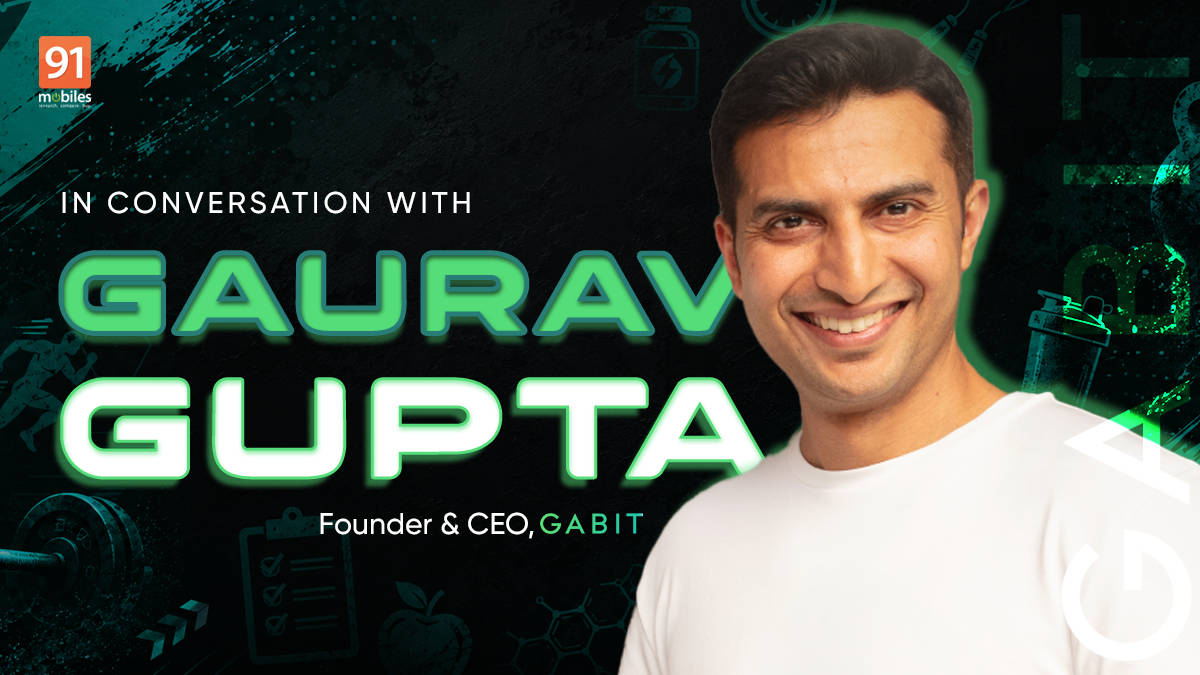
My introduction to Gabit happened the way it probably did for many others — via the smart ring (review). It’s since gone on to become one of the more compelling options in that space, backed by a Best Smart Ring of the Year win from Amazon in 2025 and others. But what I didn’t expect was just how far the company has expanded beyond the ring itself, into what’s now shaping up as a full-fledged integrated health platform. I sat down with Gaurav Gupta, Founder and CEO of Gabit, to understand how the company got here, and where it’s headed next.
Table of Contents
How did the Gabit journey start?
The journey started with Zomato, actually, where I was one of the co-founders and the chief operating officer. I was busy building Zomato, and then COVID happened. Travel stopped completely for me, and before that, I used to travel quite frequently. This meant I never really fell into a rhythm of working out regularly or eating better food. COVID forced that rhythm onto me. I lost 15kg, and my metabolic age came down drastically — I was 49 metabolically when I was 39, actually, before COVID. Now I’m around 36 when I’m 45.
I was like, this is magical. These four pillars — fitness, nutrition, sleep and stress — are magical in terms of what they can do for somebody’s health. And at that point, I thought I would like to build a mission that can do this for millions of people. So it felt like the right time.
After that, I spent a year figuring out how to build this — what customers were saying, what people really wanted. We started building Gabit in 2022 with the team. Gabit is a take on “good habit” as a word, since the idea was that health is all about good habits, and how we can build products and technology that help people inculcate good habits to get healthier over a period of time.
It was very clear that tracking is super important — you can’t improve something you can’t measure beyond a point. And unlike bad habits, where you get a kick right away and that’s why you keep doing them, good habits take weeks and months to show outcomes. So to keep people on the journey, it’s very important to track everything. We built Gabit on tracking as a very important thesis, and around those four pillars, because they’re connected and feed off each other. Even the Gabit smart ring was built to cater to all four. We’ve been building since 2022, and took the platform and the ring live for customers in 2024 — so it took us two years to build the products and the platform before launch.
Gabit is much more than the smart ring — it’s grown into a holistic, integrated health platform. How did that come about?
The vision of Gabit has always been to enable everyone to live healthier and longer, and tracking is one important part of that. Gabit is designed to be a longevity platform where you can track 150 markers on one platform, through four modes — the smart ring, blood work, a CGM (continuous glucose monitor), and a smart scale. All 150 markers can now be tracked on Gabit in one place, and because these markers are all interconnected, it gives you a complete picture of what’s happening with somebody’s health.
This is unique globally right now. Even in the US or Europe, or especially India, you’d typically have four different platforms — one for wearables, one for blood tests, one for the smart scale, and another for CGM — and that data sits on four different platforms that don’t talk to each other. We’ve brought all of it into one place.
On top of that, we built an AI engine called Gabit One over the last three years. It essentially assesses all these markers and the correlations between them, how off they are, and based on that gives you insights on what’s really not right with your health, or what’s good for it right now, and what you should be doing to fix it. It goes much beyond just the data you’d see on a wearable, and we’ve now opened that up for our users as well.
We also have coaches on the platform for fitness and nutrition coaching, and last year we acquired a Swedish supplements brand called Näck. The idea was that based on this tracking, we can recommend high-quality supplements to people, and because you can track everything on Gabit, you can also figure out whether the supplements are actually working for you — supplementation should be measured pre and post, not just taken on faith. So we’ve integrated all of this into one platform to go beyond data and actually deliver health outcomes, and because it’s all connected, it’s coherent — you don’t have to pull data from multiple sources and feed it into an AI to figure out whether it’s right or wrong.
Health platforms like Apple Health, Samsung Health, or Google Health (formerly Fitbit) are also trying to combine AI with tracking, nutrition and physical activity. You’re competing with some fairly large players here — how do you see that?
I think the fundamental difference between the players you mentioned and us is that we’re actually a health company trying to address health outcomes for customers — we’re not an electronics product company. That’s the first difference. The way you address health, the way you integrate data, differs because of that. Our integration spans different types of markers, from blood parameters to wearable parameters to CGM, whereas most of the other platforms are mostly built around wearable data alone, which is just one side of the picture. We’ve gone much deeper into different modes, and we’ll keep launching more diagnostic tests going forward that give clearer, more definitive outcomes for customers.
Secondly, we started in India, and health data differ by continent and geography. All our algorithms and our nutrition database are built for Indian users, so I’d say we’re very tuned to what Indian users specifically need.


And third, it comes down to how well we’re executing on the product. A small, agile team can also do a good job — Gabit got the Best Smart Ring of the Year Award from Amazon in 2025, and a very good rating from you after you reviewed the product, too. We’re probably doing the highest volumes and are the largest player in India by volume in just two years. Once people have used the product, they’ve been amazed by the quality and the price point — all four pillars, 10 days of battery life, no subscription. People have loved it, and now with Gabit One, people love that it’s integrated all their health in one place.
On the AI front specifically, Gabit One is one part of it. To give you an example of how powerful it is, I put my own data through it, and it told me: “You have increased your workouts a lot in the last four months. You have reduced your carb intake a lot in the last four months, and I can see this as stress on your pancreas in your blood report. Can you stop doing these two extreme things together?” I can’t think of anybody else around me who could give me this kind of specific guidance across my health and different parameters.
We also launched an AI health coach called Pep on the ring, so you can ask it anything and understand any metric. We have AI-based food logging that’s speech-based right now, and we’re launching image-based AI food logging very soon, too. And on the ring itself, we’ve added BioAge, auto workout detection, a Tribes feature where you can form a group and compete on health metrics, user consent-based data sharing so you can share data with loved ones or doctors, precision steps for more accurate step tracking, and much more detailed sleep tracking. Overall, the experience on the ring has become a lot better, leveraging AI to make it easier and more accurate. I’m genuinely excited about how this whole Gabit One piece has come together.
What’s next? What can users look forward to — both existing users from a platform perspective, and new users just making an entry onto Gabit?

We’ll keep rolling out new features — we’ve been shipping at least one key feature a month for existing customers, and often more. But the other thing I’d highlight is this: we’ve got a cardiovascular MD from Harvard on board, and we’re doing some very interesting work on predictive health using AI and all this data. If you put together data across all the modes I mentioned — the ring, blood work, CGM, smart scale — and put the power of AI on top of it, you get so much in terms of outcomes on predictive health. We can actually give early risk warning signals for key illnesses in the future, and I’m very excited about that. It’s a great start to have people understand the four pillars of health I mentioned, but the real power comes when you use that data and AI to say, here are the things you need to look at today, so it doesn’t become too grim tomorrow. We’re focused on that, and I’m excited about getting something meaningful out for it.