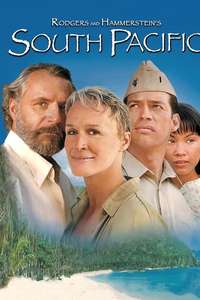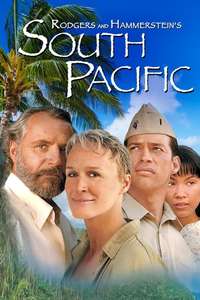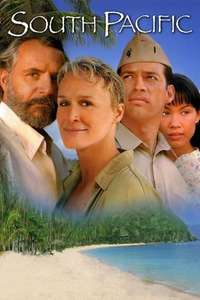


Movie |
South Seas | World War Ii
Disclaimer: All content and media belong to original content streaming platforms/owners like Netflix, Disney+ Hotstar, Amazon Prime Videos, JioCinema, SonyLIV etc. 91mobiles entertainment does not claim any rights to the content and only aggregate the content along with the service providers links.


















Outstanding Music Direction | 2001
Outstanding Single Camera Sound Mixing for a Miniseries or a Movie | 2001 | Joel
Best Sound in a Motion Picture or Miniseries | 2001
The musical number "Happy Talk" (sung by Bloody Mary) was inexplicably jettisoned from this version because its lyrics were deemed racially insensitive to modern audiences, despite the fact that all of Bloody Mary's dialogue and songs are written in a similar pidgin vein.
The original Broadway production of "South Pacific" opened at the Majestic Theater on April 7, 1949, ran for 1925 performances starring Mary Martin as Nellie Forbush and Ezio Pinza as Emile de Becque, won the 1950 Tony Award for the Best Musical, Libretto and Score and won the Pulitzer Prize in Drama in 1950.
While the central miscasting and uninspired musical presentation have branded this remake as lower echelon Rodgers and Hammerstein, the script adheres much closer to Michener's Pulitzer Prize-winning book than the stage version did. Quoting the author's prose verbatim, it is Bloody Mary whose description of de Becque plants the idea of his joining the Operation Alligator mission in Cable's mind. Later, when Cable first meets the virginal Liat, she removes her clothing the moment they are left alone, presumably following Bloody Mary's instructions, which indicates that Bloody Mary prostituted her daughter to Cable as opposed to 'setting them up' in a romantic vein.
As of 2021, this film has been released three times on home video. The Mill Creek and Kino issues present the film in its original 1.33:1 broadcast ratio. While the packaging of the Buena Vista Home Video release purports to have mastered the film in that same ratio, the DVD actually contains an anamorphic 1.85:1 widescreen print. As such, when viewed on 16:9 televisions, picture information on the top and bottom of the screen is matted, as if for theatrical exhibition.
Despite its generally lackluster musical presentation, the remake offers two musical numbers whose imaginative staging far surpasses their 1958 counterparts: The expansive "There is Nothin' Like a Dame" sequence takes full cinematic advantage of the Navy barracks, including interior and exterior tracking and overhead shots, as well as observation of the racial segregation that existed during WWII. "I'm Gonna Wash That Man Right Outa My Hair," meantime, achieves an informal, improvisational style that suggests genuine chemistry and relationships between the nurses, something generally missing from the number in previous stage and film incarnations.