Beast of Reincarnation review: a gorgeous world that struggles to hold on to you


There are few studios in gaming with a legacy as specific as Game Freak’s. For three decades, the Japanese developer has been synonymous with one thing: the primary developer and co-owner of the Pokémon role-playing game series. So when Beast of Reincarnation was announced, most people’s first reaction had less to do with the game itself and more to do with the sheer novelty of the situation.
In my experience, when a studio steps this far outside its comfort zone, you either get something genuinely special or something that reveals exactly why the comfort zone existed. Beast of Reincarnation, unfortunately, sits somewhere in the middle. Before you get into my detailed review, I’d like to share the disclaimer that the game’s review code was provided to me by the publisher for PlayStation 5. The game is out now on PS5, Xbox Series X/S, and PC.


Table of Contents
Storyline
Beast of Reincarnation is set in Japan in the year 4026, and the world you walk into is in a very bad shape. Humanity is under threat, and the land is crawling with monstrous threats known as malefacts, and the source of all this misery is a corruption called blight. What I found interesting about the blight as a narrative device is that it isn’t just something that infects people. It infects the land itself, and the environment can shift and warp under its influence, which gives the whole world an unsettled quality. Forests erupt where there was wasteland. Nothing quite stays put.


You play as Emma, an outcast born with blight, feared and rejected by the society she is nominally trying to save. Her affliction is also her weapon. Emma can manipulate plant-like growths, including her own hair, and uses them both to move through the world and to fight. She carries the title of Sealer, which means her job is to hunt down malefacts and absorb their blight into her own body, a role that is about as thankless and self-destructive as it sounds.
Then there’s Koo. Koo is a blighted dog and a malefact himself, which by the rules of this world makes him and Emma natural enemies. Instead, their meeting is what sets the story in motion, sending the pair across a harsh and mysterious landscape in search of the Beast of Reincarnation, the source of all blight. I’ll stop the plot summary right there, because the game does have a few things worth discovering on your own, and the lore around what humanity did to itself two millennia ago goes to some genuinely ambitious places.

And this is where I have to be honest with you. Despite genuinely trying, and despite an outline that reads as if it should work, I never felt invested in this story. The problem, I believe, is the characters. Emma begins the game hollow, with no memories and no real emotional register, and the arc is meant to be about her slowly developing one through her bond with Koo and the handful of people she meets. On paper, that’s a lovely idea. In practice, it fails to grip you from the start. The voice acting (English) is decent enough, but nothing to write home about, and it doesn’t do the heavy lifting a story like this needs. What you end up with is a just-about-decent story propped up by a very good setting, which is not the same thing as a good narrative.
Gameplay
This is where Beast of Reincarnation frustrated me the most, which is a shame, because it’s also where its most interesting ideas live. The systems here are genuinely clever. It’s what Game Freak points them at that loses me, time and again.

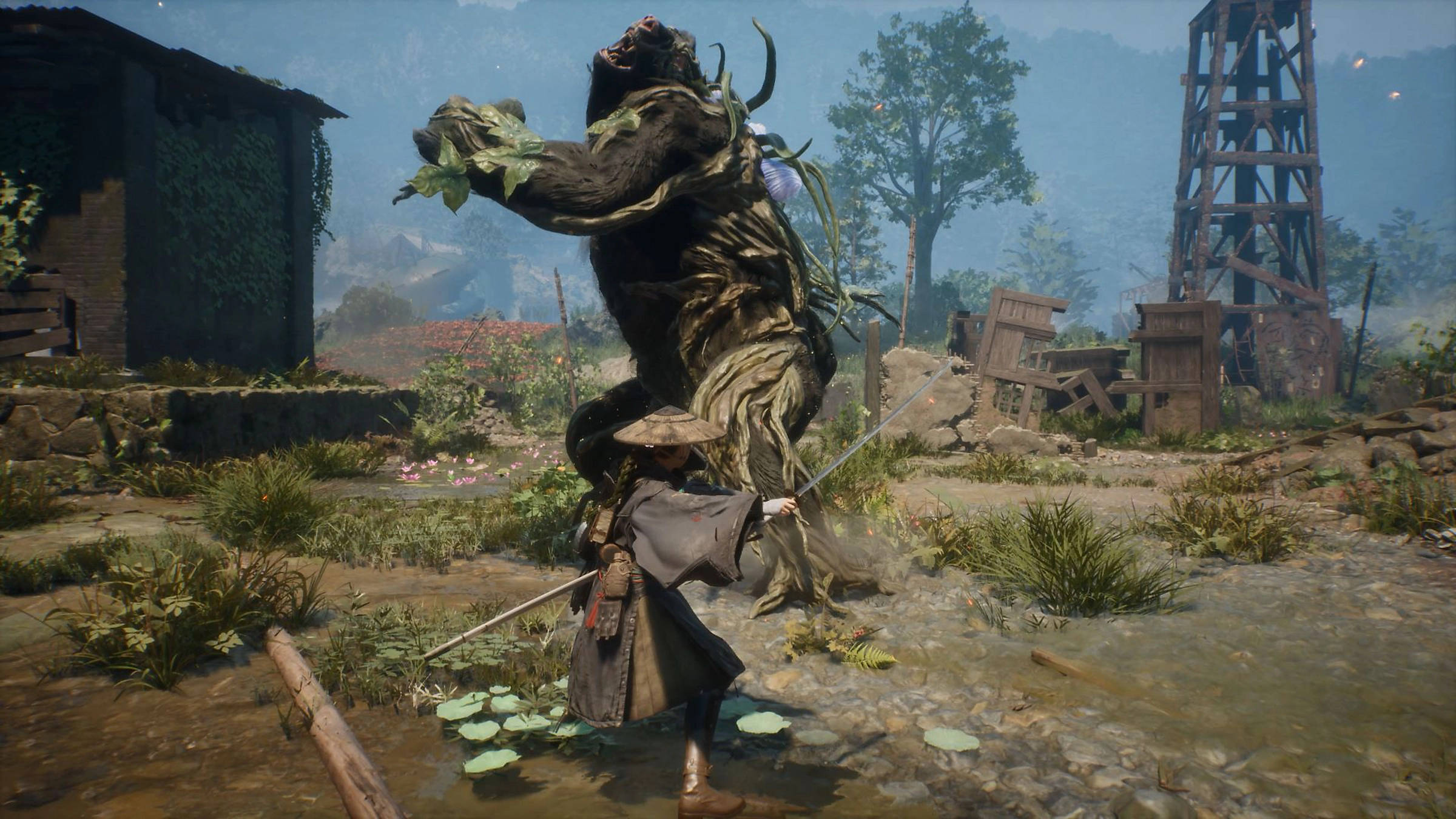
Let’s start with what works conceptually. Rather than handing you a companion who trots along in the background being useless, Game Freak has built the entire combat system around the partnership between Emma and Koo. Emma’s side of it is fast, technical real-time action, and there’s more to it than the katana. You guard ordinary strings, parry the attacks flagged in yellow, and answer the red ones with a Perfect Dodge, with a bow or crossbow on a weapon swap for when you’d rather fight at range. There’s no stamina meter to ration, so you’re free to keep the pressure on, and sustained aggression builds a stagger gauge that opens the door to a finisher.
Successful parries also generate FP, the resource that powers Koo’s Bloom Arts, which is a neat bit of design because precise, aggressive play directly funds your tactical options rather than sitting in a separate system.

The other thing I’d single out for praise is traversal. Using Emma’s growths to move through the world feels genuinely good, and it is the one part of the moment-to-moment gameplay that I never got tired of. Getting from A to B in this game is a pleasure.
The problems start when you look at what all of these systems are actually pointed at. The boss fights, which should be the payoff for a combat system this deliberate, get repetitive very quickly, and the game has a habit of making you fight the same boss multiple times. I kept waiting for the sort of escalating, hard-won satisfaction that a Black Myth: Wukong delivers with its encounters, and it simply never arrived. Enemy variety outside of the bosses isn’t sufficient either.
There are rough edges on top of that. Enemy lock-on is unreliable and has a habit of switching targets at the worst possible moment, and in a game built around parry timing, having the camera fight you is more than a cosmetic annoyance. Game Freak clearly agrees, for what it’s worth. A post-launch patch flipped the defaults for auto-targeting on attack, parry, and target switching to off, and the studio has said camera adjustments are continuing across future updates.

On difficulty, the game gives you three options: Story Mode, Normal Mode, and Hard Mode. Story Mode makes parry timing more forgiving and reduces enemy damage, which should be welcome news for anyone more interested in Emma and Koo’s journey than in being repeatedly flattened by whatever horrible thing has just burst out of the forest. Given how much of this game’s appeal rests on its world rather than its combat, I suspect a lot of players will be well served by it.
Graphics
Here, at least, I have far fewer complaints. Beast of Reincarnation is built on Unreal Engine 5, and the art direction is comfortably the best thing about it. A fair few people have likened the style to Studio Ghibli’s earlier work, and I can see why, but I’d argue it stands on its own rather than living in that shadow. There is a real sense of fantasy to this world, and the way the environments shift and bloom gives it a unique texture.

If I had to reach for a comparison, I’d say it is vaguely reminiscent of Clair Obscur: Expedition 33 in the way it presents a beautiful world gone wrong, although it never quite delivers the same highs. That is a high bar to be measured against, in fairness, and Beast of Reincarnation looks and feels good on its own terms.
Performance is solid. I played on a base PS5 and ran into no performance issues worth reporting, which is more than I can say for plenty of Unreal Engine 5 releases. You get two graphics settings, Performance and Quality, aiming at higher frame rates and higher visual fidelity respectively. I personally preferred to play mostly on Performance, and the game still looks lovely there. There is also a graphics mode available exclusively on the PS5 Pro that tries to offer the best of both worlds, but as I played on a base PS5, I couldn’t try that one out.
Verdict
Beast of Reincarnation isn’t a bad game. It is something more frustrating than that, which is a game that isn’t nearly as enjoyable as its premise suggested it would be. The world Game Freak has built here promises a great deal and genuinely feels good to move through, and I’d happily recommend it to someone who plays primarily for atmosphere and art direction. But the gameplay and the characters simply do not engage you enough to keep pulling you back, and for a single-player action RPG asking for dozens of hours of your time, that is the whole ballgame.
Don’t get me wrong, there is a lot here worth respecting. The Emma and Koo combat pairing is a fresh idea, and I’d love to see Game Freak take another swing at it with sharper encounter design behind it. Traversal is excellent. The art is lovely. But good ideas and a good-looking world are the beginning of a great game, not its entirety, and this one never closes the gap.
If you’re drawn in by the setting and the concept, I’d say it’s worth your time at Story difficulty for the world alone. If you’re coming to it expecting the combat depth its systems hint at, temper your expectations considerably.
Editor’s rating: 7.0 / 10
Pros
- Striking art direction
- Good traversal
- Emma and Koo combat pairing
Cons
- Repetitive boss fights
- Thin enemy variety