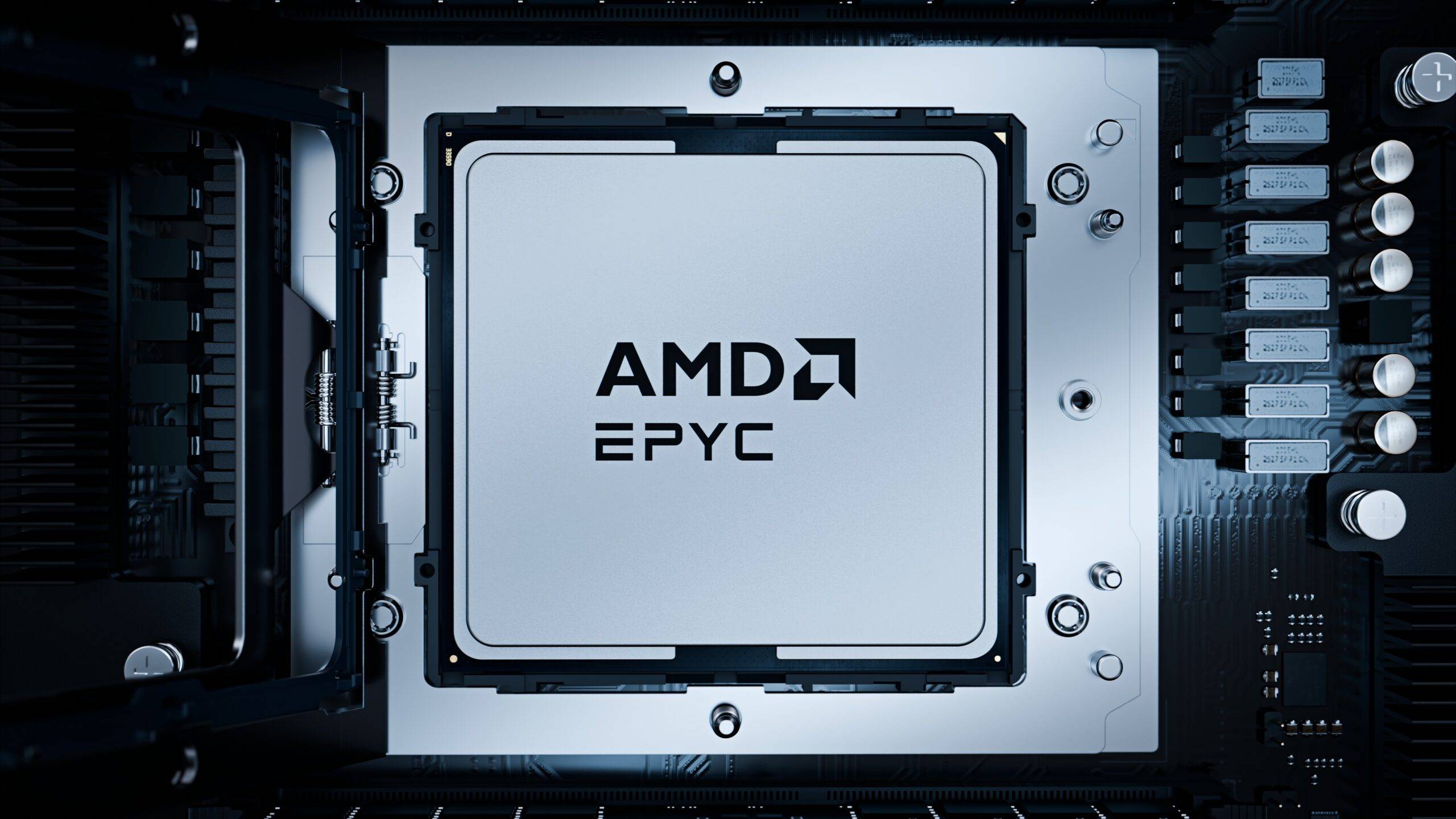
AMD has announced general availability of its 6th Gen EPYC SP7 server processors, built on the new “Zen 6” architecture. Systems are shipping now from leading server makers. Cloud instances from Microsoft Azure and Oracle Cloud Infrastructure (OCI) are coming soon. AMD positions the range as a set of workload-specific CPUs for agentic AI, enterprise, cloud, HPC and general-purpose computing, rather than one CPU for every job.
Flagship: EPYC 9996
AMD calls the EPYC 9996 the world’s best general-purpose server processor. Its claims, all from AMD’s own testing:
- Up to 3.7x the performance of a system with Nvidia’s Vera CPU
- Up to 2.2x the performance of Intel’s Xeon 6980P
- Up to 2.0x the performance per dollar of the Xeon 6980P
AMD says this lets each server support more applications, transactions and users within the same power and space limits. The press release does not give core counts, clock speeds for the 9996 or pricing.
Agentic AI: three CPU roles
An AI agent is not just a model answering a question. It plans, calls tools, runs code, and reads databases. The GPU runs the AI model, but a lot of the surrounding work runs on CPUs. AMD says that work falls into three jobs, and each job needs a different kind of CPU.
- General-purpose services: These are the ordinary business servers around the AI, such as databases, web apps and APIs. AMD’s EPYC 9996 is built for this.
- GPU host nodes: The CPU sits next to the GPU and feeds it data and instructions. If the CPU is slow, the GPU sits idle, and GPUs are the most expensive part. So AMD uses fast chips (up to 5.3 GHz) here. “1.8x LLM output throughput” means the AI model produces text up to 1.8 times faster than with the previous AMD generation.
- Agent sandboxes: When an agent runs code or uses a tool, it does so in a small, isolated environment, like a safe mini-computer. Thousands of agents means thousands of these. AMD uses chips with many cores here, so more agents fit on one CPU.
The numbers, in plain terms
- “3.3x agents per CPU watt”: For the same electricity, AMD says its chip runs about 3.3 times more agents than Nvidia’s Vera, and about 2.5 times more than Intel’s Xeon 6980P.
- “1.18x agents per rack in a 35 kW limit”: A rack can only draw so much power. AMD says its tuned power settings let a rack run about 18% more agents than default settings in the same power budget.
From server to rack
AMD sells whole racks called Helion, in three types:
- Helion Liquid: water-cooled, for packing in the most agents. It is meant for very large deployments.
- Helion Air: air-cooled, for companies that want to add agent capacity to data centres they already have.
- Helion Air Inference: puts CPUs and GPUs in the same rack, so agents can run code and AI models together.
“73,728 threads in one rack” is the total number of tasks the rack’s CPUs can handle at once. AMD uses it as a stand-in for “most agents in a rack,” though one thread is not exactly one agent.
All of these comparisons are AMD’s own claims. Real results depend on the workload and how the system is set up, so independent tests are needed.
Customers and availability
- Meta is a lead customer and is validating 6th Gen EPYC platforms ahead of deployment at scale.
- Microsoft Azure has HDv2 in preview (AI data processing, agentic AI, HPC), HXv2 for EDA and technical computing, and ND MI455X v7 (based on Helios) for AI inference.
- OCI will power its Compute E7 instances with 6th Gen EPYC.
- AMD also launched 6th Gen EPYC Embedded processors separately.
AMD’s main targets are Nvidia’s Vera CPU and Intel’s Xeon 6980P. These are AMD’s own numbers, and the footnotes with test setups were not included, so the real gains depend on workload and configuration. The “agents per rack” framing also overlaps with Intel’s recent push for a “delivered agents per rack” metric. Both companies now argue that agentic AI should be judged by how many agents a rack can run, not by core count. Independent tests at a fixed latency target will show whose numbers hold up.
AMD is betting that AI agents will increase demand for CPUs, not just GPUs. Its pitch is that buyers can stay on x86, with one software and security stack, and pick the chip that fits each job. Meta, Azure, and OCI backing helps, but the performance leads still need external confirmation. India availability and pricing have not been announced.