
The future of desktop performance isn’t just about speed. It’s about intelligence. With the power of AI behind them, Intel Core Ultra 200S desktop processors are built to redefine what’s possible for gamers, creators, and streamers. Whether you’re rendering high-resolution content, live-streaming with multiple overlays, or pushing frame rates in the latest AAA titles, these processors ensure seamless multitasking, lower power consumption, and superior cooling—all while unlocking the power of AI-driven workflows.
This article explores what makes an AI PC, how Intel’s CPU-GPU-NPU architecture enhances both gaming and content creation, and why now is the perfect time to upgrade with Windows 10 EOL, enhanced motherboard support, and cutting-edge platform advancements like Wi-Fi 7 and Thunderbolt 5. Let’s dive into how Intel Core Ultra 200S processors are shaping the next era of AI-powered desktop computing.
Game. Create. And Everything Else!
For years, processor technology has been about compromises. Greater power usually came with lower efficiency and higher temperatures. The new Arrow Lake architecture of the Intel Core Ultra 200S series processors aims to change that dynamic. The goals were simple — reduce the overall power package by around 40% and deliver over 15% generational multithreaded performance, all the while maintaining gaming-level performance. But that’s not all. The new processors also had to expand AI acceleration to enthusiasts and integrate Xe-LPG for the latest media support while also reducing overall temperatures by about 10°C during gaming.
Intel managed to deliver. The new Core Ultra 200S series processors use an updated version of its Performance Hybrid architecture with Skymont E-Cores and Lion Cove P-Cores. The new processors are available with up to 24 cores for industry-leading compute throughput on desktop PCs.1 Further, the NPU in the Intel Core Ultra 200S processors offers up to 13 TOPS, enabling advanced AI capabilities. We will talk about Intel’s AI Boost NPU in a little bit. But first, let’s go over the performance improvements.
Intel notes that the Skymont E-Cores offer a 32% IPC uplift over the previous gen Gracemont cores, along with 2x L2 cache bandwidth with a 4MB shared L2 cache. Not to be outdone, the Lion Cove P-Cores offer a 9% IPC uplift cover previous gen Raptor Cove cores and up to 36MB shared LLC. These two sets of cores, combined with the Foveros Advanced 3D packaging technology, means that the processors offer impressive Performance Per Watt gains. In fact, Intel notes that the new processors offer the same level of performance as the Raptor Lake-R series of processors but at half the power. As such, users can expect a cooler and more efficient gaming CPU.
Now, let’s take a quick look at the processors that make up the Intel Core Ultra 200S family.
Meet the Intel Core Ultra 200s series
As with any previous series, the Intel Core Ultra 200S series is further divided into sub-series to make it easier for buyers. The K-series is designed for enthusiasts like gamers, content creators, designers, animators, etc., who demand the maximum performance. Aside from impressive performance levels, these processors are unlocked, allowing users to overclock and enjoy additional performance gains.
These processors are also designed to handle demanding tasks efficiently. With up to a 24-core hybrid architecture (8P+16E), these processors aim to deliver high performance with exceptional power efficiency, benefiting gamers, creators, and streamers. It also supports advanced AI capabilities, cooler operations, and quieter performance.
Additionally, Intel’s AI Boost NPU provides hardware-level acceleration for AI-driven applications, allowing for smoother content creation, AI-enhanced gaming, and background task management.
Further, unlike the KF-series, the K-series also comes with an integrated Intel Xe-LPG GPU. While most users will use a discrete GPU, an integrated GPU can be quite handy. The iGPU is more power-efficient and takes up less space than a discrete GPU. It can also be a good backup in the event there is an issue with the primary GPU. That being said, the Xe-LPG iGPU can still offer impressive levels of performance, especially when it comes to gaming and content creation. The iGPU features four ray tracing units and supports DirectX 12 Ultimate and Intel XeSS. Meanwhile, the Xe Media Engine offers hardware acceleration for video encoding and decoding, which is crucial for video editing and streaming. As such, the K-series processors make for a very compelling option for those planning to build mini PCs.
Here’s how the Intel Core Ultra 200S family stacks up.
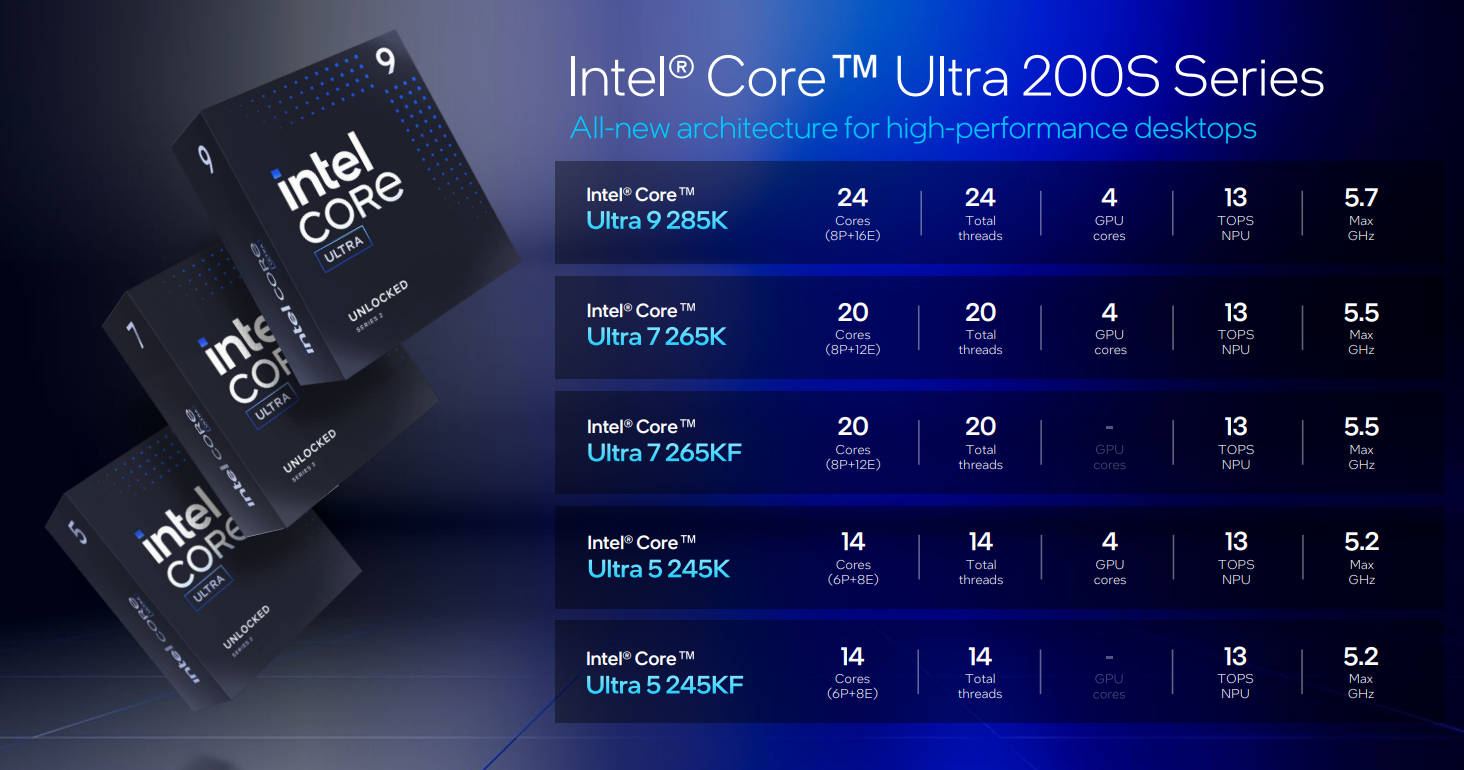
As one can see, the KF-series of processors are pretty much the same as the K-series of processors. The only notable difference is the former’s lack of an integrated GPU.
The most notable processors on the list are the Intel Core Ultra 9 285K and the Core Ultra 7 265K. Both these are aimed at enthusiasts looking for something powerful for their gaming, streaming, and content creation needs. Let’s break down why these flagship processors stand out.
Elevated gaming
As mentioned earlier, the Intel Core Ultra 9 285K and Intel Core Ultra 7 265K are designed for high-performance gaming, streaming, and content creation. And when it comes to pushing hardware to its limits, there’s no better test than gaming. With fast-paced action, the need for high refresh rates, and demanding AI-driven mechanics, modern titles require both raw power and intelligent workload management. This is where the Intel Core Ultra 9 285K and Core Ultra 7 265K truly shine as they are able to offer all this while also offering amazing power efficiency.
The Core Ultra K-series is Intel’s most power-efficient desktop processors yet2 and is designed for intense non-stop gaming without the heat usually associated with such performance. The Ultra 9 285K allows for impressive performance levels at 1440p and 4K resolutions, all the while slashing system power usage by up to 79W.3 This processor also expands the Intel Application Optimization4 for real-time thread scheduling and resource allocations. This means that classic tiles such as Metro Exodus can get up to 14%5 improved gaming performance. Those looking to crank things up even higher will be happy to know that the processor supports up to 192GB DDR5 RAM and can be overclocked easily via the newly updated Intel Extreme Tuning Utility.6
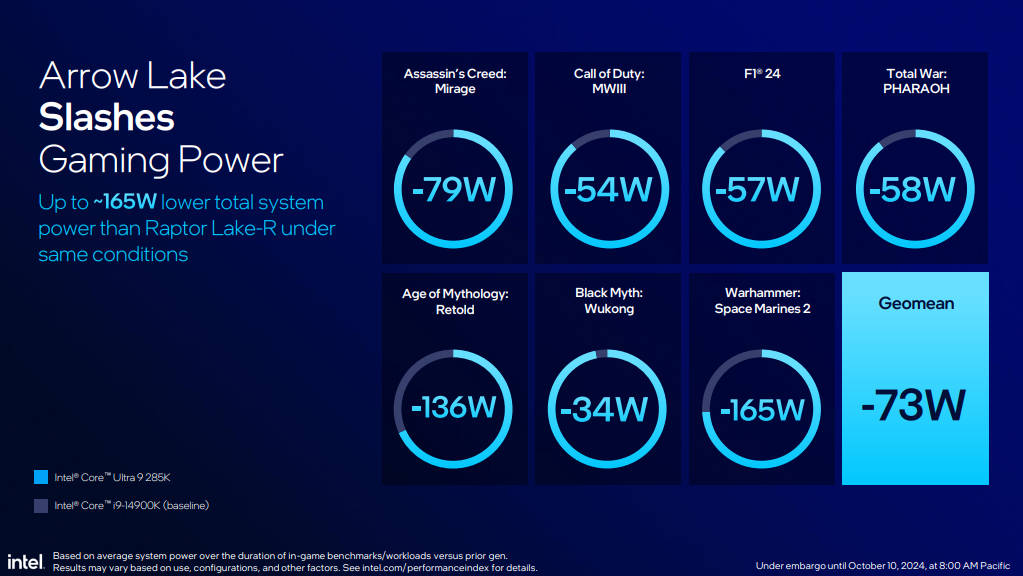
The benefits of the Core Ultra 9 285K are most obvious when compared to the previous gen Intel Core i9-14900K. When playing a relatively modern AAA title such as Assassin’s Creed Mirage. Players can expect pretty much the same FPS, but the newer processor does it at 80W less system power.7 This is indicative of the Performance Per Watt gains offered by the new Arrow Lake processors over the Raptor Lake-R processors.
In fact, Arrow Lake promises up to ~165W lower total system power than Raptor Lake-R under the same conditions across a number of titles and genres.8
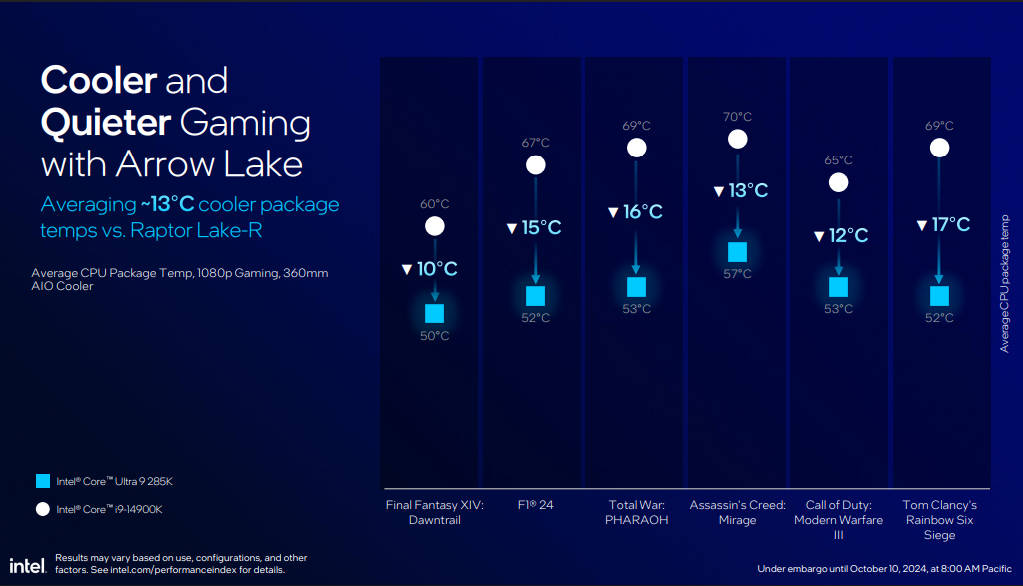
Further, Arrow Lake also offers lower temperatures, averaging ~13°C cooler package temperatures than Raptor Lake-R.9 This means much quieter gaming as the cooling fans do not have to run at very high speeds.
So it’s clear to see the performance improvements of the Intel Core Ultra 9 285K over the Core i9-14900K. But what about the competition? Compared to the AMD Ryzen 9 9950X, the Intel Core Ultra 9 285K offers up to 4% faster performance in Rainbow Six Siege, up to 8% faster in Starfield, and up to 28% faster in Total War: Warhammer 3 (Mirror Madness). Further, content creators will be pleased to learn that the Core Ultra 9 285K offers up to 6% better Pugetbench Adobe Premiere Pro scores for video editing and up to 4% better Pugetbench Adobe After Effects score for animation.10 This shows that instead of putting all its eggs in a single basket, Intel has tuned the Core Ultra 9 285K to offer a balanced performance across gaming and content creation.
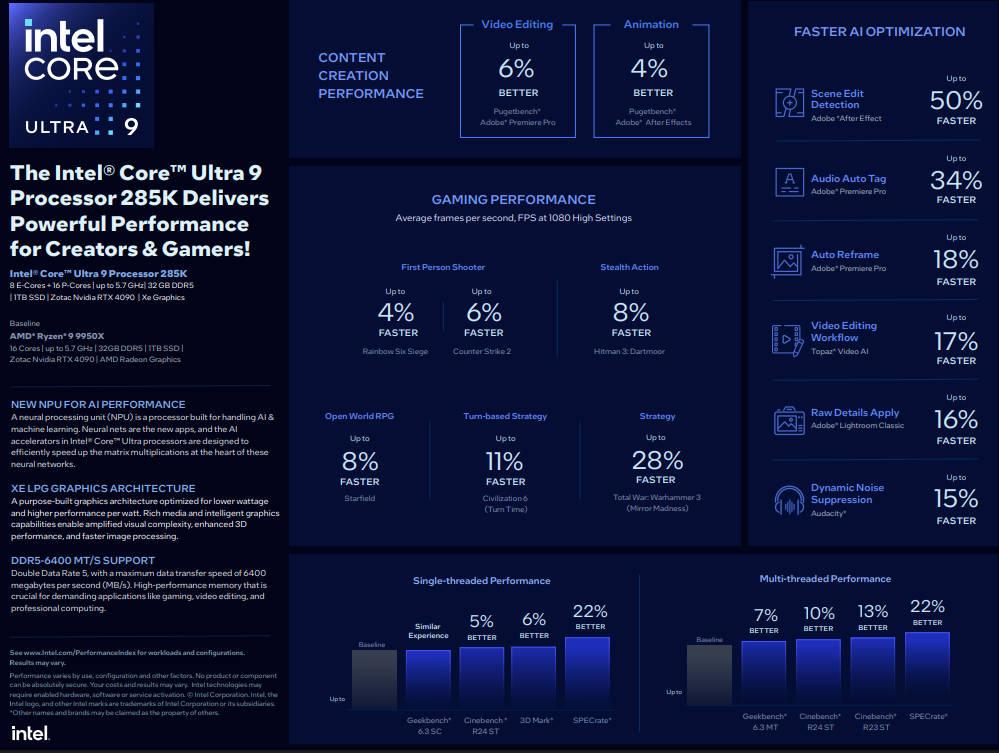
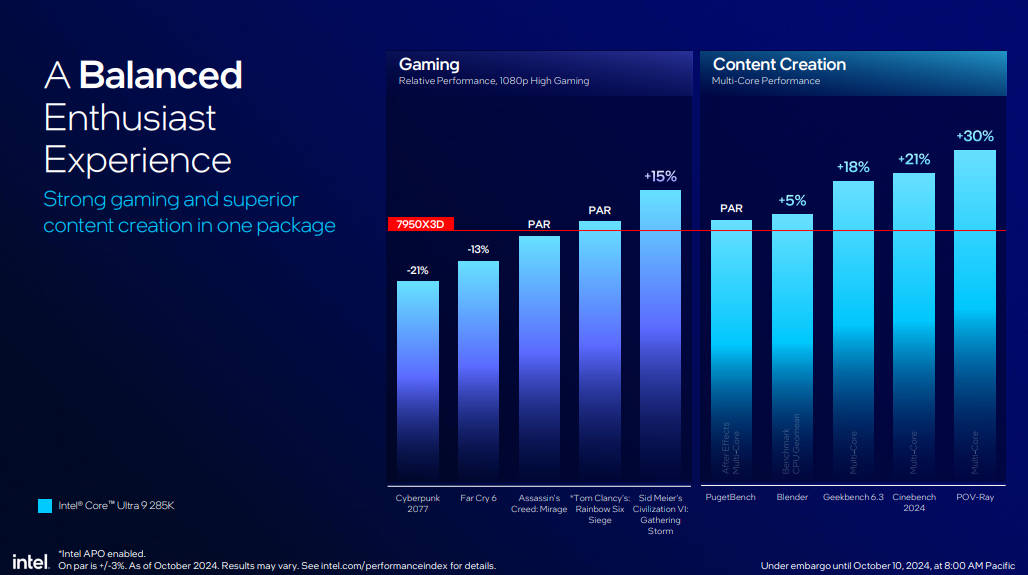
Compared to the AMD Ryzen 9 7950X3D, which is a more gaming-centric processor, the balance between it and the Intel Core Ultra 9 285K is even more impressive. In the image below, we can see that Intel’s processor can not only offer better scores when it comes to content creation benchmarks, but it is also pretty much on par when it comes to gaming.11
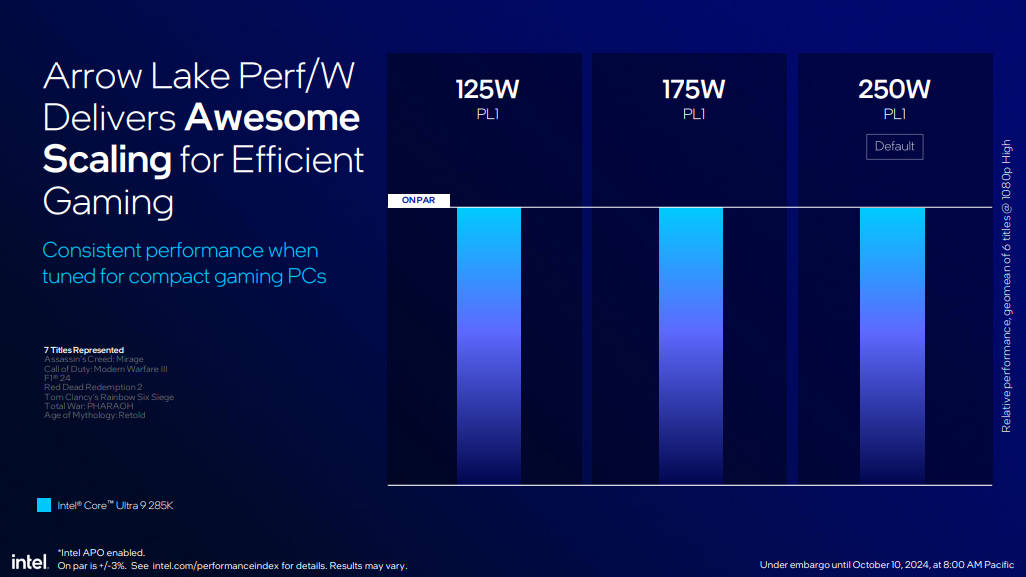
Another important point is that the Intel Core Ultra 9 285K processor scales across wattage. This means that users can expect consistent performance regardless of their PC’s form factor.12
Not to be outdone. The Intel Core Ultra 7 265K not only costs less,13 but also offers up to 21% faster performance14 on games like Starfield and up to 9%15 on average vs the AMD Ryzen 9 9900X.
AI-powered creation
For content creators, efficiency is everything. Whether it’s video editing, 3D rendering, or digital art, processing power directly impacts workflow speed and quality. The new Intel Core Ultra processors are built with AI-accelerated capabilities, ensuring faster processing times, smoother multitasking, and more responsive creative applications.
Thanks to all these features, the popularity of AI PCs has been growing over the past few years and is expected to grow even further.
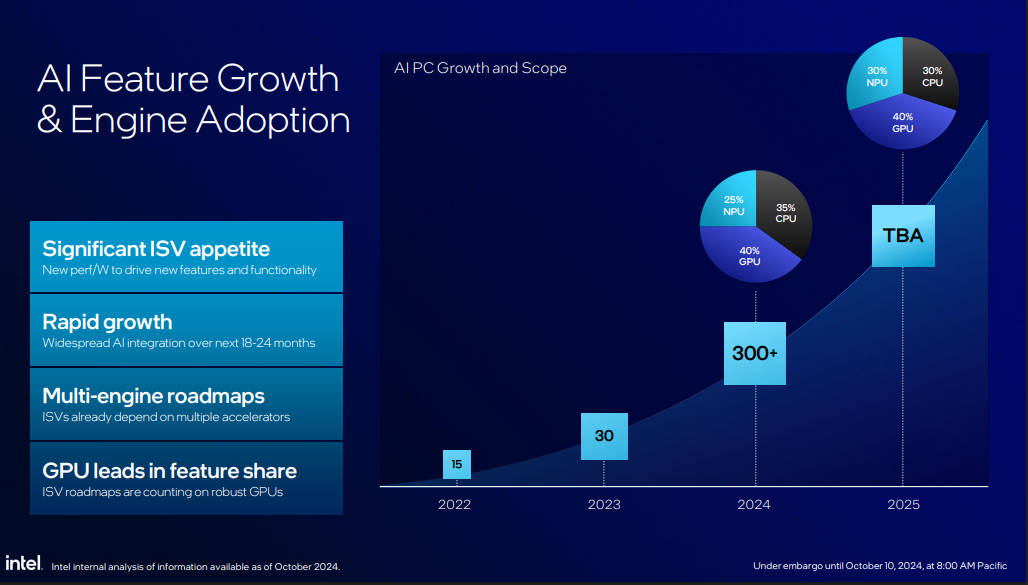
At the heart of this innovation is Intel’s AI Boost NPU, capable of delivering up to 13 TOPS of AI acceleration. This NPU is at the heart of AI PCs and works alongside the CPU and GPU one would find inside a traditional processor. The NPU is dedicated to taking on AI workloads, which helps free up the CPU and GPU for better performance. The inclusion of the NPU has enabled a new avenue to developers, who in turn have introduced several AI-centric features that help make work more efficient. As such, the new processors are all about maximising user creativity by giving them the opportunity to go beyond multitasking and start ‘megatasking’.
For example, Adobe Premier Pro now offers a feature called Scene Edit Detection that can automatically detect scene changes, and separates the video into smaller clips to make editing easier. Meanwhile, Audacity uses the Intel OpenVINO plugin to allow music generation from scratch via a quick text prompt. All these features are designed to help speed up work that would otherwise take hours, if not days of a content creator’s time.
So, how well do the new processors actually work? Well, with the Intel Core Ultra 9 285K processors, 50%16 faster AI-based video editing and a 20%17 speed up in image rendering and handle multiple demanding workloads including smooth streaming while gaming. Further, all this is done on-device to keep data private and secure.
Meanwhile, the Intel Core Ultra 7 265K is able to offer up to 16% faster video editing18 and up to 68% faster image rendering19 when compared to an AMD Ryzen 9 9700X processor. As if that wasn’t enough, it also promises a 10% boost in gaming, streaming, and recording20 on Hitman 3: Dartmoor when compared to an AMD Ryzen 9 9900X.
The best time to upgrade
If you are still using a 3-year-old desktop such as the 12th Gen Alder Lake-based Intel Core processors, then the Intel Core Ultra 200S series might be the best reason to upgrade. When it comes to gaming, the new Core Ultra 9 285K offers 62% greater FPS in titles like Watch Dogs: Legion compared to the Intel Core i9-12900K.21 Meanwhile, content creators will be pleased to know that they will be able to experience 75% faster image rendering22 as compared to the same processor.
Further, if users are still on Windows 10, do note that the aging OS is nearing its End of Life (EOL), and support will end on October 14, 2025. This means that from that date forward, Microsoft will no longer provide bug fixes for issues, security fixes for vulnerabilities, time zone updates, or technical support for problems that might occur.
As such, it would be in the best interest of the user to upgrade to Windows 11 as soon as possible. Not only is Windows 11 more secure, but it also comes with a number of new features such as Copilot and Intel Thread Director that will allow users to make the most of the new processors.
If you are planning to upgrade, then the first thing you will need is a new motherboard as the new processors feature the new Intel LGA 1851 socket. Thankfully, the new motherboards will be offered by pretty much all OEMs. Considering that the new processors are designed for enthusiasts, you will be better off with the flagship-grade Z890-series. Here are a few motherboards that you can consider.
GIGABYTE Z890 Aorus Master – Rs 59,999 – Check it out here!
ASUS ProArt Z890-CREATOR WIFI – Rs 59,999 – Check it out here!
MSI MAG Z890 Tomahawk – Rs 37,600 – Check it out here!
MSI MEG Z890 ACE – Rs 78,999 – Check it out here!
Connectivity options galore
With the new Intel Core Ultra 200S processors, you can say goodbye to lag and hello to seamless, high-speed performance with Wi-Fi 7 compatibility or integrated Wi-Fi 6E. This ensures reliable connections for gaming, streaming, and content creation.
Further, Intel Core Ultra processors also introduce native Thunderbolt 5 support, which is a first for desktop processors. With up to 120 Gbps bandwidth, Thunderbolt 5 simplifies your setup by enabling one high-speed port to connect multiple peripherals, including monitors, cameras, storage drives, and external GPUs. This helps reduce overall cable clutter.
Intel Core Ultra processors also provide 48 PCI Express lanes, including 20 PCIe 5.0 lanes. This allows for high-speed expansion, supporting faster storage solutions, video capture cards, and multi-GPU configurations, unlocking next-level customization and performance for gamers and creators alike.
Overclocking and memory expansion
Thanks to Intel’s latest overclocking enhancements, the new Intel Core Ultra 200S processors give users more control over their system’s performance. You get fine-gran control over turbo frequencies in 16.67MHz steps, independent base clock tuning, and Tile-to-Tile overclocking. Further, features like DLVR bypass and Intel’s eXtreme Tuning Utility (XTU) enable optimised voltage management while per-core voltage and frequency control provide precise tuning. Memory overclocking support for XMP and CUDIMM DDR5 ensures peak stability and speed.
When it comes to memory, users get support for DDR5-6400, up to 48GB per DIMM, and a massive 192GB maximum capacity. With ECC support, dual-channel configurations, and multiple DIMM form factors, users are assured of seamless multitasking and uncompromised reliability.
Conclusion
The Intel Core Ultra 200S series marks a new era of AI-powered desktop computing, delivering high performance while maintaining exceptional efficiency and lower temperatures. Whether you’re a gamer, creator, or streamer, these processors provide the power you need with cutting-edge AI acceleration.
Disclaimers:
1. As of October 2024, among desktop processors targeting ~125W TDP. For
more information, go to intel.com/performanceindex. Results may vary.
2. Among desktop processors targeting ~125W TDP, based on average CPU package (SoC)
power measured in watts across measured benchmarks and representative workloads. Details at intel.com/performance. Results may vary Testing as of Oct., 2024
3. As measured by average system power while playing Assassin’s Creed: Mirage on an Intel® Core™ Ultra 9 285K vs. Intel® Core™ i9 processor 14900K. Individual system results may vary as power and performance are affected by use, configuration and other factors. Details at intel.com/performance-wireless. Results may vary Testing as of Oct., 2024
4. Intel® Application Optimization is a policy within Intel® Dynamic Tuning Technology that
optimizes performance on select games, with required configurations on select Intel® Core™ 14th gen processors. For additional information on Intel® Application Optimization, see www.intel.com/content/www/us/en/support/articles/000095419/processors.html. Testing as of Oct., 2024
5. As measured by Metro Exodus on an Intel® Core Ultra 9 285K with Intel Application
Optimization Enabled vs. Intel Application Optimization Disabled
6. Altering clock frequency or voltage may void any product warranties and reduce stability,
security, performance, and life of the processor and other components. Learn more at
intel.com/overclocking.
7. Results may vary based on use, configurations, and other factors. See intel.com/performanceindex for details.
8. Based on average system power over the duration of in-game benchmarks/workloads versus prior gen. Results may vary based on use, configurations, and other factors. See intel.com/performanceindex for details.
9. Results may vary based on use, configurations, and other factors. See intel.com/performanceindex for details.
10. See www.Intel.com/PerformanceIndex for workloads and configurations.
Results may vary. Performance varies by use, configuration and other factors. No product or component can be absolutely secure. Your costs and results may vary. Intel technologies may require enabled hardware, software or service activation.
11. *Intel APO enabled. On par is +/-3%. As of October 2024. Results may vary. See intel.com/performanceindex for details.
12. *Intel APO enabled. On par is +/-3%. See intel.com/performanceindex for details. Results may vary.
13. Prices as of Jan 28th 2025 on PC Part Picker US U7 265KF = $339.99, R9 9900X = $409.00
14. As measured by average frames per second during gameplay on Starfield on an Intel Core Ultra 7 processor 265K vs. an AMD Ryzen 9 9900X processor. Details at intel.com/performance. Results may vary Testing as of Oct., 2024
15. As measured by a geomean of the average frames per second during gameplay on Far Cry 6, Sid Meier’s Civilization 6, Star Wars Outlaws, Hitman 3: Dartmoor, Total War: Warhammer III, and Starfield on an Intel Core Ultra 7 processor 265K vs. an AMD Ryzen 9 9900X processor. See intel.com/performanceindex for details. Results may vary. Testing as of Oct., 2024
16. As measured by Adobe After Effects AI Scene Edit Detection feature on an Intel® Core™ Ultra 9 285K vs. AMD Ryzen™ 9 9950X. Details at intel.com/performance. Results may vary Testing as of Oct., 2024
17. As measured by POV-Ray multi-core benchmark on an Intel® Core™ Ultra 9 285K processor vs. AMD Ryzen™ 9 9950X. Details at intel.com/performance. Results may vary Testing as of Oct., 2024
18. As measured by PugetBench for Premiere Pro on an Intel Core Ultra 7 processor 265K vs. an AMD Ryzen 7 9700X processor. See intel.com/performanceindex for details. Results may vary
19. As measured by Blender (Monster – CPU) on an Intel Core Ultra 7 processor 265K vs. an AMD Ryzen 7 9700X processor. See appendix for details. Results may vary. Testing as of Oct., 2024
20. As measured by average frames per second during gameplay on Hitman 3: Dartmoor while gaming, streaming, and recording with Open Broadcaster Software (OBS) on an Intel Core Ultra 7 processor 265K vs. an AMD Ryzen 7 9900X processor. See intel.com/performanceindex for details. Results may vary. Testing as of Oct. 2024
21. As measured by average frames per second during gameplay on Watch Dogs: Legion on an IntelCore Ultra 9 processor 285K vs. an Intel Core i9-12900K processor. See
intel.com/performanceindex for details. Results may vary. Testing as of Oct., 2024
22. As measured by Blender 4.0 – Monster (CPU) on an Intel Core Ultra 7 processor 265K vs. an Intel Core i7-12700K processor. See intel.com/performanceindex for details. Results may vary. Testing as of Oct., 2024
This is a promotional post done as part of a brand collaboration.