OnePlus 15R vs Vivo V70 Elite: which one would you pick upward of Rs 50,000?


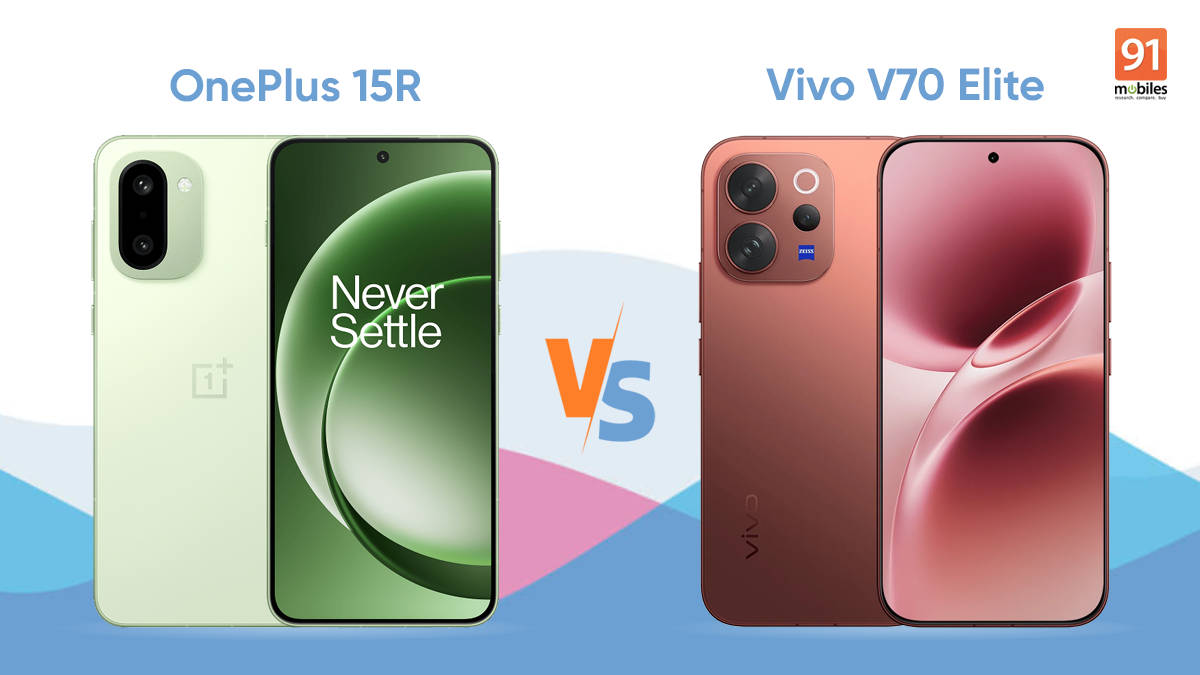
The OnePlus 15R was not really meant to compete with the Vivo V70 Elite. When the former launched in December 2025 at Rs 47,999, it sat comfortably under the Rs 50,000 mark, a deliberate positioning that gave it a clear identity as a performance flagship at an accessible price. Two price hikes later, the latest one coming in just this week, the base OnePlus 15R now costs Rs 52,999. The Vivo V70 Elite, meanwhile, launched in February 2026 at Rs 51,999 and currently sits at Rs 54,999 for the 8GB and 256GB configuration. The gap between them has effectively closed, and that makes this comparison worth having for buyers interested in the sub-Rs 55,000 segment.
Table of Contents
Specs at a glance
| OnePlus 15R | Vivo V70 Elite | |
| Display | 6.83-inch 1.5K AMOLED, 165Hz | 6.59-inch 1.5K AMOLED, 120Hz |
| Processor | Snapdragon 8 Gen 5 | Snapdragon 8s Gen 3 |
| Rear cameras | 50MP + 8MP ultrawide | 50MP + 50MP telephoto + 8MP ultrawide |
| Front camera | 32MP autofocus | 50MP autofocus |
| Battery | 7,400mAh, 80W wired | 6,500mAh, 90W wired |
| Durability | IP68, IP69, IP69K | IP68, IP69 |
| Software | OxygenOS 16, Android 16 | OriginOS 6, Android 16 |
| Software support | 4 years OS, 5 years security | 4 years OS, 6 years security |
Pricing
| OnePlus 15R | Vivo V70 Elite | |
| 8GB + 256GB | Rs 54,999 | |
| 12GB + 256GB | Rs 52,999 | Rs 59,999 |
| 12GB + 512GB | Rs 57,999 | Rs 61,999 |
Vivo is consistently Rs 2,000 more expensive across variants. However, that is a small gap and should not be the deciding factor at this price level. What matters more is what each phone does differently.
Design and display
The two phones approach design from different directions. The OnePlus 15R has a flat, boxy build with an aluminium frame, a slim camera island, and a glass back. It’s available in Charcoal Black, Mint Breeze, and Electric Violet, with the last being an India-exclusive variant using a fiberglass back. Our review notes that the understated camera module, while keeping the rear clean, makes the 15R look closer to a mid-range phone than its price tag would suggest. It draws comparisons to older Nord models rather than a sub-Rs 55,000 flagship.


The Vivo V70 Elite takes a more deliberate approach. The squircle camera module with Zeiss branding and Aura Light gives it a structured, modern look. Our review describes it as “much more appealing than the gigantic circular camera modules seen on the X-series.” At 7.59 mm and 194 gms, it’s also noticeably slimmer and lighter than the 15R, which measures 8.1 mm to 8.3 mm and weighs between 213 and 219 gms depending on the variant. The V70 Elite’s Passion Red is the hero colour in Vivo’s marketing, though the Sand Beige that our reviewer used daily drew praise for its “understated elegance that grows on you over time.”

On display, the 15R has a clear advantage in one key spec and the V70 Elite holds its own in another. The 15R’s 6.83-inch panel runs at 165Hz versus the V70 Elite’s 120Hz, a real difference for gaming and everyday scrolling smoothness. However, the 15R uses an LTPS panel rather than LTPO, which means it cannot vary the refresh rate as efficiently at the hardware level, unlike the LTPO panel on its predecessor, the OnePlus 13R. The V70 Elite’s 6.59-inch display is smaller, which our reviewer appreciated for easier one-handed use, and its 459 ppi pixel density delivers noticeably crisp content. Both hit 5,000 nits peak brightness and remain legible outdoors.
Cameras
This is the sharpest point of difference between the two phones, and it goes decisively in the V70 Elite’s favour. The Vivo V70 Elite has a proper three-camera ZEISS system comprising a 50MP Sony LYT-700V primary with OIS, a 50MP Sony IMX882 telephoto with 3x optical zoom, and an 8MP ultrawide. All four cameras, including the 50MP front shooter, support 4K at 60fps recording. Our review found the primary camera delivers “punchy contrast and vibrant colours,” and the telephoto makes the camera system genuinely versatile across focal lengths. Low-light performance was also solid, with the V70 Elite doing “a better job of controlling light flare, revealing details, and keeping noise to a minimum” compared to its rivals in testing. The 8MP ultrawide remains the weak link though, and it cannot match the quality of the primary and telephoto sensors.
The OnePlus 15R runs a dual-camera system — a 50MP Sony IMX906 primary with OIS and an 8MP ultrawide. Our review called cameras “one of the least exciting aspects of the 15R.” The primary camera handles daylight photography well with good exposure and the DetailMax engine producing natural-looking images. The 32MP front camera actually outperformed the OPPO Reno 14 Pro’s 50MP selfie camera in our testing, delivering better clarity and dynamic range. However, low-light photography is where the 15R visibly struggles. As per our review, “even with night mode enabled, the handset fails to adequately control light sources, with pole lights bleeding across the frame.” The absence of a telephoto lens is also a genuine limitation at this price.
If camera versatility and low-light performance are important to you, the V70 Elite is the clearer recommendation here.
Performance and chipset
The OnePlus 15R has the newer and more powerful chip. The Snapdragon 8 Gen 5 outperforms the Snapdragon 8s Gen 3 in the V70 Elite by a meaningful margin in benchmarks.
AnTuTu score


OnePlus 15R
Qualcomm Snapdragon 8 Gen 5
2,957,229

vivo V70 Elite
Qualcomm Snapdragon 8s Gen 3
1,815,619
AnTuTu assesses a smartphone's CPU, GPU, memory, and overall user experience (higher is better)
The V70 Elite’s Snapdragon 8s Gen 3 is a two-year-old chip built on a 4nm process, and that age is worth factoring in. Our review noted it handles “regular usage and casual gaming” well enough, posting a Burnout score of 51.7 percent, close to the 15R. Thermals were also well-managed, with the V70 Elite recording a 9.3 degree Celsius temperature rise during 30 minutes of gaming, but the OnePlus 15R recorded a lower of just about 4 degree Celsius, indicating the vapour chamber is doing a better job there.
For gaming enthusiasts or heavy users who push their phone hard, the 15R’s Snapdragon 8 Gen 5 is the stronger foundation. For everyday users, the difference will rarely be felt.
Battery and charging
Both phones delivered remarkably similar PCMark battery scores in our testing. The 15R clocked 18 hours and 13 minutes, while the V70 Elite posted 18 hours and 19 minutes. That is essentially identical endurance despite the 15R having a 900mAh larger battery, which speaks to how well Vivo has optimised the V70 Elite’s 6,500mAh cell.
PCMark Battery score (in hours)
vivo V70 Elite
6500 mAh
18.3
OnePlus 15R
7400 mAh
18.2
PCMark battery test measures phone battery life from 100% to 20% (higher is better)
Where they differ is charging speed. The V70 Elite’s 90W charging took the phone from 20 to 100 percent in 43 minutes in our testing. The 15R’s 80W charger took around 49 minutes for the same stretch, which is a modest but real difference. Neither supports wireless charging.
If you are choosing between the two on battery alone, the real-world endurance is comparable. The V70 Elite charges slightly faster, the 15R has more headroom on heavy days.
Software and longevity
Both ship with Android 16. OxygenOS 16 on the 15R is clean, close to stock, and well-optimised. Our review described it as “easily ranking among the best custom Android skins available today.” OnePlus promises four years of OS updates and five years of security patches.
OriginOS 6 on the V70 Elite is more feature-rich but comes with a cluttered app drawer from pre-installed applications, which our review flagged as a drawback. Vivo’s AI camera modes and festival filters are fun additions, though they require an internet connection and are slow to process. On longevity, Vivo has the edge with six years of security updates versus OnePlus’s five, which is a meaningful difference for anyone who holds onto a phone for four or more years.
Summing up
Our reviews scored the OnePlus 15R at 8.5 out of 10 and the Vivo V70 Elite at 8.4 out of 10, which tells you these are genuinely close phones overall. But they suit different buyers. The OnePlus 15R is the better phone for raw performance, display smoothness, selfie quality, and battery headroom.
The Vivo V70 Elite is the better phone for camera versatility, design, charging speed, long-term software support, and one-handed usability. The ZEISS triple camera system with a proper 3x telephoto, strong low-light performance, and six years of security patches are meaningful advantages that compound over time.