POCO X8 Power vs OnePlus Nord CE6: which is the better mid-ranger under Rs 40,000?


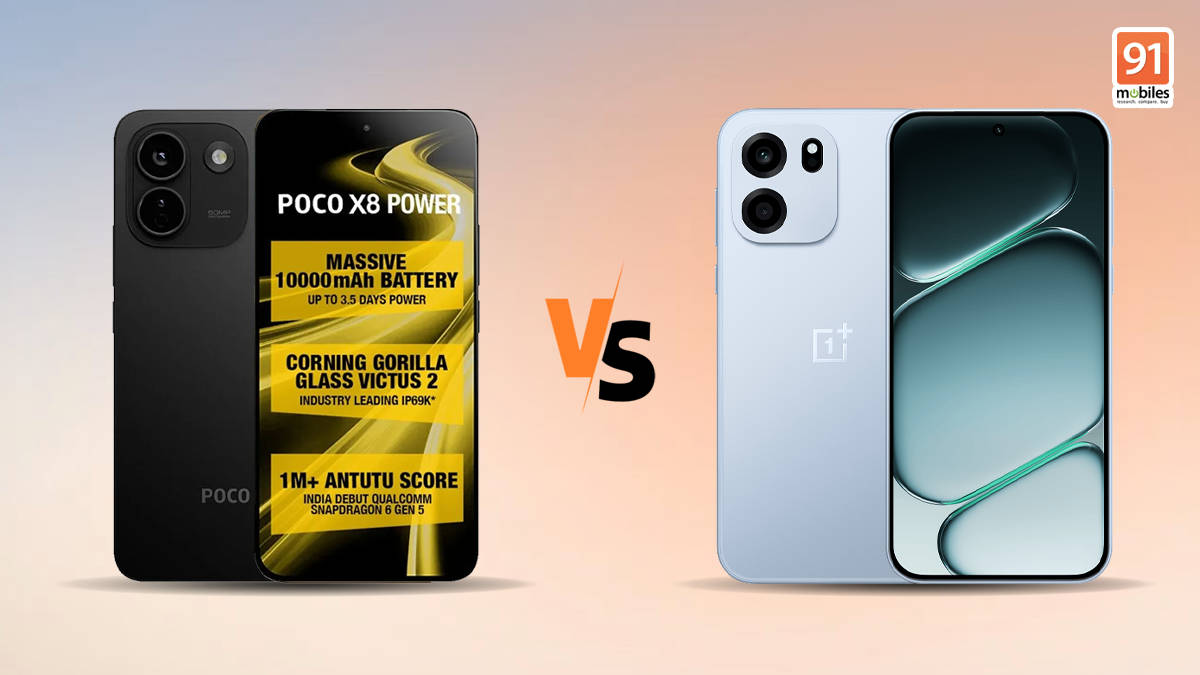
The POCO X8 Power and OnePlus Nord CE6 (review) are two mid-range phones built around a similar idea: give users a big battery, a good AMOLED display and enough performance for gaming and everyday use at an affordable price point. Both phones also put a big emphasis on media consumption, making them great options for users who spend a lot of time watching videos or playing games on their phones.
Here’s how the two phones compare in terms of battery life, performance or the overall multimedia experience.
Table of Contents
POCO X8 Power vs OnePlus Nord CE6: price, variants
| Variants | POCO X8 Power | OnePlus Nord CE6 |
| 8GB + 128GB | Rs 35,999 | Rs 37,999 |
| 8GB + 256GB | Rs 38,999 | Rs 41,999 |
POCO X8 Power vs OnePlus Nord CE6: design and durability
Both phones take a similar approach to durability, with polycarbonate frames and backs and IP66, IP68, IP69 and IP69K ratings. The POCO X8 Power is slightly thicker at 8.65mm and weighs 229g, while the OnePlus Nord CE6 measures 8.5mm and weighs 215g. The OnePlus is therefore a little easier to carry, although the POCO’s 20 percent larger battery makes its extra weight understandable.


The two phones also offer extra protection against drops and rough use. The POCO uses Gorilla Glass Victus 2 and comes with SGS and TÜV certifications, while the Nord CE6 uses Crystal Guard glass and also carries MIL-STD-810H certification. Both phones support wet-touch input as well, although POCO calls its implementation Wet Touch 2.0.


The OnePlus has a small advantage if you care about comfort, simply because it is lighter, but the POCO isn’t much heavier or denser and gives you much better durability both front and back. Its combination of a huge battery and extensive protection makes the extra weight easier to overlook.
POCO X8 Power vs OnePlus Nord CE6: display
Both phones come with large 1.5K AMOLED displays, so there isn’t much to separate them when it comes to everyday use. The POCO X8 Power has a slightly larger 6.83-inch screen with a 120Hz refresh rate, while the OnePlus Nord CE6 uses a 6.78-inch panel that goes up to 144Hz. Both displays should look sharp and colourful with full DCI-P3 coverage.
The POCO has a few advantages if you care about watching HDR content. It comes with a 12-bit panel (which in essence is actually a 10-bit panel) and supports Dolby Vision and HDR10, while the OnePlus uses a 10-bit panel and also supports HDR10. The Nord CE6 claims a slightly higher 3,600-nit peak brightness, but the POCO reaches 3,500 nits, so there shouldn’t be a major difference here in practice.
Both phones also offer up to 3,200Hz instantaneous touch sampling for gaming. The OnePlus offers 3,840Hz PWM dimming, while the POCO uses Gorilla Glass Victus 2 for protection. The POCO phone here has a slight edge for media consumption because of its larger screen and Dolby Vision support, while the Nord CE6’s 144Hz refresh rate could appeal more to gamers.
POCO X8 Power vs OnePlus Nord CE6: battery
This is where the POCO X8 Power is clearly superior to its competitor. It packs a massive 10,000mAh silicon-carbon battery, compared with the 8,000mAh battery on the OnePlus Nord CE6. Both phones support fast charging, but the POCO goes up to 100W HyperCharge, while the Nord CE6 supports 80W SUPERVOOC. Both also support 27W reverse charging, so you can use either phone to top up another device when needed.
The POCO X8 Power also supports bypass charging, which sends power directly to the motherboard during gaming instead of constantly charging the battery. OnePlus offers the same feature on the Nord CE6, while both phones claim a six-year battery lifespan.
POCO X8 Power vs OnePlus Nord CE6: Performance
The OnePlus Nord CE6 has the clear advantage when it comes to performance. It uses the Snapdragon 7s Gen 4, while the POCO X8 Power runs on the Snapdragon 6 Gen 5. Both chips use a 4nm process, but the Nord CE6 gets faster CPU cores and a more capable chipset overall, so it should handle demanding apps and games better.
Both phones offer 8GB of LPDDR5X RAM, which should help with multitasking. Storage is, however, faster on the POCO’s 256GB variant, which uses UFS 4.1, while the Nord CE6 uses UFS 3.1. Although the OnePlus uses a more advanced chipset, which tips the scales in its favour in terms of performance.
POCO X8 Power vs OnePlus Nord CE6: camera
The OnePlus Nord CE6 also uses a 50MP main camera, along with a 2MP depth sensor for portrait shots. It does not have an ultra-wide or telephoto camera, while its 32MP autofocus selfie camera supports EIS. OnePlus also highlights 4K video recording from both the front and rear cameras. Here are some camera samples from the Nord CE6:
Camera performance, however, is difficult to judge from specifications alone, so it would be unfair to pick a clear winner based purely on the hardware. We’ll have a better idea of how the POCO X8 Power actually performs once we’ve spent more time with it, so I’d recommend waiting for our dedicated review before making a decision based on the cameras.
POCO X8 Power vs OnePlus Nord CE6: software
The POCO X8 Power runs Android 16 with Xiaomi HyperOS 3, while the OnePlus Nord CE6 comes with Android 16 and OxygenOS 16. Both focus on smooth performance and keeping apps running in the background, with OnePlus using its RAM-Vitalisation feature on the Nord CE6.
However, POCO has a clear advantage when it comes to long-term software support. The X8 Power gets four years of major Android updates and six years of security updates, while the Nord CE6 gets two major Android upgrades and four years of security updates. That means the POCO should remain supported for considerably longer, which is worth considering if you plan to keep the phone for several years.
Final thoughts
The OnePlus Nord CE6 (review) is clearly ahead when it comes to performance. Its Snapdragon 7s Gen 4 chipset gives it a decent advantage over the Snapdragon 6 Gen 5 on the POCO X8 Power, so users who care most about gaming and raw performance should lean towards the OnePlus. However, the Nord CE6 starts at Rs 37,999 for the base variant, which is about Rs 2,000 higher than its rival.
The POCO X8 Power offers a lot more for the starting price of Rs 35,999. It has a much larger 10,000mAh battery, faster 100W charging, a display that is just as good or arguably better for media consumption, an ultra-wide camera and longer software support. It also costs less, which makes the performance advantage of the OnePlus feel less important when you look at the overall package.
The POCO X8 Power is the better choice for users looking for a more balanced phone. It gives up some performance but makes up for it with better battery life, charging, display features, camera flexibility and software support. If performance is your top priority and you’re willing to pay more for it, the OnePlus Nord CE6 is the better option.