Qualcomm has announced a new milestone for smartphone processors and claims that its next-generation Oryon CPU is the first mobile CPU to reach a 5GHz clock speed. While clock speed is only one part of overall processor performance, the achievement gives Qualcomm a useful advantage as it looks to push smartphone performance closer to what you’d get from a laptop or desktop processor. Let’s discuss this in more detail below.
Table of Contents
Impressive 5GHz speed, but there’s more
Qualcomm says it achieved the 5GHz milestone through a fully custom CPU design, allowing it to tune the architecture and wider CPU subsystem together. It is also introducing Oryon FlexCache, which is designed to help the CPU cores make better use of cache and reduce how often they need to access slower system memory.
A CPU’s clock speed tells us how quickly it can run its processing cycles. Simply put, a 5GHz CPU can run up to five billion cycles per second. However, clock speed alone doesn’t determine performance. Two processors can run at different speeds but deliver similar results depending on how much work they can complete in each cycle. This is where IPC (instructions per clock) can help.
To put it simply, think of two cars. One may have a higher top speed, but that doesn’t necessarily mean it will perform better in every situation. Acceleration, handling and how well it performs at high speeds also matter. Similarly, 5GHz tells us how quickly the CPU can operate, while its architecture and IPC determine how much work it can complete at that speed.
Qualcomm says the new Oryon CPU combines its 5GHz peak clock speed with high IPC, which should benefit everything from everyday apps and gaming to content creation and AI workloads.
The new FlexCache architecture
Qualcomm’s new Oryon FlexCache architecture is another important part of the design of their next-gen chipsets. Cache is a small amount of very fast memory located close to the CPU cores, allowing them to access frequently needed data without repeatedly reaching into slower system RAM.
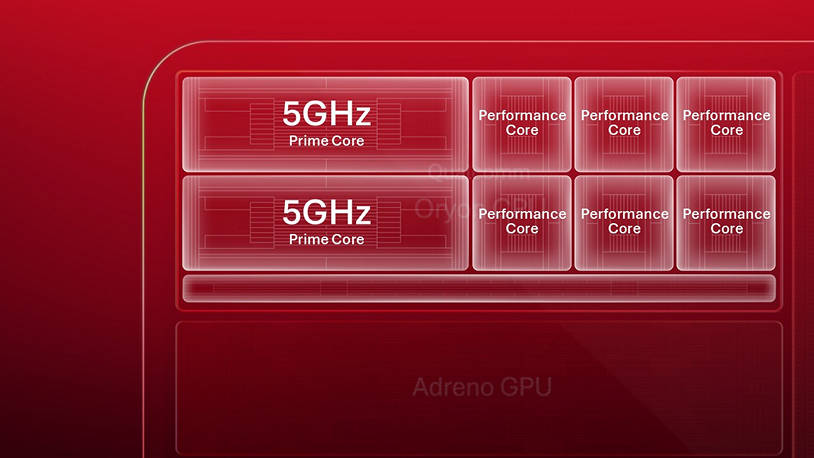
The new architecture that’s shown uses two Prime cores and six Performance cores, with both types able to access a shared cache pool. Instead of being restricted to fixed portions, the cores can dynamically use more of the cache when a workload requires it.
This doesn’t replace RAM, but it can reduce how often the CPU needs to access system memory, potentially helping maintain performance during demanding gaming, multitasking, AI and video workloads.
How could this impact future Snapdragon flagship chipsets?
The new Oryon architecture could become particularly useful as smartphone makers deal with rising memory costs. RAM was not a major constraint for flagship phones in the past, but higher memory prices are now making manufacturers more cautious about how much memory they put into each device.
FlexCache technology could help Qualcomm improve performance without relying entirely on larger RAM configurations. By allowing CPU cores to share and dynamically use the available cache, more frequently needed data can stay closer to the processor, potentially reducing the number of trips to system memory.
It is too early to say how much this will translate into actual gains, but the approach has its merits and could give future Snapdragon flagship chipsets another way to improve sustained performance without simply adding more RAM. That could become increasingly relevant if memory prices remain elevated in the future.