After releasing the Redmi Note 17 5G (review) for Rs 27,999 a few weeks ago, the company recently launched a sub-Rs 25,000 offering, the Redmi 17 5G. While both smartphones are aimed at users prioritising long-lasting battery endurance and large displays for binge-watching content, they also share key identical specifications, making it challenging to choose between the two. Therefore, we compare the Redmi 17 5G and Redmi Note 17 5G in a quick specifications-based comparison to help you assess which one is right for you.
Table of Contents
Redmi 17 vs Redmi Note 17: specs at a glance
| Specification | Redmi 17 | Redmi Note 17 |
| Display | 6.9-inch HD+ LCD, 120Hz refresh rate, 825 nits HBM | 6.99-inch Full HD+ AMOLED, 120Hz refresh rate, 1,800 nits peak brightness, 1,200 nits HBM |
| Processor | Qualcomm Snapdragon 4 Gen 5 | Qualcomm Snapdragon 4 Gen 4 |
| Cameras | 50MP primary, 8MP selfie | 50MP primary, 16MP selfie |
| Battery | 7,900mAh, 45W fast charging | 8,000mAh, 45W fast charging |
| Software | HyperOS 3 with Android 16, 4+6 years | HyperOS 3 with Android 16, 4+6 years |
Redmi 17 vs Redmi Note 17: price in India
Both Redmi 17 and Redmi Note 17 are offered in two storage configurations: 6GB RAM with 128GB storage and 8GB RAM with 128GB storage. With the Redmi Note 17 priced Rs 4,000 higher than the Redmi 17, does it offer any advantages? Find out below.
| Storage | Redmi 17 | Redmi Note 17 |
| 6GB + 128GB | Rs 23,999 | Rs 27,999 |
| 8GB + 128GB | Rs 26,999 | Rs 30,999 |
Redmi 17 vs Redmi Note 17: display, design
The Redmi 17 5G and Redmi Note 17 5G both adopt a large, practical design focused on maximising screen size and battery capacity, but they differ noticeably in terms of appearance and weight. The Redmi 17 weighs 232g, making it heavier than the Note 17, which comes in at 225g.
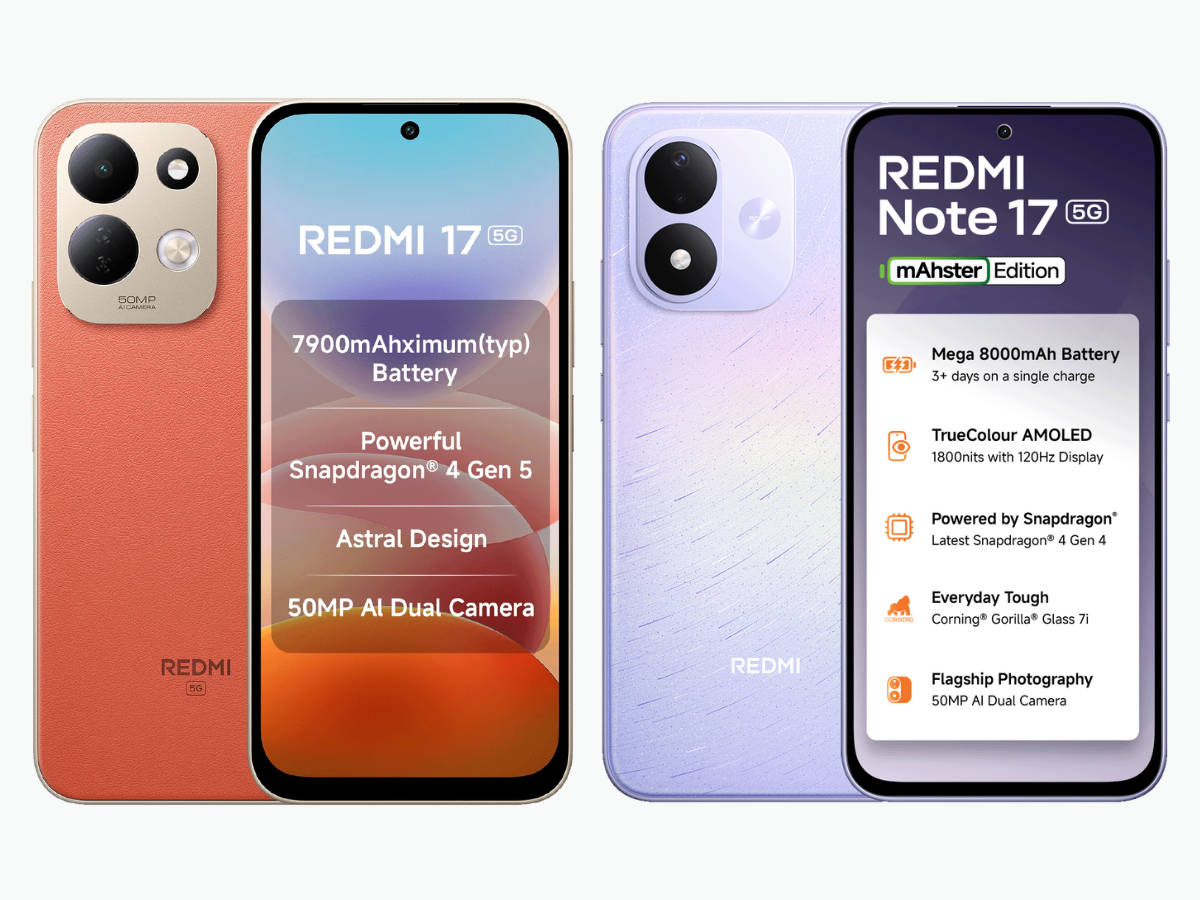
Both use plastic frames and backs protected by Gorilla Glass 7i on the front, yet the Note 17 should be more manageable in the hand thanks to its reduced thickness. The Redmi 17’s rectangular camera module protrudes more, while the Note 17’s squarish camera island seems to be more flush with the body. Both phones also differ in colour options, where the Redmi 17 comes in Eternal Orange with a vegan leather back, Endless Blue, and Absolute Black, whereas the Note 17 arrives in Arctic Blue, Starlight Purple, and Dark Night.
On to the displays, this is where the Note 17 clearly has an edge as it offers a 6.9–inch FHD+ AMOLED display, while the Redmi 17 settles for an HD+ only LCD display. The high-resolution AMOLED panel on the Note 17 should offer punchier colours, deeper blacks, higher brightness and sharper details over the Redmi 17’s LCD display. For smooth scrolling, both handsets get 120Hz refresh rates.
Redmi 17 vs Redmi Note 17: chipset
Traditionally, the Redmi Note smartphone in a given year is equipped with a noticeably better chipset than the subsequent Redmi phone in the number series. However, this time around, Redmi has switched things up a bit by offering a newer and slightly more advanced processor on the Redmi 17 5G.
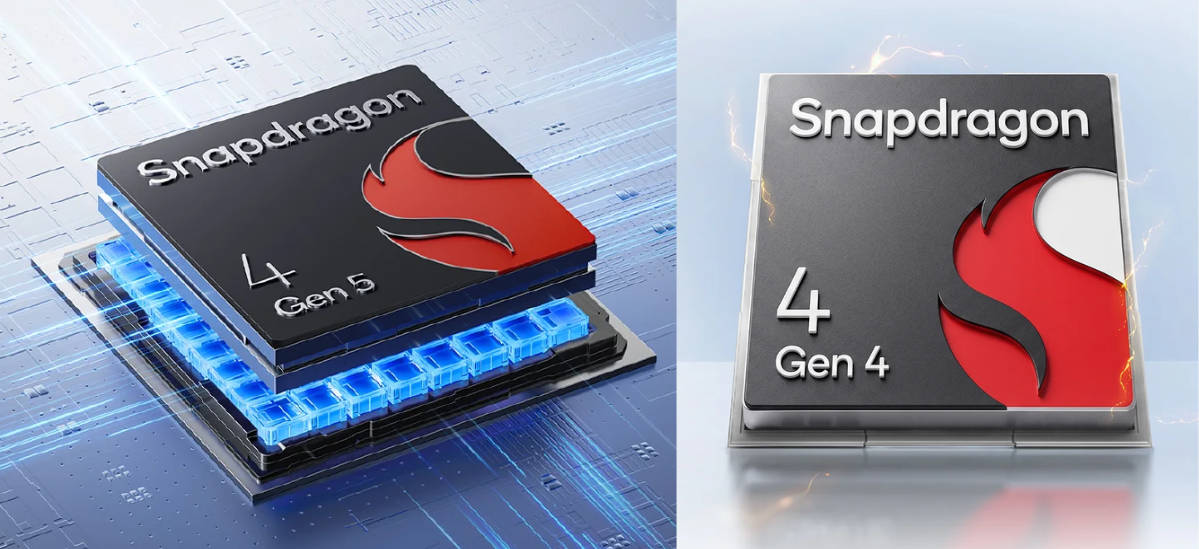
The phone carries the Snapdragon 4 Gen 5, a 4nm-based chip with up to 2.4GHz clock speeds and the Adreno 629 GPU, while the Redmi Note 17 runs on the Snapdragon 4 Gen 4 processor, also built on a 4nm process but clocked at 2.3GHz with the Adreno 613 GPU. While there shouldn’t be a noticeable performance difference between the two smartphones in real-world use, the Redmi 17 could certainly have an edge in benchmark scores over the Note 17 due to its faster clock speeds and newer GPU.
Redmi 17 vs Redmi Note 17: battery
The Redmi Note 17 5G has a slightly larger 8,000mAh battery, while the Redmi 17 5G packs a 7,900mAh cell. Charging is identical on both phones: 45W wired fast charging (charger included in the box) and 22.5W wired reverse charging. In terms of real-world endurance, the Redmi Note 17’s extra 100mAh could give it a modest advantage, but since the Redmi 17’s HD+ display has fewer pixels to push, both smartphones may end up offering the same level of endurance.
Redmi 17 vs Redmi Note 17: cameras
The 50MP primary cameras on the Redmi 17 5G and Redmi Note 17 5G are virtually identical in hardware, as both offer an f/1.8 aperture, PDAF, and multiple modes, including Film Camera, Night mode, Auto night mode, Portrait mode, Time-lapse, and Dual camera recording. Furthermore, video recording is capped at 1080p at 30 fps on these smartphones.
Up front, the Redmi 17 has an 8MP front camera, while the Redmi Note 17 features a 16MP unit for video calls and selfies. Given the hardware on paper, the Note 17 should have an advantage in producing more reliable selfie results since the photography and videography capabilities using the primary lens appear to be the same.
Redmi 17 vs Redmi Note 17: software
Both phones launch with the same software, Android 16 out of the box, running Xiaomi’s HyperOS 3. The overall user interface, animations, customisation options (themes, icons, widgets, lock screen styles), and AI features should essentially be identical. You’ll find the familiar HyperOS experience on both, including the usual set of pre-installed apps.
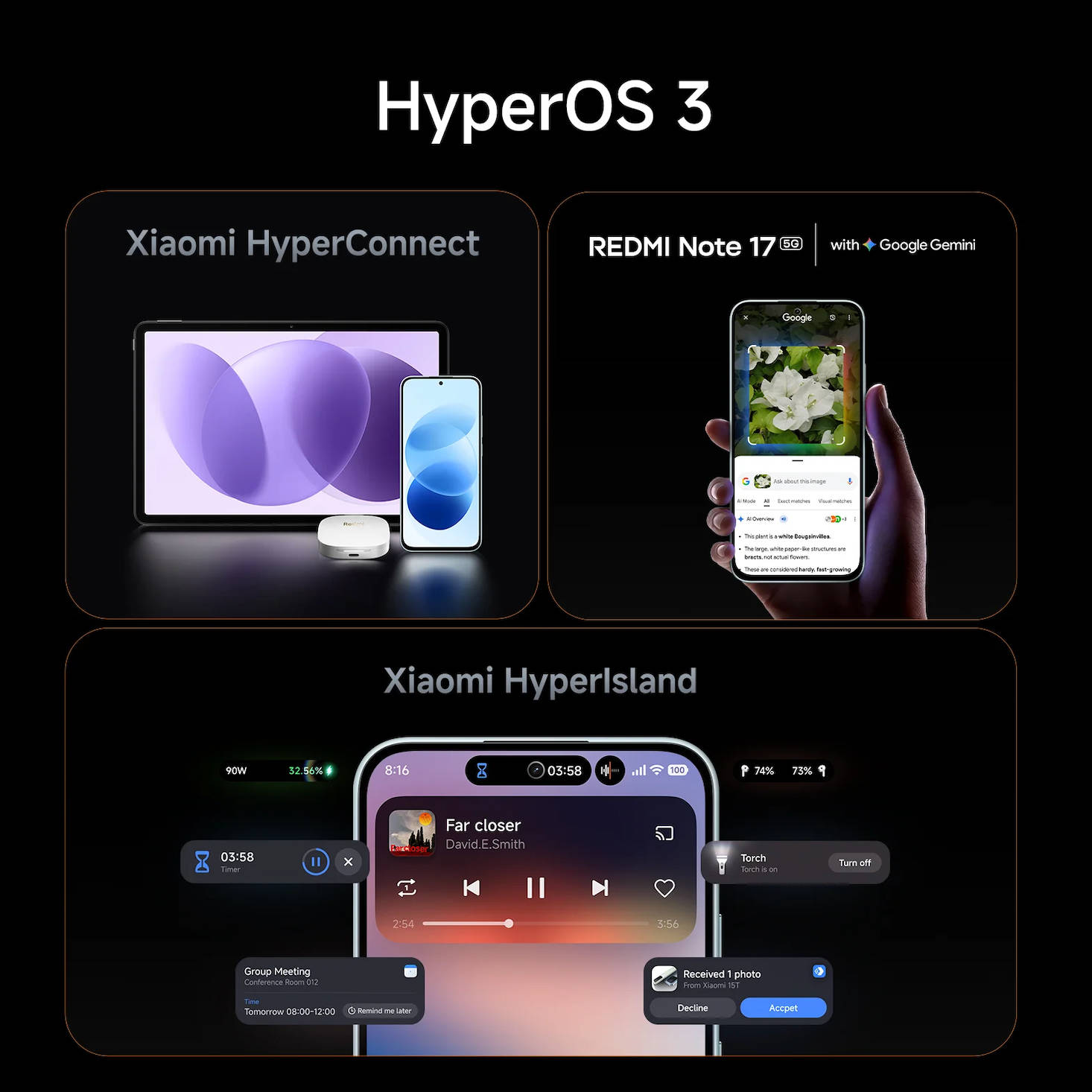
Regarding software updates, both the Redmi 17 and Redmi Note 17 are promised four major OS upgrades and six years of security patch updates. With higher-priced phones above Rs 30,000 limited to three OS updates, it’s good to see Redmi priorising software longevity, making both phones ideal for those planning to keep them for long term. Since these handsets launched within the same timeframe, they should reach their end of life (EOL) at roughly the same time, meaning you won’t gain any advantage in update longevity by choosing one over the other.
Summing up
The Redmi 17, while more affordable, features a newer, more advanced processor, the Snapdragon 4 Gen 5, offering more headroom for performance-oriented tasks in the long term. On the other hand, the Snapdragon 4 Gen 4 chipset found on the Redmi Note 17 should be equally capable for day-to-day tasks, but may not offer the same level of raw performance as the Redmi 17.
On the other hand, if you’re into watching OTT content and YouTube content, spending the extra Rs 4,000 on the Note 17 should be worth it, thanks to the AMOLED panel on board. On the contrary, if the display quality is of little concern to you, settling for the Redmi 17 at Rs 23,999 should also do the job. Other key parameters, such as battery life, cameras, and software, are nearly identical across both handsets, resulting in the same experience regardless of your choice.