Redmi 17 vs Redmi 15: is the newer Redmi smartphone really better?


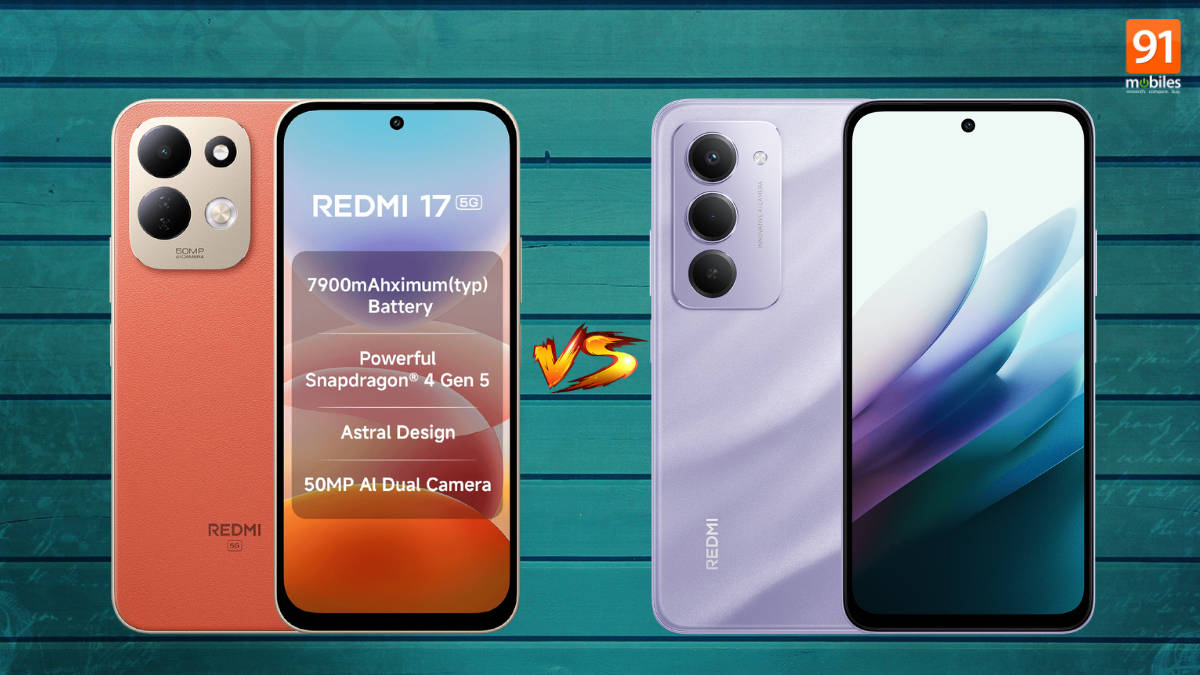
The Redmi 17 5G recently landed in India as the successor to last year’s Redmi 15 5G. With huge batteries, massive displays, and Snapdragon processors, both smartphones aim to deliver a full-day experience with good enough performance and solid endurance. So, with the Redmi 17 arriving almost a year after the Redmi 15, does it bring major upgrades and improvements to the table? Find out in this quick specifications-based comparison.
Table of Contents
Redmi 17 vs Redmi 15: specs at a glance
| Specification | Redmi 17 | Redmi 15 |
| Display | 6.9-inch HD+ LCD, 120Hz refresh rate, 825 nits HBM | 6.9-inch FHD+ LCD, 144Hz refresh rate, 700 nits HBM |
| Processor | Qualcomm Snapdragon 4 Gen 5 | Qualcomm Snapdragon 6s Gen 3 |
| Cameras | 50MP primary, 8MP selfie | 50MP primary, 8MP selfie |
| Battery | 7,900mAh, 45W fast charging | 7,000mAh, 33W fast charging |
| Software | HyperOS 3 with Android 16, 4+6 years | HyperOS 3 with Android 16, 1+3 years (remaining) |
Redmi 17 vs Redmi 15: price in India
The Redmi 15 launched in India over a year ago, starting at Rs 14,999 for the base 6GB RAM and 128GB storage variant, but its price has since risen due to the shrinking memory supply. Also, while it’s no longer available on Xiaomi India’s online store, the phone is still available on Amazon. The Redmi 17, on the other hand, was launched at Rs 23,999 for the base model.
| Storage | Redmi 17 | Redmi 15 |
| 6GB + 128GB | Rs 23,999 | Rs 21,499 |
| 8GB + 128GB | Rs 26,999 | Rs 23,499 |
| 8GB + 256GB | N/A | Rs 25,499 |
Redmi 17 vs Redmi 15: display, design
Just like its predecessor, the Redmi 17 emphasises a large display and form factor. Both the Redmi 15 and Redmi 17 carry a 6.9-inch IPS LCD panel, but they differ in resolution: the Redmi 17 settles for HD+, while the Redmi 15 sports a sharper FHD+. The Redmi 15 has another advantage up its sleeve, i.e., a smoother 144Hz refresh rate over the Redmi 17’s 120Hz refresh rate.
In brightness, though, the Redmi 17’s 825 nits HBM should make the display appear brighter than the Redmi 15’s 700-nits panel. That being said, while the refresh rate and brightness values differ marginally, there’s no denying that the Redmi 15 will deliver sharper and clearer details during day-to-day use, such as when watching videos or viewing posts on social media, due to its higher 1080p resolution.


In terms of design and build, the Redmi 17 has gained some weight and thickness over the Redmi 15, going from 217g to 232g, while the side profile has also increased from 8.4mm to 8.8mm. It’s worth noting that the Redmi 17 features more rounded corners compared to the Redmi 15, which should aid in holding the phone more comfortably for long periods. Both phones carry top-left corner-aligned rectangular camera modules, though the one on the Redmi 17 is smaller and broader.
The Redmi 15 comes in Eternal Orange with a vegan leather back, Endless Blue, and Absolute Black, whereas the Redmi 15 is available in Frosted White, Sandy Purple, and Midnight Black
Redmi 17 vs Redmi 15: chipset
For performance, the Redmi 17 uses Qualcomm’s latest entry-level processor, the Snapdragon 4 Gen 5, built on a 4nm process, with up to 2.4GHz clock speeds and an Adreno 613 GPU. On the other hand, the Redmi 15 features the 6nm based Snapdragon 6s Gen 3 chipset with up to 2.3GHz clock speeds and an Adreno 619 GPU. On paper, the Redmi 17 should offer better efficiency due to its advanced fabrication process and larger battery, while the Redmi 15 may deliver slightly better graphics, thanks to its more capable GPU.


In real-world use, both smartphones should be equally matched and may suffice for most casual to medium use cases, such as chatting, scrolling through social media and the browser, and playing light games. However, since the Redmi 17 is newer, its software may be better optimised for the hardware, resulting in smoother performance.
Redmi 17 vs Redmi 15: battery
The Redmi 17 5G features a considerably larger 7,900mAh battery, while the Redmi 17 5G packs a 7,000mAh cell. Subsequently, it also supports faster charging at 45W, whereas the Redmi 15 is limited to 33W. In real-world use, the Redmi 17’s extra 900mAh could give it a modest advantage; especially since its display is limited to 720p, it may be more efficient than the Redmi 15 with a 1080p panel.
Redmi 17 vs Redmi 15: cameras
Both the Redmi 17 and Redmi 15 feature a very similar dual rear camera setup built around a 50MP primary sensor with an f/1.8 aperture paired with an auxiliary depth or secondary lens, along with an 8MP front camera. Neither phone offers an ultrawide or telephoto lens, so the hardware is essentially the same on paper.
However, the Redmi 17’s newer Snapdragon 4 Gen 5 with an advanced ISP could deliver better sharpness, dynamic range, and more control over highlights and exposure in challenging conditions.
Redmi 17 vs Redmi 15: software
The Redmi 15 launched last year with an Android 15-based HyperOS 2 skin, but has since been upgraded to HyperOS 3 with Android 16, matching the software on the Redmi 17. When it comes to software longevity, though, the Redmi 17 has a clear advantage since it’s set to get four OS upgrades in the future along with six years of security patch updates, whereas the Redmi 15 will only receive Android 17 and three years of security updates.


With HyperOS 3 powering both phones, the user interface, animations, customisation options (themes, icons, widgets, and lock screen styles), and AI features are essentially the same. You’ll get the familiar HyperOS experience on either device, complete with the usual pre-installed apps.
Summing up
As a newer model, the Redmi 17 offers several advantages over its predecessor, the Redmi 15. Its bigger 7,900mAh battery should deliver longer endurance, while the Snapdragon 4 Gen 5’s 4nm fabrication process may also bring efficiency gains. In terms of software, it’s leagues ahead of the Redmi 15 with its promise of four OS upgrades, while users may also notice better camera results from the 50MP main sensor due to an advanced ISP.
On the other hand, the Redmi 15 has a major advantage in the visual experience, thanks to its 1080p resolution panel. It’s also the lighter and slimmer of the two, and the 144Hz display could offer smoother scrolling wherever applicable in the system. To conclude, if you value a sharper display over software longevity, the Redmi 15 could be worth considering over the Redmi 17, especially since it retails for a lower price and most newer phones like the OnePlus N6x and Realme P4R feature a lower-resolution 720p display. However, the Android 17 update will be its last major OS upgrade.
The Redmi 17 has the upper hand in battery endurance and more frequent and longer software updates. Other aspects like camera, 5G connectivity, and software experience should be identical on both.