Samsung officially announces Galaxy Z TriFold: a twice-folding smartphone with a 10-inch display


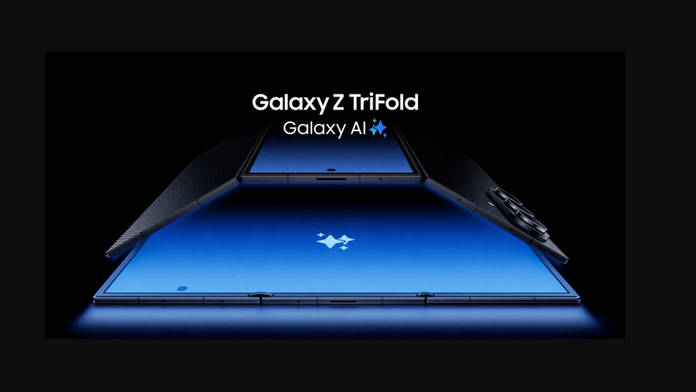
After months of leaks and then an official first look at the APEC Summit a few weeks ago, Samsung has finally officially announced the Galaxy Z TriFold, the company’s first smartphone with a dual-hinge, tri-folding design. This isn’t the first dual-folding smartphone in the world – Huawei Mate XT was the first to hit the market – but Samsung’s version hopes to bring that concept to a wider audience. The smartphone starts shipping first in South Korea on December 12th, with further international rollout to China, Taiwan, Singapore, UAE and the US later. Pricing hasn’t been officially confirmed, but leaks have suggested around 3.6 million won (around Rs 2.2 lakh).
When folded, the Galaxy Z TriFold is 12.9 mm thick and weighs 309 gms. That puts it very close to the Huawei Mate XT, which is roughly 12.8 mm thick and weighs about 298 gms. For perspective, the latest Samsung book foldable, the Galaxy Z Fold 7, comes in at just 8.9 mm folded and 4.2 mm unfolded. However, earlier folds were much thicker, with the first Galaxy Fold from 2019 measuring 17.1 mm. So there is much scope for the dual-folding phone to become more ergonomic.
Show Full Article


Apart from the form factor, the display is also the device’s headline feature. Folded open, the TriFold reveals a 10-inch QXGA+ Dynamic AMOLED 2X inner display. QXGA+ denotes a display that’s extremely sharp and detailed, much like a compact tablet. The screen supports up to 120Hz adaptive refresh, full DCI-P3 colour gamut, and a peak brightness of 1,600 nits. Samsung says you can run multiple apps side-by-side, and even use Samsung DeX in standalone mode, effectively turning the unfolded screen into a desktop-like workspace. Outside, there’s a 6.5-inch Full-HD+ cover display for everyday quick use, which is protected by Gorilla Glass Ceramic 2.
To make sure this multi-folding phone can handle daily wear and tear, Samsung has added a new layer to the screen that makes it tougher and more resistant to damage. The rear uses a reinforced ceramic-glass fiber polymer for sturdiness. The company has also redesigned the hinges, using a dual-rail structure that helps the device fold more smoothly and stay stable.
Inside, the phone runs on Qualcomm’s Snapdragon 8 Elite for Galaxy chipset paired with 16GB RAM and up to 1TB storage running Android 16-based One UI 8. Comparing the Galaxy Z TriFold and Huawei Mate XT spec sheets, you find many similarities. Both phones offer the same RAM and storage, and both pack a 5,600mAh battery, so on paper performance and stamina are comparable. Samsung’s TriFold offers 45W wired and 15W wireless fast charging, while the Huawei Mate XT supports 66W wired and 50W wireless charging.


On the camera front, TriFold comes with a 200MP main sensor, 12MP ultra-wide and 10MP telephoto lenses, compared to Mate XT’s 50MP main, 12MP ultra-wide, and 12MP telephoto setup. Samsung has retained dual 10MP selfie cameras (inner and cover), while Huawei relies on an 8MP front camera when unfolded. The setup on the TriFold, at least on paper, is definitely superior.
While both phones deliver similar heft and folded thickness, Samsung’s inward-folding design could give it better protection to the large internal screen, compared to the outward-fold approach on the Mate XT.
With the Galaxy Z TriFold, Samsung seems to be favouring screen space, functionality, and flexibility over slimness and pocket comfort. Compared with Samsung’s own Fold 7, it sacrifices the sleek and light build for a bigger, more versatile display. It’s a phone for users who may want tablet-sized flexibility in phone form, although with some extra bulk and cost. If you do a lot of reading, consume multimedia, edit documents, or use multiple apps at once, then the TriFold could make for a very worthy phone with all that screen real estate. However, the Galaxy Z TriFold currently lacks S-Pen support, as confirmed by the company to The Verge. So multitaskers hoping for some productivity with the stylus could feel that compromise.